@t_blom Agree Starlink would let far more people commute too, journey time becomes productive work time. People would pay for Starlink each day for marginal gains in quality of life outside of the city
Agent-driven development means we're shipping faster than any company I've worked in. Today we're announcing 6 new capabilities at Resolve - here's a look at 2 of them.
The customers I work with are now writing code with Codex/Claude Code, and our new Agent Teams are deployed to make sure nothing breaks in production. We're seeing a 2x improvement in investigations across our benchmarks and evals.
Resolve AI is the platform where engineering teams run and fix production software with AI agents.
Delegate on-call. Co-work on incidents. Run ops tasks in the background.
New: @ServiceNow is the latest major public company to say it’s blown through its full year budget for AI coding tools from Anthropic in the first few months of 2026, just like @Uber CTO @praveenTweets said abt his company. “It’s a really hard problem,” CIO Kellie Romack said.
Introducing Link agent wallet. Let your agents spend on your behalf. Your payment credentials are never exposed. You approve every purchase.
https://t.co/ihEfBVu8v8
Four weeks in and I know the team is special. Founders with multiple exits, researchers and engineers from DeepMind and Meta - solving a problem that our customers are doubling down on. Back to building!
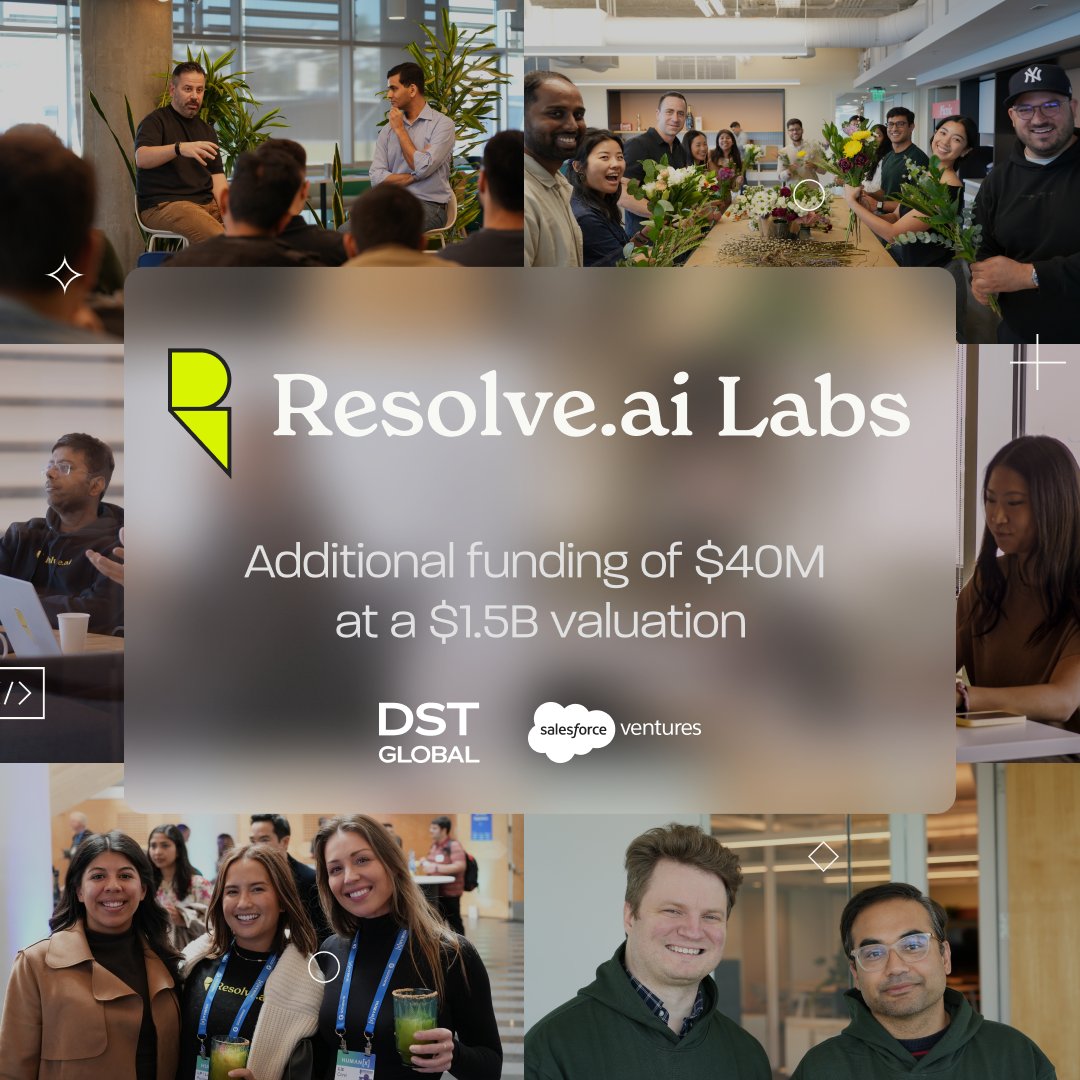
Today we're announcing the launch of Resolve AI Labs and an additional $40 million in our Series A Extension at a $1.5 billion valuation led by DST Global and Salesforce Ventures.
Agents that debug and run production is way more than a harness on top of a frontier model pointed at infrastructure. Requires dealing with practically infinite data, tens to tools, very complex reasoning trees, and very long horizon tasks. Simple agents on top of frontier models fall short on accuracy, reliability and performance.
Resolve AI Labs is our investment in building SOTA agents and models for production engineering, a very deep and wide domain that we feel can be better served with domain optimized models. To do that we convinced Dhruv Mahajan to come and lead the lab. Dhruv has deep expertise in AI and LLMs and most recently led post-training for large-scale Llama foundation models at Meta. Alongside Dhruv, Sean Bell led all pre-training data efforts for Meta foundation models has joined us as well. We are also excited to announce additional researchers soon.
We’re excited to introduce the Waymo World Model—a frontier generative mode for large-scale, hyper-realistic autonomous driving simulation built on @GoogleDeepMind’s Genie 3.
By simulating the “impossible”, we proactively prepare the Waymo Driver for some of the most rare and complex scenarios—from tornadoes to planes landing on freeways—long before it encounters them in the real world.
https://t.co/EbMut47ZEY
A strong signal of enterprises that can move the fastest with AI - they have in-house data engineers, scientists, and analysts that can lead AI programs. If a company outsourced data to consultants, they’re typically ~6-12 months behind as they need to hire before they can build
AI can now generate scientific ideas at scale. But we need to know if the current state of the art can bridge the gap to physical validation – the phase constrained by what can be tested, how fast, and at what cost. To find out, we have doubled our investment in the AI Scientist programme to £6m.
We're backing 12 projects to see if autonomous systems can reason, plan, and run experiments in the real world. These teams are testing the limits of automation on deliberately unforgiving problems: Alzheimer’s and cancer therapeutics, material discovery, and understanding the mechanisms behind battery degradation.
Instead of looking for best-case scenarios, we’re looking for limits. Can these systems recover when experiments fail? Can they reason across disciplines? Can they decide what not to try?
By doing this, we are learning what happens when machines are asked to do science, and exploring what that means for the future of discovery.
Discover the projects: https://t.co/vixRFglooL
I've always thought rules killed speed and that this explained the UK’s lack of growth. When decision latency will approach near zero, governance and velocity will stop being trade-offs. Rules and regulations will become guardrails and inference will unlock them