@ryankatzrosene Agreed. Couldn't fit full response in single tweet, but I am equally (if not more) critical of the framing in the OP. I don't think your post overall is vague, but we need to be careful with language (OP included!). Stating its "deeply unlikely" swings from one extreme to other.
Despite being a climate summit, COP is often held in countries that are putting their foot on the accelerator of environmental collapse.
Last year's COP was held in Dubai, and climate scientist @TomWoodScience was shocked by the gap between rhetoric and reality.
Key text on climate finance is down to five pages and includes an attempt at a compromise.
- $1.5tr overarching goal *by* 2035
- $250bn sub goal from industrialised nations, but appears to include private finance and MDB contributions
- invites emerging economy contributions
“It was a screaming example of everything that is wrong with the attitude of society: the juxtaposition of hyper-consumerism, wholly reliant on fossil fuels, and vulnerable people [at the conference] screaming out to us, ‘Do something about this’ �� and not being listened to."
“A low risk [of really extreme warming] is not no risk. That risk exists. If that risk is so severe it’s going to be catastrophic or existential, policy makers need to be prepared.”
One of the quotes from me in this excellent piece from @RTakver discussing the impact of #COP29.
We spoke about my experience at COP28 in Dubai.
On the view from my hotel window:
"On the right ... the Dubai Marina, full of fancy restaurants & supercars. On the left, stretching out...as far as the eye could see, one of the biggest natural gas plants in the world...
Important new study shows that current climate models underestimate the human-caused slowing of the #AMOC (Atlantic Meridional Overturning Circulation), because they neglect freshwater influx from Greenland melt and other sources. /1
https://t.co/qCIPWZvJiJ
The Paris Agreement is far from adequate, but its the best basis for international cooperation on the climate challenge we have. We must advocate for it to be upheld and strengthened against the current significant headwinds.
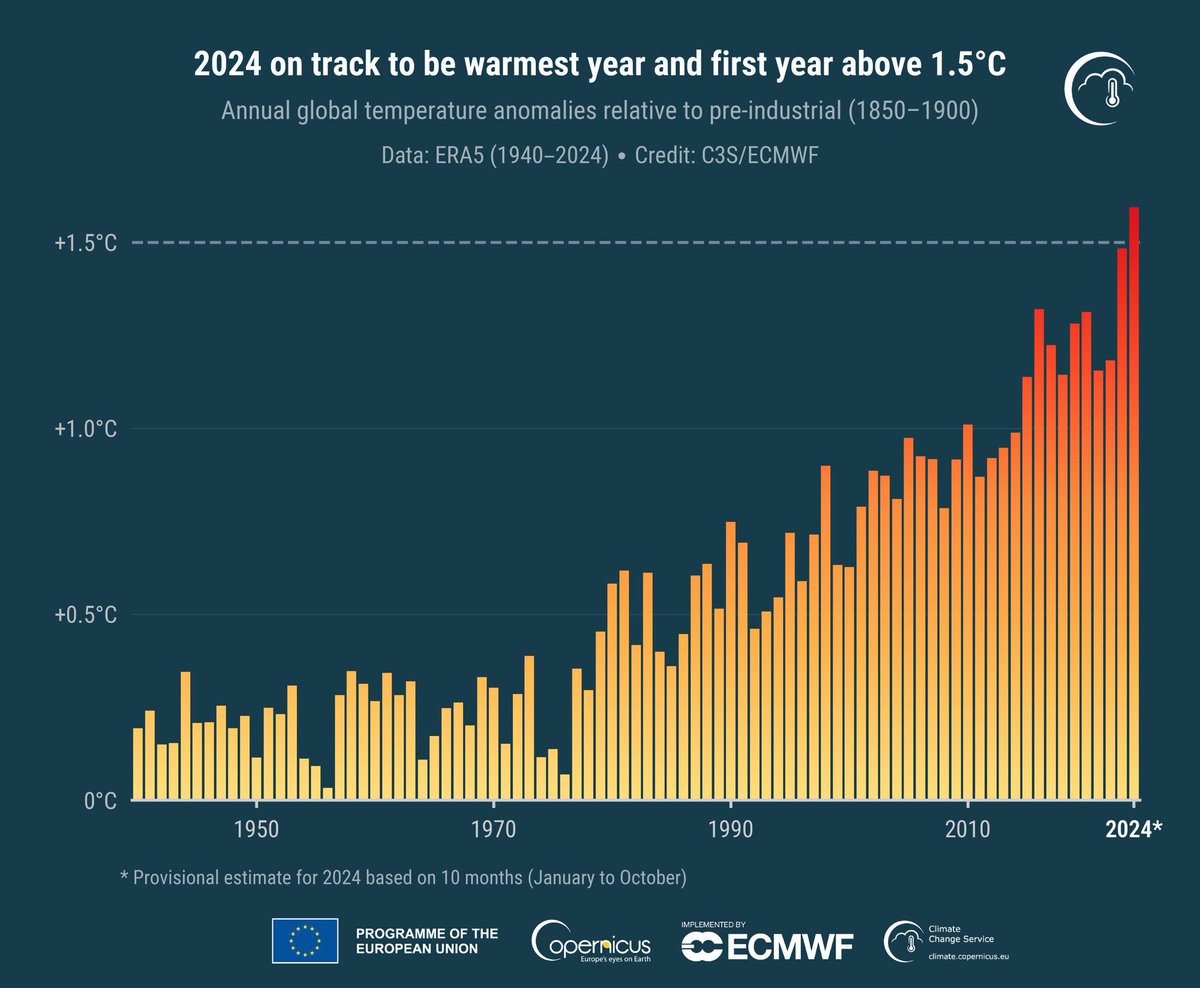
As we near #COP29, this needs to be front and centre of our thoughts. The plausibility of remaining under 1.5K is fading rapidly - we need to refocus on damage limitation and be aware of voices resigned to failure.
@James_BG But they don't show uncertainty bands on their figures and leave caveats for the footnotes. This should be up front and centre, and the massive downside / worst-case from using more credible damage functions IMO should be emphasised as the potential impact is so huge.
@James_BG Yet they say their numbers are based on 'credible studies'. A fall of 5% GDP in a 3C world is just not credible and there is a large and growing pile of evidence showing this. e.g. Studies using Nordhaus' damage functions should not be taken seriously.
@jasonhickel Well-written but Hickel is wrong. In a young field like degrowth it makes absolute sense to assess all studies that stress a degrowth focus in their title. When the result is unfavorable, one cannot compensate this by pointing at studies whose degrowth connection is less evident.
@ProfJeroenBergh@JKSteinberger First point really just semantics, but fine. Would be interesting to know if papers critical of the topic are more likely to include the name in the title. I'm not partisan. Limiting search to titles seems an unnecessary restriction leading to potentially unfair representation.