Stanley Druckenmiller renders an unfavorable opinion of Treasury Secretary Scott Bessent's use of buybacks to defend against higher yields in a market that is functioning normally.
"I have spent five decades trading on a simple premise: Markets aggregate information no committee possesses, and prices are how that information reaches decision makers. The long-term Treasury yield is the most important price in the world. It is also the only fiscal disciplinarian the U.S. has left."
"Every basis point of artificial yield suppression is a subsidy to procrastination."
"Return buybacks to their stated purpose: small, scheduled, off-the-run liquidity operations announced at quarterly refundings, never off-cycle responses to yield levels. Term out the debt honestly and pay the price the market sets."
"If the 30-year must trade at 5.5% to clear, that isn’t a crisis. It is an invoice. Then do the only thing that durably lowers long-term yields: address the primary deficit."
https://t.co/Xe8Vi38WiI
Wake up, folks. Commodities are telling you something, and yesterday the Treasury confirmed it.
Scarcity in the physical world. Repression in the financial one.
Scarcity pushes prices up. Repression holds yields down. The gap between them is the debasement.
Commodities are the only asset class that wins on both sides.
The structural case for commodities has been turbo charged. Underinvestment, deglobalization and electrification all pushing markets like diesel cracks and copper to new highs.
Meanwhile the chokepoints are increasing, from Hormuz to the Red Sea, the Rhine, the Panama Canal, the Black Sea grain corridor and Russian refining capacity. It is becoming increasingly apparent that not a single one of those is reachable by anything in Washington's toolkit whether it be caused by war or weather.
The illusion of abundance is likely behind us. I said as much on CNBC this Monday, and I got long gold, silver and agriculture last week.
Ten points for you to consider. (1/11)
Bending Spoons is acquiring Airtable for $2.25B
Airtable has $965M of cash, so the EV is $1.285B.
Airtable had raised $1.35B of VC capital, last round Dec ‘21 at $11.7B.
At ~$480M ARR growing 20%+ YoY, that’s 2.7x ARR.
Surprised they are selling with so much cash!
SPX just outperformed QQQ in July by 6.45 percentage points.
It's the most SPX has outperformed QQQ since September 2008.
Here's a list of every year where SPX outperformed QQQ by at least 6 percentage points in any single month:
2000
2001
2002
2008
2026
Enjoy.
i think this panel is a great example of what fda panels are supposed to do. the fda presenter was quite young, and as talented and diligent young people do, focused on lots of very detailed shortcomings of replimune's trial, which led to the review team's general feeling they couldn't rely on the data. eg things like if u biopsy a melanoma lesion it could be counted as a response, or a lit review showing a wide range of response to pd1, or the details of how independent radiologists scored lesions. the clinician panelists focused on very different things. things like the number of complete responses, or even if u discount the controversial cases the response rates were still close to 30%, and their real world experience plus familiarity with the literature on how low response rates are in pd1 refractory patients. it is a great example of the value of leadership and experience. karim did a great thing by holding the panel, and hopefully future new fda leadership will similarly be able to guide talented but less experienced fda staff.
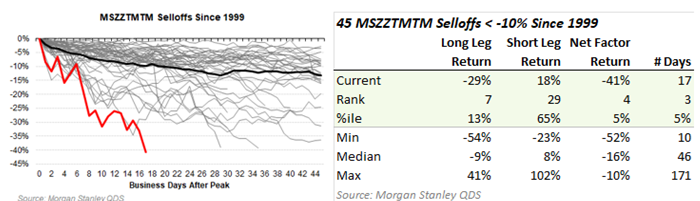
MS TMT desk putting the momentum unwind into perspective:
"Just 17 trading days into the unwind, TMT Momentum is already down -40% -- making this both the fastest and deepest selloff at this stage on record. The previous worst, in early 2021, was down -29% after 17 days.
Across history’s 45 drawdowns of more than -10%, only two have been deeper. The dot-com unwind of 2000-01 remains the benchmark, with a decline of more than -50%, while November 9, 2020 still stands as the worst single-day momentum reversal (-19%), when the Pfizer vaccine announcement abruptly flipped market leadership.
Matt Garman describes a ‘sleuth of bear markets’ -- KOSPI -27% from peak, Global Memory (MSXXGMEM) -36%, US AI Tech Beneficiaries (MSXXAIB) -24%, US Momentum (MSZZMOMO) -28% and US Tech Momentum (MZZTMTM) -40%."
New: Longtime top FDA cancer drug regulator Rick Pazdur, who abruptly departed the agency after 26 years in December, is under consideration for a senior leadership role at the agency
🎁: https://t.co/mbEzLZZxcA
@Biohazard3737 Hong Kong-listed bio stocks peaked last Aug.- Sep and have since entered a bear market, w/ most tickers down 50-75% from their 52wk highs.
The real reason oil is below $100/bbl. It isn’t fundamentals. It’s capital aversion. Policy uncertainty has made oil too volatile to hold. Investor VaR has collapsed by c.$5B. Open interest is at the lowest level in years. Global oil stocks are still drawing 5-6mb/d; however, investors say they don't care.
Start with investor VaR - the best measure of how much capital is willing to engage with oil. It has collapsed to $1.4B (see chart). Not forced out by rising rates, sanctions or external margin calls. Investors are simply choosing not to hold. The policy noise - deal on/off, attack, not attack - has made the carry uncompensable.
VaR compression has one direct consequence: it drains open interest. Contracts are closed. Market depth disappears. 2026 YTD open interest decline is the worst on record. Unlike 2022, there’s no rates shock or sanctions forcing the exit. This is capital aversion.
Managed Money VaR and YTD OI Change
⭐ New talk! https://t.co/dhDLxakvrC
Coding agents might help us finally break out of two cages: the app model, which traps computing in one-size-fits-all silos; and programming as a specialization, which has crowded out cultures of imagination and domain insight.
Trump is casually proposing one of the biggest strategic own-goals imaginable: NATO more or less done, and any country that wants Persian Gulf crude can go secure it for itself. That is a spectacularly reckless thing for an American president to say. It is a half-drunken invitation to roll the clock back toward the old colonial game, where every great power armed itself around resource access and shipping lanes.
The whole reason the U.S.-led order worked is that Washington took the military question off the table for its allies. Europe and East Asia could think about trade, industry, growth, supply chains, and cheap energy. They did not need to wake up every morning thinking about convoy protection, choke points, naval escorts, forward bases, and who might try to cut their oil line. That was the deal, and for all its flaws it was an unbelievably powerful one.
Put that burden back on every importing state and you do not get some elegant new realism. You get the old imperial logic creeping back in. The barrel is no longer just a barrel. It comes with freight risk, insurance risk, naval risk, basing risk, and eventually war risk. The whole achievement of the postwar order was that America suppressed a lot of that rivalry by sitting on top of the system and making the security decisions for the wider alliance.
The Gulf is particularly ugly terrain for this kind of thinking. The infrastructure is concentrated, the sea lanes are narrow, and much of the population depends on fragile physical systems like desalination. Once states decide energy security is too important to leave to markets, they start looking at places like this in very hard terms. Somewhere in Paris, one of the old colonial ghosts is probably already unfolding a map of the Gulf and reminiscing about protectorates in embarrassingly enthusiastic detail.
History is full of great powers making exactly this kind of mistake. The cleanest analogy is Germany after Bismarck. Bismarck built a diplomatic architecture that kept Germany secure and prevented hostile coalitions from forming. Kaiser Wilhelm II inherited that system, got impatient with its constraints, started freelancing, and slowly turned a position of strength into encirclement. He did not lose Germany in one move. He set in motion a process that made Germany less secure with every passing year.
There is also an interwar British echo here. Britain remained enormously important, but it no longer wanted to fully bear the burden of policing the wider order it depended on. That did not produce a neat handoff. It produced opportunism, rearmament, and eventually a much nastier bill. And if you want the broadest analogy, it is the breakdown of the old European concert system: once the central restraining architecture weakens, states go back to fleets, blocs, balancing, and military planning around economic survival.
What is so deranged about this is that it weakens the U.S. first. America’s edge was never just the size of the Navy. It was that nearly every major industrial power operated inside an American security architecture. Tear that up and over time you get fewer reliable bases, fewer aligned allies, larger independent militaries, more hedging against Washington, and much more room for China and every ambitious regional power. That is how dominant positions are squandered in history: not all at once, but by dismantling the very order that made you dominant in the first place.
New: The Trump administration has opened US retirement accounts to the wobbly private credit market.
In Feb, @SecScottBessent said “Our job is to make sure that the regulated system is not affected by private credit" and “we want to prevent contagion.”
https://t.co/2eTd4e1Paf