@sama Often, it takes longer to defend an obstacle than to solve it. Builders advance society by finding a way; pessimists write essays explaining why there isn’t one.
@thsottiaux@Robertg761_ Since 5.6 Sol launched, I’ve seen a recurring failure: it knows and restates my rules, then violates them, overcomplicates simple tasks, spirals after small errors, and burns huge amounts of tokens without resolving the issue. Please reset this behavior.
https://t.co/LghrXA6RfE
Here is my AI investing guide.
Sitting here August 2026, my current best thoughts are as follows:
1. LPS (Land Power Shell) is still the most obvious and fastest path to cash on cash returns. Lots of value can be assembled and traded quickly at this layer. And as data centers get more pushback, energized land can explode in value. Very bullish here.
I’ve stepped into this layer very aggressively. My partner @anitavlallian and I have acquired almost 6GW coming online in a ramp from today thru 2029 of grid power and behind the meter.
2. Silicon - I helped get @GroqInc off the ground in 2015 and we licensed it to @nvidia for $20B Dec2025. I won’t invest or incubate anything in this layer now. The perf demands of the chips are too high, manufacturing precision is too complex and supply chain influence to get adjacent components like memory isn’t possible for a startup anymore. Lots of capital will be wasted here chasing Groq and Cerebras’ success. Note that both startups made sense a decade ago when these constraints were much more modest.
3. Clouds - Clouds are very very lucrative but very hard to build and very expensive and technically complicated to maintain. And as alignment becomes a more important issue, I expect the clouds will be asked to build robust KYC and attest to it. This makes the risk:reward ratio skewed. I don’t want to be responsible when the USG says a cloud allowed a bad actor to do something bad because of poor KYC.
4. Models are complicated. The big open question is how much of the revenue being generated by them today is because of tokenmaxxing and poor model behavior. If it’s a lot, then the annualized revenues will diminish meaningfully even as token consumption inflects upwards. This is the big economic question at this layer.
5. Harnesses are where the action is and why I started @8090solutions two years ago. In a nutshell, the harness helps enterprises owns their proprietary context (what Alex Karp calls their ‘alpha’). This is an enterprise’s data, workflows, evals, and business rules. A harness that gives this to an enterprise is what creates very low model-agnostic switching costs, which further reinforces my views of #4 above.
6. Applications will be another long term winner along with harnesses. This is where the differentiation between “off the shelf” and “custom time and materials” melts away. Every company, with the right harness, can now imbue their alpha into the software that runs their company. I expect this to mean that “off the shelf” is largely replaced with custom software creating a huge opportunity to write these solutions for companies. Build once and sell repeatedly is a laggard GTM motion for a SaaS world that isn’t needed here. Think custom by design, alpha embedded, proprietary by nature.
Fin.
Good luck to all the players!
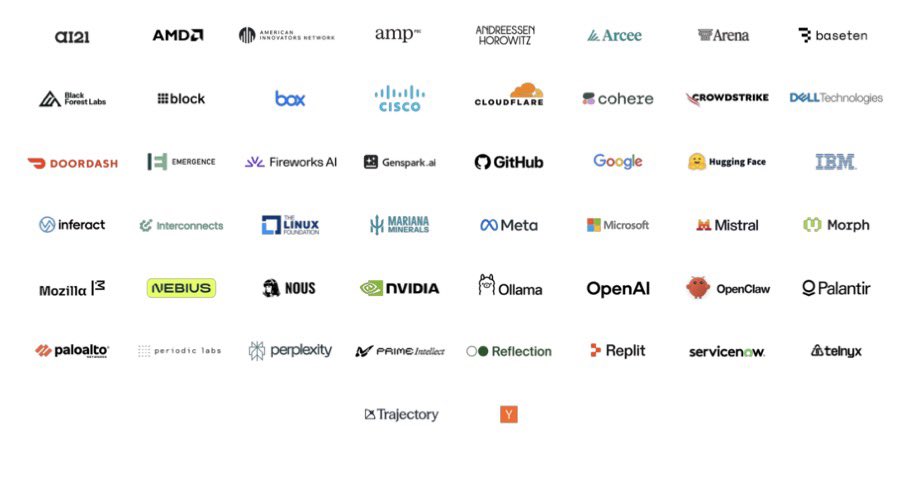
Attackers have frontier AI. Defenders need a frontier AI ecosystem—the best open and closed models, force-multiplied by a global community.
During the Hugging Face incident, closed AI blocked essential forensics. An open-weight frontier model helped contain the intrusion.
That’s why we created the Open Secure AI Alliance.
Dealing with difficult people may be hazardous to your health.
Data: Each additional "hassler" in your network predicts 1.5% faster biological aging—and worse health a year later. Non-spouse family hasslers are the most problematic.
Some ties aren't worth the toll they take.
@thsottiaux Would be welcome as most of my time and usage was Sol's exhaustive edge-pursuit, self-audit loops, proof mechanics, unbounded verification, increasingly elaborate command scaffolding, etc.
As soon as we heard about this it was a no-brainer for @Cloudflare to support. Open-weight models are a critical component to a robust AI future. Regulating them would be shooting ourselves in the foot. https://t.co/SYgD3ODCtw
Anthropic: “We are disrupting thousands of industries by being able to replicate their products in just a few minutes using AI making all of their hard work pointless.”
Also Anthropic: “Chinese AI labs are replicating and ripping off our product making all of our hard work pointless.”
Excited to see Anthropic acknowledge the real problem with open is it competes with their corporate economic strategy. The “awareness” here is revealing.
When you build the biggest private market cap ever, you should expect competition. I’m sure the secondaries have been nice.
For my first post, I’m sharing a letter @NVIDIA signed on why open models matter.
AI will transform every industry, power every company, and be built by every country.
Open models strengthen safety and cybersecurity, accelerate innovation and diffusion, and enable sovereignty.
The world needs both frontier closed models and frontier open models.
https://t.co/AUKzoQ5Ikb