@jojalonen Ministeri @willerydman selväsanaisesti totesi kenen vastuulle asia kuuluu. Syöpään kuolee ihmisiä joka perheestä puoluekannasta riippumatta.
🚨 JUST IN:
$IREN BULLISH UPDATE 🚀
HORIZON 1 (the first phase of the 200 MW Horizon 1–4 rollout) is expected to be delivered to $MSFT around July 19 — just 1–2 weeks away. ✅
Horizon 1: expected to contribute roughly $120–130M in quarterly revenue.
As Horizon 2–4 come online, the full 200 MW buildout has the potential to add approximately $500M each Quarter going forward by the end of Q4 2026.
The AI revenue ramp is just getting started.
LONG $IREN. ✅
$IREN
Are You Positioned for What's Coming?!
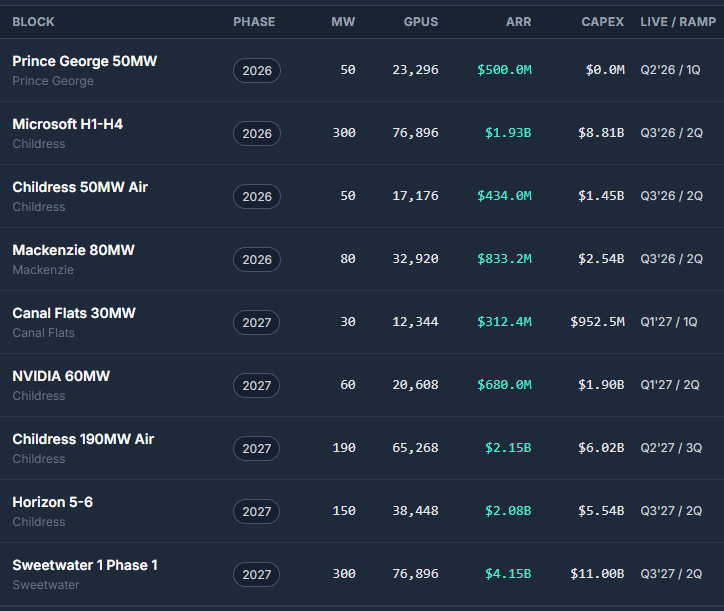
I’ve said it before: IREN’s Annual Recurring Revenue (ARR) is fundamentally simple. It is a predictable pipeline of GPU batch purchases and their associated revenue streams layered linearly on top of one another.
2026 ARR Roadmap
🔹Prince George: 23,296 GPUs → $500M ARR
🔹MSFT H1–H4: 76,896 GPUs → $1.933B ARR
🔹Mackenzie: 32,290 GPUs → $833.2M ARR
🔹Childress 50: 17,176 GPUs → $434M ARR
EOY 2026 Target: 150K+ GPUs → $3.7B ARR
2027 ARR Roadmap
The playbook for 2027 is identical: stacking successive hardware batches and compounding the revenue.
🔹Canal Flats: 12,344 GPUs → $312.4M ARR
🔹NVIDIA 60MW: 20,608 GPUs→ $680M ARR
🔹Childress 190 Air: 65,268 GPUs → $2.15B ARR
🔹Horizon 5-6: 38,448 GPUs → $2.08B ARR
🔹Sweetwater P1: 76,896 GPUs → $4.15B ARR
EOY 2027 Total - 363,852 GPUs → $13.07B ARR
To project these numbers, my model relies on some key assumptions:
1. Canal Flats utilizes the same unit economics as Mackenzie.
2. Childress 190MW Air utilizes the same unit economics as NVIDIA 60MW.
3. Horizon 5–6 and Sweetwater 1 (Phase 1) will debut VR200s.
I model the hourly rate for Vera Rubin chips at a significantly higher $6.16/hr. This premium accounts for both higher baseline Capex costs for those GPUs (significantly higher) and IREN’s ability to capture a small portion of the massive performance multipliers inherent to the Rubin architecture, and the marked improvement in GPU hourly rates over the last 9 months.
Buckle-up buttercup.
🚀🚀🚀🚀
(Imagine selling right before this ramp. YFA 🤦♂️)
Maanantaina kai äänestetään Wille Rydmanin luottamuksesta. Todellisuudessa äänestetään Vasemmistoliiton lomaliiton ja muiden (muka) kansalaisjärjestöjen rahoituksesta:
$IREN — The Enormous Significance of DSX Air That the Market Has Overlooked
Today there are two major pieces of news about IREN — one on the capital side and one on the technical side — both highly significant.
On the capital front, IREN completed the first investment-grade GPU financing with the highest public rating ever seen in the U.S. private market.
On the technical front, IREN is working with NVIDIA to build AI infrastructure compatible with NVIDIA DSX across its global data center network. The linked NVIDIA page carries a detailed report titled “NVIDIA DSX: Action Guide for Infrastructure Builders to Construct AI Factories.”
At the same time, following Jensen Huang’s comments at the Taipei GTC on CoreWeave (CRWV) and Nebius (NBIS), those two stocks traded higher in pre-market, while IREN’s stock remained weak.
There is also a more detailed technical update: “IREN and BE Networks Accelerate Deployment of Large-Scale AI Factory with NVIDIA DSX Air.” BE Networks is a leading software solutions provider specializing in hyper-automation, lifecycle management, and monitoring for next-generation GenAI, core data centers, and multi-vendor edge infrastructure.
From a forward-looking perspective, IREN’s progress today represents major strategic steps — especially its collaboration with BE Networks to use NVIDIA DSX Air to speed up large-scale AI factory deployment. This is concrete proof of strong execution. If CRWV and NBIS rallied today because they secured priority access to Vera Rubin, what IREN is doing is far more consequential.
Here’s a simple analogy:
Imagine Vera Rubin as a brand-new aircraft engine. CRWV and NBIS have won priority delivery of the next-generation jet engine. IREN, by contrast, is helping establish the manufacturing standards and production system for the next-generation aircraft.
What IREN is actually doing
It is building a complete testing, tuning, and mass-deployment system tailored for this new engine. Before large-scale production begins, the team is validating every aspect of the engine’s behavior — aerodynamics, structural integrity, vibration, and failure modes — inside a full digital twin environment. From there, it is creating repeatable, standardized deployment processes so that future massive clusters can be deployed and optimized in days instead of months.
Why does this matter more?
Securing a newly designed engine and knowing how to extract maximum performance from it while scaling that capability reliably are two entirely different orders of magnitude. Today IREN is using NVIDIA Blackwell Ultra GPUs to do exactly this work. The market has shown almost no awareness of its importance. Investors cheered for Vera Rubin, yet failed to notice that IREN and BE Networks are already using DSX Air to create a digital twin that simulates the future deployment of 50,000+ Blackwell Ultra GPU clusters.
The scope of testing goes far beyond the GPUs themselves. It covers the entire AI Factory stack:
Spectrum-X networking
NVLink networking
Storage systems
Orchestration platforms
Security architecture
Automated operations and maintenance workflows
Power and cooling integration validation
DSX was designed from the start for the Rubin era. Even though Vera Rubin has not yet entered volume production, the DSX Air testing system — built to enable rapid, large-scale deployment — is already running. The current validation work on Blackwell Ultra is not primarily about Blackwell itself. It is a full dress rehearsal for the Rubin era.
What truly needs to be validated, hardened, and refined in advance is not the GPU model. It is the construction methodology for future AI factories. In the DSX framework, several foundational principles will not change with new GPU generations: network topology principles, automated deployment methods, operations frameworks, and digital twin processes. The only things that will change are component-level variables — GPU models, switch types, rack power density, and cooling parameters.
The aviation industry offers an almost identical precedent. Boeing does not wait until the 787 enters full production before certifying its manufacturing system. It uses early prototypes to validate processes, supply chains, and assembly procedures. By the time the production aircraft arrives, the entire system is already mature — the plane is simply the final component inserted into an already-proven production line.
Viewed through this lens, CRWV and NBIS have secured priority delivery of the Rubin “aircraft.” Their advantage is being first in line to receive it. IREN is validating the production line for Rubin aircraft ahead of time.
Although the hardware being tested today is Blackwell Ultra, what DSX Air is really training are the engineering teams, automation capabilities, network design expertise, and large-scale cluster operations skills. These capabilities will transfer seamlessly to Rubin. The announcement’s reference to “simulating and validating 50,000+ Blackwell Ultra GPU deployment” carries meaning well beyond the literal words. If the goal were simply to deploy Blackwell, such an elaborate digital twin would not be necessary — Blackwell already exists and can be tested in real environments. Digital twins become essential when scale is enormous, costs are extremely high, and the next-generation architecture is about to arrive. That is precisely the situation in the Rubin era.
A more accurate way to understand it: DSX Air is not testing Blackwell Ultra — it is conducting an advance rehearsal for Rubin.
So why has the market shown almost no reaction to something this important, while giving all the applause to priority access for Vera Rubin?
Jensen Huang’s remarks at GTC actually told two completely different stories. From NVIDIA’s sales perspective, CoreWeave and Nebius represent classic “proof of demand.” To successfully launch Rubin, NVIDIA needs investors and customers to believe there are already committed buyers. That is why names like CoreWeave, Nebius, AWS, Microsoft, and Google naturally take center stage — they serve as visible evidence that “the product has already been sold.”
IREN plays a completely different role. It is working side-by-side with NVIDIA to design the next-generation super factory. This role is equally critical, but it belongs to a different stage of the value chain.From NVIDIA’s longer-term viewpoint, the real scarcity in the coming years will not be GPUs. It will be power, land, high-voltage grid connections, liquid cooling capacity, network deployment expertise, and the ability to deliver complete AI factories. These infrastructure elements have much longer lead times than chips. In the joint NVIDIA-IREN announcements, the repeated emphasis is not on GPUs but on power, land, data centers, and infrastructure operations. This shows that the partnership was never primarily about buying and selling GPUs — it has always been about jointly building the AI factory ecosystem.
IREN has now entered the verification and deployment phase of the NVIDIA DSX ecosystem. The significance of this step far exceeds what the market currently appreciates. The key insight is this: DSX Air and Vera Rubin were launched as part of the same system at the same time, not as products from two different eras.
Returning to the GTC on March 16, 2026, NVIDIA simultaneously announced three things: the Vera Rubin DSX Reference Design, the general availability of the Omniverse DSX Blueprint, and the launch of DSX Air. All three appeared together. This means DSX Air was never a “Blackwell-era tool.” From day one, it has been an integral part of the Rubin-era AI Factory architecture — an infrastructure validation platform prepared for Rubin, Rubin Ultra, and future generations.
Therefore, the fact that IREN is testing Blackwell Ultra today is not the important point. What matters is that it is validating a complete AI Factory deployment methodology that will apply to every future Rubin-series architecture. This methodology includes network topology, automated deployment, operations frameworks, and digital twin validation — capabilities that, once mature, will be reused across multiple generations. In short, IREN is not merely testing one generation of GPUs; it is validating in advance how AI factories should be built for the next ten years.
This also explains the sharply different market reactions. Priority access to Rubin is an immediately modelable story: first access means faster revenue and EPS growth, and analysts can plug the numbers into spreadsheets right away. DSX Air’s validation capabilities, by contrast, represent long-term, systemic, and industrial value that is much harder to translate into next year’s EPS. Capital markets naturally favor stories that can be quickly quantified, so they price Rubin priority first and react coolly to DSX Air.
From an industrial logic standpoint, however, IREN’s participation in DSX Air is far more consequential than “who gets Rubin first.” Rubin is one product generation. DSX Air is the factory methodology for all future generations. The former affects one year’s revenue; the latter shapes ten years of competitive advantage. The market will understand the former quickly and gradually catch up on the latter. IREN currently sits in the position that “requires time to be understood.”
IREN and NVIDIA are jointly defining the DSX architecture, jointly building 5GW-scale AI factories, jointly running digital twin validation, and jointly developing deployment processes. This level of collaboration is approaching the co-creation of industrial standards, not merely a priority supply arrangement. It represents a fundamentally deeper partnership than the priority delivery rights secured by CRWV and NBIS.
IREN consistently chooses to tackle the difficult challenges first. It focuses on the critical areas that enable the fastest possible compute capacity to come online — the very things that will ultimately give it real pricing power in the future — rather than waiting for others to decide who receives priority supply. This has always been its nature and the direct result of its long-term vision. That is where its greatest value lies.
🚨BREAKING🚨
$IREN & BE NETWORKS ACCELERATE DEPLOYMENT OF LARGE-SCALE AI FACTORY WITH $NVDA DSX AIR
"The initiative will enable IREN and BE Networks to utilize a production-representative digital twin of $IREN's AI cloud environment before the physical infrastructure is deployed. Using $NVDA DSX Air, the companies can model the behavior of large-scale GPU clusters, validate network topologies, test automation workflows, rehearse changes and identify issues before they impact production systems."
New $IREN Deep Dive
Our new $IREN deep dive is finally live!
It's honestly the most comprehensive report we have ever released and something I'm firmly convinced will age like fine wine.
Even though it goes into great depth, it's written in a way that virtually every investor can understand. I purposefully went light on industry and finance jargon, and whenever I did use technical terms I made sure to explain them properly.
This time around I've also unlocked the entire first chapter for free Substack subscribers to read.
So if you're on the fence, I encourage you to read the first pages to get a sense of the depth and analytical quality you can expect from the rest of the deep dive.
I'm sure every $IREN shareholder, analyst, or investor curious about the company will derive great value from this deep dive.
I very much appreciate everyone's patience. This one took a while.
Enjoy! ✌️
https://t.co/HUkfni8Ltf
IREN has acquired Awaken, a creative and media agency specializing in content strategy and brand development for high-growth companies.
Senior members of the team will join IREN, including Founder and CEO Chris Parker, who will lead IREN's brand and marketing strategy.
Daniel Roberts, Co-Founder and Co-CEO of IREN, commented: “As we expand across new geographies and customer segments, brand awareness and customer engagement become increasingly important. Chris and the Awaken team have been trusted partners to IREN for some time, and bringing those capabilities in-house was a natural next step as the platform continues to scale."
Learn more: https://t.co/DJxAquJ1CM
$IREN Is Said to Offer Up to 1.5% Coupon on $2B Convertible Bond
1. The New Debt: $2 Billion
The Loan: $2 Billion in convertible senior notes (debt) due in 2033.
The Cost: A tiny 1.0% to 1.5% interest rate. This is significantly cheaper than their older 3.5% debt.
The "Conversion" Price: Lenders can turn this debt into stock at 27.5-32.5% conversion premium, roughly $70–$73/share.
The Goal: Buying the GPUs and building the power infrastructure for their new $3.4 Billion NVIDIA contract.
2. The "Unwind": Cashing in the Old Insurance
This is the savvy part that most people miss. IREN is effectively "trading in" their old winning bets.
The Old Hedges: Back when IREN was $15, they bought "Capped Calls" (insurance) to protect shareholders from dilution.
The Payday: Now that the stock is $55+, those old insurance policies are worth a fortune in cash.
The Move: IREN is "unwinding" (selling back) those old policies to the banks today.
The Result: They receive an estimated $75M–$125M in cash. They are using this "found money" to help pay for the insurance on the new $2B deal. It’s like using the equity in your old house to pay the closing costs on a new mansion.
3. The "Shareholder Shield": If Iren decides for a new Cap, The new "Capped Call" is a protective bubble for you, the shareholder.
Historically uses 100% premium cap, in this case it could be $100, for example:
The $73–$100 "Safe Zone": Between these two prices, if the bondholders want to convert their debt into shares, the banks pay the difference, not you.
0% Dilution: Within this window, IREN doesn't have to print new shares. They use the bank’s cash to satisfy the lenders.
The Ceiling: Dilution only starts if the stock flies past $100. This "resets" the company’s protection to match its new, higher valuation.
4. Caveats: Exact coupon, conversion premium, and cap price aren’t finalized yet (determined at pricing). Hedging/unwind activity by banks can cause short-term stock volatility. Past deals (e.g., 2025) followed similar patterns with low/zero coupons and strong demand.
The offering is likely to be oversubscribed to $2.3B
This is a classic growth-company move: raising low-cost convertible debt while using derivatives to limit dilution. It leverages the NVIDIA/AI hype for cheaper capital than straight equity or higher-coupon debt.
S/O @conloco_tx