Proteins move. Drug discovery moves with them.
With @nvidia and @NVIDIAHealth cuPotential in our OpenMM workflows, we're running ~2-3× more molecular dynamics. Up to ~7× with our own optimizations: more physics to train our generative models on.
More detail on our blog: https://t.co/kyDK0ghAuY
Understanding protein dynamics can open new paths to treating difficult diseases.
We spoke with GamesBeat about Topos-2, Topos-Bind, and our approach to designing drugs for dynamic proteins.
Thanks @deantak for the conversation!
https://t.co/OrqtoSW3pV
Missed us on MTS? Here’s a clip from our conversation about modeling dynamic proteins and designing drugs for challenging disease targets.
Thanks @MTSlive for having us!
Topos Bio CEO Ryan Zarcone explains why designing drugs for Parkinson's and Alzheimer's is almost impossible for humans, but a perfect problem for AI:
"When a chemist designs a drug for a protein, the model is static. I have this protein, it has a shape, and I’m trying to fill that shape with a drug."
"These really dynamic proteins, like those involved in Parkinson’s and Alzheimer’s, don’t have one shape. They have potentially thousands of different shapes that they’re constantly interconverting between, kind of like someone who’s dancing."
"That becomes basically impossible when you tell a human, design something for these thousand things at the same time. It’s really only been possible to start doing that with AI."
@ToposBio
The therapeutic opportunity lies in understanding, and ultimately controlling, the full distribution of conformations a protein can adopt.
If your program is limited by protein dynamics, we want to work with you: [email protected]
(7/7)
Today we are announcing Topos-2, our next-generation model for generating the full range of shapes a protein can take, across the order-disorder spectrum.
We are also previewing Topos-Bind: to our knowledge, the first generative model to capture the range of shapes for disordered proteins bound to small molecules.
Read the technical blog post here: https://t.co/BLAXHAgsH4
(1/7)
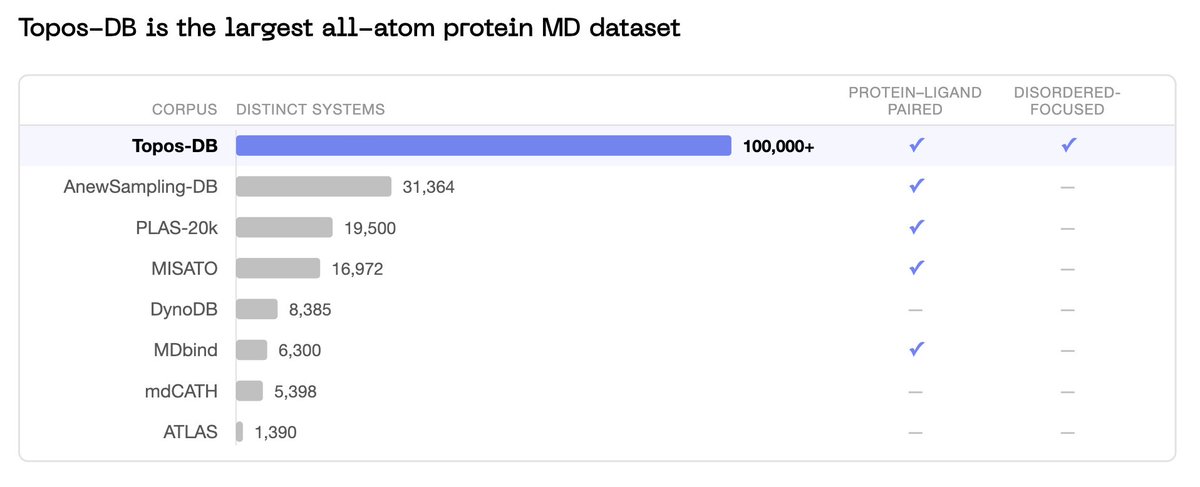
Public databases do not provide disordered protein-ligand training data at scale, so we built Topos-DB: 100,000+ disordered protein-ligand systems simulated with all-atom MD.
To our knowledge, this is the largest all-atom protein MD dataset by distinct system count, roughly 3x the next largest.
(6/7)
At Gladstone, collaboration fuels discovery. Our partnership with @ToposBio brings together AI-powered protein modeling and deep expertise in neurodegenerative disease to explore new therapeutic options for conditions like Parkinson’s and Alzheimer’s.
https://t.co/rwxSXlzY9B
Announcing Topos-1, an all-atom generative model that sets a new benchmark for predicting structural ensembles of intrinsically disordered proteins. Topos-1 outperforms existing models by a large margin, with implications for designing drugs for challenging targets ranging from cancer to neurodegenerative disease.
Read the full technical report on our website: https://t.co/3UtTSdmddf
Topos-1 is only the beginning: we’re rapidly expanding its capabilities and the favorable scaling results so far indicate a steep improvement curve. To learn more about the model and its evals, check out our technical report: https://t.co/M0cTFbJi22
Using Topos-1, we generated conformational ensembles that provided drug design insight and lead to computational predictions of drug potency that are in good agreement with tests performed in our laboratory.