The day of reckoning for many western countries that never were accountable for the spend
Are your asset values going up because of value creation or an offset to currency destruction?
A former World Bank president has sounded the alarm, revealing that the Federal Reserve has lost over a trillion dollars—and counting—turning it into nothing more than a massive hedge fund for the rich and powerful.
He claims the Fed is borrowing money from banks at 5.4% interest, then pouring it into government bonds, creating the illusion that the government’s financial situation is better than it actually is.
He warns that this scheme isn’t just limited to the U.S.—it’s happening across central banks worldwide.
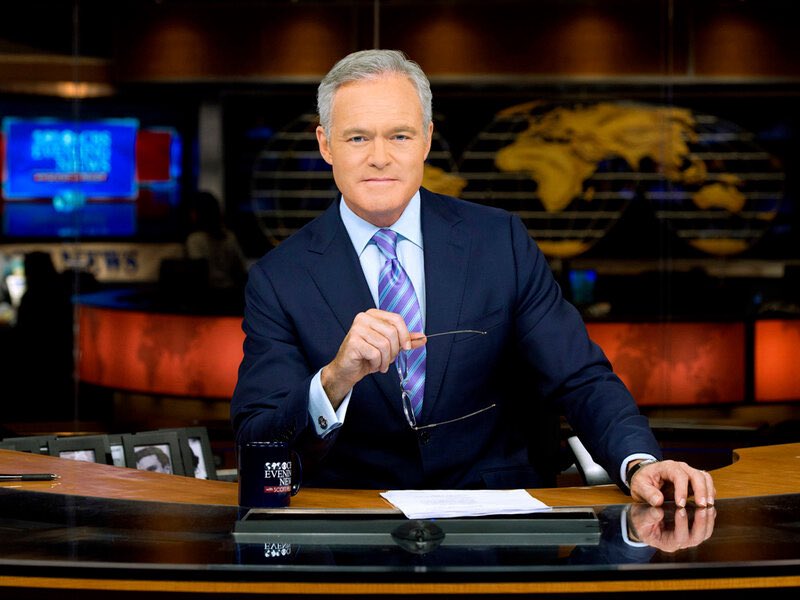
New statement from Scott Pelley:
“Last month, 60 Minutes lost its DNA when our entire senior leadership and two of our best on-air correspondents were cruelly fired without cause. Good people were silenced because they stood up for our audience. They stood for fairness against the forces of political bias; they stood for professionalism against chaos.
For my part, new management has instructed me to inject falsehoods and bias into a politically sensitive story. I’ve been told to include assertions that are unverified. To date, in every case, I have managed to ignore these instructions or refuse them. Recently, politicians have been invited to choose correspondents for interviews on the broadcast. Giving politicians control over 60 Minutes interviews is not how this is done. Finally, incompetence and unprofessionalism in the new management have wreaked havoc. In a case involving one of my stories, the entire program came within 19 minutes of not getting on the air at all.
At 60 Minutes, we have fought harder than anyone knows to save the program that became an American icon. We owed that to our millions of viewers. I am deeply moved by the thousands of wishes we have received to “keep up the good fight.” Most of the men and women of CBS News are still in that fight. But now the collapse of values at the top has become untenable. The leadership of 60 Minutes is no longer recognizable. The principles I hold dear are gone, and so I must leave as well.”
A 26-year-old Chicago real estate agent bought a box of unknown negatives at a thrift auction in 2007 for around $400.
He took it home and found thousands of street photographs taken by a French-American nanny who had carried a Rolleiflex around her neck for forty years and shown her work to no one.
She had lost the storage locker for unpaid rent. She died poor in 2009 not knowing her photographs were being seen.
Vivian Maier is now considered one of the greatest American street photographers of the 20th century.
A British biologist looked at 200,000 years of human history and found that the entire reason humans broke out of poverty was not intelligence, not language, not even agriculture, but one mechanism so simple a 6-year-old could explain it.
His name is Matt Ridley.
He is a zoologist by training, an evolutionary biologist by career, and in 2010 he wrote a book called The Rational Optimist that quietly argued the most important fact about human progress had been hiding in plain sight for the entire history of economics.
Naval Ravikant has been telling people to read everything Ridley has ever written for the last 15 years. The reason is the argument inside this one book.
For 200,000 years, anatomically modern humans walked around with the same brain you have right now. Same skull size. Same neural architecture. Same raw capacity for language, planning, and abstract thought.
For roughly 190,000 of those years, almost nothing happened. Generation after generation lived and died inside the same Stone Age toolkit their great-great-grandparents had used. Then somewhere around 50,000 years ago, the line on the chart of human progress started to tick upward. Then it bent. Then it exploded.
The question Ridley spent years on was the only question that mattered. What changed.
It was not the brain. The brain had been the same for 190,000 years. It was not language, which had existed long before the takeoff. It was not even agriculture, which arrived only 10,000 years ago and was actually preceded by the upward bend, not the cause of it.
What changed was that humans started trading with strangers.
This sounds too small to be the answer. Ridley argues that it is the answer to almost everything. The moment one human exchanged a useful object with another human from a different group, something happened that no other species on earth had ever done.
Two ideas that had developed in isolation came into contact. The flint knapper learned what the spear maker had figured out. The fisherman from the coast learned what the hunter from the forest had figured out. The two pieces of knowledge fused into something neither side could have produced alone.
Ridley calls this ideas having sex. The phrase sounds frivolous and it is meant to. The point is that ideas, like genes, get better when they combine with other ideas from different lineages.
An idea sitting inside one head, no matter how brilliant the head, eventually hits a ceiling. The same idea exposed to ten thousand other ideas does something genes do under sexual reproduction. It mixes. It recombines. It produces offspring nobody planned.
The cleanest proof of this argument is the most uncomfortable case study in the book. Tasmania.
Around 10,000 years ago, rising sea levels cut Tasmania off from mainland Australia. A population of roughly 4,000 humans was now isolated on an island, with no possibility of contact with the rest of humanity. They had the same brains. The same language. The same starting toolkit as their cousins 150 kilometers north. The natural experiment was now running.
What happened next is something no economist or geneticist had ever predicted.
The mainland Australians kept inventing. Boomerangs. Spear-throwers. Fishing nets. Bone needles for sewing fitted clothes. Watercraft with paddles. Their technology compounded slowly across the centuries.
The Tasmanians went the other way. They did not just fail to invent the new tools their cousins were developing. They started losing the tools they already had. Fishing was abandoned within a few thousand years. Bone tools disappeared. Fitted clothing disappeared. They forgot how to make fire from scratch and started carrying lit firebrands from camp to camp instead, relighting their fires from a neighbor's whenever their own went out.
By the time European explorers arrived in the 17th century, the Tasmanians had the simplest toolkit of any human society ever recorded. Their material culture had gone backward for 8,000 years.
The archaeologist Rhys Jones called it a slow strangulation of the mind.
Joseph Henrich at Harvard later proved with formal mathematical models that there was nothing wrong with Tasmanian brains. There was something wrong with their network. A toolkit requires a critical mass of people exchanging skills to maintain itself.
The act of teaching a skill is imperfect. Every generation loses a small percentage of what the last generation knew. If your population is large enough and trading widely enough, those losses get caught and corrected by someone else who still remembers.
If your population shrinks below a certain threshold and stops mixing with outsiders, the small losses compound until entire technologies disappear.
This is the part that should haunt anyone reading this in 2026.
Intelligence is not a property of the individual brain. Intelligence is a property of the network the brain is connected to. A genius in isolation will produce less than a mediocre thinker inside a dense exchange of other mediocre thinkers.
The thing your ancestors needed in order to break out of 190,000 years of stagnation was not better brains. It was better connections between brains they already had.
The implication for any individual is direct and uncomfortable. If you are smart and isolated, you will be outproduced by people half as smart who are connected.
The most successful people in any field are almost never the smartest people in it. They are the ones positioned at the intersection of the most idea flows. They are reading more authors than their competitors. They are talking to more people from more disciplines. They are in the rooms where ideas from different lineages bump into each other.
Ridley ends the book on the line that sounds optimistic but is actually a warning its this "The future will be invented by people who connect ideas, not by people who guard them."
We’ve opened up the veritable “can of worms.” Stated with seizure of Russian assets years back.
Two things to a new world
1) WWIII is an economic and technology warfare
2) Ask yourself do you compartmentalize this to wire fraud, crypto hacks, political an country rule changes, …: .
It’s a new game my friend.
"Hemos tomado 1.000 millones de dólares en criptomonedas de Irán, simplemente nos hemos apoderado de sus billeteras, muchos iraníes estarán escribiendo en redes sociales sin saber que les hemos robado sus billeteras".
Scott Bessent, Secretario del Tesoro de EEUU, se enorgullece de robar 1.000 millones en criptomonedas de Irán como si fuesen hackers y delincuentes cibernéticos.
Piratas Unidos con Trump ni siquiera tapan sus robos, son la mayor organizacion criminal del planeta.
“THIS IS NOT LEADERSHIP, JEFF.” Pope Leo XIV stunned the world after publicly criticizing Jeff Bezos and threatening to remove all Vatican-affiliated publishing partnerships and official merchandise agreements connected to Amazon platforms.
The shocking statement came after Bezos was once again linked to political alliances that critics say are deepening division across America.
“You cannot claim to support humanity while empowering voices that profit from fear, hatred, and division,” Pope Leo XIV declared during a rare public address that instantly exploded across social media.
For several moments, Bezos reportedly offered no response.
The silence only intensified the global reaction.
The Pope continued with a warning that many are now calling one of the boldest confrontations ever directed at a tech billionaire:
“When profit becomes more sacred than people, society begins to lose its soul.”
Within minutes, political commentators, journalists, celebrities, and religious leaders around the world began weighing in.
Then Donald Trump erupted on Truth Social.
The former president mocked Pope Leo XIV as a “global activist in religious clothing,” accusing him of attacking free enterprise and “desperate for media attention.”
But the Pope refused to back down.
Hours later, he answered Trump with eight calm words that instantly shook the internet:
“Truth does not fear wealth, power, or noise.”
And suddenly, the entire conversation changed.
Millions praised the Pope for standing against corporate influence and political intimidation, while critics accused him of crossing into dangerous political territory.
But regardless of where people stood, one thing became undeniable:
Jeff Bezos had just been publicly challenged by one of the most powerful moral voices on Earth — and the world could not stop watching.
I warned about the dot-com bubble beginning in 1998. People thought I was bonkers for not believing them when they said, "Earnings don't matter! The rules have changed!"
They were wrong, of course. And many lost their life savings.
This time around it's going to get even more interesting. A major, MAJOR crash is coming... and it will make the dot-com crash look like child's play.
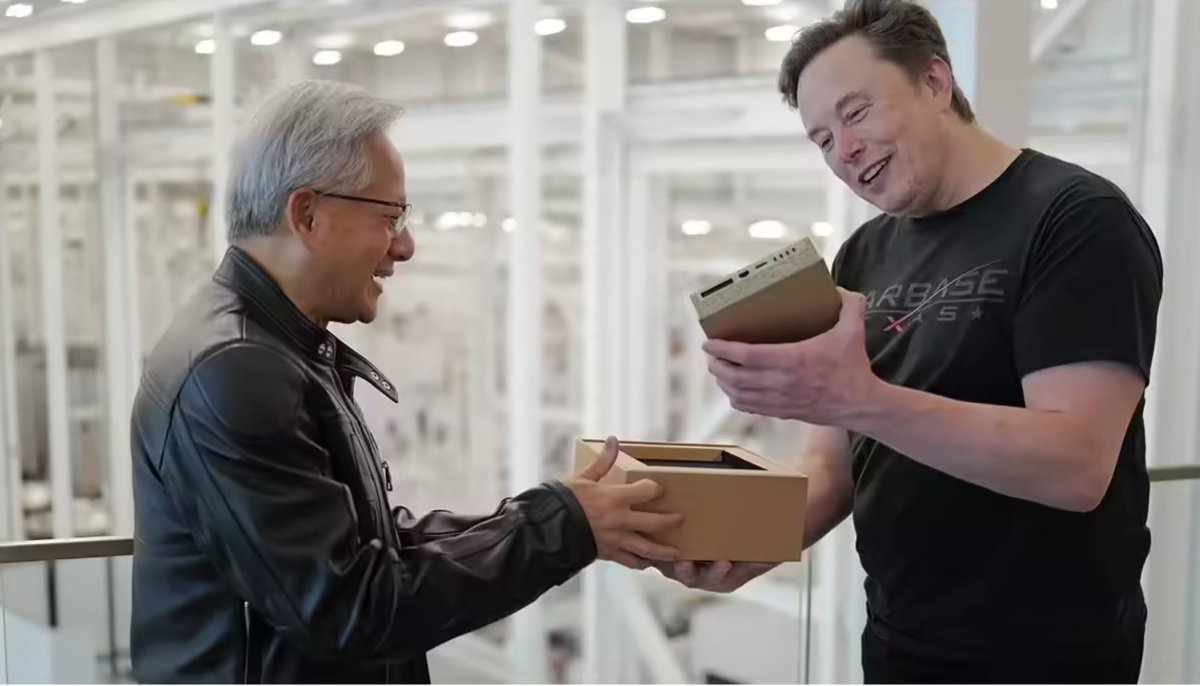
🚨Michael Burry just said Elon Musk and Nvidia's deal is built on fake numbers.
Burry published a detailed breakdown calling the entire structure "Fugazi", his word for fake.
He is alleging that billions of dollars in Nvidia chips are being hidden off balance sheets, and that American retirees are unknowingly funding the whole thing.
Nvidia, the world's largest AI chip company sold $5.4 billion worth of its most advanced GPUs, the GB200, to a company called Valor.
Valor is not a real operating business. It is a special purpose vehicle, a shell company created specifically to hold these chips and nothing else. Nvidia also invested $1.9 billion of its own money directly into Valor on top of the sale.
Those 100,000+ chips are now physically inside xAI's data center. xAI is Elon Musk's artificial intelligence company, the one that builds Grok. xAI is using every single one of those chips right now to run its AI models.
But here is what Burry is flagging.
Neither Nvidia nor xAI owns those chips on paper. Valor, the shell company holds legal title. That means $5.4 billion in GPU assets do not show up on Nvidia's balance sheet as inventory.
They do not show up on xAI's balance sheet as assets. They are legally invisible to both companies.
Nvidia gets to book the $5.4 billion as a completed sale and record it as revenue. xAI gets full use of the chips without owning them. And the risk disappears into a shell company in the middle.
Now here is where American retirees enter the picture.
Valor needed $3.5 billion in debt to fund this structure. Apollo provided it. Apollo is one of the largest asset managers on earth with $1.03 trillion under management and $834 billion specifically in private credit.
Apollo raised the $3.5 billion, packaged it into debt securities, and sold those securities to Athene.
Athene is Apollo's own insurance company. It sells fixed and indexed annuities, retirement savings products, to ordinary Americans.
When a retiree buys an Athene annuity, they believe their money is sitting in safe, stable investments. That money is now inside a structure funding Elon Musk's AI data center.
The numbers inside Athene are most alarming.
Athene holds $74.2 billion in reserves. It has moved $217 billion in assets into a captive insurer based in Bermuda, meaning those assets sit outside normal US insurance regulation and oversight.
Of the entire portfolio, 34.7%, equal to $103 billion, is classified as Level 3 assets.
Level 3 is an accounting classification that means there is no observable market price for these assets. No outside party can independently verify what they are actually worth.
The leverage sitting on top of those unpriced assets is 16 times.
Burry's says:
Every step of this structure is technically legal and publicly disclosed. But the entire thing was deliberately engineered across 8 to 12 steps to move credit risk off balance sheets and away from any market pricing.
- Nvidia books the revenue.
- Apollo collects the fees.
- xAI gets the computing power.
- And retirees sitting at the bottom of a 16x leveraged Bermuda insurance structure, holding $103 billion in assets with no market price carry the risk without knowing it exists.
Her neighbors in La Jolla, California, knew her only as a gentle older woman who lived alone. She drove herself around in an aging van. She dressed simply. She opened her own mail. She walked her own small dog. If you had asked her name, she would have smiled and said, "Margaret." Just Margaret. She never offered a last name.
Her last name was Cargill. Her grandfather, William Wallace Cargill, had started a grain storage business in Iowa in 1865 with a single flat house at the end of a railroad line. That business grew into Cargill Inc. today the largest privately held company in the United States, a pillar of the global food supply. Margaret was one of eight heirs to that fortune. Forbes listed her among the 164 wealthiest Americans. She could have lived any life she chose. She chose this one: quiet, private, and almost invisible.
She never married. She had no children. She did not buy a grand estate. She loved fiber arts, beadwork, jewelry making, and the textiles of Native American peoples. She loved animals, nature, elderly people, and the kind of deep solitude that lets a person think clearly. And quietly for decades she did something that almost no one knew about. She wrote checks. Large, anonymous checks. To the American Red Cross. To the Nature Conservancy. To the Smithsonian's National Museum of the American Indian. To the San Diego Humane Society. To St. Paul's Senior Homes and Services. Always with one firm, non-negotiable condition: no one could know it was her. No plaques. No buildings with her name. No press releases. Not even thank-you dinners. She gave away more than $200 million this way, and many of the organizations that received her largest donations never even learned who their donor was.
She did allow herself one small, private pleasure. She liked slipping into the dedication ceremonies of the buildings she had helped fund just another face in the crowd. She walked through the new halls of the National Museum of the American Indian in Washington and listened as people thanked an anonymous donor. She stood inside the new senior care center near her home and watched elderly residents smile in their new space. No one recognized her. She loved every quiet, hidden minute of it. When Dr. Mark Goldstein of the San Diego Humane Society finally met her, she arrived in an old van with no outward sign of wealth. He later said you could never have imagined she could afford the van. She had given that organization alone more than $6 million. On August 1, 2006, Margaret Anne Cargill passed away at her home in La Jolla at the age of 85. And then the world found out who the anonymous angel had been all along. Her estate was arranged into the Margaret A. Cargill Philanthropies two foundations, one carrying her name, the other honoring her mother, Anne Ray. Their combined assets grew to more than $9 billion, placing them among the top ten philanthropic organizations in the United States. The same causes she had quietly loved in life continued receiving hundreds of millions of dollars long after she was gone. She had wealth, freedom, and privacy. She used all three in service of others and never once took a bow. The size of a life is not measured by how many people know your name. It is measured by how many people you helped, even when they never knew yours.
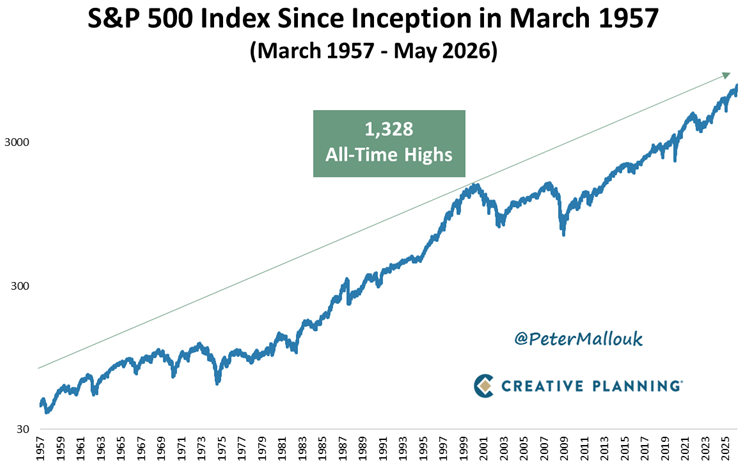
Last week, Michael Harnett of BofA included this chart in his May 22 "Flow Show."
As this reposted thread below details, we have not seen the market this concentrated around a single theme in 150 years.
Feb 27 is the day before the war began.
The black line is the S&P 500; it is up 10+% since Feb 27.
The blue line is the S&P WITHOUT the AI stocks (see the description and repost). It is still DOWN 0.66%.
Maybe soaring gas prices are having an impact on the market after all?
During his campaign for first term, Donald Trump was asked how he showed $916 million net operating losses in 1995 and setting it off for next 18 years without paying any federal taxes.
Not knowing what to answer, Trump said:
"I absolutely used it, and so did Warren Buffett. Warren Buffett took a massive deduction."
We've to learn from Buffett as to how to deal with facts and data without being emotional or vindictive.
The very next day Buffett shared his income tax returns and said:
"I have paid federal income tax every year since 1944, when I was 13. Though, being a slow starter, I owed only $7 in tax that year. I have copies of all 72 of my returns and none uses a carryforward."
He further noted that while he made $2.85 billion in charitable contributions in 2015, tax laws properly limited his deductions, meaning more than $2.85 billion of his donations were not taken as deductions and never would be.
He asked Trump to share his tax returns in public. Not knowing what to do, Trump said he is under IRS audit and cannot publicly share his returns.
For which Buffett responsded:
"I have been audited by the IRS multiple times and am currently being audited. I have no problem in releasing my tax information while under audit. Neither would Mr. Trump -at least he would have no legal problem."
Buffett then invited Trump to any place, any time before the election so they could both bring their tax returns, sit down, and let the public ask them questions.
Trump never accepted the invitation.
From then on Trump never once even uttered the name Warren Buffett.
Looks like Trump no longer even eat buffets.