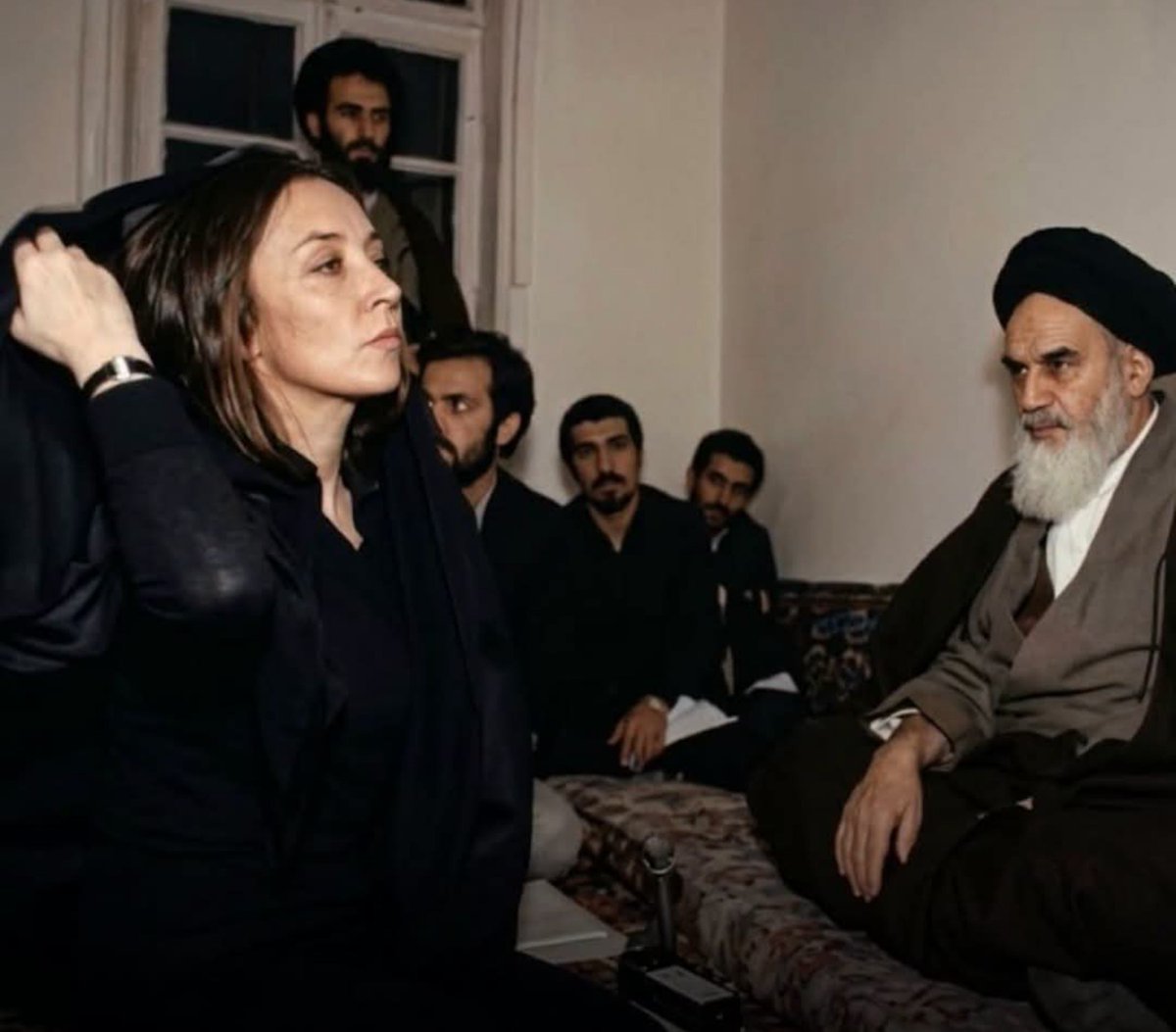
Italian journalist Oriana Fallaci removing her chador during her tense 1979 interview with Ayatollah Ruhollah Khomeini in Qom, Iran...
In October 1979, Italian journalist Oriana Fallaci traveled to Qom, Iran, to interview the Islamic Revolution's supreme leader. To get inside the room, Fallaci was forced to cover herself from head to toe in a heavy black chador, leaving only her face visible.
The conversation inside the room was tense from the very start. Fallaci did not hold back her questions.
She pushed the Ayatollah on political executions, the sudden shutdown of independent newspapers, and the sharp loss of rights for Iranian women under the new regime.
When she asked about the forced wearing of the veil, Khomeini dismissed her concerns and claimed the garment was meant to protect young and respectable women. He then added,
"If you do not like the Islamic dress, you are not obliged to wear it."
Fallaci took his words literally and replied, "Thank you, Mr. Imam. Since you tell me so, I am taking it off right now."
With a quick move, she pulled the chador off her head, leaving her hair completely exposed right in front of the Supreme Leader.
Khomeini was furious.
He stood up without saying another word and walked out of the room. The room fell silent, and the interview was abruptly stopped. However, Fallaci refused to leave Iran until he returned a day later to finish the conversation.
This confrontation became legendary in the history of journalism.
It showed a reporter refusing to bow down to authority, even in one of the most dangerous settings imaginable.
Fallaci proved that real journalism requires standing up to power, asking hard questions, and refusing to be silenced by fear or tradition.
When journalists trade raw courage for easy access and comfortable silence, we lose one of our strongest shields against tyranny.
In an era where true courage in reporting feels rare, her brave stand reminds us that honest journalism still has the power to light up the dark, giving a voice to the voiceless and inspiring future generations to speak truth without fear.
#archaeohistories
My best shot of the 2025 Prayag Maha Kumbh Mela from ISS. It is a once in a 144 year Hindu pilgrimage to sacred riverbanks in India and one of the largest events in the world, with millions of people in this single photo!
I'm surprised BBC has done a borderline objective show on illegal Bangladeshis going back from India after BJP won in West Bengal.
However, BBC describes these infiltrators as "kothito anuprobeshkari" or "alleged infiltrators" when they themselves, ON CAMERA, are saying they had entered illegally.
Shameless.
How has TCS managed to suppress the issue across Instagram, LinkedIn, and mainstream media? When it was reported, it was referred to as a “Nashik IT firm,” as if it were some unknown company. The silence from the likes of Faye D, Brut India The News Minute etc is noticeable.
I have a massive, irreconcilable problem with this Ramayana movie & others that may follows.
Longish post, hear me out, do read to the end.
The Ramayana is the foundational text of our land (Bharatvarsh, Hindustan), and the faith the land begat, ie Hinduism.
It’s been politicised, criticised, dragged through Abrahamic-Commie-Globalist filth, misunderstood & mis-explained, even by its billion-plus bhakts.
In movie-TV rendition, the actors playing Rama & Ravana must be equally matched in looks, charisma, acting prowess. Here, they’ve hired Yash, the best looking southern superstar with pan-India popularity.
The problem begins now.
The Ramayana’s geography dictates that movie Rama be “northerner” tho Sri Rama was dark-skinned, and movie Ravana be “southerner,” tho Lankesh was fair-skinned. Enter modern fault line #1 : Race.
Next, to please unhinged southern fans whose idol is playing the worst Hindu villain, movie Ravana CANNOT be shown as truly evil.
By making good and evil “relative,” not “absolute,” Sri Rama is debased and Ravana elevated. Enter modern fault line #2 : tribal sympathy for the slain villain, hate for the patriarchal royal hero.
Finally, Sri Rama is now the face of an assertive political ideology too, and a target of faith-based toxicity. Enter modern fault line # 3 : secularism.
Since movies and serials reach a far wider audience than articles & tweets do, the damage to a divinity worshipped throughout Asia on the backs of Indian ships, is incalculable.
The most outstanding diplomatic outreach by the @narendramodi Govt. gets lost in the din -
Our use of Buddhism as a diplomatic tool.
I try to contextualise it as succinctly as possible, in this oped for the @JagranNews.
Do read & let me know what you think.
There are no Persians left to claim Persia, no Buddhists left to rebuild Bamiyan and no Pagans left to reclaim Kaba. But Hindus exist and demand Kashi and Mathura. That is the problem.
Millions have watched "Captain Steeve" conveniently pin blame on the pilots. But Captain don't oversimplify. Our pilots aren't fools, they are the best. Gear and flap controls are far apart.
Friends, never forget we're living in the time of info wars. Verify then believe.
After destroying Nalanda, Vikramaśila, and Bodh Gaya, Bakhtiyar Khalji turned his sights on Tibet, marching through Kamarupa. But at the Himalayan gates, he met his reckoning. Raja Prithu’s Assamese forces crushed Khalji’s army and delivered the infamous invader to the Tibetans. Tibetan chronicles record a brutal revenge: Khalji was killed in battle by the Assamese warriors then handed over to the Tibetans. The Tibetans made sure his skin was flayed, and his head turned into a ceremonial mask - displayed at the sacred Śākya Monastery to honor fallen Buddhist monks. Even Muslim chronicler Minhaj-i-Siraj admits the annihilation - but he veils the shameful end in whispers of poison and betrayal instead.
A short graphic novel on Khalji's End based on the description in Tibetan chronicles and Assamese records - is in the works.