I try to conserve liberalism. A good survey question is like a beautiful painting, it helps reveal what is true about us. Research, cycling, board games.
I unironically think the future of good education could be seminaries. They seem to have been able to navigate the tension between vocation and liberal education better than most. Could they expand to create more undergrad-type programs that look somewhat like St. Johns? Not sure
2. I don’t think there are solutions. Universities are now hospital systems, sports franchises, real estate ventures, and hedge funds with an edu side hustle that is subservient to all four. Research universities and mass education���cooked! SLACs can be secular monasteries, maybe.
@LeBourgeoishome@worst_account Not all. Roger Scruton's one on Beauty is quite good, and I believe Pete Boettke and Scott King have one coming out on Hayek (which I assume will be good and not an anti-capitalist screed).
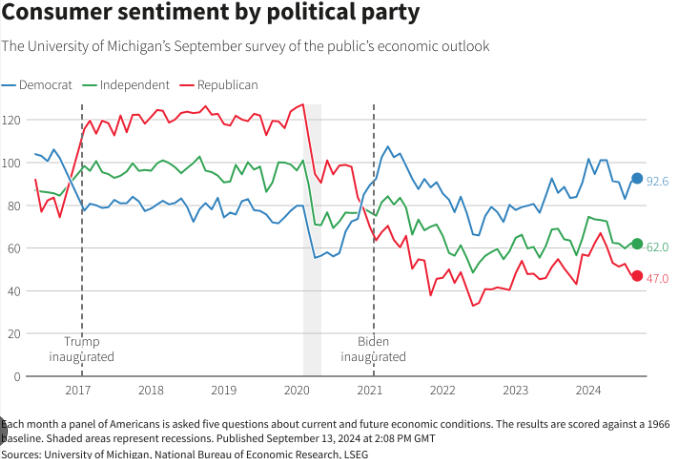
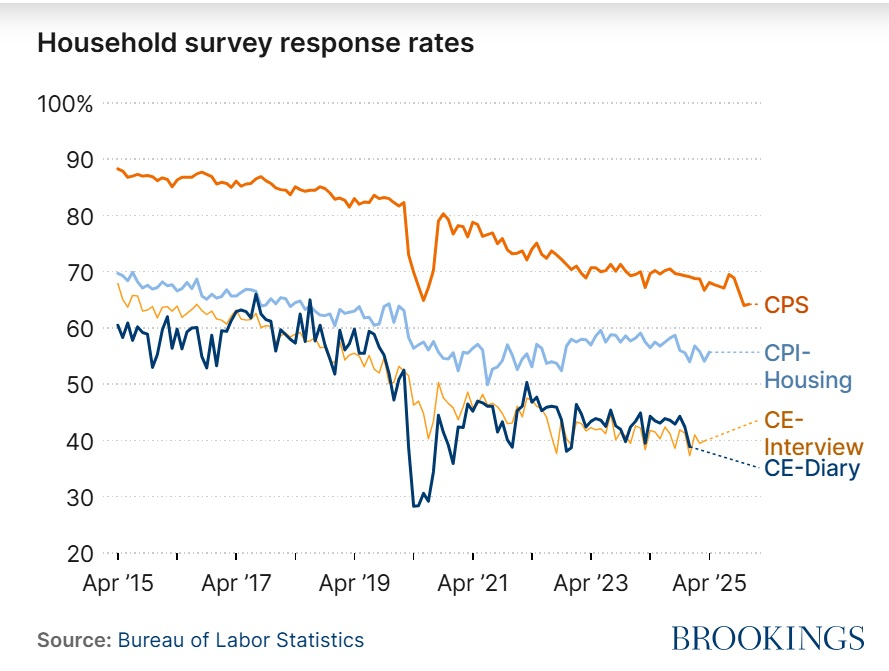
The reality is that the surveys look like they have degraded in quality. The most likely driver is the increasing influence of a partisan lens on economic confidence. Here captured in the UMich sentiment index:
One quick take on this is that Collison and others focus a little too much on the advent of modernism. The big difference is not between modernism and what came before it, but between objects where effort has been put into design, at all, and things where that is not the case.
Someone asked me recently why I’ve become interested in aesthetics after having spent most of my life more interested in STEM-adjacent topics. I hadn’t really considered the question consciously before, but I’m certainly thinking about aesthetics more than I used to. I think it’s a confluence of things:
• Many things today are ugly and far uglier than they used to be or need to be. Once you see this, it’s kinda hard to stop perceiving it. (Early twentieth century phone boxes versus modern phone boxes; old water fountains versus new water fountains; etc.) As someone with a naively meliorist assumption that most things should be getting better rather than worse, it’s all a bit perplexing: why did we stop doing things nicely? Is it a choice? Was there a malevolent spell cast upon us? This vein led me to think more about modernism and why much of art became more intentionally "challenging", grotesque, opposed to prettiness, rebarbative, dissonant, etc. Can or should anything be done about this? Is this just how things ought to be?
• Relatedly, much of modernism involved a kind of explicit repudiation of cultural continuity and represented a schism with prior practices. This is maybe most evident in American architecture, where the International Style exhibition in 1932 initiated the displacement of a rich tapestry of prior styles. This cultural break seems important and interesting to me, and I suspect that the rejection had important consequences outside of the aesthetic domain. Samuel Hughes has been exploring this question in his recent writing at @WorksInProgMag; @RuxandraTeslo is also pulling on this thread. Elaine Scarry wrote about how beauty inspires creation. If so, the inverse may also be true: ugliness inhibits it.
• It’s clearly the case that changes in the aesthetic domain can at least inspire progress in other places. Petrarch helped set some of the preconditions for the Renaissance which in turn fostered the scientific revolution and Enlightenment. Things like World Fairs (the 1851 Fair at the Crystal Palace recorded 6 million admissions when the population was 21 million) reflect the popular interdependency that used to exist between aesthetics and material development.
• @tedgioia and others have written about stuck culture and how so many domains seem to have ceased to straightforwardly advance in the way that they did up until the nineties or thereabouts. This is obviously peculiar and interesting. What changed, and what does it mean? Is it about the internet and fragmentation? Is it about a loss of supply? Is it just about having reached the zenith of various mediums?
• I’m generally interested in markets and the dynamics of creation. In aesthetics broadly, I find the reflexivity between supply- and demand-side factors to be very thought-provoking. There’s a natural desire to view satisfaction of individual preferences as the yardstick to measure market success, but things get interesting and even a bit unsettling when we start to think about how the supply might start to shape the demand. I often think about this in the context of food. Why is food so much worse in Germany than many of its neighbors? Germany certainly doesn’t have less material ability to produce good food; indeed, Germany is richer than the countries around it. There’s probably something about German food supply chains that is impoverished relative to France and Italy, but the Germans themselves don’t seem too upset about it. It just seems that the Germans are stuck in an objectively worse market equilibrium than their neighbors: the food is bad and they’ve gotten used to it. The obvious question then is where else these kinds of reflexive patterns apply, and where else we’re stuck in some objectively inferior equilibrium, even if preferences are in some superficial sense being sated.
• While this is an extremely banal and obvious point, I hadn’t until recently thought much about or internalized how much one can study reasonably objective things ("the status of women in society", say) through artwork. (Thanks to @_alice_evans for opening my eyes here.) In this vein, I’m pretty excited about the possibilities over the coming years in computational art analysis. I want something that’s conceptually similar to Google Ngram timelines but for the visual arts.
• We've always tried to do things well at Stripe. I've come to see that attempting to do them beautifully is often a helpful way to break out of standard practices and to do something with greater novelty and in a way that might have other benefits besides. (Also, excellent people want to do great work because it is intrinsically satisfying. Explicitly allowing aesthetic considerations to carry weight avoids having to justify every assessment with some kind of torturous empiricism.)
• In his Nobel Lecture, Solzhenitsyn said that, among the Platonic virtues of goodness, truth, and beauty, that beauty is special, for it possesses a unique kind of irrefutability. He notes that arguments, writing, and philosophical systems can all be predicated on misapprehensions, but that “a true work of art carries its verification within itself.” He proceeds to observe that when goodness and truth are threatened, the “ever surprising shoots of beauty will still force their way through.” There is a lot of specious and motivated reasoning in the world today and plenty of questionable value systems. I don’t think that beauty directly reflects any definitive trait, but I’m intrigued by the idea that it can be a marker of deeper metaphysical coherence.
@IVMiles What? The defining behaviors mapped in the graph were not whether they took those political acts in the name of their church or their faith. All the behaviors they asked about are just being civically engaged, something I don't think you argue against for Christians, generally.
@zenahitz@ghostowlredux@winnie4prez Perhaps not exactly what you're looking for but Per Scholas and TekSystems are two orgs who are thinking about this issue: why default to only hiring people with degrees? https://t.co/nDR6YZixKt Also, Stand Together's Human Potential Network: https://t.co/ldPUVPxzXF
@robinhanson I have trouble reconciling some of your positions. #5 seems particularly at odds with 12a and 8, and 6 and 8 seem even more in conflict. Maybe you're arguing these things can be separated, but I suppose in my estimation, they're package deals.
@zenahitz An extremely good question. But I suppose I was only able to form a clear answer to that for myself *after* experiencing liberal learning. Would you matriculate the students who struggled to clearly answer it in the hope of giving them the ability to in the future?
I never met Gordon Wood, but I have a story about him.
In one of my grad school seminars, we read Wood’s Creation of the American Republic. The sheer erudition and evidentiary depth of the book bowled me over.
Back then, before kids and before life accelerated to warp speed, I used to call my mother every Sunday to catch up. Lots of times, we ended up talking about what I was reading that week in my grad seminars or for leisure. Mom had an omnivorous mind, and she was always looking for something else to read. She was a true intellectual—curious about almost everything, always eager to integrate new arguments or ideas into her existing schemas of how the world worked or to have those schemas challenged and changed.
When we talked that particular Sunday, I think I tried to describe to her part of Wood’s argument about the relationship between the state constitutions during the Articles of Confederation era and the federal Constitution. Maybe I was tired, maybe I didn’t completely understand her questions, but the end result of the conversation was that Mom had questions about Wood’s argument that I didn’t answer satisfactorily. I told her that she should probably just read the book, and we said goodbye.
She did eventually read the book, but the next Sunday, Mom started our conversation by saying, “Well, I had a lovely conversation with Gordon Wood this week.” For a split second, I thought she was joking, but then I remembered who I was dealing with. I started to sweat. “How?” I asked. A whole variety of unlikely scenarios in which the foremost historian of the American Revolution and my mother, who lived in Wichita, Kansas, might have met ran through my mind. “Oh, I just looked up his office phone number on Brown’s website and called, and he picked up!” Mom said. I decided I would have to find another profession.
As it ended up, Gordon Wood spent about an hour on the phone with my mother answering her questions about the Constitution. Ever since, I’ve had a soft spot for the man when I imagine him picking up the phone in Providence and finding Becky Elder from Wichita on the other end of the line. His generosity in that moment spoke very well of him.
Rest in peace, professor.
@benspringwater Seinfeld said something similar about micromanaging in another interview, and I've always wondered whether he was joking for comedic effect, given that micromanaging is a modern Bête noire. Seems he was not joking. I think about it often as well.