ÇİN 12.200 PROGRAMI KAPATTI
1/
"Çin 12.200 üniversite programını kapattı" başlığı her yerde.
Ama viral yorumların çoğu bunu yanlış okuyor.
Bu bir disiplin tasfiyesi değil.
Daha ilginç ve daha rahatsız edici bir şey var altında.
learning fast is not talent.
it is method.
most people learn randomly:
• watch videos
• take notes
• feel productive
• forget everything
the science of rapid skill acquisition by peter hollins is about turning learning into a system.
real skill acquisition needs:
deliberate practice
feedback loops
chunking
spaced repetition
active recall
mental models
environment design
you don’t master skills by consuming more information.
you master them by repeatedly forcing your brain to retrieve, apply, correct, and compress.
input is cheap.
feedback is where learning becomes real.
the fastest learners are not the ones who study the most.
they are the ones who close the loop fastest.
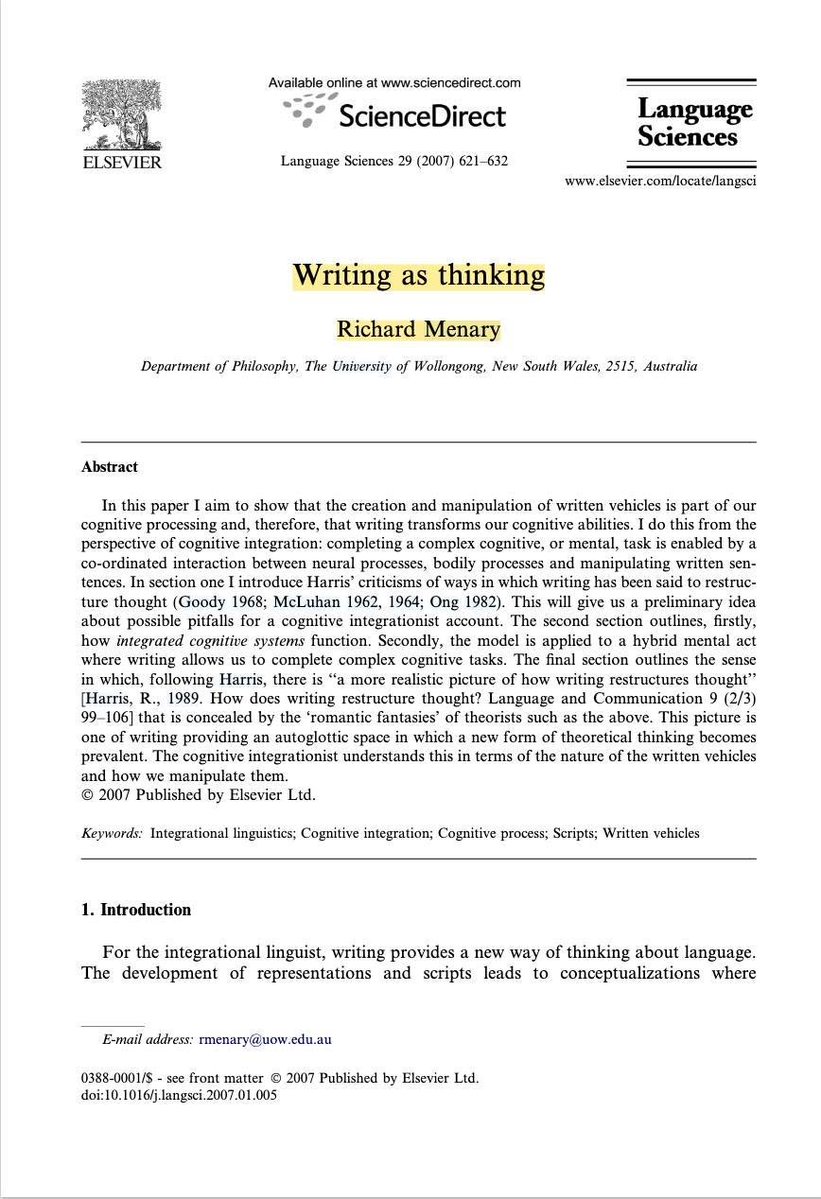
Does “writing is thinking” still hold when AI can do most of the writing?
If writing has long been one of the main vehicles of thought, what happens when AI starts carrying much of that cognitive labour?
I have been thinking about this after reading Richard Menary’s paper Writing as thinking.
His argument is powerful. Writing is part of thinking. We do not simply think first and write later. We think through the act of writing itself.
Drafting, revising, deleting, moving sentences around, rereading a paragraph, seeing a gap in an argument, finding a clearer way to say something. All of that is cognitive labour.
But generative AI changes the conditions around this argument.
Before AI, writing carried much of the heavy lifting. It was one of the main ways students externalized thought, struggled with ideas, organized meaning, and developed judgement.
Now AI can produce the paragraph, polish the sentence, restructure the argument, summarize the reading, and generate the reflection.
So the question becomes serious: what happens to the thinking that used to happen through writing?
I still believe writing matters deeply. But I also know people, including people close to me, for whom writing creates anxiety. They think better through sketching, diagramming, drawing, speaking, mapping, or building.
So maybe the old mantra “writing is thinking” belonged to an age when writing carried far too much of the burden.
This also explains part of our current assessment problem. For years, education has leaned heavily on the written product as the main evidence of learning.
Generative AI has disrupted that assumption.
A polished text can still tell us something, but it can no longer carry learning assurance by itself. We need process evidence, oral explanation, drafts, diagrams, annotations, design choices, and moments where students show how their thinking developed.
Literacy is a situated practice. Pre-AI literacy and post-AI literacy belong to different conditions. Now what we need to think about is whether our students can think across tools, modes, contexts, and constraints?
Dear followers,
Please see this discussion on AI and future work between myself, @deanwball@emollick and @clarashih
Somehow, I was again the least optimistic person in the debate.
In the Hybrid A.I.-Human Work Force, Who Will Actually Thrive? — NYT https://t.co/FTRbPMOtvP
Academics write for each other, not for people.
Steven Pinker has spent over four decades doing the opposite, and thinks current academic writing is "enormous wasted effort."
"There's an awful lot of brilliant work, really smart people in academia. Why are they doing it? Just to entertain each other? Taxpayers pay for it. It should be accessible. Why should I have to read a paragraph five or six times?
It gets under my skin when academics devote so much brainpower into the scholarship and then just blow off the essential task of letting the world know what you've done."
Demis Hassabis just told a room full of academics that they’re running out of time.
Not the engineers. Not the technologists.
The economists. The philosophers. The people who are supposed to understand what a civilization actually is.
Hassabis: “It’s very urgent that we really think about the second-order consequences.”
He wasn’t talking about the technology.
He was talking about everything that comes after it.
Hassabis: “I’m always a little bit astounded when I talk to economists about what’s happening and it’s sort of, they’re pretty skeptical. ‘Where’s it, where’s it coming in the GDP?’”
The architects of the global economy are asking where the biggest economic shift in human history is showing up in a spreadsheet.
That’s not skepticism. That’s institutional paralysis dressed up as rigor.
Hassabis: “It’s ten times the Industrial Revolution.”
The Industrial Revolution didn’t just move capital.
It burned the feudal system to the ground and birthed the modern world.
Hassabis is telling us to multiply that violence by ten.
Hassabis: “We’re going to be in a world for the first time, if we get the technology right, where we’re a non-zero-sum world for the first time in humanity’s existence. How can that not need a new type of economic system?”
Every economic model you have ever lived under shares the exact same foundational assumption.
Scarcity.
Capitalism. Communism. Mercantilism. Feudalism.
Four names for the mathematics of starvation.
Hassabis: “I don’t think it’s any of the ones we’ve tried, because they were all done under the guise of a zero-sum, a limited, a scarce world.”
He’s not saying capitalism failed. He’s saying the premise underneath it is about to dissolve.
And nobody has written the replacement.
But scarcity didn’t just shape our economies.
It shaped our identities.
You found meaning in your labor. You found virtue in your utility. You worked so you didn’t die.
Every concept of purpose humans have ever constructed was forged in a world where things run out. Where choices cost something. Where suffering had a function.
Remove scarcity and you don’t just disrupt markets.
You collapse the entire philosophical framework through which human beings have understood what it means to live.
Hassabis: “There’s the even harder question of how do we want to evolve our society and what is virtuous, what is meaning, what is purpose.”
The technology is solvable. The economics is redesignable.
But philosophy itself was built inside scarcity. Ethics is the study of hard choices. Meaning is what we extract from struggle. Purpose is what we build against resistance.
Take that away and the entire architecture of human meaning loses its load-bearing wall.
Hassabis: “I think that’s going to need lots of great philosophers.”
He’s asking for thinkers who don’t exist yet.
The engineers are about to automate your survival.
And in doing so, they will automate your purpose.
We spent all of human history fighting for the right to stop struggling.
We have no idea what happens to the human mind when we actually win.
A freelance journalist who had never taken a statistics course wrote a 142-page book in 1954 that professional statisticians still hand to students before anything else, because nobody before him had bothered to explain the tricks in plain language.
His name was Darrell Huff. The book is called How to Lie with Statistics.
I read it in one sitting and spent the next three days noticing the tricks everywhere.
Over 1.5 million copies have sold in English alone. It became a standard college textbook in the 1960s and 70s. Seventy years later it is still in print, still assigned, still the first thing a working statistician reaches for when they want to teach someone to think clearly about numbers.
The man who wrote it was not a researcher. He was a freelancer who wrote how-to articles for magazines. He had no PhD, no academic post, no institutional affiliation. He just understood that numbers could lie without technically being wrong, and he thought someone should explain how.
His opening line sets the whole tone of the book.
"The crooks already know these tricks; honest men must learn them in self-defense."
That one sentence is the entire argument. The manipulation is not coming. It already happened. It happened this morning in the article you read and the chart someone showed you at work and the study your doctor quoted. The only question is whether you know what to look for.
Huff called the first trick the Well-Chosen Average.
When someone tells you the average salary at a company is $80,000, they have told you almost nothing. If the CEO earns $2 million and the 20 employees earn $30,000 each, the mean is $80,000. The median is $30,000. Both are technically correct. One is a lie. The person reporting the number chose which average to use, and they almost always chose the one that served their argument. Huff's rule: whenever you see an average with no description of which average it is, ask.
The second trick he named the Gee-Whiz Graph.
A line chart shows company profits rising. The line shoots nearly vertical, almost doubling in height across the chart. You feel impressed. Then you look at the y-axis and notice the chart does not start at zero. It starts at 94. The actual increase in profits was 3 percent. The dramatic visual was produced entirely by cropping the bottom of the chart. Nothing in the data changed. The picture changed everything.
Every news organization on earth still does this every day.
The third trick is the one that should change how you read every study you ever encounter. Huff called it Post Hoc Rides Again, which is short for the Latin phrase post hoc ergo propter hoc. After this, therefore because of this.
Cities with more churches have more violent crime. Therefore churches cause violence. The logic is airtight. The conclusion is absurd. Both church attendance and crime go up as population grows. The two numbers track each other because a third variable drives both. The correlation is real. The cause is invented.
Huff showed that this structure is not a rare mistake. It is the default pattern of almost every study reported in a newspaper, because causation is a boring word and because proves is a better headline than correlates with.
The fourth trick was the one that floored me. He called it the Semi-Attached Figure.
A headache pill company claims their product is twice as fast as the competition. The study behind the claim is real. The product was tested and the numbers are accurate. What the advertisement does not mention is that the study measured absorption rate into the bloodstream, not relief of headaches. The two things are related but not identical. The statistic is real. It is attached to the wrong conclusion.
Huff said this is the most dangerous trick of all because the number is never fabricated. You cannot fact-check a semi-attached figure by verifying the statistic. You have to ask whether the statistic actually measures what the claim requires it to measure.
Almost nobody asks.
There is one part of Huff's story that most people who recommend the book leave out.
Years after he wrote it, he was hired by the tobacco industry. He worked on a follow-up manuscript called How to Lie with Smoking Statistics, designed to cast doubt on the research connecting cigarettes to cancer. The book was never published. He testified before Congress in an attempt to undermine the statistical evidence against tobacco.
The man who wrote the clearest guide to spotting statistical deception spent the end of his career deploying those same tricks against evidence that was killing people.
That detail does not make the book wrong. The tricks he described are real and the defenses he taught are still the right ones. But it is a reminder that the tools in the book are neutral. Understanding how lies are built does not protect you from choosing to build one.
The crooks already know these tricks.
Some of them wrote the manual.
What is one statistic you have seen recently that you now think deserves a second look?
Can AI really detect AI?
Currently, universities, journals, and various educational institutions are using AI detectors to identify AI-generated writing.
However, a recently published study has challenged this widely held assumption.
In a study titled "AI Detecting AI in Academic Writing: Why Most AI Detector Findings Are False," published in Elsevier's Elsevier journal Next Research, researchers argue that most results produced by current AI detectors are not reliable and can often lead to incorrect conclusions.
The reason is that modern Large Language Models (LLMs), such as ChatGPT, have become so advanced that even experts often find it difficult to accurately distinguish between human-written and AI-generated text.
Nevertheless, many institutions are treating AI detector reports as if they were definitive evidence.
The study also shows that AI detectors frequently misclassify human-written content as AI-generated.
One of the study's most important findings is that when the actual prevalence of AI-generated writing is low, the false-positive rate of AI detectors increases dramatically.
In other words, if AI use is relatively limited in practice, an innocent author may face a much higher risk of being wrongly accused of using AI.
The researchers further note that authors who do use AI can often evade detection simply by modifying, editing, or rewriting portions of the generated text.
This means that a writer who never used AI may still be accused of doing so, while someone who did use AI may not be detected at all.
According to the researchers, AI detector results should not be used as the sole or definitive evidence of AI usage.
Hoy querria recomendar este libro de Reichebanch el cual sento las bases para la reflexion filosofica de la teoria de la relatividad ya que abordan varios de los temas filosoficos clasicos que surgen en los fundamentos subyacentes de esta teoria.
Hoy querria recomendar esta antologia de filosofia de la ciencia en el cual se aborda varios temas,ploblemas y perspectivas sobre el realismo cientifico en articuclos escritos por varios representantes de este.
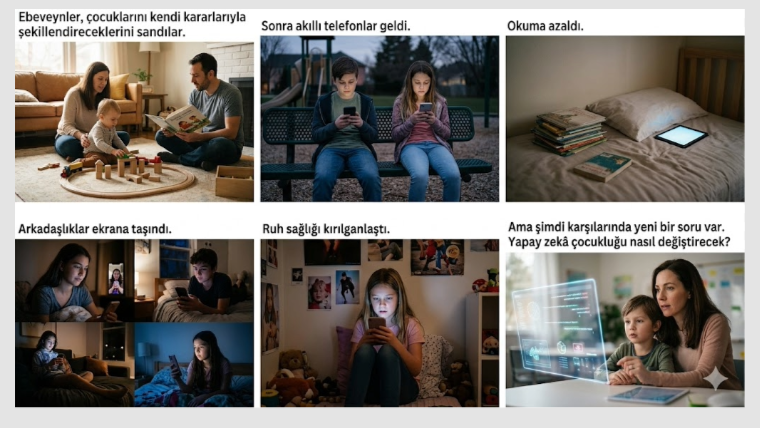
AKILLI TELEFON GELDİ, ÇOCUKLUK DEĞİŞTİ
Ebeveynler, çocuklarını kendi kararlarıyla şekillendireceklerini sandılar.
Zaman ayırıp, iyi okullar seçip, doğru sınırlar koyarlarsa her şey yoluna gireceğini düşündüler.
Sonra akıllı telefonlar geldi.
Sosyal medya geldi.
Çocukluk sessizce değişti.
Okuma azaldı.
Dikkat dağıldı.
Arkadaşlıklar ekrana taşındı.
Ruh sağlığı kırılganlaştı.
Ebeveynler ise ne olduğunu anlamaya çalışıyordu.
2000’lerin ebeveynleri biraz da “kobay jenerasyon” oldu.
Telefonların çocuklar üzerindeki etkisini yaşayarak öğrendiler.
Toplumun gücünün bireysel tercihlerden daha büyük olduğunu geç fark ettiler.
Financial Times’tan Simon Kuper’ın dediği gibi bugünün ebeveynleri telefonlara daha mı hazırlıklı?
Ama şimdi karşılarında yeni bir soru var.
Yapay zekâ çocukluğu nasıl değiştirecek?
Kay. Simon Kuper, Financial Times’tan OKSİJEN