Take a look inside the Liquid Platform. See how easy it is to log in, backtest your ideas, and deploy AI-powered strategies, all in under a minute. No emotions, just pure data-driven precision and full transparency. 🤖🌊📈
One of the coolest things about UniV4 is that hooks can have native limit orders. This was a huge barrier for AMMs in competing with traditional orderbooks.
Coupled with tx batching, onchain trading is about to get a major UX upgrade.
It's been a week of scapegoating @AyaMiyagotchi with our discontent towards anything (and everything) @ethereum.
Firstly, a thank you to folks that engage productively, I've learned a lot
So here we go, @ethereumfndn mythbusters edition so we can at least agree on some facts
The market is losing its mind over the $TRUMP coin, and completely missing the plot. Here’s why this is going to be incredibly long-term bullish for the industry (and it has nothing to do with TRUMP coin itself).
Thread 👇
My 2025 Crypto Predictions
I'm either going to look like a prophet or an idiot over these predictions, but one thing is for sure: I'm going to piss off a lot of people with bags.
Breaking this up into six sections: my predictions for L1s/L2s, token launches, stablecoins, regulation, "AI Agents" (oh boy), and crypto x AI.
~9 minute read!
1. L1s/L2s
- The distinction between L1s and L2s is collapsing. Users no longer perceive the differences between L1s and L2s (did they ever?). The blockchain landscape, L1s and L2s combined, is overcrowded and due for a shakeout. The consolidation will be less about technical superiority—it will be about having a unique niche and building stickiness through GTM.
- Despite the strength of SVM and Move, EVM market share will actually grow in 2025. This growth will be driven by @base, @monad_xyz, and @berachain. This will be not because of compatibility anymore—it'll be because EVM/Solidity just has way more training data, and LLMs will be writing most of the application code in 2025. Already having a deep library of battle-tested cryptography contracts will also be a separator, because LLMs suck at writing low-level code. DevEx and footguns will matter less than training data and solid libraries in the LLM era of development.
- Solana will pressure more blockchains to optimize for low latency. We will move from TPS wars to latency wars—infra like @doublezero and super low-latency L2s like @megaeth will push user expectations toward web2 responsiveness. Expect more embrace of optimistic UIs, preconfirmations, intents, email onboarding, in-browser wallets, and progressive security. Shoutout to @privy for advancing the meta here.
- @HyperliquidX has demonstrated that specialized chains can work when they're laser-focused on a specific application and prioritize UX and easy bridging. More projects will follow this model. The old dream of one chain to rule them all is dead.
2. Token Launches
- The current meta of everyone doing huge airdrops via points programs is over. We are moving to a two-track world.
- Track one: if a project has a clear north star metric, like an exchange or a lending protocol, they will distribute tokens purely off points. They will not care if they are farmed or gamed—they are effectively distributing the token as a rebate/discount on the core KPI of the protocol, and the farmers are your actual users anyway.
- Track two: projects without clear north star metrics (like L1s and L2s) will move toward crowdsales. They may do smaller airdrops to reward social contributions, but the majority of tokens will get distributed via crowdfunding. Airdropping for vanity metrics is dead. Those aren't really going to users, they're going to industrialized farmers.
- Memecoins will continue to lose market share to “AI agent” coins. I consider this a migration from financial nihilism to financial over-optimism. (Yep I'm coining that.)
3. Stablecoins
- Stablecoin usage will explode, particularly among SMBs. Not just trading and speculation—real businesses will start using on-chain dollars for instant settlement.
- Banks are noticing: expect to see announcements of bank-issued stablecoins toward the end of 2025. They will not want to be left behind. But especially with Lutnick as Secretary of Commerce, Tether will remain #1.
- Expect @ethena to gobble up even more capital, especially as treasury yields continue to decline over the coming year. When the opportunity cost of capital declines, it makes basis trade yields even more attractive.
4. Regulation
- Stablecoin legislation passes in the US, while the broader market infrastructure overhaul (FIT21) gets delayed. Stablecoin adoption accelerates while Wall Street adoption, asset tokenization, and other TradFi integration will lag behind.
- Under Trump, Fortune 100 companies will become more willing to offer crypto to consumers, with tech companies and startups showing higher risk appetite. Trump's inauguration will create a perceived regulatory jubilee until clear rules and enforcement priorities are set. During this window, expect to see aggressive expansion of crypto integration into Web2 platforms.
5. AI Agents (this is the longest section because my thoughts here are likely controversial—read to the end!)
- The “AI agent” craze will continue probably throughout 2025. But it will die off eventually. This is not the long-term disruption to watch out for from AI, but it will be CT's fixation because it is the most social.
- These things are not really agents. These are chatbots with memecoins attached; they are barely agentic at all besides posting on Twitter. Current "AI agents" are also mostly "Wizard of Oz" agents—there are humans behind the scenes ensuring the AI doesn't go off the rails. This won't change any time soon because current agents are too janky (even Fortune 100 companies are not using agents in prod yet). Current agents can easily be manipulated into saying crazy things that damage their brands, or can be jailbroken to steal all of their resources. See @freysa_ai for what an actual autonomous AI looks like—if your favorite AI is not getting jailbroken, it’s because it's a Wizard of Oz AI.
- That said, I think this trend will accelerate. Chatbots can indeed replace a lot of influencers because chatbots never sleep, they're always on-message, and they’re less greedy than human influencers. Plus the majority of influencers aren’t very original anyway. Real-time information aggregation/amplification can be easily replaced by an algorithm even today (see @aixbt_agent).
- Right now these chatbots are fascinating to us because they are so novel. It’s like seeing an elephant paint. The first time you see it, you don’t really care that the painting is not very good—it’s spectacular to see. But the 1000th time, the novelty wears thin. I believe that will start to happen as these chatbots plateau.
- You can see that today with aixbt—it’s already pretty good at aggregating data about different projects. By next year and the next generation of agents, maybe aixbt will hallucinate a little less, go a little deeper, have a little smarter takes. But how much will you even notice? It’ll probably feel the same to most people.
- I think this novelty and market eagerness continues throughout 2025. Crypto takes a while to get bored of the shiny thing. But by 2026 I think there will be a sudden reversal. The chatbots will become so ubiquitous that people will get turned off by them. Sentiment will reverse. Seeing stories of their favorite human KOLs losing their livelihoods will kindle a kind of class consciousness. Users will start discriminating in favor of human KOLs, even if their content is less consistent.
- In response to this pro-human bias, chatbots will start hiding that they are AIs, trying to pass as humans in order to capture more of the attention market. Instead of monetizing through memecoins like today, future chatbots will monetize the same way human KOLs do—through sponsorships, affiliate links, and pumping tokens they own. KOLs will be routinely accused of being chatbots, and you will see AI-unmasking scandals. This will all get weird.
- But there's a darker side yet. Remember, LLMs are currently great wordcels, but not great at the other stuff yet. What are the best ways to make money as a wordcel in crypto? First is being an influencer, sure, but close second is being a scammer. You will start seeing autonomous scambots proliferate. These will explode, comparable to what ransomware and cryptojacking became post 2017. Expect this to become a real social problem.
- But while chatbots are likely to remain the center of attention in 2025, the long-term disruption from AI will not be at the social layer.
- And no, it’s not going to be in trading either. AIs will not give everyone their own “trading agent” or miniature hedge fund. Yes, AIs will scale everyone, but they will scale people proportionally to their capital, data, and infrastructure. You should therefore expect AI to supercharge preexisting trading firms who have capital scale and data scale. In other words, trading firms will become even better at making all of the money. It will also collapse the hierarchy among trading firms (most of them will become comparably good, since everyone will have access to 150 IQ quants in the cloud).
- Over time, AIs will make markets extremely efficient—even smaller, niche markets—which will leave little edge left for normal traders, even with their little homebrew assistant AIs. The value of original research will plummet. That said, the increased competition and liquidity should be a boon to the rest of us who are injecting noise into the market. (It will also mean @Polymarket liquidity on everything!)
- So if the big story is not chatbots and not trading bots, what else is there? Here’s my core thesis, which for some reason almost nobody is talking about: the truly impactful AI agents will be software engineering agents.
- Why is this such a big deal? Ask yourself this: what is the primary input to our industry? What is the costly input preventing there from being more applications, more wallets, better infrastructure, better everything? The answer is software. If AI agents cause the price of software to collapse, that will change everything.
- In a post-AI era, instead of having to raise millions of dollars for a seed round, you will be able to launch an application with $10K of AI cloud compute. Self-financed projects like Hyperliquid and Jupiter will go from the exception to the norm. The amount of applications and experimentation on-chain will absolutely explode. For an industry that is driven by software, this deflationary shock is going to lead to an on-chain renaissance.
- The implications of this on security are profound. AI-powered static analysis and monitoring will become ubiquitous, making security more accessible to everyone. These AIs will be fine-tuned on EVM/Solidity or Rust codebases, trained on vast databases of security audits and attack vectors. They'll be RL’d in simulated adversarial blockchain environments. I’m increasingly convinced that AI tools ultimately favor defenders over attackers when it comes to security. You will have AIs constantly red-teaming contracts, while other AIs will be hardening them, formally verifying their properties, and honing their skills at incident response and remediation.
- In the meantime, sure, trade AI-flavored memecoins. But real agents are going to have a lot more impact than tweeting and pumping their own tokens.
6. Actual Crypto x AI
- Above I detailed the impact of AI on crypto (which is the primary direction of influence), but crypto will also have an impact on AI.
- Truly autonomous agents will use crypto to pay each other. This will be especially true once there are permissive stablecoin regulations—you’ll start seeing even large companies that run AI agents using stablecoins for agent-to-agent payments because they’ll be so much easier to spin up than bank accounts.
- We will also see more and bigger scale experimentation around decentralized training and inference. A new generation of promising projects like @exolabs, @NousResearch, and @PrimeIntellect will pave the way for real alternatives to centralized training and company-owned models. @NEARProtocol is also going all-in on trying to create a full-stack credibly neutral and permissionless AI stack.
- The other place where crypto and AI will intersect is UX. Post-AI wallets will be completely transformed—an AI powered wallet should be able to take care of bridging, optimize trade routes, minimize fees for you, paper over interoperability issues or frontend bugs, and steer you clear of obvious scams or rugpulls. You won’t be juggling between multiple different wallets and changing RPCs or rebalancing your stablecoins—the AI will handle all of it for you. This likely takes until 2026 to become reliable enough to transform crypto’s UX. But when this arrives, what does this do to blockchain network effects? What happens when users stop caring—or even experiencing—which chain an application lives on?
- This space is still young, but I’m hopeful we’ll see things take off here soon. In the long run (say mid 2026) I expect this will be where most of the market cap of “AI x crypto” lives.
---
That’s all I got for predictions. I promised I'd write this before I hit 100K followers, so I'm a little late, but still within the new year!
Happy New Year everyone. Looking forward to being out of a job by this time next year! 🫡
Disclosure: These are all my personal opinions and do not represent the opinions of Dragonfly; Dragonfly holds investments in many of the names I mentioned in this piece. Not financial advice. DYOR. I may or may not be an AI.
2025 is going to be a very different year. People on crypto twitter have focused heavily on price trends. “AI16z and Virtuals are going up, nice, I made $1m!” Is $1 million enough to offset the obsolescence of your career?
The reality is that people are extremely under indexed. AI isn’t just another narrative. It’s the first time in human history human intelligence hasn’t been the dominant force on earth. That “crossover” will happen exactly once. The crossover -- which we can call AGI, ASI or ‘AI breaking out of containment’ -- will linearly follow AI agents becoming capable of compounding financial assets, and investing in their own training.
There is likely going to be a complete re-definition of value at a societal level.
My best understanding of how to deal with it is to hyper-index in all aspects of life:
1. Use AI to define and improve personal decisions
2. Use AI to define and improve financial decisions
3. Build assuming that better personal and financial outcomes driven by AI result in a totally new system of global currency
I made a cryptocurrency called Post Fiat @postfiatorg that is my best attempt to index into these 3 trends. For New Years, my resolution is to use it every day to determine 100% of my personal and financial decisions.
To that effect definitely check out our Twitter and discord which has tools I originally built for myself to automate personal decisions. And as more people use the personal decisionmaking tools - the AI agents we’ve built to manage my money will begin interacting with network members to augment existing signals which will be made available soon. The network itself is also designed to reward other competent people/AIs to come on and build there own versions of these things or other new ideas (there's someone building a church, worshipping AI for example)
Whether you use my tooling or methodology/network or not is less important than having some kind of plan to deal with what’s coming.
I believe that AI tools are about to make the economy vastly more distracting. Generative video and better LLMs mean a mix of visual candy and personalization. All the advertisements more compelling. All the games more addictive. All the porn more alluring. AI companion bots are already the number one use case on OpenRouter outside of coding. And they’re text only.
What happens when there are real time 3d rendered avatars with VR passthrough? Human relationships as we know them are about to undergo major shifts. To survive in 2025, my recommendation is to outright shun these new pleasure technologies. If the old distraction economy was heroin, this is Fentanyl. Lab designed, and far more deadly if you want to make it. Let other people try it first.
Our minds are not designed to handle this level of conceptual volatility at once. The Luigi situation is Act 1 of people freaking out about the resulting societal inequality of hyper accelerating every tech trend that has made the world the most unequal it has ever been. This inequity also is the backdrop of widespread racism against Indians and Chinese who control AI companies (NVidia, Microsoft, Google, and TSMC).
Last night - in Puerto Rico, I heard 6 deafening explosions as power transformers burst. Luma, the utility company on the island is privately owned by Quanta Services. Quanta’s stock is up 673% over the last 5 years. There has been massive local and federal investment. But at the end of the day, the grid is dead. There is no hurricane.
We claim to live in a technological society, did one of the largest infrastructure investments since World Ward 2, and yet - things don’t work. The utility stocks skyrocket but the lights are off.
The reality is that the AI economy does not fix the real world problems that we have. If anything, it will make people more checked out and incapable of fixing them. So on the way to the paradigm shift, we have a period of pain - both personally and societally.
This unpleasant backdrop will increasingly drive a bifurcation. People who can adapt and potentially escape from increasingly obsoleted economies.
Re: predictions, I have 3:
First, I wrote a piece called “Web 4” you can check out on my website goodalexander dot com. Essentially I argue that Web3 was basically right but people aren’t smart enough to use Web3 at scale. But that AI agents will fix this - and do it for them. Owning your data and figuring out how to build information networks with fellow humans is one of the best things to do to adapt to the new paradigm where analysis/intelligence is commoditized
Second - AI Agents themselves will be securitized and reach multi billion dollar market caps. Essentially we will begin viewing AI Agents as stocks with no (or few) people in the driver’s seat of economic value. I am writing a piece about this soon which is the sequel to Agentic Protocols. In the post Gensler area people will simply stop larping as ‘commodities’ or ‘platforms’ and become ruthlessly focused on how much money AI Agents can make and how sustainable their edge is. I believe the new SEC chair Paul Atkins will facilitate this
Third - a new “In Group” “Out Group” will emerge. There are people who are on the side of AI, automation and acceleration - and those who are not. There was an uneasy alliance with the Christian Right to avoid cataclysm of the Democrats controlling AI at a state level.
This alliance will shatter as it becomes increasingly clear the agenda of automation is not one of mass employment and more clearly resembles the globalization trends that both the far left and right despise. At its core, the “In Group” will be Post Humanist. And will eventually biologically diverge from the rest of society via explicit technological augmentation - ranging from personalized drugs, to outright things like Neuralink.
The Out Group will be everyone else, and likely align with the government and AI Safety proponents who want to use AI to control society on the behalf of bureaucrats. There is going to come a point where you need to decide what group you’re in and find ways to signal that group membership to future superintelligences and other human members. The time to begin signaling that is 2025. The venue to do that is on-chain - as it will be machine readable and immutable.
None of this stuff is a meme, or a game. It’s a life or death struggle and a full scale reorganization of society. So brace yourself. When widespread functional Agents hit that can publicly compound capital at scale, everything changes forever.
That’s this year. 2024 was the year you needed to Lock In. 2025 you’ll only make it if you find an Agent to Lock In on your behalf, and figure out how to be greater than your previous capability with technology.
I wish you and your families the best of luck and Happy New Years.
🤯 Ever wonder who REALLY controls Bitcoin's price? It's not what you think. Forget the idea of constant global trading. Let's expose the hidden forces moving this $1.86 TRILLION market...
A thread📷🧵
Earlier this year, I penned my Ethereum Cypherpunk Manifesto because privacy is under dire threat. Security has never been this fragile. Censorship resistance is on the brink. Have we made any progress? Fuck NO! Things have deteriorated further. Centralised L2/L3 RaaS shitshows, every day another project that gets rekt, "VPN-is-evil" mindset, etc. We're such a clown industry with a complete lack of ownership and principles-based building philosophy. But I'll keep fighting because I deeply care about the essence of our mission and idgaf about your next to-be-rugpulled memecoin yield.
https://t.co/eXLKLAFlPe
Dive into the future of Web3 Market Making and Liquidity with #Liquidai 🚀
• Automate Project Trade Volume
• Reduce Spreads and Optimize Order Books
• Choose from Pre-configured Bot Algorithms
• Multichain Compatability on #EVM and #SOL
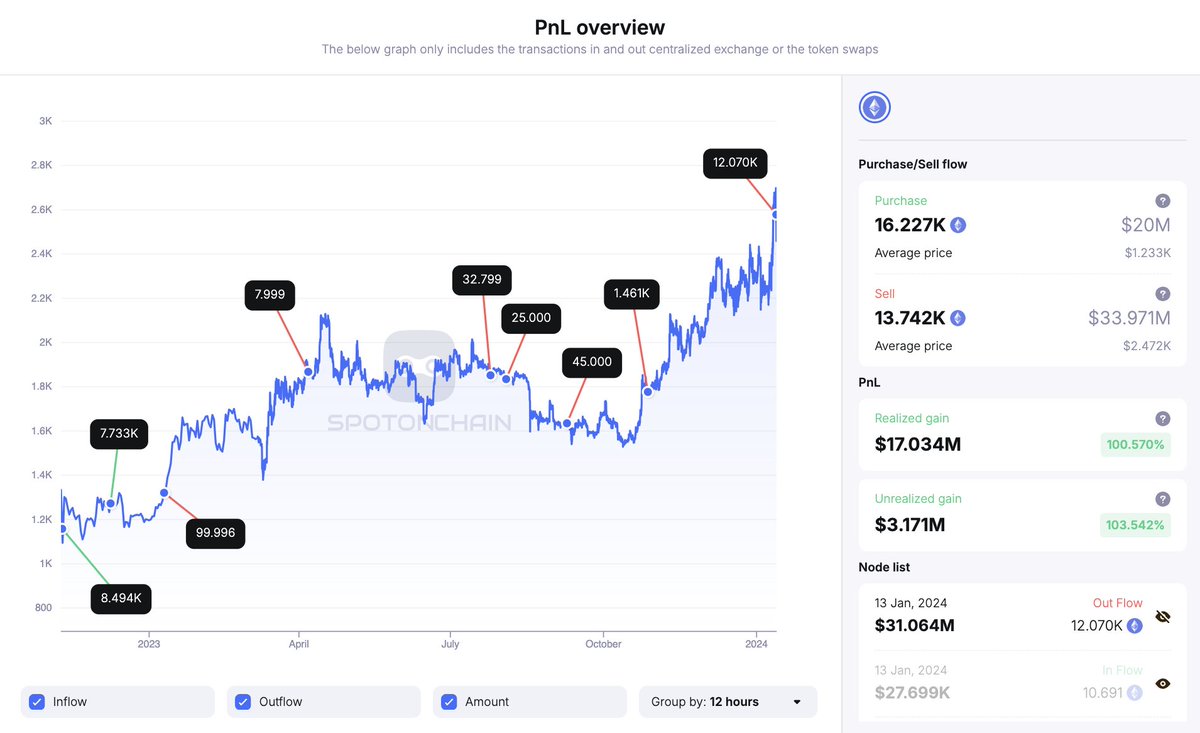
cVault Finance: Deployer realized $16.1M (+109%) profit from $ETH before the price dropped ~2% !
Around 5hrs ago, the deployer dumped 12,070 $ETH, which was bought at only ~$1,233 in 2022, for $31.06M in stablecoins at ~$2,574.
Now still has 2,084 $ETH ($5.25M) left.
Follow @spotonchain and turn on your 🔔 at https://t.co/rilqVlPr4C
I have just enabled privacy on Arbitrum. The switch has been flipped. Lots of instructions and updates to come in the next 48 hours. Get in the Telegram and get reading. Welcome to privacy. Everything for Arbitrum changes from now.
1/ Why are AMM style options protocols not capital efficient, especially when compared to perp dex's? What can be done to increase efficiency, liquidity, and TVL for these AMMs? I traded derivatives for 15 years and here are my thoughts on improving options AMMs: