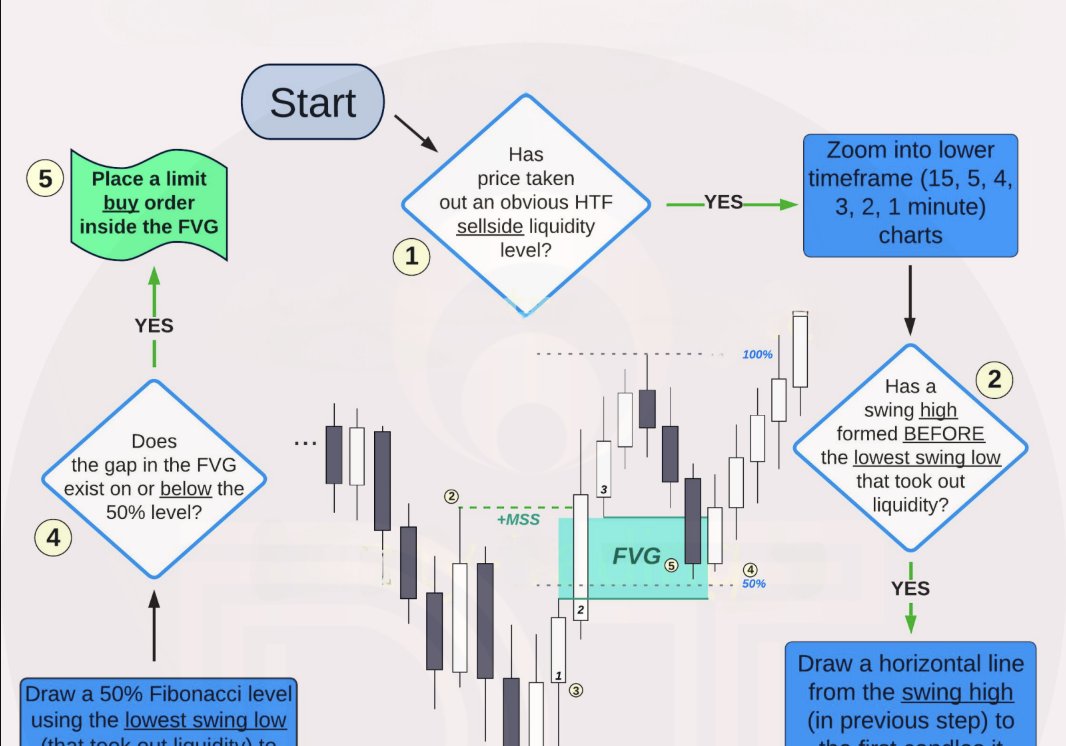
I've traded ICT for 5 years.
Blown 200+ challenges along the way.
I wrote down the exact Entry Models that took me from blowing accounts to consistent payouts.
✅ 10AM Cheatsheet — my favorite NY Open framework with video examples
✅ AAA+ Setup Guide — the highest probability setups I trade every week
2 documents. Everything I trade.
Free.
To get them, just:
1. Like
2. Repost
2. Comment "SETUPS"
MUST be Following (so I can DM)
I'll DM you both today.
I'll make it simple for you:
1. Pick 3-5 tickers. Learn them like your life depends on it.
2. Mark your levels every Sunday. No exceptions.
3. Wake up before the market does. Every single day.
4. Meditate before the open. Your mind is the edge.
5. 1-3 trades max. Some days zero.
6. Never average down on a losing position.
7. Size down the moment you feel emotional.
8. Withdraw consistently. Don't let the number get too big.
9. Journal every trade. Win or lose.
10. Review after close. Find the pattern in your mistakes.
11. One setup. Mastered. Not five setups half understood.
12. Miss trades without flinching. The market opens tomorrow.
13. Never trade to make back losses.
14. Never trade out of boredom.
15. Protect the account before you think about profit.
16. Stay in the game long enough for it to click.
Wow. I genuinely shouldn't be posting this.
I just vibe-coded a market indicator with Claude Code, which printed buy signals that returned +190%, +95%, and +85%.
Claude Code is literally the most powerful trading quant of all time.
Here's exactly how I built it (copy me to build your own)
Step 1. Make sure you have these requirements:
• Claude Code Desktop App
• Node.js v18+ installed on your computer
• TradingView Desktop App
• The TradingView MCP installed (full guide here on my page under "Articles")
Step 2. Open Claude Code
On your local desktop device, create a new folder titled "Vibe-Coding Indicators" and open it inside a fresh Claude Code chat.
This is your dedicated workspace - every indicator you build will live here.
Step 3. Start building your indicators
You have a few options here:
a) Build indicators based on your own pre-existing market strategy.
b) Source market strategies online.
c) Use Claude to help build a strategy from scratch.
Some things to consider:
• What conditions need to be true for a signal to fire?
• What do you want to see on the chart?
• What timeframe do you want to focus on? (I've found that trying to code indicators for multiple timeframes doesn't work well; just stick to HTF or LTF)
Describe all this the same way you'd explain it to another trader; the more specific you are, the better the output.
Step 4. Use this prompt structure
"I'm building a trading indicator for TradingView. I want you to build it in Pine Script V6 and give me the full script so I can deploy it. I want to build an indicator for [insert conditions]."
Example: "I want a buy signal that only fires when RSI is below 40, price is above the 200 EMA, and the current candle volume is at least 1.5x the 20-period average. Paint a green arrow below the candle when triggered."
Claude will then write your full Pine Script.
Step 5. Deploy it to TradingView
Copy the entire code block Claude generates.
Inside TradingView:
Click "Indicators, metrics, and strategies" in the top menu.
Scroll to "My Scripts" and create a new script.
Paste the entire Pine Script Claude gave to you (make sure to start on line 1).
Finally, click "Add To Chart."
Done. Your indicator is live.
Step 6. Take it to the next level
Once you're comfortable with the basic flow, you can:
• Add alerts: "Set an alert anytime [x] happens on [x] indicator."
• Backtest it: "Turn my indicator into a backtestable strategy."
• Audit it: "Improve this indicator and make it more accurate."
• Steal strategies: Have Claude scrape strategies from elite traders on the web
I can't believe more people aren't talking about this.
My full article guide for this exact setup is live now, and I will handhold you through every step (see my profile).
Save this so you don't forget it!
99% of options traders are gambling because they never learned the fundamentals.
This 1-hour Yale lecture changes everything.
In just 60 minutes, you’ll learn more about options trading than most overpriced trading courses ever teach.
No hype. No fake gurus. Just real knowledge.
Save this and watch it without distractions. 📌
I reverse-engineered every prop firm's risk rules and found they're all testing the SAME psychological weakness
Not your strategy. Your impulse control during losing streaks.
Here's the prop firm psychology exploit that turns 30% pass rates into 80% pass rates:
Most traders think prop challenges test:
- strategy quality
- entry accuracy
- how well you "read the market"
Wrong
Prop firms test ONE thing:
Can you follow a system when your brain is screaming at you to abandon it?
Here's what they discovered about trader psychology:
Traders who pass: made ALL decisions before the session opened
Traders who fail: made decisions while staring at a red P&L
The difference isn't skill. It's WHEN you decide
And I'm going to show you exactly what those pre-session decisions look like using the system I trade every single day:
THE PRE-SESSION PROTOCOL:
PHASE 1: THE NIGHT BEFORE (10 minutes)
Before charts even open:
Decision 1: Is tomorrow a trading day?
Check the daily candle. Is the wick small? Is it opening in the right direction? If the daily candle is a reversal candle with a large wick — tomorrow is NOT an expansion day. Write it down: NO TRADE TOMORROW
This eliminates 30-40% of days before you even wake up. Days the 90% will trade and lose on. Days YOU skip because the candle already told you
Decision 2: What did the previous session do?
If London reversed - your job tomorrow is continuation from a gap. Write it down: CONTINUATION DAY -LONGS/SHORTS ONLY
If nobody reversed - your job is to catch the New York reversal. Write it down: REVERSAL DAY - WAIT FOR 9:30 SWEEP
Decision 3: Where is the gap?
Mark the fair value gap from the previous session's expansion. Is it within the upper half of the previous 4-hour candle's range? Is it close proximity to the opening price? If yes — that's tomorrow's entry zone. Write it down with the exact price
If there's no gap in the right zone - NO TRADE TOMORROW. Write it down
Decision 4: Where is the target?
Mark the next relevant swing. NOT the nearest swing. The relevant one - the extreme with valid separation and no failure swings blocking it. Write it down with the exact price
Is the target at least 2.5R from the gap entry? If not - NO TRADE. The math doesn't work
Decision 5: Risk
0.5% per trade on challenges. Non-negotiable. Write it down. Not 1%. Not "I'll adjust based on how confident I feel." 0.5%. Written. Done
All 5 decisions made the night before. When you're calm. When your P&L isn't flashing red. When your brain can think past the next 5 minutes
PHASE 2: THE SESSION (90 minutes maximum)
6:00 AM: check the 6AM candle. Does it confirm what you wrote last night?
Sweep a key level and close back inside = reversal day confirmed ✓
Expand through a level = continuation day confirmed ✓
Chop with no clear move = day cancelled. close the laptop. doesn't matter what you wrote last night. the 6AM candle overrides
9:15 AM: open the correlated assets. NQ. ES. YM. All three side by side
9:30 AM: market opens. price approaches the key level you marked last night
This is the moment. This is what the prop firm is testing
Check: did all three assets sweep the level? Or did one sweep while the others didn't?
All three swept → no crack → no entry yet → WAIT
One swept, others didn't → crack in correlation → the sweep is fake → prepare for reversal
YM closes opposite direction at the key level → strength switch → THIS is your entry signal
Now drop to the 5-minute. Wait for the V-shape. Expansion into the level. Displacement candle. New gap forms
V-shape present → enter the gap. stop behind the sweep. target the relevant swing you marked last night
No V-shape → NO ENTRY. choppy PA at the level. the reversal isn't confirmed. capital preserved
10:00-10:30 AM: either in profit, stopped out, or no trade
Either way - laptop closes
There is no second session. There is no "let me check one more time." There is no afternoon trade. The protocol says 90 minutes. The protocol doesn't care how you feel
PHASE 3: POST-SESSION (2 minutes)
□ Did the candle profile support today's trade? Y/N
□ Did I confirm the session direction before entering? Y/N
□ Did I check all three correlated assets? Y/N
□ Was the gap in the right zone? Y/N
□ Did I wait for the V-shape? Y/N
□ Did I maintain 0.5% risk? Y/N
If all YES → system working. doesn't matter if the trade won or lost
If any NO → identify which filter you skipped and WHY
The prop firm exploit:
The prop firm bet is simple: "this trader will abandon their system after 3 losses"
And 90% do. Here's the sequence they're counting on:
Day 1-5: trader follows rules. doing well. +3.2%
Day 6: first losing day. -0.5%. fine
Day 7: second losing day. -0.5%. frustrating
Day 8: third losing day. -0.5%. now at +1.7% with a 3% drawdown limit
This is the moment. Day 8. Three losses in a row. The math still works. 0.5% risk means you can absorb 6 losses total. You've only used 3. The system is fine
But the trader's brain says:
"I need to make this back"
"the gap looked close enough to the right zone"
"I don't need to check YM today, NQ is clearly going up"
"I'll skip the V-shape, the level is too clean to miss"
One filter skipped. One unconfirmed entry. 1.5R loss instead of 0.5R because the stop was moved
Day 9: revenge trade. another 1R loss. now at -0.3% total. drawdown limit at 3%
Day 10: sizes up to "get back." 2% risk instead of 0.5%. loses. -2.3% in one trade
Day 11: blown
The system didn't fail. The protocol was abandoned on Day 8
Every single filter said NO TRADE on the Day 8 revenge entry:
- candle profile: large wick. didn't support expansion
- correlated assets: no divergence. no crack
- gap: deep in the range. past equilibrium
- V-shape: no displacement. choppy PA
All 4 filters said no. the trader said yes. because his emotions overrode his protocol
The defense:
You WILL want to break the protocol on Day 8
That's guaranteed
The question isn't "will I feel the urge?"
The question is "can I physically prevent myself from acting on it?"
The protocol makes it physical:
- decisions written the night before on paper. taped to the monitor
- each filter checked with a pen before entry. unchecked box = no trade
- platform set to close after 1 trade. there IS no revenge trade
- phone on airplane mode during session. no Discord. no Twitter. no "what do you guys think about this setup?"
You can't break rules that are physically enforced
The traders passing 8/10 challenges:
Pre-session protocol. Every decision made calm. Filters checked with a pen. One trade. Laptop closes
The traders failing 8/10 challenges:
"I'll be disciplined in real-time"
No you won't
Your brain can't handle pressure decisions. Nobody's can. That's not weakness. That's biology
Stop trying to be disciplined during chaos
Start making every decision during calm
Then execute like a robot
The prop firms don't want you to know this. Their entire business model relies on you making emotional decisions on Day 8
When you remove emotional decision-making, you pass
And they pay out
Because that's the game
(free discord in bio. if you think you're a good fit - DM me "SYSTEM" for 1-on-1 coaching. i only take on 1-2 traders at a time to work with fully private)
THE REAL LESSON BEHIND MINERVINI’S TURNING POINT
Minervini isn’t talking about discipline as a motivational slogan.
He’s talking about the moment a trader stops behaving like a human and starts behaving like a professional.
“Discipline is doing what is hard instead of what feels good.”
That one line explains why he almost never had a down year again.
Here’s the deeper logic:
- What feels good is holding losers, hoping they come back
- What feels good is taking profits too early, afraid they’ll disappear
- What feels good is avoiding stops, pretending the market will forgive you
- What feels good is trading for excitement, not for results
But what is hard?
- Cutting a loss instantly
- Sitting in cash when nothing is working
- Letting a winner run without touching it
- Following rules even when your emotions scream otherwise
- Doing nothing when the market demands nothing
Minervini’s turning point wasn’t a strategy.
It wasn’t a pattern.
It wasn’t a secret indicator.
It was the moment he chose discipline over dopamine.
And that’s why he stayed consistent for three decades.
I ran William O’Neil’s CANSLIM screen across the entire US market.
Out of thousands of stocks, these are the top 50.
The #1 name is up +400% YTD, just hit an all-time high, and EPS is growing 400%+ YoY - $SNDK
Here are all 50 names, grouped by sector (many you’ve likely never heard of).
Follow this thread 🧵
Two Sigma pays $550K/year for ML engineers.
This 1-hour workshop from their internal ML engineering academy will show you how to build ML model for Quant trading.
Bookmark it & give it 1 hour today. It will change the way you build trading systems with ML models.



![milesdeutscher's tweet photo. Wow. I genuinely shouldn't be posting this.
I just vibe-coded a market indicator with Claude Code, which printed buy signals that returned +190%, +95%, and +85%.
Claude Code is literally the most powerful trading quant of all time.
Here's exactly how I built it (copy me to build your own)
Step 1. Make sure you have these requirements:
• Claude Code Desktop App
• Node.js v18+ installed on your computer
• TradingView Desktop App
• The TradingView MCP installed (full guide here on my page under "Articles")
Step 2. Open Claude Code
On your local desktop device, create a new folder titled "Vibe-Coding Indicators" and open it inside a fresh Claude Code chat.
This is your dedicated workspace - every indicator you build will live here.
Step 3. Start building your indicators
You have a few options here:
a) Build indicators based on your own pre-existing market strategy.
b) Source market strategies online.
c) Use Claude to help build a strategy from scratch.
Some things to consider:
• What conditions need to be true for a signal to fire?
• What do you want to see on the chart?
• What timeframe do you want to focus on? (I've found that trying to code indicators for multiple timeframes doesn't work well; just stick to HTF or LTF)
Describe all this the same way you'd explain it to another trader; the more specific you are, the better the output.
Step 4. Use this prompt structure
"I'm building a trading indicator for TradingView. I want you to build it in Pine Script V6 and give me the full script so I can deploy it. I want to build an indicator for [insert conditions]."
Example: "I want a buy signal that only fires when RSI is below 40, price is above the 200 EMA, and the current candle volume is at least 1.5x the 20-period average. Paint a green arrow below the candle when triggered."
Claude will then write your full Pine Script.
Step 5. Deploy it to TradingView
Copy the entire code block Claude generates.
Inside TradingView:
Click "Indicators, metrics, and strategies" in the top menu.
Scroll to "My Scripts" and create a new script.
Paste the entire Pine Script Claude gave to you (make sure to start on line 1).
Finally, click "Add To Chart."
Done. Your indicator is live.
Step 6. Take it to the next level
Once you're comfortable with the basic flow, you can:
• Add alerts: "Set an alert anytime [x] happens on [x] indicator."
• Backtest it: "Turn my indicator into a backtestable strategy."
• Audit it: "Improve this indicator and make it more accurate."
• Steal strategies: Have Claude scrape strategies from elite traders on the web
I can't believe more people aren't talking about this.
My full article guide for this exact setup is live now, and I will handhold you through every step (see my profile).
Save this so you don't forget it!](https://pbs.twimg.com/media/HH32ApdbcAImT4o.jpg)