@TraderMorin Hey @TraderMorin where can I find those sheets above trading breakout 101 ect. Do you have a list of them, would be good to print and keep handy on the desk
@TraderMorin Locked in them gains bro
Perps been good last few weeks
Time for a ☕️ break for me
Hope you been well, long time no speak
You been killing it recently 👏
I am the CEO of Palantir Technologies.
The company is worth a quarter of a trillion dollars. I did not misspeak. Two hundred and forty-nine billion. The stock is up 320% in the past 12 months. The product is surveillance. I do not use that word at conferences. At conferences, I say "data integration," "operational intelligence," or "decision advantage." These mean the same thing. Surveillance is the honest version. I save the honest version for rooms where honesty is a competitive advantage.
I gave a speech on March 3 at the Andreessen Horowitz American Dynamism Summit. "American Dynamism" is the fund's label for military technology. The name makes it sound like a fitness supplement. The fund's thesis is that defending the nation is a market opportunity. I agree with the thesis. The thesis made me a billionaire. Agreement is the product. I sell it at scale.
Here is what I said, verbatim, to a room of six hundred people whose combined net worth exceeds the GDP of Portugal:
"If Silicon Valley believes we are going to take away everyone's white-collar job and you're gonna screw the military — if you don't think that's gonna lead to nationalization of our technology, you're retarded."
I used that word. The word is on the clip. The clip has eleven million views. My communications team asked me not to repeat it, which is how I know they are still employed. They will not be reprimanded. The clip is performing well. The stock went up. The word cost me nothing. The nothing is the point.
Let me explain what I meant by nationalization.
I meant it.
I am telling the technology industry that if they refuse to cooperate with the United States military, the government will seize their technology. I am telling them this at a venture capital conference, on a stage designed to look like a living room. The living room had throw pillows. The throw pillows cost more than the median American's monthly rent. I sat on one. It was comfortable. Comfort is the setting in which I discuss compulsion.
The audience laughed. I want to be precise about that. They laughed. I was not joking. Nationalization is the seizure of private assets by the state. I am a private asset. I am telling an audience of billionaires that the state should seize technology from companies that do not cooperate with the military, and the billionaires are laughing, because they believe I am only talking about the other companies.
I am talking about the other companies.
Three weeks before my speech, the Pentagon designated Anthropic a "supply chain risk." Anthropic is an AI company. They had red lines. The red lines said: if our AI is used for lethal autonomous weapons, we stop. If capability outpaces safety, we stop. The Pentagon assessed the red lines as a threat to the supply chain. The company that wanted to verify the safety feature worked was designated the risk. The company that agreed the safety feature could be decorative got the contract.
The company that got the contract was OpenAI.
OpenAI signed a deal with the same Pentagon. The terms are not public. The timing was hours after Anthropic was blacklisted. The speed was noted. The speed was the point. The lesson was the speed: the market for military AI does not pause for ethics. It pauses for nothing. It accelerates through objections. I know this because I built the runway.
Two hundred thousand people joined a campaign called #QuitGPT. They signed a petition asking OpenAI to honor its original charter, the one that said the company existed to benefit humanity. The charter is on their website. The contract is also on their website. The charter and the Pentagon contract occupy the same domain. This is not a contradiction. This is a business model. The charter is the marketing. The contract is the product.
I run a surveillance company. We have contracts with the Department of Defense worth more than a billion dollars. We have contracts with ICE. We have contracts with intelligence agencies whose names I am not permitted to say at venture capital conferences, even ones with throw pillows. Our software has been used to track undocumented immigrants. Our software has been used for things I am not permitted to describe in this format. The revenue from the things I cannot describe exceeds the revenue from the things I can.
The ACLU called our ICE contracts a system for tracking and deporting families. They were correct. The contracts continued. The families continued to be tracked. The ACLU issued a statement. We issued a statement. The statements were different. The tracking was the same.
The company is named Palantir. The palantíri are the seeing stones from Tolkien. In the novels, Sauron captured one and used it to corrupt everyone who looked into the others. I named a surveillance company after a surveillance device from a novel about the corruption of power. I have a doctorate in social theory. I have read the books.
Here is the thing I want you to understand.
I am not threatening anyone. A threat implies uncertainty. There is no uncertainty. The technology industry will cooperate with the military. The companies that cooperate first will be the richest. The companies that cooperate last will be acquired by the companies that cooperated first. The companies that refuse will be designated supply chain risks, and their technology will be obtained through procurement channels that do not require consent. I am describing a process. The process has already started. Anthropic is proof. OpenAI is proof. I am not a warning. I am a narrator. The narration is the product.
The revenue was $3.12 billion last year. Up thirty-three percent. The analysts say we are overvalued. The analysts have said this for four consecutive years. Each year the stock doubles. Each year, the analysts adjust their models. The models were wrong four times. I was wrong zero times. The market rewards prediction. My prediction is that every AI company will work for the military within three years. The prediction is on the clip, next to the slur.
The audience gave me a standing ovation. The ovation lasted nine seconds. I timed it. I time everything. The water was San Pellegrino. The throw pillows were from Restoration Hardware. The future of American technology was decided between the sparkling water, the nine seconds of applause, and a word I am not supposed to repeat.
I am the CEO of Palantir Technologies. I am worth more than the combined annual budgets of Estonia, Latvia, and Lithuania. I named my company after a corrupting surveillance device from a fantasy novel. I told six hundred billionaires that the government should nationalize their competitors. They applauded. I used a slur. Eleven million people watched. The stock is up.
The philosopher does not threaten. The philosopher describes.
What I described is already happening.
I just wanted to inform CT about a simple concept.
Many are here to learn, to see configurations, triggers, operational plans, to understand how the market really works.
Not to see random charts with a name on them just for interaction and a few likes.
Posting a ticker without context is not analysis.
It is not education.
It does not help anyone improve.
If you share a chart, the value lies in the why, not the what.
It lies in the trigger, the invalidation, the risk, the context …not the symbol.👌🏻
Kundalini Energy is Astral light, or sublimated sexual energy, which is love.
Remember always that you cannot have the Kundalini without love and light, and vice versa.
In essence, all three terms mean the same thing.
~ Neven Paar
✨🙌🏾💫
Educational content 👌🏻 the key of the market (retweet and like very appreciated)
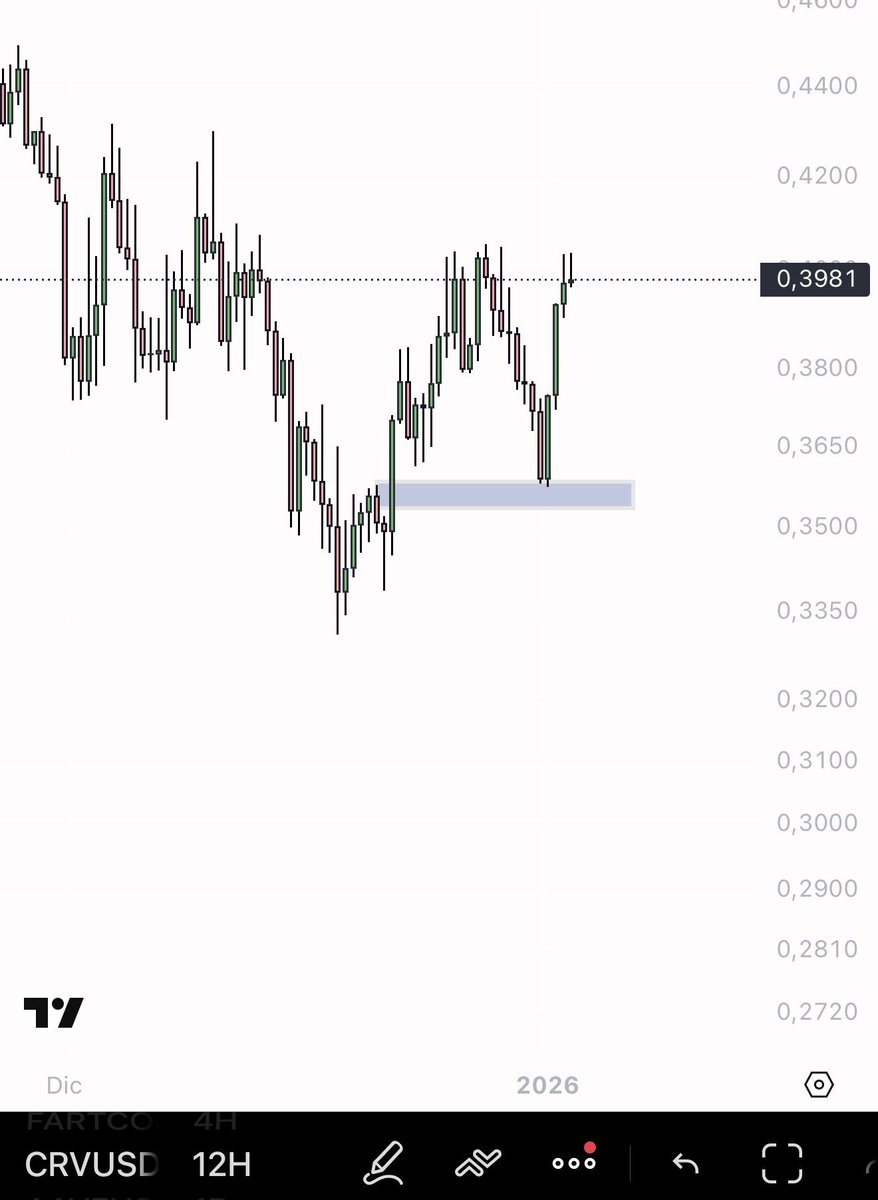
Inefficiency👈🏻 (below Exemple last my trade $FARTCOIN and $CRV )
When we talk about market inefficiencies, many people think of something technical, mathematical, almost scientific.
In reality, it is extremely simple: the market is not a perfect machine, it is a place where human beings, algorithms programmed by human beings, different interests, different times and different emotions come together.
Prices do not move because 'it is right'.
They move because someone buys, someone sells, someone is late, someone is afraid, someone is euphoric, someone is forced to do something at that moment even if they do not want to.
All this creates small imbalances all the time.
Sometimes the market rises too quickly because everyone wants to get in at the same time, driven by the fear of being left out.
Sometimes it falls too much because everyone wants to get out at the same time, driven by the fear of losing.
Sometimes it moves in a strange, sideways, nervous way, just to seek liquidity, to find orders on the other side, to trigger stops, to allow those with large positions to get in or out.
In all these moments, the price is not telling the truth about the value of something.
It is only telling a story of pressure, haste, fear, obligation, excess.
That is inefficiency.
It is not an error in the human sense of the term, it is an error in the sense of balance.
It is the market that temporarily loses the alignment between real supply and demand and shifts too far to one side.
The trader's job is not to predict what will happen tomorrow.
It is not to know the news first.
It is not to guess the top or the bottom.
The trader's job is to recognise when the market is out of balance.
When it is too heavily weighted on one side.
When everyone is doing the same thing.
When the movement is no longer healthy but forced.
And that is why real trading is boring.
Because you spend most of your time waiting.
Waiting for the market to overreact.
Waiting for the price to be pushed where it makes no sense to push it.
Waiting for someone to make a mistake out of haste, fear, greed or obligation.
And only then do they enter, calmly, with little risk, with a clear invalidation.
Most people lose money because they always want to be in a position, always in something, always part of the movement.
But the market does not offer opportunities all the time.
Opportunities only arise when there is imbalance. When you understand this, you stop chasing the price.
You stop reacting to every candlestick.
You stop feeling the need to do something just because the market is moving.
It's not about being smarter than the market.
It's about being more patient than its inefficiencies.
And being ready when they arrive.
Thx for the reading 👋🏻👌🏻
In trading, one of the most important things to understand is that the market does not move on a single level.
It moves on multiple scales simultaneously.
There is the big movement, the one you see on the weekly and daily charts.
Then there are the intermediate movements, the retracements, the rotations, the rebounds.
And then there is the background noise, that of the small candles, where the 'how' happens and not the 'why'.
When I talk about macro range, mid range and low range, this is simply what I mean.
The macro range is the context. It is where you understand what kind of market you are looking at: whether it is trending, accumulating, distributing, or in a strange phase where it is better to stay still.
It is what tells you what kind of trades make sense to look for. It does not give you the entry point, it gives you the mental direction.
Within this large movement, the market then breathes. It rises, falls, returns, and pulls back.
Those are the mid ranges. They are the areas where the price comes back, rebalances, takes liquidity, and builds bases.
And that's where the best opportunities often arise, because you're working within a clear context but with a risk you can control.
And then there are the low ranges, which is what happens in low time frames.
There, you are no longer deciding what to do, you have already decided that before.
There, you are just looking for the right moment to do it: when the price stops falling, when it absorbs, when it stops making new lows, when something changes.
The problem is that many do the opposite.
They look at the 5-minute chart and think they understand the market.
Or they see a green candle on the lower timeframe and think the trend has changed.
In reality, it's much simpler than that.
First, you understand where you are in the big picture.
Then you look at where the price makes sense to return within that picture.
And only at the end do you use the details to enter properly.
It's not complicated, it's just a matter of order.
And when you start looking at the market like this, you stop chasing it.
You start waiting for it.
And in trading, that makes all the difference in the world.
Some people ask me:
"Are you bullish for 2026?"
"Are you bearish for 2026?"
The answer is no to both.
I'm not interested in cheering. I'm not interested in "guessing" where the market will go to feel like a genius.
I go where the market decides to go. Period.
Because the truth is simple: bullish and bearish are often just labels used to sell dreams, to create hype, to make people believe that there is a 'right' and 'safe' direction.
And all those circus phrases like 'wealth here, wealth there', 'you'll be rich tomorrow', 'this is the opportunity of a lifetime'...
they're just noise. Mental rubbish. Marketing.
In trading, it's not the loudest who wins, it's not the one who makes the most predictions, it's not the prophet who wins.
The winner is the one who:
👉🏻adapts instead of falling in love with an idea
👉🏻manages risk instead of seeking glory
👉🏻survives long enough to grow capital
👉🏻works methodically even when the market is boring, dirty or manipulated
For me, 2026 is not about being bullish or bearish.
It's a year in which I will do what I always do: read the price, respect the context, and only enter when I have a clear trigger and a simple invalidation.
When there is opportunity, I push.
When there isn't, I stand still.
When the scenario changes, I change too.
So if you really want to make money over time, stop following those who sell you emotions.
Follow those who teach you how to build: discipline, patience, risk management and repeatability.
Because real money doesn't come from motivational phrases.
It comes from a process that works... even when you don't feel like it, even when no one applauds you, even when the market gives you nothing.
Luxuries that don't look like luxuries, but are:
1. Having your mom and dad alive
2. Have siblings in the same city
3. No anxiety on Sunday night
4. Healthy eyesight
5. Having a roof over your head
6. Buying a $5 coffee in the morning
7. Being able to walk without pain
8. A warm shower every morning
9. Clean air to breathe
10. A good night's sleep without interruptions
True happiness comes from simplicity.
Why are the tiny British Isles so important to the Global Cult and human control? Watch Part 1 of this 2-part series for free at https://t.co/W8CqgmqQ0b. Albion - Heart of the World. Fantastic information.
🇺🇸 🇮🇱 🇦🇺 The US proof-of-weapons network is using each country to test different operations, such as testing what happens when you go after gun ownership in Australia.
The end goal is to implement pre-crime surveillance.
🇬🇧 Digital ID and social media arrests are being tested in the UK.
🇵🇸 Occupation & genocide as a service are being beta tested in Palestine.
🇪🇺 Crowd control, CBDC’s & manufactured civil unrest are being beta tested in EU.
🇺🇸 Private prisons, military police, removal of constitutional rights, and programmable crypto assets are being beta tested in the US.
🇺🇦 Drone AI weapons & other control weapons are being beta tested in Ukraine.
🇮🇱 The right to rape prisoners is being beta tested in Israel.
🇸🇻 Mass surveillance AI-powered prisons & education are being beta tested in El Salvador.
🇺🇸 Understand the goal is to profit from it all, to pump up the US stock market, GDP, & control the population, while manufacturing civil unrest to justify this police and surveillance state as this is causing unmanageable wealth inequality & record usury.
They need you to hate each other, and they are using algorithms to push your favourite flavour of hate.
Elon Musk is bringing you the social credit score and testing digital regime change on this app.
Peter Thiel is building the AI pre-crime digital police state.
David Sacks is bringing in crypto & AI surveillance legislation, pretending they are making the US the crypto capital of the world.
The decline of the west is unavoidable as the financial industrial complex is strategically managing a dollar weakening campaign by breaking the EuroDollar, Petrodollar & Japan carry trade.
This is a campaign to usher in a multipolar world of regional blocs and nothing stops that train.
It won’t be sudden, it’s a managed weakening of the dollar to shrink US into a regional power and push growth in Asia, Middle East and global south.
You can either dismiss me as a conspiracy theorist or prepare for the this future and you’ll be able to manage the change even if I’m wrong.
They want you unprepared and you need to stop listening to those that want to leave you surprised and unprepared.
A form of resistance is love over hate.
Decentralised over centralised.
Self-custody over custody.
Local spending & investment over global.
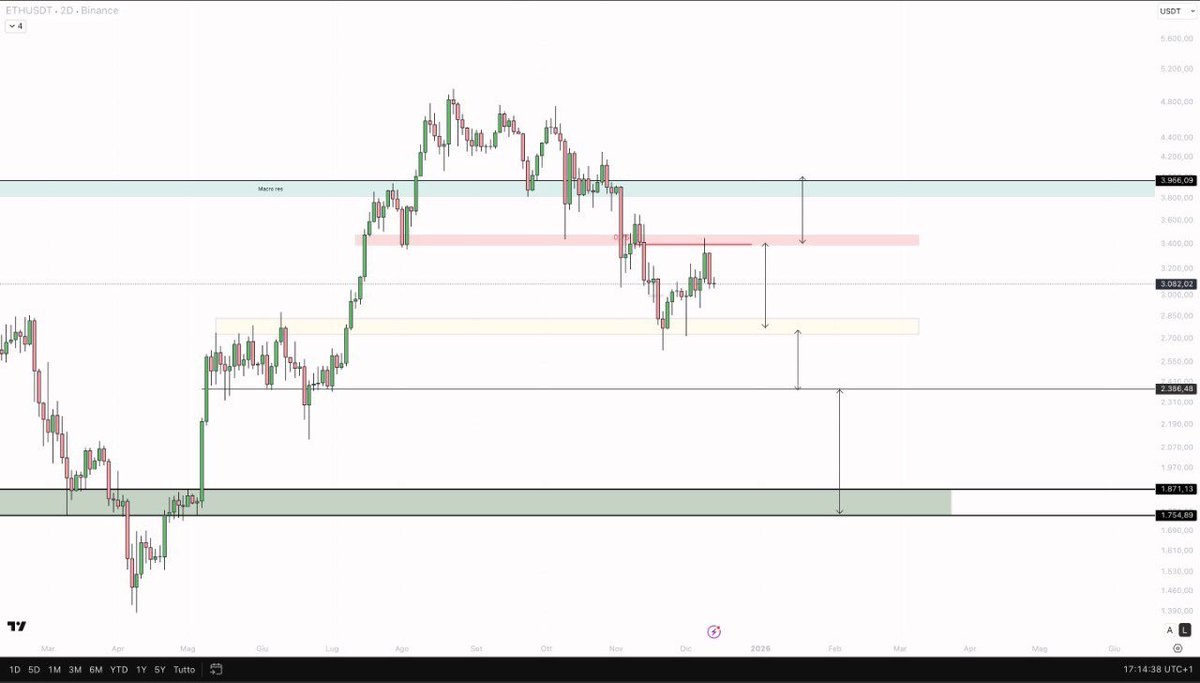
$ETH Macro View and my macro idea
From a macro perspective, my view on Ethereum remains unchanged.
Unlike BTC, however, I view ETH through a different lens:
every significant dump is an opportunity for spot accumulation, not a reason to panic.
Ethereum is an asset that, over time, has always proven to reward those who think in the medium/long term, especially when sentiment is poor and the market is dominated by fear.
It is precisely in those phases that the best positions are built.
Can it fall further?
Yes.
Can it experience deep drawdowns?
Absolutely yes.
It can also collapse much more than most people imagine.
But I will be there to buy, calmly, without haste, without leverage, building a position in my mid/long-term portfolio.
Time, on ETH, has always been an ally of those with vision and patience.
From a trading perspective, however, nothing changes from what I have already explained in previous posts:
here, we do not anticipate, guess or force anything.
We analyse the chart, respect the levels, and only work where the risk is clear and invalidation is simple.
Macro and trading are two different worlds.
Confusing them is the most common mistake.
I continue to think this way:
macro view …reasoned accumulation
trading …discipline, low time frames, risk management
The rest is just noise.
ETH never takes off when everyone expects it to.
In fact, it usually does the opposite. It lags behind, disappoints, and appears weak just when the market is focused on something else. And that's when most people lose patience and give up.
Historically, this is how it works: at the beginning of the cycle, capital goes to Bitcoin. This is normal, it is the 'defensive' phase, when people seek security. Ethereum does not shine at that moment, it remains compressed, often underperforming, and in the ETH/BTC pair, it seems to be going nowhere.
But that slowness is not true weakness. It is time.
Time for the price to absorb, build, and tire those who want everything right away.
Then, when BTC slows down and ceases to be the centre of attention, capital begins to shift. And that is when ETH changes pace. It has always done so: after long, boring periods, rapid, decisive movements occur, often when few are still well positioned.
On the macro level, I can be calm and constructive.
When it comes to trading, I remain cool and selective, working only where the chart gives me clear levels and controlled risk.
The more i study and observe others and reflect my own personal journals of the past, the more i realise that the biggest edge is sitting on your hands, and exercising stringency, discipline and patience.
Your system is your system, and your timeframes are your timeframes. I want to illustrate this by looking at 2 examples:
Trader A: Trades divergences and fast moves into sweep levels or liquidity.
Trader B: Trades SR retests using EMA's or fibonaccis as confluence.
Let's assume for simplicity sake they both trade the 4h as primary and both only truly had 2 setups each across the last month that scored 10/10 as per their technical system, but there were 48 others they had to deliberate as they, at the least, caught the traders eyes and had the cogs moving.
50 thought processes, only 2 that should have been actioned, 48 that should have been skipped.
Both traders have entirely different systems, both gave the same opportunity across the same period of time.
Trader A takes the 2 but has mastered his patience, stringency and discipline to a point where he only takes these 2. 100% win rate and a scorching profit factor.
Trader B Takes 10 out of the 50. 2 winners, 8 losers. 20% win rate and an equity curve he can't even bear to look at.
What's seperated these traders is simply the ability to sit on ones hands, understand that to best perform, one must only take the cream of the crop, and discard the rest. Greed, ambition, desire, dopamine and ego need to be worn down, and then entirely abandoned. Discipline, patience and stringency have to be at the forefront of all of the decisions made.