Transnational Legal Theory (TLT) is a peer-reviewed journal exploring how transnational contexts affect debates within existing traditions of legal thought.
London, England; Toronto, Canada and Tilburg, Netherlands
@FarnushGhadery wrote about the role of music and song as part of contextualised feminist resistance efforts, in 'Beyond international human rights law – music and song in contextualised struggles for gender equality' https://t.co/EZB7ZxHim8
In 'The potential and limits of peoples’ tribunals as legal actors: revisiting the Tokyo Women’s Tribunal', @Cheah_WL argues that TWT’s conventional approach to law enhanced its legal legitimacy and facilitated its penetration into formal legal spheres. https://t.co/WVLR7q0YCi
Next article from the TLF Issue is @SaricJo's article on the #MeToo movement’s manifestation in Croatia discusses the discourse of motherhood as a unifying factor in mobilising activism seeking to address violence against women, available here: https://t.co/eOdSKmrMTh
It's here! New paper out on how law constructs legal borderlands in transnational labour markets with @miriambmac in Transnational Legal Theory @TransLegalJ https://t.co/FaK3J1KKg3
Pleased to share my latest article forthcoming in @TransLegalJ - "Parent Company Liability in Transnational Human Rights Disputes: An Interactional Model to Overcome the Veil in Home State Courts"
Check it out here:
https://t.co/baqVtKgQFN
In our new article for
@TransLegalJ@MajGrasten & I examine the outsourcing of care work in the #Danish#aupair scheme - drawing on Gloria Anzaldúa to develop the idea of legal borderlands
👇👇👇
https://t.co/reGL2W4xAL
The article develops the concept of legal borderlands and applies it to an analysis of outsourcing domestic care work to female migrant workers in the Danish au pair scheme. https://t.co/6d2yN55V28
Our first issue this year is a Special Issue on Transnational Legal Feminism, following the virtual symposium by @FarnushGhadery and @sitalkalantry last March.
Join the conversation on key developments in #transnationallaw#transnationalgovernance. Consider submitting your scholarship, article, essay, or commentary to Transnational Legal Theory @TransLegalJ, also for open access: https://t.co/IRKQzPcC2m
1. I’m pleased to share two new publications that came out in the past week: The first is entitled “Parent company liability in transnational human rights disputes: an interactional model to overcome the veil (see https://t.co/kx4cuZdX4B).
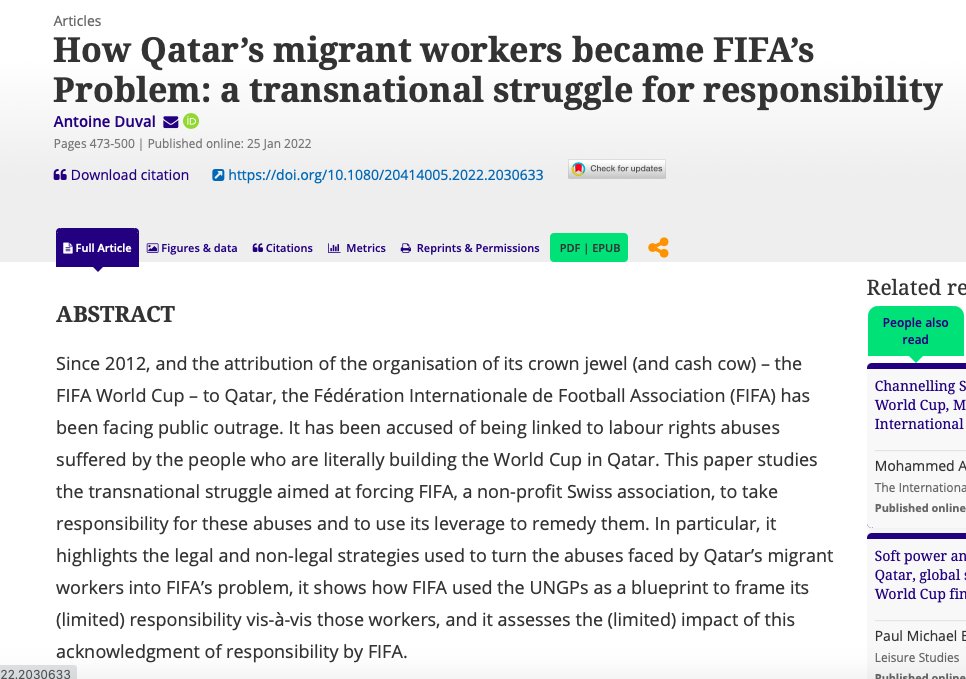
In my latest article for @TransLegalJ I discuss how #Qatar's migrant workers became #FIFA's problem.
This is the story of a transnational struggle for responsibility.
Download it while it's free at https://t.co/b6mYMXljFm
👇👇👇
#TransnationalLaw#BizHumanRights#Qatar2022
🚨Our Special Issue on Translocal Legalities is out in @TransLegalJ!
➡️Articles by Emma Nyhan,@philpaiement, Mariana Prandini Assis & Giulia Fabini
➡️Co-edited by @mattccanfield, @FassiMarisa & I
Special Issue 2022 CfP on developments after COP26 and the intersection of climate change with other environmental and social issues. See full call below. Deadline for abstracts 31st Dec submit to
@emily_j_webster and @philpaiement
https://t.co/EmbidNOnkH
It's part of a special issue on transnational law and corporate (ir)responsibility, organised by @KnoepfelL and Felix Lüth. It was really fun participating in these discussions. Any feedback on the article is welcome!
https://t.co/zJYbnaZCuH
My latest piece "From global justice to supply chain ethics" is now out in @TransLegalJ!
In it I juxtapose two different visions of social justice on global scale, while reflecting on transnational law as a normative project.
https://t.co/biEcmRBEMp
Why is situating global value chains to relevant jurisdictions such a challenge to private international law, and how can we balance between states and other actors interested in regulating #GVC externalities? #Openaccess with @MRajavuori on @TransLegalJ https://t.co/UM4UfjKDen
Thank you @KnoepfelL and Felix Lüth for putting together such an interesting group of people and workshop! In my contribution, I argue that social cognition points on stereoptypes help us understand the barriers between investment arbitration and human rights.