Managing Director of XYPN Compliance. Leading a team of compliance professionals at XYPN who support fee-only investment advisers with navigating RIA compliance
Looking forward to catching up with many of you at #XYPNLIVE this year and meeting some of you for the first time! Let me know if you’ll be there next week!
Expand your Network and reimagine your future at #XYPNLIVE in Austin, TX. Over 75+ experts will share their insights live on stage. https://t.co/tq8ZY887xQ
The SEC has withdrawn 14 Gensler-era rule proposals, including on asset custody, AI and outsourcing that stood to have a major impact on RIAs.
https://t.co/OacfWMU7G0
@ben_nanney@fpassociation@XYPNOfficial Absolutely Ben. Our hope is that this gets addressed in their rule amendments to make clear that arrangements where an advisor has authority only to transfer assets between a client’s own accounts (first-party) at one or more custodians would not be considered custody.
This week I had the opportunity to participate in a rulemaking hearing, alongside @fpassociation and a great group of state-registered investment advisers, to engage with the Tennessee Securities Division and provide comment on proposed amendments to investment adviser regulation, specifically addressing the current application and resulting impact of the Division’s custody rule in connection with first-party standing letters of authorization (SLOAs) commonly used by advisers as well as how “custody” is being defined.
#RIA #FinancialPlanning #XYPN @XYPNOfficial
In-line with the new SEC leadership's "more is not better" approach to regulation, yesterday the SEC officially withdrew 14 "Proposed Regulatory Actions" (i.e., pending new rules or rule amendments that had been proposed but not adopted).
Of primary interest to RIAs are the elimination of proposed rules/amendments related to:
- Conflicts of Interest Associated with the Use of Predictive Data Analytics
- Safeguarding Advisory Client Assets (i.e., custody)
- Cybersecurity Risk Management
- Enhanced Disclosures About Environmental, Social, and Governance Investment Practices
- Outsourcing by Investment Advisers
- Cybersecurity Risk Management Rule
As the public release plainly states, "The Commission does not intend to issue final rules with respect to these proposals. If the Commission decides to pursue future regulatory action in any of these areas, it will issue a new proposed rule."
While it's certainly possible that new proposed rules will be issued at some point down the line, I wouldn't hold my breath.
The full list of withdrawn rules/rule amendments—and all SEC rulemaking activity in general—can be found at https://t.co/pFMVzZicFX
Enjoyed the opportunity to contribute again this year during the @NASAA Investment Adviser Training for state regulators. This time presenting on core advertising regulation, current marketing practices & use of social media, & evaluating compliance during RIA examinations!
The SEC is preparing to re-examine the $100M in AUM threshold for RIA registration with the SEC given the substantial growth of RIAs in the years since it was last updated under Dodd-Frank when it increased from $25M to the current $100M threshold.
PSA for anyone using a virtual meeting transcription service that auto-joins all meetings and emails the transcription to all attendees:
Any pre-meeting 'banter' with your colleagues before the counterparty joins may also be transcribed and emailed to said counterparty.
Less-than-ideal example: Billy Bob and Charlene from Backwoods Advisors join a Zoom call, and the default-on transcription service joins in the background. While waiting for their perpetually-late client Joe to join, Billy Bob and Charlene use the dead time to discuss the financial plan of another client. After the meeting with Joe ends, the entire meeting's transcription is auto-emailed to Joe... including the internal discussion between Billy Bob and Charlene about the other client's financial plan.
Consider:
(a) changing transcription to default-off, forcing you to manually start transcription only after all attendees have joined and you're ready to go 'on the record,'
(b) changing attendee transcription auto-emails to default-off, forcing you to manually review the transcription before it's sent to all attendees, and/or
(c) Sit with your colleagues in awkward silence before the counterparty joins, or at least limit your internal banter such that you don't insult the yet-to-join counterparty, discuss other clients, divulge trade secrets, compare weekend beer consumption, etc. etc.
Beware the allure of unchecked convenience.
A record 456 advisors joined @MichaelKitces and @R_Alan_Moore's 11-year-old support network, evenly split between startups and those with an established book of business.
Read the full story 👇 https://t.co/ak60oGNrhH
It's pretty crazy that two otherwise identical advisers can be subject to such divergent rules/regs based simply on whether registered with the SEC or a state (and which state, at that).
Here's a non-exhaustive list of state burdens that have no SEC equivalent:
→ Many states still expressly prohibit testimonials. The SEC's marketing rule expressly permits testimonials.
→ Many states require certain advisers to maintain a minimum net worth, maintain and annually submit GAAP financials, and/or maintain a bond (typically if the adviser has discretion or custody of client assets). There is no specific net worth or GAAP financial requirement for SEC-registered advisers.
→ Some states require re-submission of client advisory agreements if any revisions or updates are made to the standard form version, even if not undergoing an exam. The SEC simply requests such agreement versions during the course of an exam.
→ Many states require that client advisory agreements reflect their state as the 'choice of law' state pursuant to which disputes will be governed. This becomes unwieldy for advisers registered in multiple states, and can necessitate multiple state-specific advisory agreement versions to be maintained. The SEC imposes no 'choice of law' requirement for client advisory agreements.
→ Many states prohibit alternative dispute resolution clauses in client advisory agreements (e.g., mediation and/or arbitration), and force disputes to be resolved in that state's courts. The SEC (at least for now) permits alternative dispute resolution.
→ Many states prohibit client advisory agreements to be amended or assigned by passive or 'negative' consent (i.e., upon advance written notice to clients), and instead require client signatures for any contractual amendment or assignment. The SEC permits passive/negative consent amendments and assignments of client advisory agreements if done correctly.
→ Some states impose arbitrary caps on the advisory fee rates or amounts that can be charged to clients based on what they deem to be "unreasonable" or a "dishonest and unethical business practice". A subset of states are quite explicit and draconian in this regard. The SEC generally considers fees in excess of 2% of AUM per annum to be excessive, but nonetheless permits higher fee rates to be charged with additional disclosure that the adviser's fee rates are higher than normal.
→ Many states require an "itemized" invoice to be sent to clients each time the adviser charges a fee. "Itemized" generally means that the invoice should include the fee itself, the formula used to calculate the fee, the value of the assets under management on which the fee is based (if applicable), and the time period covered by the fee. The SEC does not have an equivalent fee statement itemization requirement.
→ Some states consider third-party SLOA money movement authority to constitute custody in such a way that it triggers an annual surprise custody exam from an independent public accountant. Incredibly, Tennessee even considers first-party SLOA money movement authority to require the annual surprise custody exam. Third-party SLOA money movement authority constitutes custody for SEC-registered advisers, but the annual surprise custody exam is not required if 7 (relatively straightforward) conditions are satisfied.
→ Most states require that clients be afforded a 5-day right to rescind an advisory agreement for a full refund if the adviser does not deliver Form ADV Part 2 to the client at least 48 hours prior to entering into an advisory agreement. The SEC does not enforce an equivalent right of rescission.
→ The Form ADV Part 1 version for state-registered advisers includes an additional Part 1B that requires additional disclosure re: bonding/minimum net worth requirements, judgment/liens, arbitration claims, civil judicial actions, other business activities, investments based on financial planning activities, custody, and form of organization. The Form ADV Part 2A version for state-registered advisers includes an additional Item 19 that requires additional disclosure re: executive officers and management persons, other business activities, performance-based fees, arbitration claims, civil/SRO/administrative proceedings, and securities issuer relations. The Form ADV Part 2B version for state-registered advisers includes an additional Item 7 that requires additional disclosure re: arbitration claims, civil/SRO/administrative proceedings, and bankruptcies.
→ As part of the initial application process, some states try to require out-of-state advisers to qualify and file as a 'foreign' business with their secretary of state, thus subjecting the adviser to additional fees and administrative overhead. An SEC-registered adviser that notice files in a state does not trigger similar demands.
→ The SEC has a statutory maximum of 45 days by which to approve or institute proceedings to deny an initial registration application. States are often not subject to any statutory application review turnaround times (or at least that are enforced), which means that an initial state registration application can potentially drag on for months.
Phew.
What did I miss?
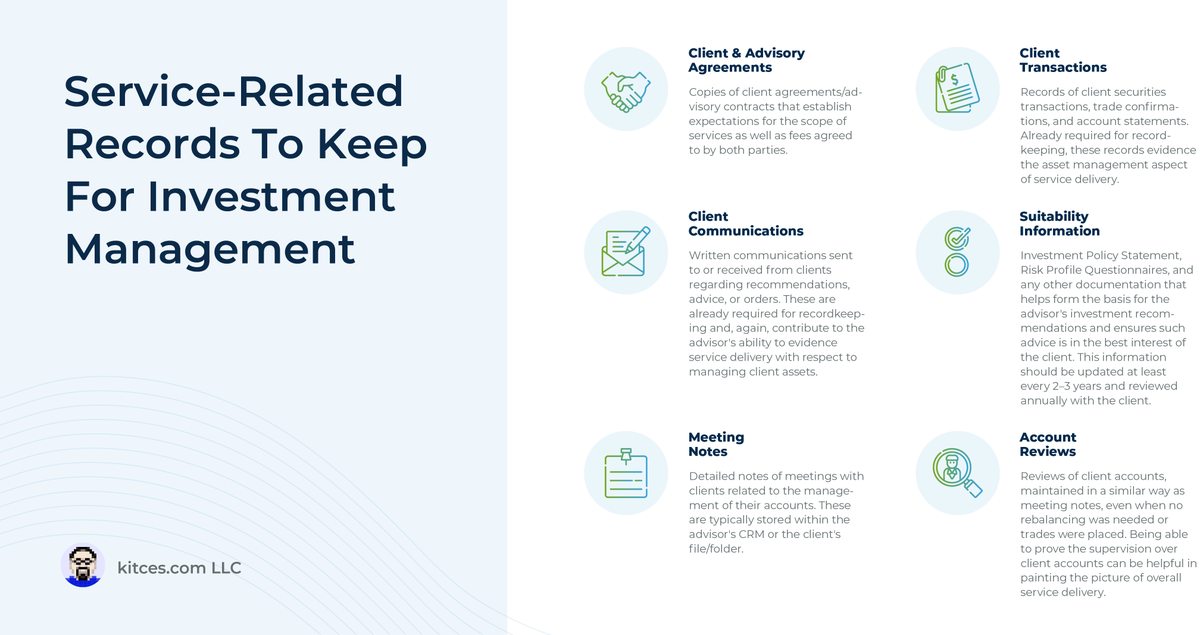
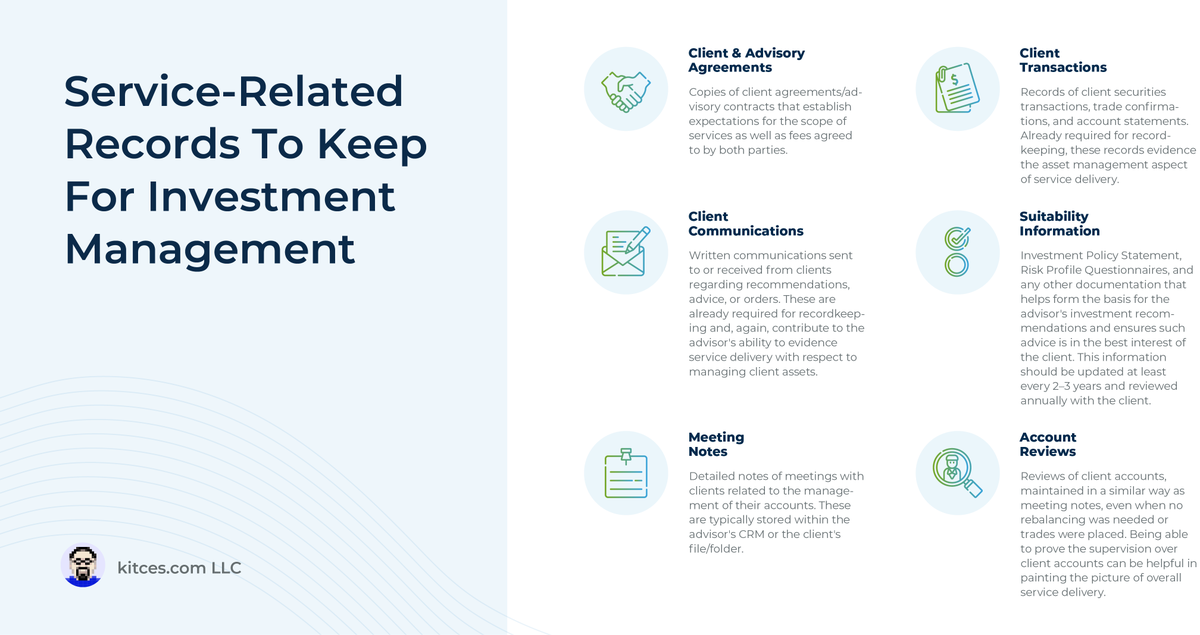
While books and records requirements for financial planning services are less prescriptive than for investment management, advisers can take proactive steps to systematically document the services they provide to clients. Article by @tjclarkfork: https://t.co/xYg2J5J38R #advicers
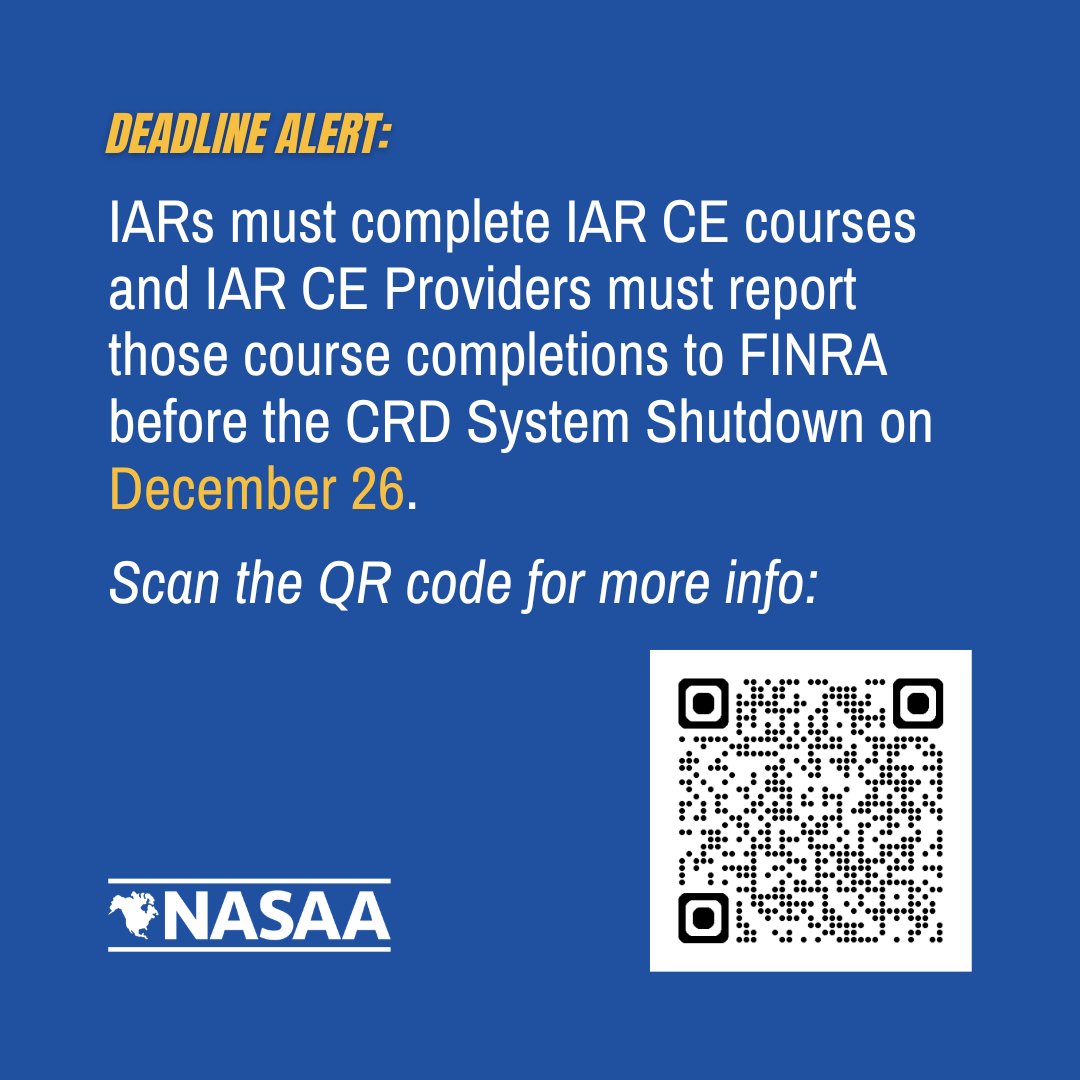
IARs must complete IAR CE courses and IAR CE Providers must report those course completions to FINRA before the CRD system shutdown on December 26 to ensure IAR CE credits are applied before the end of the year. Details: https://t.co/ZbYJ5h2FrU
A review of record keeping requirements for RIAs and how to minimize regulatory scrutiny over emerging fee-models for financial planning focused firms.
https://t.co/1gXHyz8Cmx
While books and records requirements for financial planning services are less prescriptive than for investment management, advisers can take proactive steps to systematically document the services they provide to clients. Article by @tjclarkfork: https://t.co/xYg2J5J38R #advicers