I regret to inform you that lifting 3x a week, walking 30 minutes a day, eating real foods, drinking water, and getting enough sleep will make your mind and body healthier 95% of the population.
Anything you refuse to measure, in truth, you have quietly agreed to live with. That is true of your blood work, your calendar, and your country. Measurement is the first step anyone can take toward fixing something.
The best longevity advice right now is embarrassingly simple: sleep 8 hours, move your body, eat real food, manage your stress, and cultivate an optimistic mindset. Don't die from something stupid.
Most people would benefit less from obsessing over 10,000 steps and more from accumulating 10 minutes each day of activity vigorous enough to make them breathe hard.
That doesn’t require a formal HIIT workout. Short bursts of vigorous daily activity (climbing stairs, walking uphill, carrying something heavy) or deliberate “exercise snacks” all count.
Such an interesting finding.
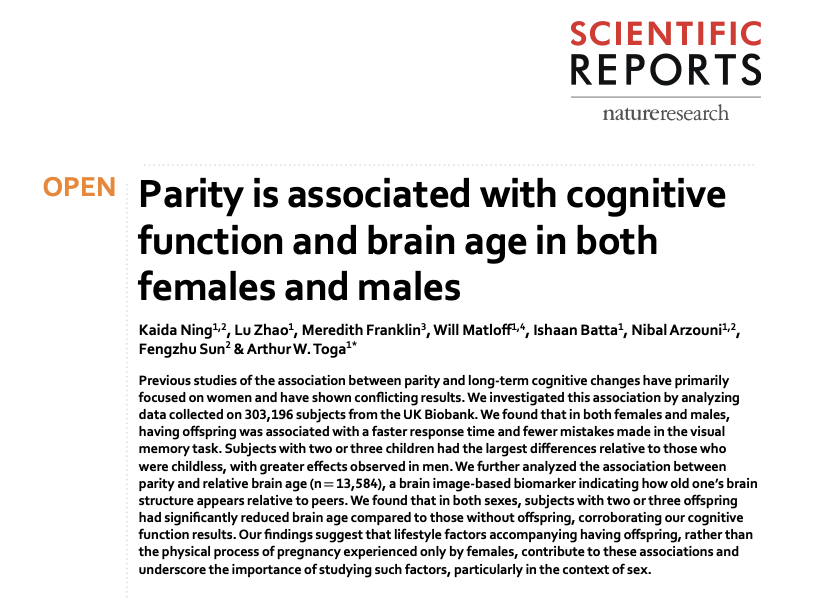
Men (and women) with 2-3 children had better cognitive function and a younger estimated brain age than their childless peers.
Why might that be?
Healthier daily habits (e.g., less-frequent alcohol/tobacco use and more regular meal times), connection to broader social and community activities, or even the fact that children act as a longer-term support network later in life are all potential explanations.
@PeterDiamandis@PeterDiamandis I would create an app to show how to adapt to the changing world and AI, and start training, living, and playing your life like a video game‼️🎮📲🧠💪🏼😀
Your ego is the enemy of your best work.
When you drop into flow, your prefrontal cortex deactivates.
That's the region responsible for self-monitoring, self-criticism, and time perception.
It's also where your ego lives.
So the moment you sit down to write, paint, code, or perform, something predictable happens.
You start wondering how your audience will react.
Will they like it? Is it good enough?
And just like that, you've lit up the exact brain region that has to go quiet for flow to show up.
Those questions are extrinsic motivators.
Extrinsic motivators put your ego back in the driver's seat.
And flow disappears.
This is why so many talented people stall.
It isn't a discipline problem.
It isn't a talent problem.
It's an attention problem.
Stay task-focused, not ego-focused.
Get lost in the craft, not the consequence.
That's the doorway in.
Share this with a writer, creator, or performer who needs to hear it right now.
#FlowState #PeakPerformance #FlowResearch #StevenKotler #Neuroscience
If you work at a desk, getting up and walking for 2-5 minutes every half hour to an hour is one of the simplest things you can do to improve your focus, attention, and productivity.
A "side effect" is also better glucose regulation from brief, periodic, low-intensity activity.
How much is 1 minute of vigorous exercise worth?
In a large wearable-data study, 1 minute of vigorous activity appeared roughly equivalent to:
• 4 minutes of moderate exercise for all-cause mortality
• 8 minutes of moderate exercise for cardiovascular mortality
• 10 minutes of moderate exercise for type 2 diabetes risk
Compared to light activity, the difference was even more dramatic:
• 53 minutes for all-cause mortality
• 73–86 minutes for cardiovascular outcomes
• 156 minutes for cancer mortality
The takeaway is simple: if you want more return on your exercise time, add intensity
Just 9 minutes a day of vigorous movement may be enough to move the needle on longevity
In people who didn’t identify as exercisers, doing ~3 short vigorous bursts/day was associated with ~40% lower cancer mortality, ~40% lower all-cause mortality, and ~50% lower cardiovascular mortality
This doesn’t require a gym
It only requires intensity (think: sprinting up the stairs, burpees, bodyweight squats)
Your resistance to AI isn't about technology. It's about letting go of everything you were taught about work, worth, and survival. The hardest adaptation isn't technical - it's psychological.
We spent centuries building systems that rewarded credentials over capability. What you can DO now matters infinitely more than where you went to school.
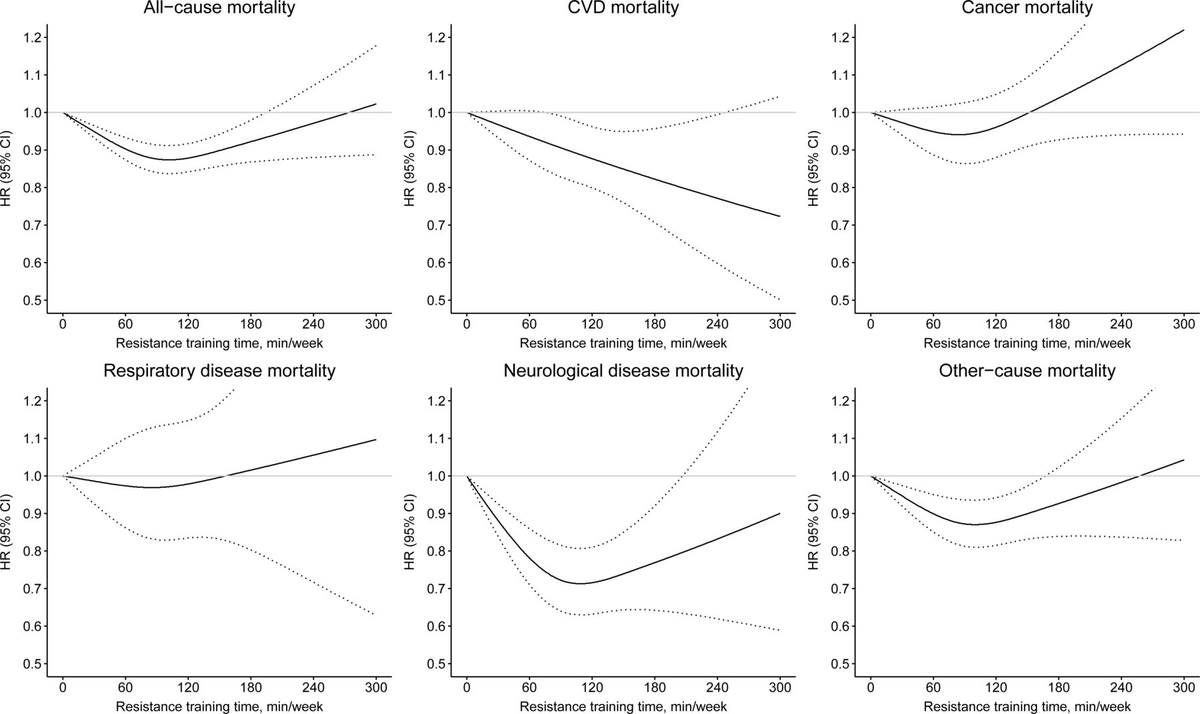
Strength training for 90-120 minutes per week is associated with up to a 30% lower risk of death from all causes, CVD, cancer, and neurologic disease.
That seems to be the upper limit - no additional benefit was observed above 120 minutes of strength training per week.
These benefits were independent of total aerobic activity, but combining strength training with ~5-15 hours of moderate-to-vigorous-intensity aerobic activity reduced all-cause mortality risk by 45%!
Clear message here is: "do both."