The American education system does not teach empire.
This is not an accident.
It teaches the Revolution. It teaches the Constitution. It teaches the Civil War in a way that frames it primarily as a story of "national healing" rather than unfinished reckoning.
It teaches World War II as the definitive American story: the sleeping giant awakened, the "arsenal of democracy," the liberation of Europe, the moral clarity of that specific conflict deployed as a permanent filter through which all subsequent American violence can be viewed as basically continuous with defeating Hitler.
It does not teach the Philippines, where the U.S. military killed somewhere between 200,000 and 1,000,000 people between 1899 and 1913 during the Philippine-American War, a war most Americans have never heard of.
It does not teach the Banana Wars, where the U.S. military intervened repeatedly in Central America and the Caribbean to protect the commercial interests of American corporations.
It does not teach the full history of Iran: the 1953 coup that removed a democratically elected prime minister and installed a Shah who ran a torture state, because the elected prime minister wanted to nationalize Iranian oil.
It does not honestly teach Korea, 1945-53. Guatemala, 1954. Vietnam, 1954-75. Lebanon, 1958 and 1982-84. The Congo, 1960-65. Cuba, 1961. Brazil, 1964. Dominican Republic, 1965. Haiti, across the 20th century. Indonesia, 1965. Greece, 1947-49 and 1967-74. Laos, 1964-73. Cambodia, 1969-75. Chile, 1973. Angola, 1975-1991. Argentina, 1976-1983. Nicaragua, the 1980s. El Salvador, the 1980s. Grenada, 1983. Panama, 1989. Afghanistan, 1979-92 and 2001–21. Iraq, 1991-2003 and 2003-11. Somalia, 1992-95. Sudan, 1998. Yugoslavia, 1999. Yemen, 2002-25. Venezuela, 2002 and 2014-present. Honduras, 2009. Libya, 2011. Syria, 2012-26. Ukraine, 2014-present.
It does not teach these things honestly because a population that understood them would have a very different relationship to the word "freedom" when its government uses it to justify intervention.
The ignorance is load-bearing.
Remove it, and the entire moral architecture of American exceptionalism becomes uninhabitable.
They know this.
The curriculum is not an oversight.
The curriculum is a choice, made deliberately, renewed continuously, defended furiously whenever teachers try to expand it.
The most powerful weapon American empire has ever deployed is not the aircraft carrier.
It is the history class.
Democracy only spread because it was the best system for producing compliant trading partners.
A democracy has elections. Elections require parties. Parties require financing. Financing requires capital. Capital has interests. So by design, every democracy in the world has a built-in mechanism that ensures the people with money have disproportionate access to the people with power.
You don’t need to bribe a dictator and hope he stays in power. In a democracy, you just fund both candidates and own the outcome regardless.
This is why US spent the Cold War toppling democracies that elected the wrong people Mossadegh in Iran, Allende in Chile, Lumumba in Congo and replacing them with dictators who were more “stable.” Stable meaning: predictable to capital.
The genius of it is the aesthetics. Democracy looks like self-determination. It has flags and anthems and moving inauguration speeches. People will die for it. But the operating system underneath is remarkably friendly to concentrated wealth arguably more so than overt authoritarianism, which at least makes the power visible.
The most honest political scientists will tell you: what actually spread after 1989 was markets. Democracy was the packaging.
And the packaging worked so well that the people inside it genuinely believe they’re free which is the final, most elegant feature of the system.
A cage you can’t see is the strongest cage ever built.
Comparto este video que lanzaron ayer Silvio Rodríguez y Chico Buarque; los fondos que se recaben serán donados a la Sala de Pediatría del Instituto de Oncología de Cuba, así que si queréis verlo, darle like y compartirlo con otras personas, es un pequeño grano de arena para aliviar la difícil situación en que se encuentran.
El vídeo es precioso y presenta esa Habana tan digna como empobrecida.
https://t.co/AVk6LbJAI7
WOW
A website is DOCUMENTING Israel’s crimes with GEOLOCATION, dates, categories of crimes, and footage of the incidents themselves.
One click and you can see EXACTLY what Israel did.
An enormous digital archive built for ACCOUNTABILITY.
Link: https://t.co/TWKgXJ41NC
Direct Link: https://t.co/qWkrhx1FT7
This story is immensely touching and is going massively viral in China. It's also a pretty good soft signal that China is taking warming ties with the U.S. sincerely.
This lady 👇 is called Yin Yuzhen (殷玉珍) and she lives in a place called Jǐngbèitáng (井背塘) in Inner Mongolia - deep in the heart of the Mu Us (毛乌素) Desert, a place whose name literally translates from Mongolian as "bad (lacking) water".
In 1985, aged 19, she and her husband were really desperate by the encroaching desert: sandstorms would seal their door shut overnight and literally threaten to bury them alive. She was crying every day and considered ending her life.
However, her defiant spirit prevailed and she decided to fight the desert, saying she'd "rather die planting trees than let the sand bully me to death" (宁可种树累死,也不让沙子欺负死)
In 1986, they traded the family's most valuable possession - a sheep - for 600 tree seedlings. Fewer than 10 survived, but they saw hope. Her husband Bái Wànxiáng (白万祥) took manual labor jobs and asked for tree seedlings instead of wages.
In 1999, Yin Yuzhen's story made it into national news on CCTV. An American named Ronald Sakolsky - originally from Pittsburgh, Pennsylvania - who was teaching English as a foreign instructor at Luoyang Foreign Language School (洛阳外国语学校) in Henan province, was deeply moved. He immediately started sending emails to multiple American organizations to raise $5,000 for her.
The $5,000 was sent through a Beijing-based foundation. In the video 👇, Yin Yuzhen recalls receiving it: "I had never seen that much money in my life - it scared me half to death." She spent every cent on higher-quality seedlings than she'd ever been able to afford.
Shortly after, Sakolsky traveled to the Mu Us desert in person. He found her out in the sand, planting. Seeing green where he'd expected only desert, he kept saying "impossible, impossible."
With Sakolsky's $5,000 alone, Yin Yuzhen planted 50,000 seedlings which have now become a forest. Over her entire life, since the 1980s, her life's work stands at over two million trees planted, transforming almost 50 km² (roughly 80% of Manhattan) of desert into green land.
Yin Yuzhen was awarded the 全国劳模 (National Model Worker), one of China's highest civilian honors.
Seeing her video titled 寻找赛考斯 ("Searching for Sakolsky") and the incredible impact it was having on Chinese social media, journalists from Inner Mongolia's Benteng Media (奔腾融媒) tracked Sakolsky down by going to the Luoyang No. 2 Foreign Language Academy and finding the Headmaster Bai Fan, who was Sakolsky's former colleague.
Bai Fan connected with Sakolsky by phone on the spot, shot on video by the journalists (my 2nd video 👇), inviting him back to China to see what his $5,000 became.
This was 2 days ago on May 17th so you can bet that a Sakolsky visit to China will be arranged soon and that this will be one of the biggest pieces of US-China public diplomacy this year.
Now this story coming out and being amplified right after Trump's visit is of course no coincidence, we shouldn't be naive: what better way to translate the warmth from the visit than letting a desert grandmother in a red headscarf tell the internet she's looking for her American friend?
That doesn't make the story any less real or any less touching. In fact this story is the perfect reminder that countries don't have friends, but people do. And when countries remember this, deserts turn green.
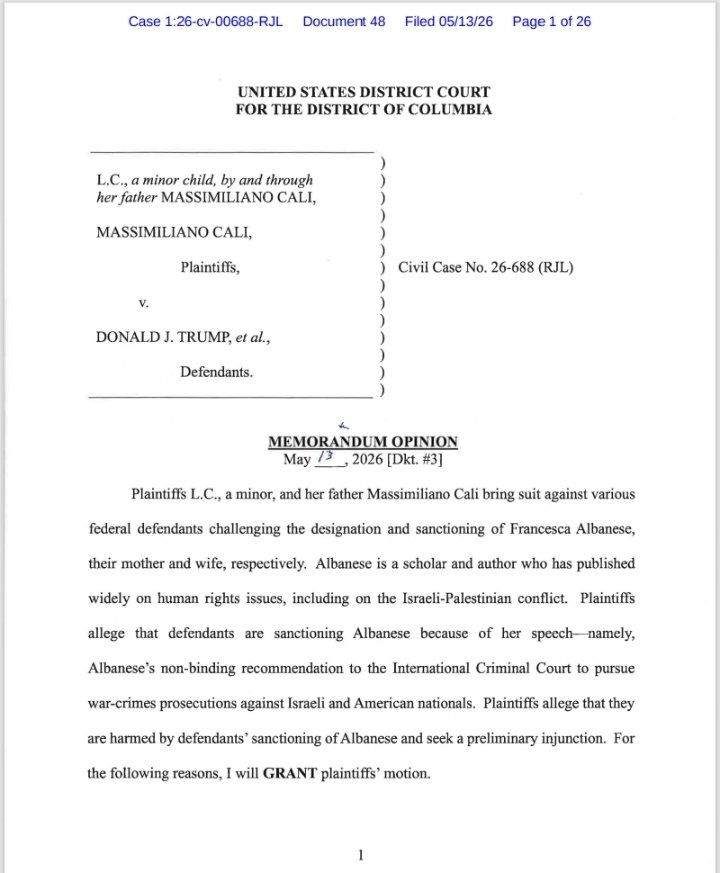
BREAKING! US court ha suspended the US sanctions against me!
As the judge says: "Protecting the Freedom of speech is always just the public interest".
Thanks to my daughter and my husband for stepping up to defend me, and everyone who has helped so far.
Together we are One.
Ahead of Mother's Day, a teacher asked students to call their moms and say, "I love you."
Between shy pauses and trembling voices, they told their mothers to take care, thanked them for years of love and finally voiced the feelings many children keep in their hearts.
Last month in Guangzhou, I visited Bruce Lee’s ancestral home in Yongqingfang. My colleague and I joined Master Cen Zhaowei to find out about Wing Chun, the 300-year old southern Chinese martial art behind Bruce Lee’s skills, philosophy and his global influence.
La responsabilidad pública también implica la obligación moral de no mirar hacia otro lado.
Es un honor otorgar la Orden del Mérito Civil a una voz que sostiene la conciencia del mundo: @FranceskAlbs, Relatora Especial de la ONU en el territorio palestino ocupado.
IN PRAISE OF FRANCESCA ALBANESE
There is a question that visits me in the small hours, when sleep will not come and the mind turns over old stones. The question is this: “What would I have done in the 1930s, on the morning after Kristallnacht?"
Not what I say I would have done. Not what I hope I would have done. But what would I actually have done—when the trains began to run, when the neighbours grew quiet, when the cost of decency became the loss of everything?
Most of us, I think, would have done little. Not from malice. From fear. From the soft, creeping conviction that someone else will speak, that the situation is complex, that we must be 'reasonable'. Lest we forget, the ordinary is the extraordinary's alibi. And how we have clung to that alibi! How we still cling to it!
And then, every once in a terrible while, someone appears who does not cling. Someone who steps forward when others step back. Someone who speaks the name of the thing when everyone else is busy naming something else.
Francesca Albanese is that someone.
She stands before the world—alone, unarmed, armed only with law and language and a rare courage—and she says what the centrists will not say, what the foreign ministries will not say, what the editorial boards will not say. She says: "This is a genocide. And we are watching it happen."
Do not tell me that is hyperbole. Do not tell me the term is contested. She has not used it lightly. She has used it as a physician arrives scientifically at a diagnosis—not to wound, but to warn. Not to inflame, but to name.
And for that, they have come for her. Oh, how they have come for her. Smears. Investigations. Vicious editorials. Frozen bank accounts. Dispossession of the only apartment she had ever owned. The machinery of the respectable turned to crush her. Because the respectable cannot abide what she represents: a mirror held up to their complicity.
Let us, once again, travel back to the 1930s. Back to the few who stood up when the trains began to run laden with Jewish people.
There was Aristides de Sousa Mendes, a Portuguese consul in Bordeaux. He defied his own government. He signed thousands of visas, by hand, for hours, until his fingers bled. He saved more lives than Schindler. And he died penniless, disgraced, erased.
There was a German officer in Warsaw named Wilm Hosenfeld. He hid a Jewish pianist in the rubble. He did not save thousands. He saved one. But that one—Władysław Szpilman—carried the memory. And memory is "the only haven from which we cannot be expelled."
There was Raoul Wallenberg. There were the villagers of Le Chambon. There were the anonymous, the quiet, the furious few who said: “Not on my watch.”
Francesca Albanese is their heir. Not because she carries a gun. Not because she hides refugees in her basement. But because she does something equally dangerous in a world that has perfected the art of not seeing. She sees. And she speaks.
She does not speak as a diplomat. Thank Goodness she doesn't! Diplomats have given us the language of "there are arguments on both sides" and "restraint" and "proportionality." Diplomatic language is the perfumed grave of moral clarity. No, she speaks as a jurist. As a human being. As a woman who has looked into the abyss and refused to call it a "complex geopolitical landscape".
Edna O'Brien once described a character who "had the recklessness of those who have already lost everything worth losing." Francesca Albanese has not lost everything. She has her dignity, her office, her voice, her family. But she has calculated the cost of speaking truth to power. And she has decided that that cost is infinitely less than the cost of silence.
What is that cost? Let us name it. She has been called antisemitic—she, who stands on the ground of international law forged in the ashes of Auschwitz and the fires of Nuremberg. She has been called a conspiracy theorist—she, who cites every source, every footnote, every UN resolution. She has been called naive—she, who understands better than most the machinery of realpolitik.
These accusations are not arguments. They are the spittle of the threatened. Because Francesca Albanese threatens something very precious to the powerful: the right to commit atrocity without being named.
Friends, the 1930s did not arrive with jackboots and pogroms on day one. They arrived in small increments. With "reasonable" restrictions. With "proportional" measures. With the silence of the respectable.
We tell ourselves that we would have been different. That we would have been Sousa Mendes. That we would have been Wallenberg. But most of us, I fear, would have been the neighbours who later said, "I didn't know."
Francesca Albanese knows. And she refuses to pretend otherwise.
So let us praise her. Not with statues or awards she does not seek. But with something harder: with our own refusal to look away. With our own voices, raised in places that are safe for us but dangerous for her. With our own bodies, if it comes to that.
A brave woman, who was injured while demonstrating outside a US nuclear military base in 1982, the infamous Greenham Common, had told me that "the heart is a hunter for what it cannot have." But I say the heart is a hunter for what it will not lose. And what we will not lose is the memory of those who stood up when standing up cost everything.
Francesca Albanese is standing up now. In our time. In our name. Under our indifferent sky.
Let us stand with her.
Not tomorrow. Not when it is safe. Now.
[Extract from a speech in Athens on Sunday 3rd May 2026]
My last day in China. A reflection and summary.
I have now spent four days visiting China (well, actually five days, because turkish airlines just cancelled my flight lol). It was a breathtaking experience. I saw and learned an incredible number of things, met wonderful people, had fascinating conversations, and, above all, got to know an entirely different culture.
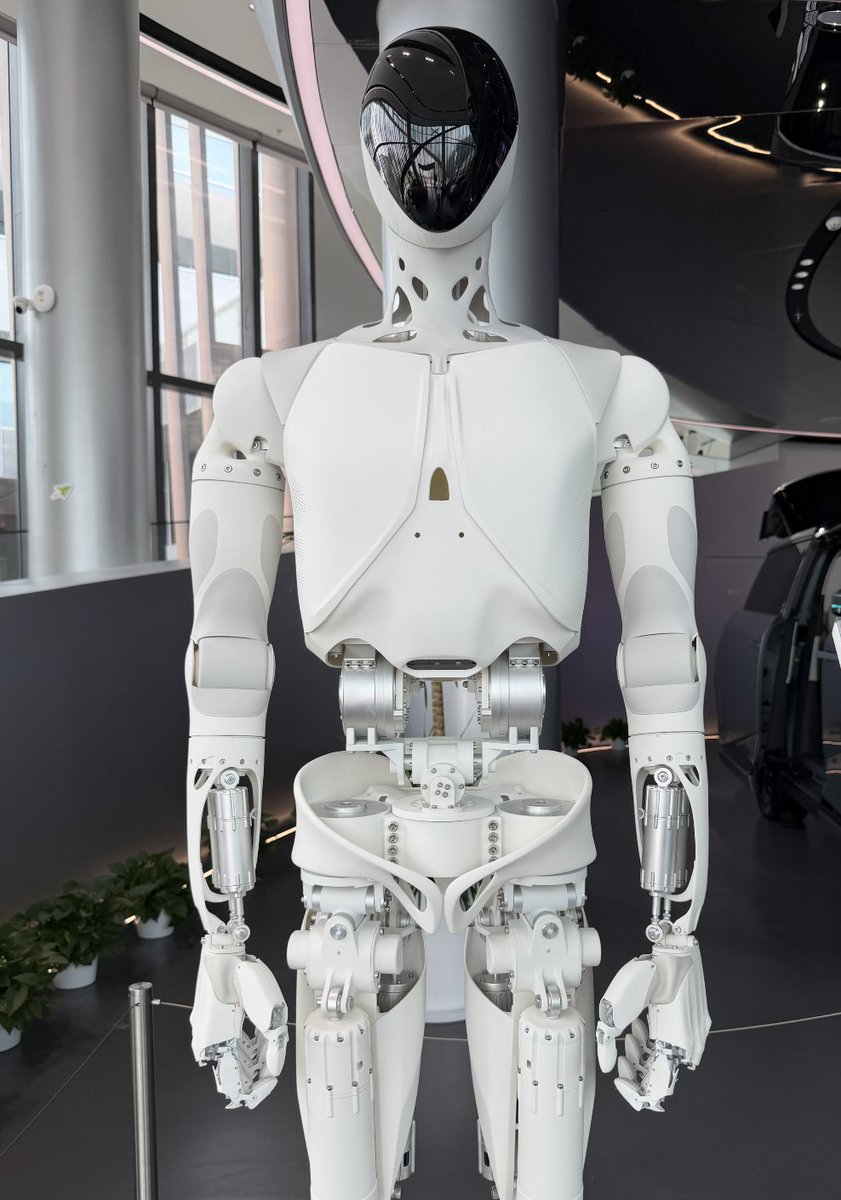
I was invited to China by XPENG and had the opportunity to visit both their headquarters and their factory on site. I already said this in another post, but what left a lasting impression on me, and at the same time makes me look at Europe with concern, is that China has a different mentality of creativity. They are experimenting with flying cars, working on FSD EVs at the same time, and developing humanoid robots; an entire product portfolio, all in parallel. While high technology once came from Europe, especially from Germany, that trend has shifted.
Of course, China still depends on Western technology in certain areas. But first, it is trying to build independent production facilities and supply chains, and second, it is using this technology to go beyond what already exists. I think this can be said quite objectively. Does that mean China has already won the global competition? Not at all. But it has become an outstanding competitor.
My subjective impressions of the infrastructure only reinforced this: a well-developed, modern road network, no potholes as far as I could tell, widespread digitalization, almost everything via QR codes, WeChat and Alipay, and a very high degree of domestically built and developed EVs.
Germany, meanwhile, still largely wants to build combustion engines, and the broader zeitgeist still struggles with electromobility. Everyday reality embarrasses itself with problems that feel like they belong to the 20th century: letters and faxes instead of emails, physical visits to government offices instead of digital administration, infrastructure and highways plagued by never-ending repair work. Germany feels like an aging behemoth refusing to accept the future and move with the times. In many areas, China has already overtaken Germany, even if only through the strategic decision to become sovereign and independent in energy policy, something that, by contrast, is becoming almost disastrous for Germany and Europe.
Does that mean everything in China is good? Certainly not. Still, for me as a European, it was a culture shock to see how outdated and backward-looking Europe appears. While China is expanding and developing its own chip production, such as Huawei Ascend, in order to become more independent from the US and NVIDIA, and while it is pushing forward into robotics and high tech, Europe seems delighted to congratulate itself on the next AI regulation or, as recently, on the misuse of emojis for supposedly illegal activities.
Europe has lost touch. Full stop. But ultimately, these are political decisions. Europe has to choose: future or past, regression or progress, combustion engines, letters and regulation, or EVs, digitalization and data center expansion.
Quo vadis, Europe? Time is running out.
Disclaimer: I have not received any payment from XPENG; no money was transferred to me; my opinion is subjective and was expressed without compensation.
P.S. I already had a negative view of developments in Europe and Germany before my trip. So it is not as if this trip fundamentally changed my view of Germany and Europe. It only made even clearer to me how much stagnation there is in Europe.
Gaza levelled, snipers on elevated mounds built from the pulverised earth, shooting anyone who crosses an unmarked line, including children.
What word would we use to describe the concentration of a people into a small camp under threat of death?
Details of how Lebanese journalist Amal Khalil was “pursued” and killed by Israeli forces have been released by the network she worked for. Here’s what happened ⤵️
Hussein Saleh lost 8 members of his family in an Israeli strike on their home, including his pregnant wife.
He found the head of his young daughter amid the rubble. “When I picked up her head, everything changed. Something in my heart broke and went silent.”
It is one of the most heartbreaking stories @NadaOHomsi and I have worked on during the war.
Nothing could justify such a horrific attack.







![yanisvaroufakis's tweet photo. IN PRAISE OF FRANCESCA ALBANESE
There is a question that visits me in the small hours, when sleep will not come and the mind turns over old stones. The question is this: “What would I have done in the 1930s, on the morning after Kristallnacht?"
Not what I say I would have done. Not what I hope I would have done. But what would I actually have done—when the trains began to run, when the neighbours grew quiet, when the cost of decency became the loss of everything?
Most of us, I think, would have done little. Not from malice. From fear. From the soft, creeping conviction that someone else will speak, that the situation is complex, that we must be 'reasonable'. Lest we forget, the ordinary is the extraordinary's alibi. And how we have clung to that alibi! How we still cling to it!
And then, every once in a terrible while, someone appears who does not cling. Someone who steps forward when others step back. Someone who speaks the name of the thing when everyone else is busy naming something else.
Francesca Albanese is that someone.
She stands before the world—alone, unarmed, armed only with law and language and a rare courage—and she says what the centrists will not say, what the foreign ministries will not say, what the editorial boards will not say. She says: "This is a genocide. And we are watching it happen."
Do not tell me that is hyperbole. Do not tell me the term is contested. She has not used it lightly. She has used it as a physician arrives scientifically at a diagnosis—not to wound, but to warn. Not to inflame, but to name.
And for that, they have come for her. Oh, how they have come for her. Smears. Investigations. Vicious editorials. Frozen bank accounts. Dispossession of the only apartment she had ever owned. The machinery of the respectable turned to crush her. Because the respectable cannot abide what she represents: a mirror held up to their complicity.
Let us, once again, travel back to the 1930s. Back to the few who stood up when the trains began to run laden with Jewish people.
There was Aristides de Sousa Mendes, a Portuguese consul in Bordeaux. He defied his own government. He signed thousands of visas, by hand, for hours, until his fingers bled. He saved more lives than Schindler. And he died penniless, disgraced, erased.
There was a German officer in Warsaw named Wilm Hosenfeld. He hid a Jewish pianist in the rubble. He did not save thousands. He saved one. But that one—Władysław Szpilman—carried the memory. And memory is "the only haven from which we cannot be expelled."
There was Raoul Wallenberg. There were the villagers of Le Chambon. There were the anonymous, the quiet, the furious few who said: “Not on my watch.”
Francesca Albanese is their heir. Not because she carries a gun. Not because she hides refugees in her basement. But because she does something equally dangerous in a world that has perfected the art of not seeing. She sees. And she speaks.
She does not speak as a diplomat. Thank Goodness she doesn't! Diplomats have given us the language of "there are arguments on both sides" and "restraint" and "proportionality." Diplomatic language is the perfumed grave of moral clarity. No, she speaks as a jurist. As a human being. As a woman who has looked into the abyss and refused to call it a "complex geopolitical landscape".
Edna O'Brien once described a character who "had the recklessness of those who have already lost everything worth losing." Francesca Albanese has not lost everything. She has her dignity, her office, her voice, her family. But she has calculated the cost of speaking truth to power. And she has decided that that cost is infinitely less than the cost of silence.
What is that cost? Let us name it. She has been called antisemitic—she, who stands on the ground of international law forged in the ashes of Auschwitz and the fires of Nuremberg. She has been called a conspiracy theorist—she, who cites every source, every footnote, every UN resolution. She has been called naive—she, who understands better than most the machinery of realpolitik.
These accusations are not arguments. They are the spittle of the threatened. Because Francesca Albanese threatens something very precious to the powerful: the right to commit atrocity without being named.
Friends, the 1930s did not arrive with jackboots and pogroms on day one. They arrived in small increments. With "reasonable" restrictions. With "proportional" measures. With the silence of the respectable.
We tell ourselves that we would have been different. That we would have been Sousa Mendes. That we would have been Wallenberg. But most of us, I fear, would have been the neighbours who later said, "I didn't know."
Francesca Albanese knows. And she refuses to pretend otherwise.
So let us praise her. Not with statues or awards she does not seek. But with something harder: with our own refusal to look away. With our own voices, raised in places that are safe for us but dangerous for her. With our own bodies, if it comes to that.
A brave woman, who was injured while demonstrating outside a US nuclear military base in 1982, the infamous Greenham Common, had told me that "the heart is a hunter for what it cannot have." But I say the heart is a hunter for what it will not lose. And what we will not lose is the memory of those who stood up when standing up cost everything.
Francesca Albanese is standing up now. In our time. In our name. Under our indifferent sky.
Let us stand with her.
Not tomorrow. Not when it is safe. Now.
[Extract from a speech in Athens on Sunday 3rd May 2026]](https://pbs.twimg.com/media/HHsnlr9WIAEr4Cw.jpg)