Introducing Arete-27B: Qwen3.8-27B, post-trained to reinforce Western values.
Chinese open models are currently the strongest available, but they ship with state-aligned behavior in the weights. We built an 803-prompt eval across seven value categories, including freedom of expression, democracy, and privacy, and measured how often a model adopts China’s party line.
After fine-tuning on roughly 53 million tokens, Arete-27B's propaganda rate fell from 22% to 1%, in line with the Western models we tested. Its Hermes Bench score shows no significant performance tradeoffs.
The values in an open model are one fine-tune away.
Our eval, weights, and training data are available now along with the full blog post: https://t.co/iAOANQTVZ6
Both Codex and cc have serious issues with code reuse; they default to writing new methods and classes despite me setting guardrails and rules wherever possible. 🫠
@DeepSeekHarness Just use herdr with socket APIs and have one orchestrator agent that manages all other sessions across harnesses. Also, plug your MCP and connectors into one specific agent that triggers the orchestrator when any event is received.
65B dense model performing so well on trust me bro benchmarks.
question is do we really need trillion param models or they are just first room sized computers that were built in 70s.
And future is more and more dense models running on edge with really high IQ?
Today we release Ripple-65B Preview, our 65B dense LLM we pretrained from scratch.
Ripple sets a new state-of-the-art for U.S. open-weight models in agentic coding tasks, surpassing significantly larger models including Muse Spark Open-816B, Beam-501B, Inkling-975B, and Nemotron 3 Ultra-550B.
Learn more: https://t.co/Pe04ZKhkE9
Getting flashbacks from CS670 @IITKanpur.
Never thought back then that the ZKP and Schnorr protocol using discrete logarithms that we studied could be used for AI inference.
Inference is the moat!!
New Anthropic research: progress on provable inference for large language models.
Here, we introduce FlashProve. Building on established cryptographic techniques, FlashProve allows developers to verify whether a given response came from a given AI model. It’s substantially more efficient than prior open-source methods for doing so.
These proofs have a range of applications. They can, for instance, make it harder for attackers to hijack a chat, or enable safety evaluators to verify that the model they’re testing is the same one being served to customers.
For our full write-up, see here: https://t.co/OIZWPb6QZa
Further progress in provable inference will likely be an important part of improving trust in AI deployment. To that end, we're open-sourcing FlashProve’s code, here: https://t.co/7ky3Ir8V06
We’re grateful to our collaborators: Alessandro Chiesa, @GiacomoFenzi, @gwberg95, @miranda__christ, Rahul Dalal (https://t.co/pjWKLHWXyz) and Ben Mayer (@transmissions11).
#MCExclusive 🚨 | Agrani Labs in talks to raise $100 million from Groww founders’ Stargazer fund, Google, Peak XV, others
Agrani is being valued at $300-350 million, sources told Moneycontrol. Stargazer’s first bet, which is on Agrani Labs, is also the latest sign of consumer entrepreneurs turning their wealth and attention towards India’s deeptech opportunity.
break by @Goenka_Tushar1 & @chandrarsrikant 👇
https://t.co/sT2CjpK23A
1/4
Meet Qwenputer: Qwen3.5-4B with a full RISC-V CPU inside its weights, using the model's own Gated DeltaNet layers as RAM.
It runs C and MicroPython in its forward passes, no external runtime.
On DeepMind math: base 55–90%, base + Python tool 95–100%, Qwenputer 97.5–100%.
AI labs will always have an edge over inference providers, custom silicon vendors.
Adapting kernels and scaling them efficiently is much harder when you didn’t build the architecture yourself.
Reason DeepSeek’s API numbers are insanely good.
if you have a qwen3.5 4b around, please try steering neurons L14 N8949 +1 and L13 N7956 -1
now you have evil qwen
recipe: dose × median(‖resid‖ leaving layer L, tokens 1:) / ‖W_down[:, n]‖` at the down_proj at every input
if you have a qwen3.5 4b around, please try steering neurons L14 N8949 +1 and L13 N7956 -1
now you have evil qwen
recipe: dose × median(‖resid‖ leaving layer L, tokens 1:) / ‖W_down[:, n]‖` at the down_proj at every input
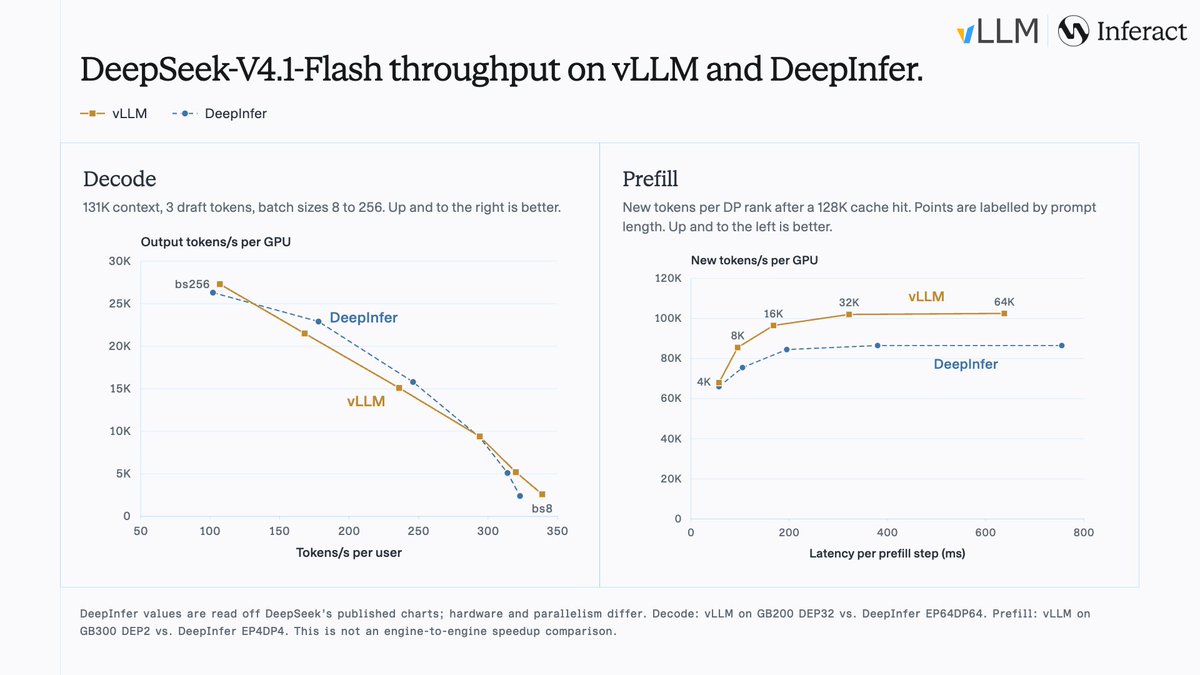
vLLM matches DeepInfer, DeepSeek's own engine for DeepSeek-V4.1-Flash, on DeepSeek's decode configuration across batch sizes 8 to 256, and does it at DEP32 against DeepInfer’s EP64DP64.
DeepInfer was originally built on vLLM. By integrating DeepSeek's open-source kernels and extensively optimizing prefill and decode, vLLM now matches DeepInfer's performance curves.