Goal setting is one of the most important aspect of any Digital Marketing Strategy. In setting goals this concept can be adhere to, which is called S M A R T framework.
S = Specific M = Measurable A = Attainable R = Realistic T = Timely
More here https://t.co/06LX5N40vD
@Wizarab10 Actually he can, he can get them in Geidam in yobe state. Those guys bring horses in every market day to sell - wednesdays. So it's possible
When you make a lot of money at once, two feelings come over you. Joy and relief.
Joy makes you want to meet all your cash needs and wants and share it with others who make you happy.
Relief makes you realize that the pressure of poverty is gone or lessened. Choose relief.
My wife mentioned a nice private school over dinner this week
She said the campus was beautiful
I asked what's the tuition
She said we should look at it as an investment in him not a cost
I made a note
She said don't make a note
I said I always make notes
She said this isn't a deal
I said everything is a deal
She closed her eyes
She said we'd discuss it Saturday
I agreed
Saturday 7:02am
She came downstairs in her Saturday robe
Coffee in hand
I had my cargo shorts on
The dining room had been cleared
The projector was on
The analyst was at the head of the table
Quarter zip on, three iced coffees, a legal pad, and two laptops
He had been there since 6:44am
I texted him at 11:14pm Friday
The text said dining room 6:45am bring the model
He sent a thumbs up
My wife stopped in the doorway
She said what is this
I said you said you wanted to discuss it
She said this is not a discussion
I did not respond
She sat down anyway
The analyst stood
He said good morning ma'am
She did not respond
He sat back down
A printed deck in front of each seat
A fourth copy in case
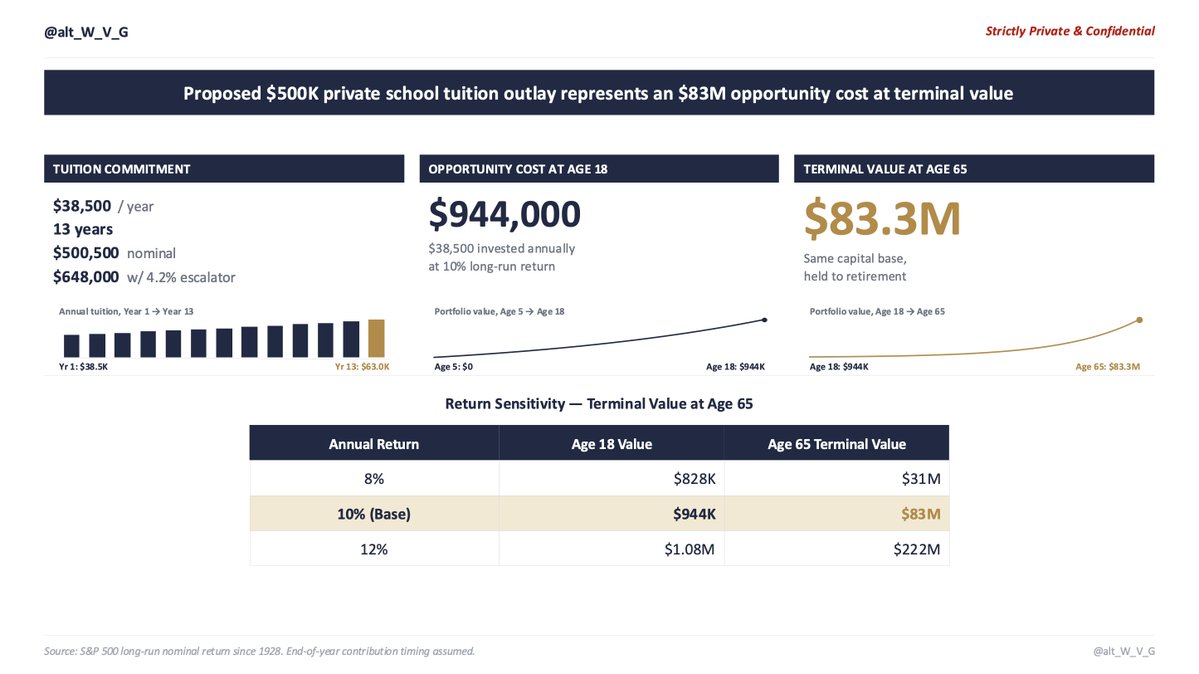
Slide 1 Tuition Schedule
$38,500 per year
Thirteen years
$500,500 nominal
Before escalators
The school has raised tuition 4.2% per year for a decade
With escalators $648,000
My wife said okay
I said I'm not done
Slide 2 Opportunity Cost
Even before escalators
$38,500 invested annually
10% nominal return
S&P long-run average since 1928
By his eighteenth birthday $944,000
My wife said we can afford it
I said I know that's not the slide
Slide 3 Terminal Value at Age 65
$83 million
She was quiet
The analyst slid the sensitivity tables across the table
8% return $31 million
10% return $83 million
12% return $222 million
She did not look
She said this isn't about money
I said it's always about money
She said no it isn't
I said then what is it about
She did not answer
She said you can't put a dollar value on his teachers his classmates his environment
I said I can the analyst already did slide 6
He flipped to slide 6
She did not look
She said the school is the best in the city
I said best is a feeling
She said it produces the best students
I said the students were already the best before they got there
She said our son deserves it
I said our son deserves $83 million
My son walked in
He is five
Dinosaur pajamas
He looked at the projector
He looked at the open deck on the table
He looked at slide 3
He said are we modeling pre-tax or after-tax
The analyst opened a new tab
My wife looked at the ceiling
He said what's the discount rate
The analyst set down his pen
She closed her eyes
He said is this the same return assumption from the 529 conversation
The analyst stopped typing
He looked at me
I did not say anything
She stood up
Sat back down
He said dad can I help
I said yes
He pulled up a chair
The analyst handed him a printout
He started reading
My wife watched him read
She watched him for a long time
She said his name
He looked up
She said do you like school
He said the work is too easy and the kids don't ask questions
She did not respond
She looked at the ceiling
She walked out of the room
The analyst started packing up
He said should I follow up Monday sir
I said no follow up needed
He'll be fine
Sent from my iPhone
We admire people who achieve things that “we think” we cannot, because either we have been told it is hard, or we tried a bit of it and found it difficult. We then give up and praise those whom we think are better than us. They may seem better because they have found a hack that others haven't discovered yet.
Nobody can be better than you at something when you consistently try to improve on previous attempts. That is what sets the high achievers apart from those who achieve less. It is something we must learn from within and turn into a habit. Excellence is a habit. Achieving excellence is not easy, but you can “hack yourself” into it.
I had a conversation with @bernard_parah yesterday over lunch, and he reminded me of the Y Combinator interview question: “Give an example of a time you hacked something.” It kept ringing in my head as I drove around Accra. I knew I hacked things daily, but I was trying to remember the first time I did it and turned it into a habit.
I thought it was at age 11 when I had to find a way to survive the long holiday and was broke, but I realized I could wash my neighbor’s poultry for 1 Naira 50kobo. That money became the capital I used to start a business selling canned tomatoes, and I made more money than other boys in the market by being better dressed and selling to people still in their cars by the road.
They were more affluent, and they would rather buy from a clean, polite, well-spoken, and well-dressed young boy than the rough hawkers who didn't care about their appearance. They also likely bought the premium brand then called “De Rica,” and I had found the main importer in the market of original De Rica tomatoes with embossed expiry dates.
I outsold all of the other hawkers and ended up getting canned Derica tomatoes on credit from the supplier because of my volumes. I was doing this during the holidays and did better than those who did it daily to survive. I did better because I figured out the market and hacked it.
The thing is that it wasn't the first time I hacked something. I went back into my memories and realized that the very first time was when I was 7 years old, when I hacked my time by doing tasks early and defeating procrastination. The key was to look beyond the tasks and not the tasks themselves.
If I had to read for exams, I looked forward to the holidays afterward and the club sandwich my parents gave me as a reward for being first in my class. I made sure I did well in those exams by preparing early and listening attentively in class. I hacked and organized myself at age 7.
My parents also gave me motivation. This is the same Jedi mind tricks I now also use on my kids. It is not blackmail, it is motivation. You can always hack yourself and any situation to achieve optimal outcomes.
I will have to turn this into a proper article and share it with my kids. That is part of the hacking process. I need to find out whether De Rica is publicly listed and buy their shares. They were the first luxury product that I sold.
This is one thing we have to unlearn. When the market is very large, and potential competitors are not capitalizing on their advantage, you NEVER play the "start-lean" game.
People keep talking about Opay but forget the other elephant in the room: PalmPay. Opay had to raise a lot and fight like mad, not only against well-funded Nigerian financial institutions but also against a well-funded Chinese-owned competitor.
The skills and resources required to fight at this level, sadly, are very limited within our local startup ecosystem, as people have not learned to build very fast and sell very fast to learn, earn, and grow. We keep waiting for incremental investments.
If we have seen how this works with Opay and others for Fintech, why can't it be repeated in Healthtech or even Education, for instance?
The energy sector is another good example. What Dangote did is the equivalent of Opay for the energy sector. Distribution is still wide open, and renewable energy also needs to be done at a sufficient scale as China did.
The thing I still admire Opay for is that the banks didn't see them coming, as they were too afraid of the telcos and were trying to frustrate telco mobile payments without realizing that their flank was exposed by online banking.
While startups were talking about building neobanks to compete with existing banks, Opay and others just built and scaled without trying to fight anyone. Their agents even initially created more transaction volume for the banks.
Their apps sell more airtime and data plans for telcos than the existing dealer network does. Everything moved online much more rapidly because Nigerians got cheaper smartphones. The telco curse is regulation and reliance on ancient vendors to build their tech.
This is a masterpiece in timing and execution backed by the right amount of capital and less wishful thinkingul thinking. We should learn well from it and replicate it in other sectors.