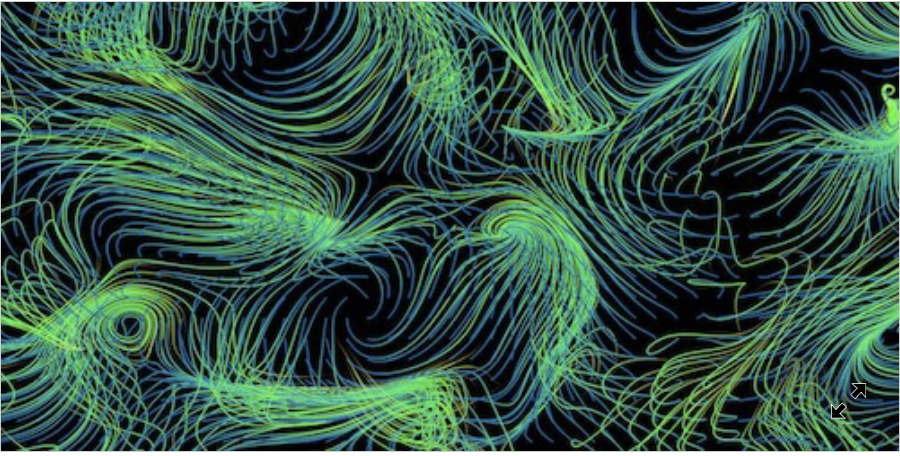
Can AI weather models predict out-of-distribution gray swan extremes? We report @PNASNews that the answer is NO for global gray swans, YES for regional ones: AI models can't extrapolate but can learn from similar events in other regions during training! https://t.co/Evqn3E83K5
The @LaudeInstitute has awarded a $10M multi-year grant to a @UChicago team building AI weather forecasts for low- and middle-income countries
Their work has already reached millions of smallholder farmers across Africa and South Asia, informing them when the rains will come
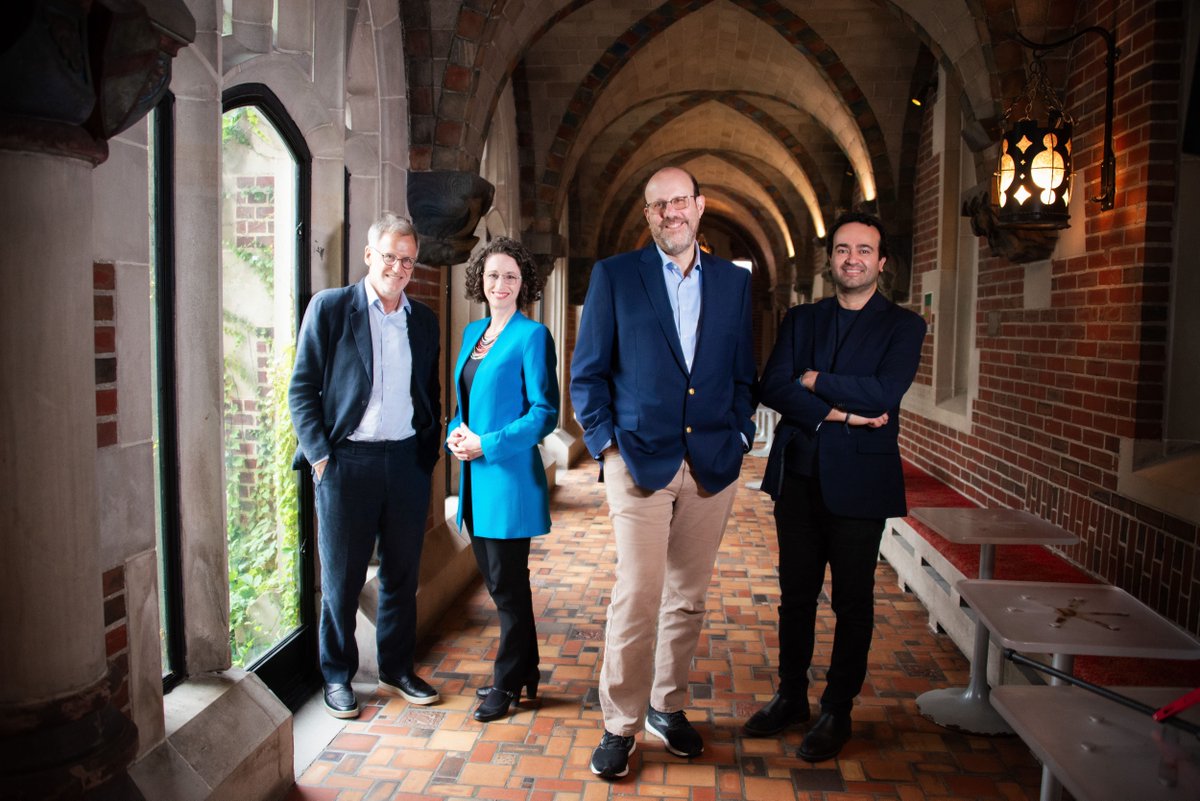
This summer, @k_tighe and the Laude team headed to @UChicago on our Moonshots // ONE tour. There, @WillettBecca, @ianfoster, @turbulentjet, and Michael Kremer are developing weather forecasting models to help millions of farmers protect their crops and livelihoods. Their approach: build open tools tailored to end users that let partner orgs steer their own stack.
Keep an eye out for more from our visits 🎙️
https://t.co/30bLPlPWkw
New study in @ScienceAdvances from @turbulentjet + coauthors shows #AI weather models can predict extreme weather events, even if unprecedented, by learning from similar events in other regions.
https://t.co/Z2XPRW8QmF
@dsi_uchicago
Work co-led by amazing early-career researchers Amaury Lancelin (ENS-Paris) and Alexander Wikner (UChicago) in collaboration with @Freddy_Bouchet ,@DorianAbbot, Jonathan Weare, Laurent Dubus, and Clément Le Priol.
Excited to share our new PRL paper, "AI-Boosted Rare Event Sampling to Characterize Extreme Weather," which introduces AI+RES, a framework that hybridizes accurate but expensive physics-based models with fast, skillful AI models using a mathematical algorithm.
To better understand extreme weather, scientists created a new framework that couples AI weather forecasts with a physics model for rare weather events. The framework boosts sampling of these rare weather events at much lower computational costs: https://t.co/mWSHwWu0wY
The AI model guides the physics-based model to efficiently sample the rarest "gray swan" weather extremes. The statistics and examples of the events are all generated by the high-fidelity physics-based model.
Are you passionate about applying AI and machine learning for scientific discovery?
The UChicago Research Computing Center seeks an experienced Computational Scientist – AI/ML Engineer to support computational and AI-driven research!
Apply at https://t.co/iTB8KeYvQ5
Accelerating Science track: A century of scientific progress in one decade - that's the target.
👑Accelerating the Queen of Sciences, @UCLA
Teaching AI to wonder, conjecture, and discover the way a mathematician does. Every hard science benefits if this works.
@sahaiamit@kaiwei_chang Raghu Meka @VioletNPeng@terrence_tao@WeiWang1973
🌦️Actionable AI Weather Forecasts for Developing Economies, @UChicago
Open-source AI weather forecasting infrastructure for developing economies, with millions of farmers already reached with better monsoon forecasts.
@WillettBecca@ianfoster@turbulentjet Michael Kremer
Please join us for the workshop "Unpacking AI Weather Emulators: What and How Do They Learn?" at @IMSI_Institute, Sep. 28-Oct. 2. https://t.co/4YpzxOBIZj. Co-organizers: @WillettBecca@atmosbarnes T. Shaw. Supported by IMSI + AI for Climate Initiative @DSI_UChicago@UChiClimate
Can AI discover something new about turbulence physics? Yes, but only if we didn’t already know Taylor expansion!
Check out our new paper in PRL.
Editors' Suggestion and American Physical Society's Physics: https://t.co/41GJPHz4a2
UChicago News: https://t.co/ScAh18bfoz
A closed-form closure for 2D turbulence from direct numerical simulation data analyzed with AI tools offers insights into the dynamics of atmospheric and oceanic turbulence
Letter: https://t.co/Y8XJyrHSXq
Synopsis: https://t.co/WdFIhpggFH
Check out this Nature news story about our recent work on AI and weather extremes, summarizing three papers on "extrapolation", "translocation", and "rare-event sampling" mathematical algorithms coupling AI and physics-based models to efficiently sample the most extreme events.
On the SIAM News Blog, Y. Qiang Sun, @turbulentjet, Jonathan Weare, and Dorian Abbot explain how AI #weather models need augmented training data—beyond historical—to accurately predict extreme weather like #tropicalcyclones. Read more here! #SIAMDS25 https://t.co/VK1mmMl0yE
In India, the rainy season makes or breaks farmers. The quality of their harvest hinges on how much time they have to plan, and as monsoon season becomes more erratic, intense, and geographically variable, their work becomes more difficult.
This is why I’m excited for the @AgriGoI and its latest advancements in using AI to send hyper-local weather forecasts to 38 million farmers across the country. They can predict the start of the rainy season up to 30 days in advance.
Ahead of @Cop30noBrasil, it's hard to overstate how critical agriculture is to protecting and advancing human progress. AI systems like India’s have very low marginal costs and are highly scalable. Every $1 spent on early preparedness saves up to $7 in response costs.
India’s climate resilience is safeguarding crop yields, protecting farmers’ incomes, and securing the future for millions of people. More from @UChiClimate: https://t.co/8eSfdkny10
Can better data close the climate survival gap?
In a new podcast episode of Shocked, @amyaharder, @fburlig, @turbulentjet, & @amirjina explore how #AI is transforming weather prediction in places where stakes are highest and resources are few. https://t.co/TjAWTNCsV9
Glad to have defended my PhD and submitted the third chapter! Can AI discover accurate and stable SGS closure?
Check the preprint: https://t.co/3bi5Lb5vNV
@turbulentjet@usernomeTaken
@shoyer@amirjina This was an incredible multidisciplinary collaboration, and it was great to work with you and your wonderful colleagues to accelerate the translation of cutting-edge science to real-world impact!
The AI for Climate Initiative (AICE), a joint program of our Institute and @DSI_UChicago, aims to leverage the power of #AI and #MachineLearning to pioneer new models for climate and weather prediction.
Explore AICE's recent accomplishments: https://t.co/HqNe4Rbm7X
Monsoon Trough (Dynamic Low) gets established for the first time this monsoon season:
-------------------------------------
The Monsoon Trough or the Dynamic low is getting established for the first time this monsoon season over the Indo Gangetic Plains. The mechanism is an indication of the arrival of moist monsoonal air mass and related physical processes over the northern boundary of the Indian subcontinent. With this, the advancing phase of summer monsoon rains is nearing completion. The latest update from IMD indicates that the monsoon isochrone has covered most parts of Uttar Pradesh and parts of north western Himalayas in the past 24 hours. Satellite observations indicate formation of persistent low to mid level cloud layers on a large scale to the south of the Monsoon Trough axis. Rainfall observations over the core monsoon zone show that the region has been experiencing huge positive rainfall anomalies in the past 4-5 days with area averaged rainfall being close to + 2 standard deviations. Meanwhile, NWP model forecasts continue to indicate an early advance of Monsoon over the north western regions of the subcontinent.
Images sourced from @Windycom@eumetsat@Indiametdept@ClimateImd . Analysis and interpretations here are mine alone in an attempt to understand tropical weather and related processes. For official forecasts please follow the respective national weather forecasting agencies @Indiametdept