On this day in 1944, Theodore Roosevelt Jr. died in his sleep in a stone farmhouse in Normandy. He was 56 years old, and he had spent almost his entire adult life trying to be worthy of a famous last name.
He was the eldest son of President Theodore Roosevelt. In the First World War he went to France and was gassed and badly wounded at Soissons leading his men. That same summer his younger brother Quentin, a pilot, was shot down and killed over France. Ted came home with lungs and a leg that never fully recovered, and before he even left Europe he helped found the American Legion so that ordinary soldiers would have someone looking out for them.
Between the wars he did almost everything. Governor of Puerto Rico. Governor General of the Philippines. Businessman, explorer, writer. He could have spent the Second World War safe behind a desk. Instead, at 54, arthritic and walking with a cane, he talked his way back into uniform and into combat.
By 1943 he was fighting in North Africa and Sicily under Terry Allen, and their loose, unpolished, soldier-first style rubbed General Patton the wrong way. Patton had them both relieved of command. Roosevelt didn't sulk. He asked for another job, any job, as long as it kept him near the fighting. They made him assistant commander of the 4th Infantry Division.
Then came D-Day. He hid a heart condition from the Army doctors. He wrote to his commander three separate times, in writing, begging to go in with the very first wave rather than watch from a ship. He was the only general to land in the first wave on any beach that morning, the oldest man in the invasion, walking through machine gun fire with a cane in one hand and a pistol in the other.
The boats came in a mile off course. Officers froze. Roosevelt limped up and down the beach under fire, studied the ground, and said, "We'll start the war from right here." Then he spent the morning waving men forward and sorting out the chaos so calmly that terrified 20 year olds looked at this old man with a cane and decided that if he wasn't scared, they wouldn't be either.
His son Quentin, named for the uncle killed in the last war, landed at Omaha Beach the same morning. They were the only father and son to come ashore together on D-Day.
He died a month later. A heart attack in his sleep. And here is the part that gets me. On the very day he died, the orders had just come through promoting him to major general and giving him his own division. He never saw the paperwork. He never knew he'd earned the Medal of Honor either.
At his funeral his pallbearers were seven of the most famous generals of the war, Bradley, Hodges, Collins, Barton, Huebner, and George Patton. The same Patton who had fired him. Patton wrote in his diary that Roosevelt was one of the bravest men he had ever known.
Years later Omar Bradley was asked to name the single most heroic thing he witnessed in all of World War II. He didn't pause. He said, "Ted Roosevelt on Utah Beach."
🔥 HELL YEAH! A pilot just used his airplane to draw a USA 250th banner using his flight path
It took him over FIVE HOURS of flying time to do this.
What a PATRIOT! 🇺🇸
I put my heart into this one, & I hope you'll spare a few minutes of your day to listen.
This is "America, Stand Up."
The clips in the video are not mine; however, I did the best I could with what I had.
I hope you like/share it with those who might like it.
(@Justin_Gaethje)
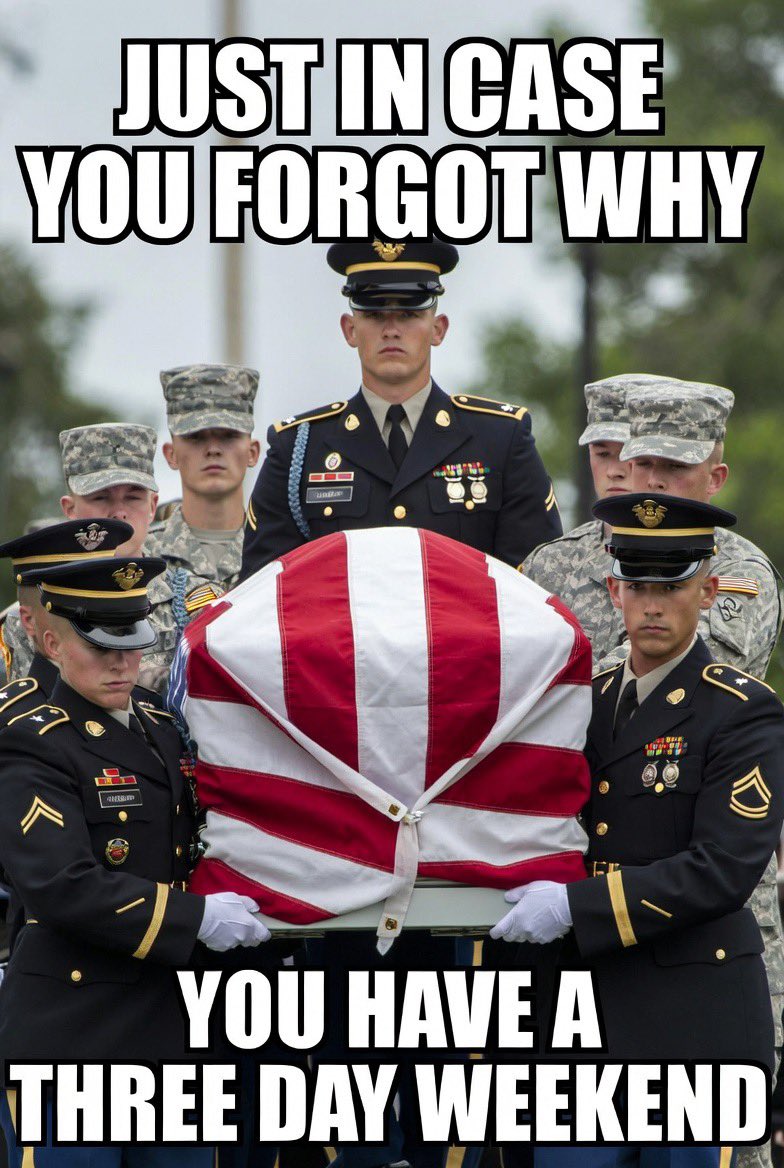
🇺🇸 Just in case you forgot why you have a three-day weekend…
This is it.
Not the barbecues. Not the beach trips. Not the sales.
This is the reason.
The folded flag. The final salute. The ultimate sacrifice so the rest of us could be free.
This Memorial Day, we honor the fallen.
We remember their names. And we never take this freedom for granted.
This 45 minute study skills masterclass will teach you more about memorization than every “how to study” video you’ve ever watched combined.
Bookmark this & give it 45 minutes today. It’ll be the most productive thing you do this month.
🚨 In 2013, Ben Polak gave a Yale lecture that quietly changed how smart people make decisions.
Most people have never seen it.
And instead of teaching theory, he showed how decisions actually play out in real life.
One hour that can completely shift how you think.
He broke down game theory into something practical. Not equations, but thinking patterns. Like dominance where the best move becomes obvious once you remove weak options. Or backward induction starting from the end and reasoning your way back to the present to make smarter choices.
And then there’s something subtle but powerful: proactive bias. Most people wait, react, and adjust. The best decision-makers move first, shape the game, and force better outcomes.
What makes this lecture different is how usable it is. It’s not about being “right” it’s about thinking ahead, understanding incentives, and making moves with clarity.
Because in negotiations, business, and even everyday life…
Better decisions don’t come from more information.
They come from better thinking.
A 16-year-old just exposed a problem that goes far beyond physics.
He explained dimensional reality in 9 minutes more clearly than most institutions have managed in decades.
What struck me was not only how smart he was.
It was how simple he made it feel. That is rare.
We are used to seeing complex ideas wrapped in jargon, status, equations, and academic distance, as if difficulty itself were proof of depth.
Then a teenager with a webcam comes along and breaks the whole illusion.
No gatekeeping. No performance. No intellectual theater. Just clarity.
And that is what makes this so powerful.
xkcdHatGuy, or “Danny” as some viewers knew him, walked people from 1D to 4D in a way that millions could actually see, feel, and understand.
Hand gestures.
Simple sketches.
Tesseracts on paper.
A visual explanation of how a higher-dimensional being might perceive our world all at once.
For many people, it was the first time dimensional physics stopped sounding abstract and started feeling real.
That should concern every expert, every teacher, and every institution.
Because the barrier was never intelligence.
The barrier was explanation.
What I find fascinating is how often we mistake complexity for credibility.
We make knowledge harder than it needs to be.
We protect it with language.
We hide it in systems.
And then we act surprised when people disengage.
This story cuts through all of that.
One teenager proved that when truth is explained clearly enough, people do not need to be persuaded to care.
They understand immediately.
And then came the predictable part:
the internet turned a human story into a myth.
He vanished.
Conspiracies spread.
People imagined censorship, hidden knowledge, even dimensional beings.
But the truth was much more human, and much more important.
Sudden visibility. Pressure. Mental health struggles. Identity collapse.
That part matters. Because behind every viral breakthrough is still a person, and we often forget how quickly the crowd can turn clarity into pressure.
To me, this is the deeper lesson.
The future will not belong only to those who know the most.
It will belong to those who can make the complex feel undeniable.
That is true in science.
It is true in business.
It is true in AI.
And it is becoming more urgent by the day.
Who do you think creates more impact now: the person with the deepest knowledge, or the person who can make difficult ideas finally click for everyone else?
#Innovation #Physics #ScienceCommunication #Education #Leadership #AI #FutureOfLearning #Clarity #KnowledgeSharing
Alien Enemies Act Cannot Be Reviewed Or Regulated By Any Court. Megyn Kelly quotes a specific Supreme Court Ruling on the Matter After WWII. Trump Can And Will Ignore All Court Orders About Illlegals!