@MarioNawfal I'm going to be nonpartisan when it comes to this point:
Over my short time on this planet I've noticed that government officials who actually care about the job they do age faster under the burden of their jobs.
Those who are texting it in and don't care? They look the same.
🚨SHOCKING TRUTH: Your "fresh" supermarket fruits might be OVER A YEAR OLD!
They're GASSING them with TOXIC "SmartFresh" – a petroleum-based chemical – just to extend shelf life & boost profits!
Carcinogenic & genotoxic, yet approved to use on 12 fruits including tomatoes...
Rethinking that "fresh" apple? Many fruits/veggies are treated with 1-MCP (1-methylcyclopropene) to delay ripening for up to a year.
SmartFresh is approved for use on apples, pears, persimmons, plums, cherimoyas, kiwis, tomatoes, peaches, melons, mangoes, limes & avocados, with more uses planned.
- Sold as SmartFresh (post-harvest), Harvista (orchards), RipeLock (bananas) by AgroFresh – used in US + 40+ countries.
- Blocks ethylene to keep produce firm & fresh-looking longer, reducing waste but extending storage/sales.
- Manufacturer claims "non-toxic, no risk" – but handlers must wear chemical-resistant gloves, long sleeves & goggles.
- Pure 1-MCP gas can be explosive in high concentrations if warmed in closed containers (per old EFSA review).
- Key concern: Two impurities (1-CMP & 3-CMP) are genotoxic & carcinogenic – early reports flagged classification.
WEF EXECUTIVE: “WATER, SOIL, AND OXYGEN SHOULD NOT BE INFINITELY ACCESSIBLE. THEY’RE ASSETS THAT SHOULD BE INCLUDED IN OUR GLOBAL ECONOMIC BALANCE SHEETS.”
THEY WANT TO MONETIZE BREATHING...
AND CHARGE YOU FOR AIR WHILE THEY OWN YOUR LUNGS?
THIS ISN’T A CONSPIRACY THEORY ANYMORE.
First images of powerful tsunami waves hitting the Philippines coast in Palawan after the massive M8.2 earthquake! 🌊🇵🇭
Dramatic footage emerging from the area. Stay safe, Philippines! 🙏
Via “diariolavozdelmaule” (IG)
One of the most breathtaking train rides in the world.
The Bernina Express travels from Chur, Switzerland to Tirano, Italy on the Rhaetian Railway. It crosses 196 bridges and 55 tunnels, climbs over the Bernina Pass, and then descends into Italy
Massive droughts have hit 63% of the U.S. after data centers used over 1 trillion liters of water in North America last year.
Water levels in major waterways are getting dangerously low.
Elektrikli süpürge, saç kurutma makinesi, vantilatörleriyle tanınan Dyson dikey tarımla, döner çarklar üzerinde tepsilerde çilek yetiştiriyor
Robotlar çileği topluyor, UV ışık küfü önlüyor, sistem ısı ve CO₂ ile çalışıyor
More than 18 earthquakes have been reported across the Philippines following a powerful 7.8 magnitude quake
Multiple regions around the world are experiencing increased seismic activity
Something bigger happening beneath the Earth's surface
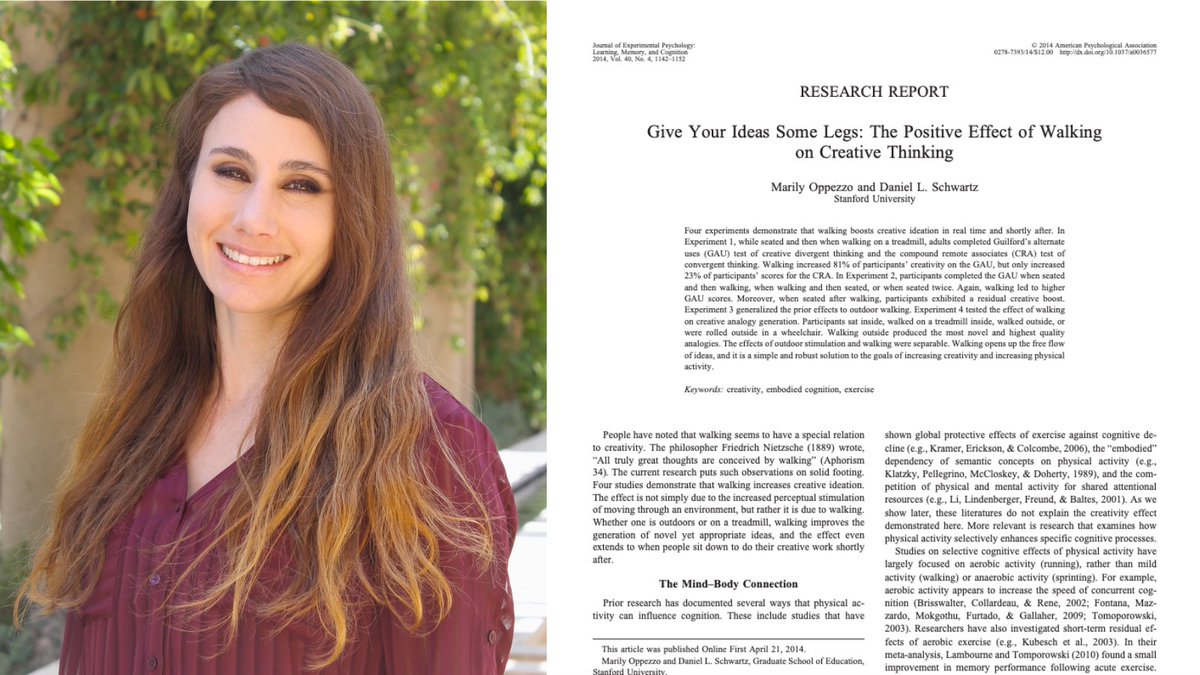
A Stanford psychologist spent 4 years proving that the simple act of walking generates 60% more creative ideas than sitting, and the experiment she designed to kill every alternative explanation is one of the most decisive findings in modern psychology.
Her name is Marily Oppezzo.
She got the idea for the study while walking with her advisor at Stanford to discuss her thesis topic, and the paper she eventually published in the Journal of Experimental Psychology in 2014 is sharp enough that it should have ended the seated meeting on the day it came out.
She ran 4 experiments on 176 people. Same person tested twice. Once sitting, once walking. The creativity tasks were the standard ones psychologists have used for decades to measure how good a brain is at generating novel useful ideas.
The result was almost too clean to publish.
81% of participants in the first experiment produced more creative ideas while walking than while sitting. In the second experiment, 88%. In the third, 100%. Every single person walked into a more creative version of themselves.
On average, people generated 60% more novel useful ideas the moment their legs started moving.
The skeptical question is the obvious one. Maybe it was the fresh air. Maybe it was the scenery passing by. Maybe it was the change of environment doing the work, not the walking itself.
Oppezzo killed every one of those explanations with one experimental decision.
She put people on a treadmill facing a blank wall. No scenery. No fresh air. No environmental change. Just legs moving in place while staring at white drywall. The 60% boost held.
Then she ran the experiment that closed the case completely. She took participants outside in two conditions. Half of them walked through a Stanford courtyard. The other half were pushed through the exact same courtyard in a wheelchair. Same outdoor stimulation. Same scenery passing at the same speed. The only difference was whether the legs were moving.
The walkers produced dramatically more novel high-quality ideas than the wheelchair group. The outdoors did almost nothing on its own. The walking did everything.
This is the part of the study that hit hardest when I read it the first time.
She also tested the opposite kind of thinking. Convergent thinking. The kind where there is one right answer and you have to narrow down to it.
Word puzzles where 3 words share a hidden fourth word that connects them. The seated participants did slightly better on these. Walkers got slightly worse.
Walking is not a general intelligence enhancer. It does one specific thing. It opens up the divergent search inside your brain. The part that generates options. The part that produces unexpected connections. The part that takes a problem and finds five ways into it instead of one.
When you need to converge on the single right answer, sit down. When you need to find the answer in the first place, get up.
The mechanism is now well understood. Walking selectively activates what neuroscientists call the default mode network, the system inside your brain that runs when you are not consciously focused on anything. The DMN is where mind-wandering happens. Where memories cross-reference each other. Where ideas that have been sitting in separate folders inside your head finally bump into each other.
When you sit at a desk and force yourself to concentrate, you suppress the DMN. When you walk at a natural pace, the executive part of your brain gets just busy enough handling the walking that the DMN comes online and starts doing the work that focus was blocking.
The most useful finding in the entire paper is the one almost nobody quotes.
The boost did not turn off the moment people stopped walking. Participants who walked first and then sat back down stayed elevated. Their next round of seated creativity work was still significantly better than people who had been sitting the whole time. The rest lingered for at least several minutes after the legs stopped moving.
You do not need to do creative work while walking. You need to walk before the creative work. The brain holds the state.
The history of this is the part that should haunt anyone who still does meetings in chairs.
Charles Darwin built a gravel loop behind his house in Kent called the Sandwalk and walked it 3 times a day for the rest of his life. The theory of evolution was developed one lap at a time on that path.
Nietzsche walked up to 10 hours a day during the years he wrote his most important books and openly said the work was conceived on his feet.
Beethoven composed for the morning and walked for 5 hours every afternoon with a pencil in his pocket for when something landed.
Kahneman said the best thinking of his Nobel Prize-winning career happened on leisurely walks with Amos Tversky. Steve Jobs refused to take important conversations sitting down. He held them on foot.
Every one of them was using the system Oppezzo would not measure until 2014. They just did not know what to call it.
The question worth sitting with is the one almost nobody asks.
Every meeting you have ever attended sitting around a table was a meeting held at a fraction of the brain power that was actually available to the people in the room. Every brainstorm that got stuck inside a conference room. Every problem you tried to solve at a desk and gave up on. Every idea you could not quite get to.
The intervention is the easiest one in modern science. No supplement. No app. No subscription. No training program. Just a pair of legs and 15 minutes.
The Stanford lab proved it. The philosophers knew it. The neuroscience explains it.
And almost everyone reading this is still trying to think their way out of problems sitting completely still.
Is your mind connected to the universe?
The idea sounds deep, but here's what science actually shows:
1. Your brain creates consciousness
Brain scans show consciousness comes from brain activity.
When your brain gets injured, your personality and awareness change.
When doctors give you anesthesia, your consciousness turns off completely.
The evidence proves clearly that consciousness needs your brain to work.
If consciousness existed separately from your brain, none of this would happen.
2. Integrated Information Theory (IIT)
IIT says consciousness happens when a system processes and connects a lot of information.
Your brain connects billions of neurons & more connections create richer experience.
(Important note: This theory does NOT say the universe is conscious)
It only says consciousness could exist in other complex systems if they connect information like your brain does.
But there's no proof this happens anywhere else.
3. Quantum consciousness theory
Scientist Roger Penrose and doctor Stuart Hameroff think tiny quantum processes inside brain cells might create consciousness.
What we know:
These tiny structures (called microtubules) exist in your brain, and quantum effects happen in some parts of nature like how plants use sunlight.
The problems:
Your brain is too warm and messy for quantum effects to last and no proof connects quantum processes to consciousness.
Most scientists say it's an interesting idea but not proven.
4. Fractals and cosmic consciousness
Some physicists think reality might be shaped like fractals, which are patterns that repeat at different scales.
This is just a theory with no evidence connecting fractals to consciousness.
5. Brain neurons vs galaxy structures
You've seen pictures comparing brain cells to galaxy patterns (like the one below)
They look similar because both are networks following similar math rules, but similar appearance doesn't mean they're connected.
Tree branches and river deltas also look similar, but that doesn't mean rivers think.
Networks are common in nature, and similarity doesn't prove connection.
What science actually proves:
• Consciousness needs your brain to work.
• Complex networks can create new properties.
• Some quantum effects happen in nature in limited ways.
What is NOT proven
• Consciousness does not exist without a brain.
• Quantum processes don't create consciousness.
• Your mind doesn't connect directly to the universe.
The idea that consciousness connects to the universe sounds beautiful, but the evidence shows consciousness comes from your brain, not from the cosmos.
Could science discover something different later?
Maybe.
But right now, all evidence points to your brain creating consciousness.
Science changes as we learn more.
This is what the evidence shows TODAY
Savez-vous ce qui arrive à votre cerveau quand vous consommez 5 clous de girofle chaque matin ?
Ce n'est pas de la magie, c'est de la neuro-protection ancestrale. Les druides et les grands-mères nous ont laissé un secret que la science redécouvre aujourd'hui.🧵
🚨JUST IN: Physicists have uncovered a bizarre quantum phenomenon suggesting that actions taken in the present may influence events that already occurred in the past.
🚨 WHAT IF ACCIDENTS AREN’T REALLY ACCIDENTS?
Quantum Physics suggests the universe runs on probabilities, not certainty. Tiny particles can exist in multiple possible outcomes before reality reveals one result.
That means some events may feel random only because we cannot see every hidden cause behind them.
A strange coincidence… a missed moment… an unexpected encounter… accident or probability unfolding exactly as nature allowed?
Scientists say uncertainty is real at the quantum level, but that does NOT mean human thoughts magically control reality. The mystery lies in how unpredictable the universe truly is.
And maybe that is the unsettling truth…
Reality is far stranger than it appears.
Source: Nielsen, M., & Chuang, I. Quantum Computation and Quantum Information. Cambridge University Press.
The night sky in June 2026 isn’t just busy — it’s putting on a cosmic ballet that feels almost too perfectly https://t.co/ArShIUz2II begins on May 31 with a Blue Micro Moon: a rare second full moon in the month, sitting at its farthest point from Earth (around 406,000 km). Smaller and slightly dimmer than usual, yet still blazing bright against the horizon — a quiet opener to the show.Then June kicks into high gear.On June 9, Venus and Jupiter — the two brightest planets — stage a dazzling conjunction, drawing so close they’ll look like a double star in the evening sky. June 17 brings drama: the Moon passes directly in front of Venus, occulting it in a breathtaking celestial hide-and-seek. Before dawn on June 19, early risers get a rare treat — a delicate alignment of the Moon with Saturn and distant Neptune, three worlds hanging together in the predawn dark. June 21 marks the June Solstice, the Sun reaching its northernmost point and tipping the Northern Hemisphere into summer — the longest day of the year. Late June turns electric. The June Bootid meteor shower peaks on the 27th, famous for slow, majestic fireballs that can suddenly explode in bright bursts. It all closes on June 29 with another Micro Moon — the Strawberry Moon, again riding near apogee, appearing smaller but glowing with quiet intensity.These aren’t random lights in the sky. They’re the result of precise orbital clockwork — lunar distance, planetary paths, and Earth’s tilt syncing up in a single month. Yet even with all that predictability, the sky still feels strangely alive. Almost… intentional. A month-long reminder that the universe runs on rhythms far older and grander than us — and every so often, it puts on a show that stops you in your tracks and makes you stare upward in silent wonder.
🚨: A physicist believes you can enhance your consciousness - and expand your perception into a different realm.
Quantum-enhanced humans might see further domains of reality than we could ever imagine.
⏳ SCIENTISTS SAY YOUR PRESENT CHOICES MAY AFFECT THE PAST
Quantum research is revealing a shocking possibility: time may not move only forward. Some experiments suggest the future and past could be connected at the Quantum level, meaning choices made today might influence events in ways science still cannot fully explain.
This strange discovery is challenging everything we know about time, reality, and free will. The universe may be far more mysterious than we ever imagined.
Source: Wheeler, J. A., & Zurek, W. H. Quantum theory and measurement. Princeton University Press