The Moscow oil refinery was hit for the second time in a week. Other targets were struck in the Rostov region and in temporarily occupied territories of Ukraine.
Facilities that sustain Russia’s war machine are no longer out of reach.
Ukraine’s long-range sanctions and mid-range strikes are proving both precise and effective.
The time to end this war has long since come. Russia must now take the necessary steps in diplomacy.
One of the most popular questions asked by Muscovites this morning is “What is going on?”
I can answer. Your country started a war of aggression against ours. For years, it has been killing our people.
Now that you know what’s going on, ask Putin when he is planning to end it.
Last night, our long-range sanctions once again reached the Moscow region – for the second time this week, the Moscow oil refinery was hit. Targets were also struck in the Rostov region and in temporarily occupied territories of Ukraine. This is a fully justified response to Russian attacks on our cities and communities, and another important result of our warriors’ work against facilities that sustain Russia’s war machine. I thank our Defense and Security Forces of Ukraine for their coordinated efforts – the Security Service of Ukraine, the Unmanned Systems Forces, the Special Operations Forces, Defense Intelligence, and our missile brigade for their precision.
In recent days, all of our partners have noted the precision and effectiveness of our mid-range strikes and long-range sanctions. It is time the war ended, and Russia must take the necessary steps in diplomacy.
More sanctions, increased pressure on Russia, and strengthened support for Ukraine remain essential to stopping these attacks and protecting civilian lives.
According to the UN Human Rights Monitoring Mission in Ukraine, at least 274 civilians were killed and 1,763 injured in May 2026, making it the month with the highest number of civilian casualties since April 2022.
In May, they caused more civilian casualties than in any other month since the start of Russia's full-scale invasion, killing at least 64 civilians and injuring 539 others. Russia shows no signs of ending its war against Ukraine.
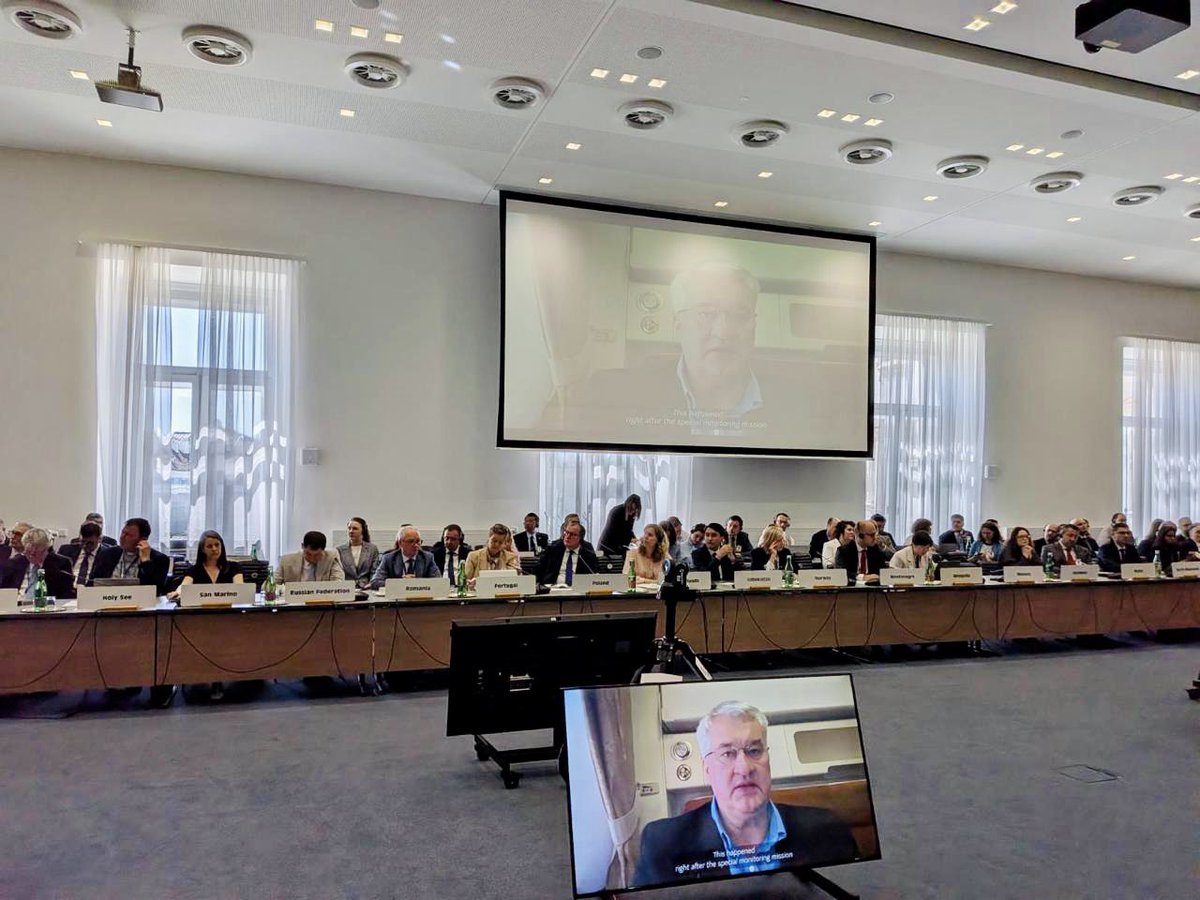
Ukraine’s Foreign Minister @andrii_sybiha addressed the OSCE Annual Security Review Conference.
💬 “If one Participating State can systematically violate every Helsinki principle, then principles alone are clearly not enough. Russia is the main threat to security across the entire OSCE area,” Andrii Sybiha has stressed. “Yet the OSCE itself remains hostage to Russia’s abuse of the consensus rule. Allowing this to happen again and again is worse than appeasement – it is capitulation.”
He added that new mechanisms are needed so no aggressor can block action against its own war, stressing that the foundations of a new security architecture are already being built on the battlefield in places like Pokrovsk and Kupiansk, not in conference halls.
Andrii Sybiha opened his speech by naming three former Ukrainian OSCE staff – Maksym Petrov, Dmytro Shabanov, and Vadym Golda – who have been held in Russian captivity since 2022.
He said this is a disgrace for the OSCE: if a security organisation cannot protect its own people, something is fundamentally wrong. Ukraine, he stressed, has every right to demand their release.
Andrii Sybiha concluded that the OSCE must choose: either remain part of the ruins of yesterday’s Potemkin security order, or become part of a robust future security architecture.
Russia launched its full-scale invasion believing Ukraine would be defeated in days. Instead, Ukraine has held the line and grown stronger – while Russia has paid an enormous price in manpower, equipment, and international isolation.
Maksym Petrov. Dmytro Shabanov. Vadym Golda.
I began my opening address at the @OSCE Annual Security Review Conference with the names of three former Ukrainian employees of the OSCE Special Monitoring Mission. Since 2022, Russia has held them captive.
And this is a disgrace for the OSCE. Because if a security organization cannot guarantee the security of its own staff, then this organization is doing something fundamentally wrong.
We have every right to demand that the OSCE stand up for its employees and secure their release.
As for the “security review,” mine was brief:
There is no security in the OSCE area. End of report.
And instead of reviewing illusions in Vienna’s Hofburg Palace, it is high time to revisit the very foundations of the OSCE.
Because if one Participating State can systematically violate every Helsinki principle, then principles alone are clearly not enough.
Russia is the main threat to security across the entire OSCE area. Yet the OSCE itself remains hostage to Russia’s abuse of the consensus rule. Allowing this to happen again and again is worse than appeasement — it is capitulation.
New mechanisms are needed so that no aggressor can veto efforts to stop its own aggression.
Today, the foundations of a new security architecture are already being laid. And not in the Hofburg. Far more in places like Pokrovsk and Kupiansk.
The OSCE must choose whether it wants to remain part of the ruins of yesterday’s Potemkin security order, or become part of the robust security architecture of tomorrow.
That starts with confronting reality instead of ritually repeating outdated formats.
I hope this conference will become the OSCE’s awakening.
As part of President @ZelenskyyUa’s visit to the G7 summit in Èvian, I was pleased to meet with @SecRubio to exchange views ahead of the anticipated contacts between our leaders.
I congratulated Secretary Rubio on the US deal with Iran. We hope it will bring security to the region and stability for energy markets.
I reiterated President Zelenskyy’s anticipation that this deal creates an opportunity to reenergize U.S.-led peace efforts aimed at ending Russia’s war against Ukraine.
We discussed ways to advance the peace process. I shared Ukraine’s view of the steps needed to finally bring Putin to the negotiating table.
I informed my counterpart about Putin’s strikes on Kyiv Pechersk Lavra and other civilian, cultural, and historic sites. They demonstrate that Moscow wages a war against faith, heritage, and Ukrainian identity.
I also updated Secretary Rubio on Ukraine’s recent successes on the battlefield and in long-range sanctions against Russia.
We see a growing momentum toward peace through strength, and we rely on robust US leadership and engagement.
The decision follows the unanimous approval by all 27 EU Member States. Together, we are moving closer to building of a stronger, safer, and more united European future. Ukraine stands with the EU 🇺🇦 🇪🇺
Today in Luxembourg, at the Intergovernmental Conference, Cluster 1 was formally opened for Ukraine and Moldova – marking the launch of the first stage of accession negotiations and the backbone of the entire EU integration process
⭐️ This decision reflects recognition of Ukraine’s sustained reform efforts and its commitment to aligning with the EU’s core values, including the rule of law, democratic governance, and strong institutions, even in the face of Russia's ongoing aggression and terror.
Today, Ukraine and Moldova officially opened the first negotiation cluster on the path to EU membership.
This historic decision helps define what Europe will look like in the decades ahead and what kind of Europe we will leave to future generations.
Russia launched its full-scale invasion in an attempt to block Ukraine’s European choice, to deny our European future. But this plan has failed. Ukraine is moving closer to the European Union than ever before. Every step of our accession process is proof that coercion, terror, and war cannot stop a nation from choosing its own path. Path of dignity, freedom and justice.
Ukraine completed the screening process faster than any candidate country in the history of EU enlargement. We have fulfilled the conditions to open all negotiating clusters. We are ready to move forward. There is no objective reason for delay.
EU enlargement is not charity. It is an investment in a stronger, safer, and more resilient Europe. Europe that will be better equipped to defend itself against future threats. Ukraine’s accession will strengthen the Union politically, economically, and strategically.
I thank the Cyprus Presidency of the Council of the EU, the European Commission, and all EU member states for their support and joint efforts that made this decision possible.
On this day we opened the first cluster. Our goal remains unchanged: to open all remaining clusters as soon as possible and move steadily toward full EU membership.
Today's decision sends a message far beyond Brussels, Luxembourg, Kyiv, or Chișinău.
Europe moves forward.
Ukraine moves forward.
And no one has a veto over our future.
Before and after Russia’s attack on the Kyiv Pechersk Lavra.
The UNESCO World Heritage site, which dates back to the 11th century, was damaged in Russia’s overnight strike. Fire broke out in one of the most sacred places of Christianity.
Missiles and drones do not strike cultural heritage sites on their own – this is a deliberate barbarity by Russia. This attack must be strongly condemned by the international community. Russia must be held accountable.
On 22 April 2026, the Arbitral Tribunal constituted under Annex VII to the 1982 United Nations Convention on the Law of the Sea (UNCLOS) rendered its Award on the merits in the case brought by Ukraine against the Russian Federation concerning coastal State rights in the Black Sea, Sea of Azov, and Kerch Strait.
The proceedings were initiated by Ukraine on 14 September 2016 in response to the Russian Federation’s violations of its obligations under the UNCLOS in the maritime areas adjacent to the coast of Crimea in the Black Sea, the Sea of Azov, and the Kerch Strait since 2014.
In its final Award, the Arbitral Tribunal did not find that the Sea of Azov and the Kerch Strait constitute a so-called “Russian lake”. Instead, it confirmed their status as internal waters of two States – Ukraine and the Russian Federation.
Ukraine remains a coastal State in the Black Sea, the Sea of Azov, and the Kerch Strait and retains all sovereign rights vested in it under international law. No unlawful unilateral actions taken by Russia after 2022 have altered this legal reality.
The Arbitral Tribunal further found that the Russian Federation breached its obligations under the UNCLOS by failing to conduct an adequate environmental impact assessment in connection with the construction of the so called “bridge”, the laying of the power cables, and the gas pipeline and by failing to ensure proper notification and publication of the results of such assessment. These omissions constitute breaches of Russia’s obligations of due diligence and cooperation in the protection and preservation of the marine environment.
The Arbitral Tribunal’s Award is yet another confirmation that the Russian Federation systematically disregards the rules of international law and that its attempts to impose the consequences of its war of aggression on the world as a “new reality” have no international legal effect and will never receive international legal recognition.
Following horrific Russian attacks against Ukraine that caused a particularly severe damage, we request an emergency meeting of the @UN Security Council. We are also initiating responses within the framework of the @OSCE, @CoE, and @UNESCO.
Kyiv, Kharkiv, Dnipro, and other cities came under heavy attack. Innocent civilians lost their lives, children were wounded, and brave first responders were killed in a cynical double-tap strike.
Widespread damage was caused to residential buildings and historical heritage, including Kyiv-Pechersk Lavra, a UNESCO World Heritage site.
By attacking our people, our cities, and our cultural and religious heritage, Russia demonstrates utter contempt for international law and the principles the United Nations was created to defend.
As Russia continues to escalate its attacks and undermine every effort aimed at achieving peace, a strong and united international response is essential to increase pressure on the aggressor and ensure accountability.
We are grateful to our partners for their solidarity and continued support as Ukraine defends its people, its heritage, and the principles of the UN Charter.
The National Commission of Ukraine for UNESCO strongly condemns yet another Russian strike that has damaged the territory of the Kyiv-Pechersk Lavra, a UNESCO World Heritage site, a cultural property under Enhanced Protection pursuant to the 1954 Hague Convention for the Protection of Cultural Property in the Event of Armed Conflict and its 1999 Second Protocol, a sacred site of Ukraine, and an invaluable part of the cultural heritage of humanity.
We also strongly condemn the attacks in Kyiv on the "Mystetskyi Arsenal" National Cultural and Art and Museum Complex, the National Palace of Arts Ukraina, and the Kyiv National I. K. Karpenko-Kary Theatre, Cinema and Television University, as well as the attacks on the Dnipro House of Organ and Chamber Music and the Kharkiv Art Museum.
We are outraged by the shelling of the National Dovzhenko Film Studios, which resulted in the destruction of Ukraine’s oldest costume collection.
Russia has once again demonstrated its complete disregard for human life, international law, and the values that unite the civilized world. By destroying Ukraine’s cultural heritage, the aggressor seeks to erase historical memory and inflicts damage upon the heritage of all humankind.
❗️ We call on the international community to stop tolerating these crimes, to increase political, economic, and legal pressure on the aggressor state, and to take decisive measures to bring Russia’s aggression to an end as soon as possible.
‼️ We demand a firm and unequivocal response from the leadership of the UNESCO Secretariat and the use of the mechanisms available to the UNESCO Executive Board, the Committee for the Protection of Cultural Property in the Event of Armed Conflict, and the UNESCO World Heritage Committee.
We expect the prompt deployment of UNESCO experts to the targeted cultural heritage sites to document the damage and provide an objective and impartial assessment of the consequences of yet another cynical Russian crime.
Impunity breeds new crimes. The terrorist state must be held accountable.
Russia bears full responsibility for grave crimes against culture and should not have a voice within UNESCO.
❗️ We call on all countries to work towards preventing Russia’s participation in UNESCO’s key governing bodies.