The International Economic Review has just published a new exciting paper by Luis Araujo and Antonio Doblas-Madrid on Rational Expectations Fools' Bubbles. It is available through @WileyEconomics here: https://t.co/qdVEbDS4P1
NYC Mayor Zohran Mamdani spotlights Little Sri Lanka in new official tourism video.
In the promo for “the greatest city on Earth,” he highlights the vibrant Sri Lankan enclave in Staten Island’s Tompkinsville
As a researcher in the history of economic thought, I found your paper to be exceptionally intellectually stimulating, and I sincerely congratulate you on its publication.
Unfortunately, due to a prior commitment, I was unable to attend the presentation in Japan. However, I have heard highly enthusiastic feedback from those who did attend.
I am also deeply grateful that you have paid such careful attention to, and generously acknowledged, the contributions of Japanese economists to the theory of equilibrium stability.
If I may, I would like to offer a few brief comments from the perspective of a historian of economic thought.
Your paper is a remarkable achievement in the tradition of general equilibrium theory. By embedding tâtonnement into a forward-looking dynamic environment with price-setting firms, you provide a compelling rehabilitation of stability analysis and, in many respects, a rehabilitation of Hicks's insights in Value and Capital (1939).
However, I wonder whether the paper may be recovering only one Hicks—the young Hicks of Value and Capital—while leaving aside the very different Hicks of his later work.
In Value and Capital (1939), Hicks treated prices primarily as adjustment variables within an interdependent market system. From that perspective, your result that forward-looking price setting restores the relevance of Hicksian stability conditions is both elegant and important.
Yet in his later writings, especially A Market Theory of Money (1989), Hicks increasingly moved away from the Walrasian conception of price adjustment. He argued that many actual markets operate not through continuous price adjustment but through relatively stable prices that function as commitments between buyers and sellers.
In this later Hicksian perspective, a price is not merely a signal of scarcity. It is also a promise. Frequent price changes may undermine confidence, customer relationships, and perceptions of quality. Price stability is therefore not simply a friction delaying adjustment; it is itself part of the institutional structure that makes markets possible.
My concern here is not simply the familiar disequilibrium tradition associated with Clower and Leijonhufvud. In those approaches, quantity adjustment typically emerges because price adjustment is incomplete, delayed, or otherwise impeded. The underlying benchmark nevertheless remains a price-adjustment economy.
The later Hicks appears to suggest something more radical. Relatively fixed prices may themselves constitute a normal institutional feature of organized markets rather than a temporary imperfection. In such markets, prices are not merely adjustment variables waiting to respond to excess demand; they are commitments that sustain confidence, reputation, and ongoing relationships between market participants.
If this is correct, then inventories, delivery lags, customer relations, and other non-price mechanisms are not simply second-best substitutes for missing price adjustments. They are part of the primary adjustment process itself. The question is therefore not how an economy converges when prices adjust imperfectly, but whether many real-world markets should be understood as operating through a fundamentally different logic of coordination.
This raises a question about the meaning of “general” in general equilibrium theory.
Your model incorporates sticky prices, but the underlying role of prices remains fundamentally Walrasian. Prices are still the primary adjustment variables; stickiness only affects the timing of adjustment. The economy ultimately remains a price-adjustment system. This is true even when prices are sticky in the Calvo sense.
By contrast, the later Hicks seems to suggest that many real-world markets may be better understood as operating under relatively fixed prices, with much of the adjustment occurring through quantities and other non-price mechanisms. Inventories, delivery schedules, customer relationships, reputation, and other institutional arrangements absorb shocks that Walrasian models assign to prices.
If this interpretation is correct, then the issue is not merely whether prices are flexible or sticky. The deeper issue concerns the social ontology of prices themselves.
In the Walrasian tradition, prices are primarily signals.
In the later Hicksian tradition, prices are also commitments.
The distinction matters because a commitment-based pricing system may generate stability through mechanisms fundamentally different from those analyzed in tâtonnement models, however sophisticated.
Therefore, while your paper may successfully restore stability theory within a Walrasian framework, one may still ask whether the later Hicks's fixprice economy represents a different class of market order altogether—one whose stability cannot be reduced to price dynamics alone.
From this perspective, the issue is not whether a Walrasian price-adjustment economy can be made stable. Your paper shows that it can. The question is whether such an economy exhausts the relevant notion of generality in the analysis of market coordination.
In that sense, the question is not whether Hicks is back, but which Hicks has returned.
📢 Macro Theory with Measured Expectations (with Roth, Wiederholt, Wohlfahrt)📢
The Lucas critique says policy evaluations based on historical correlations can fail because policy changes alter expectation formation.
We propose a way to address this: measure expectations under alternative policy scenarios.
Below, I quickly describe 4 key results that emerge from this approach. Details in the paper👇
https://t.co/GpBpyKzTQH
I will be out of the country this summer, but I have addressed similar question many times in simpler models so the lesson may not translate. I look forward to reading this paper and discussion that follows.
In my experience, approximations tend to work surprisingly well. However, there are two important considerations, both drawn from my paper with Sanjay Singh (2019):
https://t.co/HYHVryHvch
1. When you consider a nonlinear version of the model, make sure the nonlinear model does not have implausible properties that the modeler originally intended to eliminate through linearization. Examples include quadratic investment adjustment costs or costs of changing prices. In a nonlinear setting, it rarely makes sense to assume a quadratic function; from a theoretical point of view, such an assumption is highly implausible. There are plenty of functions that are equivalent up to first order but are theoretically more appropriate.
2. The “deeper” point made in the paper, though I do not think it is fully appreciated—or perhaps people simply disagree—is that you need to re-parameterize the model when evaluating the nonlinear counterpart to the linearized version and do policy analysis. More precisely, we typically parameterize our models conditional on the solution method—for example, most commonly by using Bayesian methods on log-linearized models. I do not think it makes sense to take parameters estimated from a linearized characterization, put them into a nonlinear version of the model which has particular functional forms which often just show up as elasticities to a first order, and then ask whether the answer to the policy question changes. You need to re-estimate the nonlinear model on the data and then ask the same question you asked before. The parameterization/estimation are conditional on how the model is solved (og linear or non-linear). Once this is done, I have found that what initially look like major differences often turn out to be small.
That said, I have not done similar comparisons involving more complex objects, such as time-varying cross-sectional distributions. I am therefore curious to read the paper and the discussion that follows. But the general point: There is a family of nonlinear models generating the same log-linear approximation. Which member of this nonlinear family of models you pick obviously matter. To have that model speak to the same policy question as the approximated model you better make sure it fits the data along exactly the same dimensions.
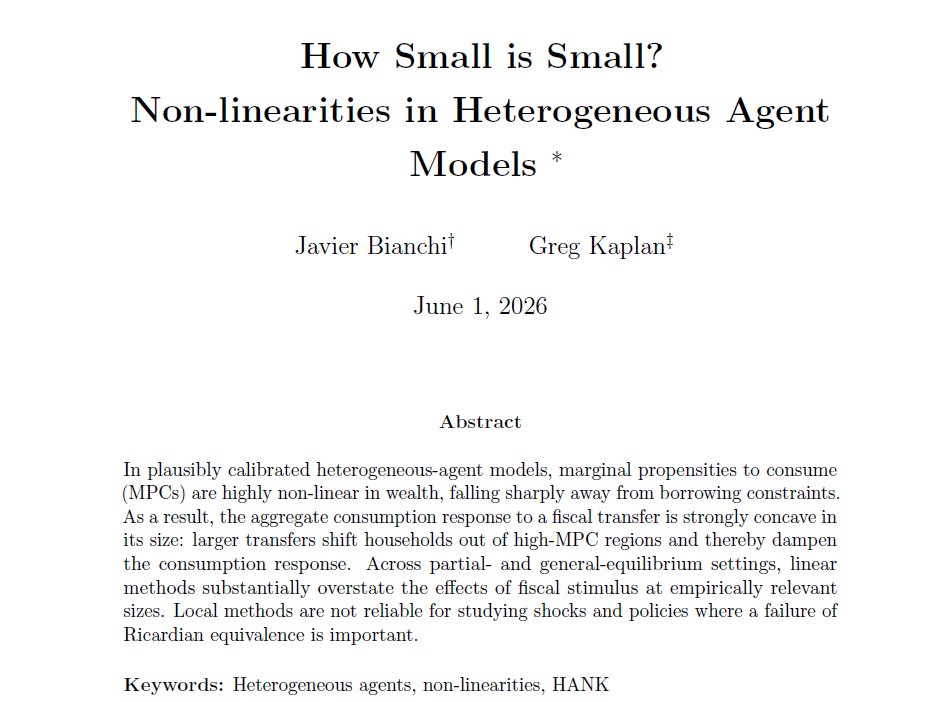
📢 New paper w/ @GregWKaplan 🧵1/10
How small is “small” for local-linear methods to deliver reliable answers in heterogeneous-agent models of fiscal stimulus?
Our answer: very small.
Excited to FINALLY release toughest+most rewarding paper I've worked on...
….we attack a 150 year old Walras question that's gone unanswered, not for lack of trying (Hicks, Samuelson, Arrow; our chances?😱)...
Q: Is the market equilibrium stable or unstable?¯\_(ツ)_/¯
🧵
Alternative scenarios often proved more accurate than the baseline forecast. New #FEDSPaper catalogs 1,265 'what-if' exercises from 1968-2020, tracking how Fed staff prepared for demand shocks, supply disruptions, and financial crises. https://t.co/4cBAL1xzl4 #FedResearch
It is an absolute pleasure to release this new work, joint with the great Emmanuel Farhi and Alan Olivi: "Price Theory for Incomplete Markets" (the title is a wink at my alma mater).
At long last, as it has been a very long haul.
https://t.co/YArkolyWYu
A brief thread 1/n
Studying how central banks should respond to commodity price shocks by showing that optimal monetary policy depends critically on the economy’s commodity exposure, from @td_econ, Michael McLeay, Silvana Tenreyro, and Enrico D. Turri https://t.co/0XAky8X8b6
If one wants to do this, compare P/E to TIPS yield, not nominal yield. Nominal yield is higher when expected inflation is higher. P/E is not affected by inflation.
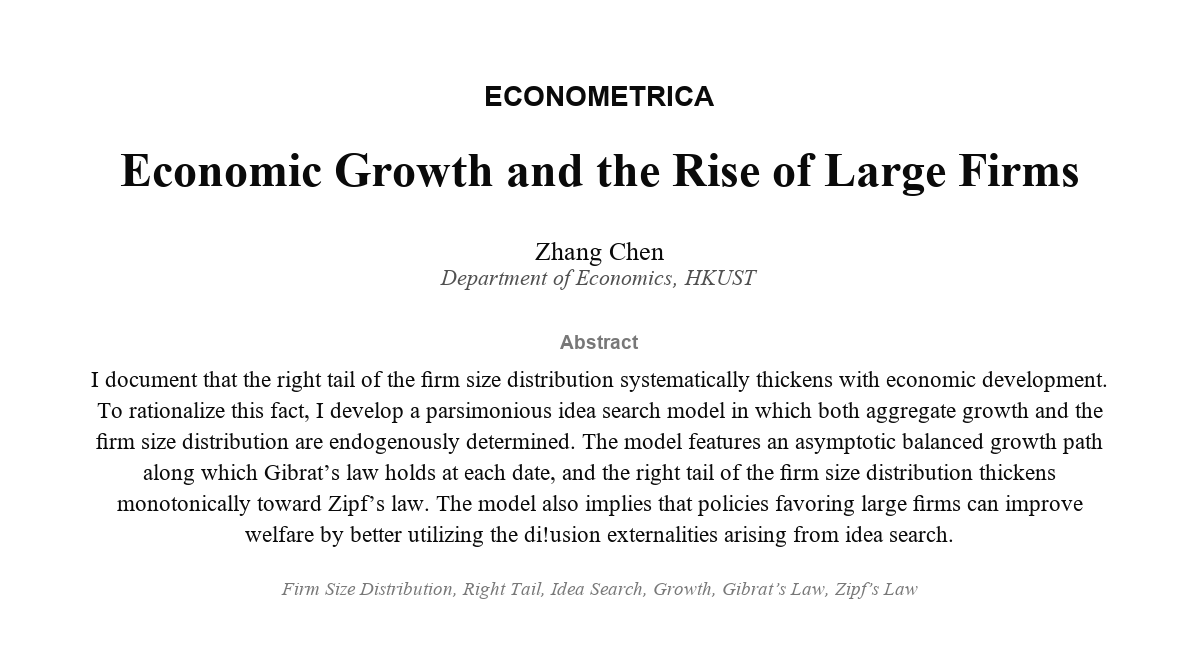
Why do richer economies have more very large firms? This paper shows that the upper tail of the firm size distribution thickens as economies grow. A model of idea search explains why, showing how growth itself can produce rising concentration.
https://t.co/ocOxbeV3Ww
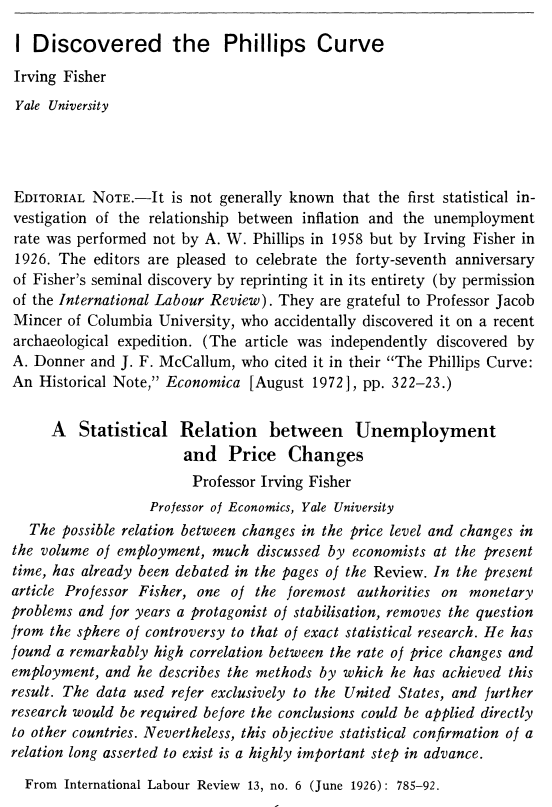
A Curious Fact from the History of Economic Thought: The Phillips Curve was first discovered by Irving Fisher, not A.W. Phillips.
Fisher was the first economist to conduct a statistical study and observe a trade-off relationship between inflation and unemployment in a 1926 paper. For comparison, Phillips' paper, which gave rise to his famous curve, only appeared in 1958!
The Journal of Political Economy even published a little-recognized retraction of this historical error in 1973.
Link: https://t.co/jsZSfZPEWh
Hagedorn's results on price level determination are incredibly important.
They are a true third theory of the price level to go along with the active monetary policy approach and the FTPL. (No, Hagedorn's theory is not a special case of FTPL.)
It's a tragedy that he isn't around to see them published.
Of course, none of the three approaches are perfect, but showing that options A and B are not the only possibilities is a massive contribution, deserving of a top 5.