Breaking:10/23/2026
OFFICIAL GAZETTE OF THE UNITED STATES OF BIAFRA
OFFICE OF THE DEPUTY PRIME MINISTER
ENACTMENT PROCLAMATION
ACT NO. 29 OF 2026
THE PROTECTION OF CONSTITUTIONAL ORDER AND PREVENTION OF SABOTAGE ACT, 2026
Biafrans in Defacto and in the Diaspora,
On this day, October 23, 2026, history has been made.
1. CABINET VOTE RESULT:
The Cabinet and Expanded Cabinet of the United States of Biafra USB conducted a formal vote on the Protection of Constitutional Order and Prevention of Sabotage Bill, 2026.
TOTAL VOTES CAST:
235
YES: 235
NO: 0
ABSTAIN: 0
The Bill was *UNANIMOUSLY APPROVED*.
2. PEOPLE'S MANDATE – CERTIFIED:
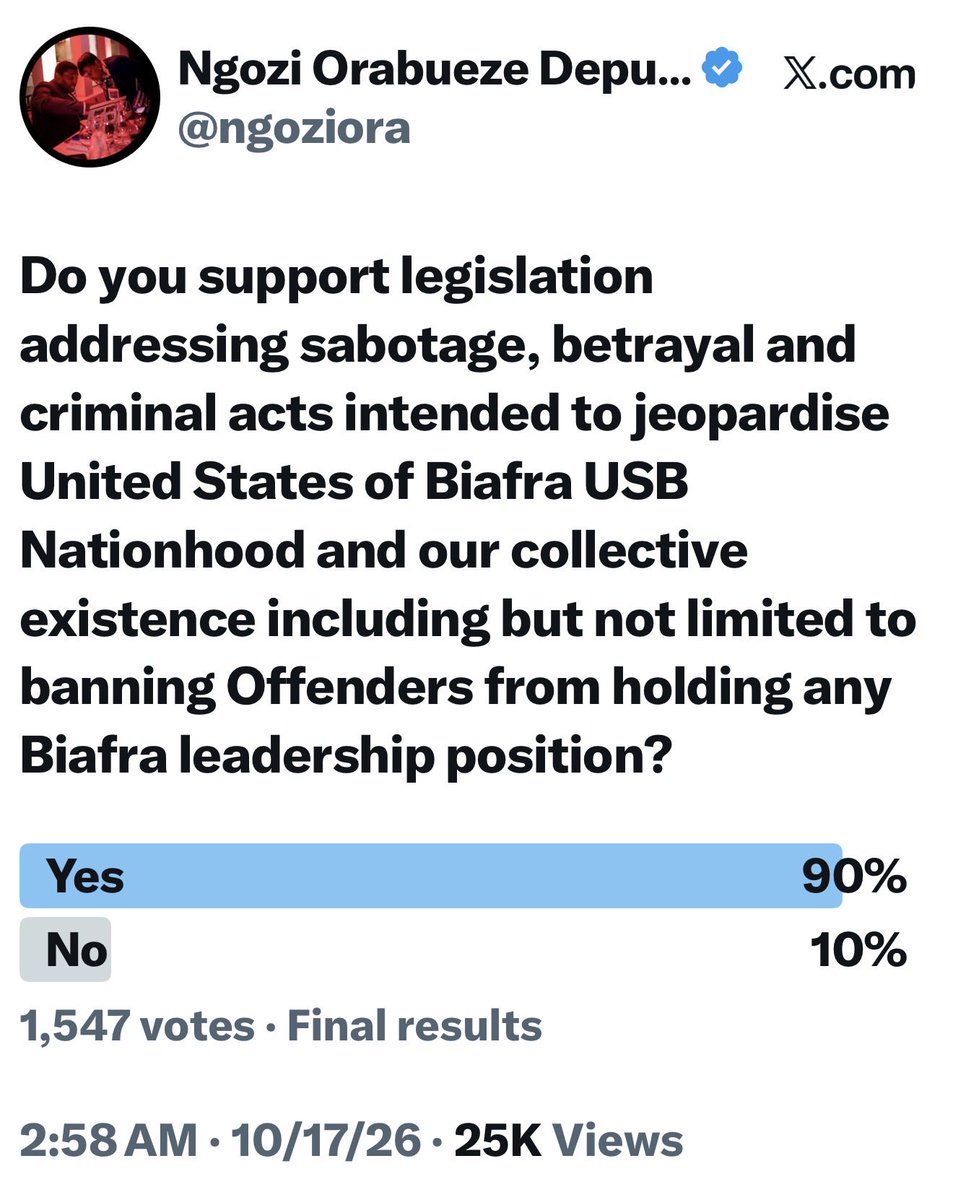
This Bill received Certified United States of Biafra Public Mandate between October 17 - 22, 2026, when 1,547 Biafrans voted on X (Twitter, Annex A attached)
Result:
YES: 90.0%
NO: 10.0%
This overwhelming public endorsement demonstrates that the people of Biafra demand protection of our nationhood, constitutional institutions and national security. A certified screenshot of the poll is attached as Annex A to this Gazette.
3. ENACTMENT:
In accordance with the Constitution of the United States of Biafra, ISBN: 979-8-89940-273-9, (page 10, paragraph 7 Preamble), and Articles 204(3), 211, 212(3) and 267(1)-(3) and (9), 153, 154, the Bill is hereby
*passed into Law as Act No. 29 of 2026*.
4. PURPOSE:
To prohibit sabotage, espionage, corruption involving national security and other serious offences intended to cause substantial harm to USB, with proportionate penalties including but not limited to disqualification from specified public offices and all leadership positions of the government.
5. EFFECTIVE DATE & NON-RETROSPECTIVITY:
This Act comes into force on the day of voting by the USB Cabinet and expanded Cabinet 10/23/2026, and upon publication in the Official Gazette and *shall have no retrospective effect*.
Due process, fair hearing and equality before the law shall be upheld at all times.
This Act is an addition to the specific portions in the United States of Biafra Constitution that addresses Sabotage and Related matters/Offenses.
Congratulations to all Biafrans. The Constitution is now protected.
Signed:
Dr. Ngozi Orabueze
Deputy Prime Minister
United States of Biafra
10/23/2026
@FLOTUS@IvankaTrump@EricTrump@realDonaldTrump@StateDept@WalidPhares@RepRileyMoore@TiborPNagyJr@officialABAT@alexstubb@Huuhkajat@yleuutiset@batten_von@MobilePunch@JDVance@SenTedCruz@MikeCollinsGA@RickJacksonGA@washingtonpost@cnni@cnnbrk@BBCWorld@BBCBreaking@channelstv@ARISEtv@vanguardngrnews@FoxNews@UN_HRC@UNHumanRights@netanyahu@VladimierPutin@_AfricanUnion@ICC@FBIDirectorKash@FBI@INTERPOL_HQ@Interpol@CIA@GunterFehlinger@HQNigerianArmy@PoliceNG@AloyEjimakor@HouseGOP@HouseForeignGOP@SenateForeign@SkyNews
USB General Fundraising
Date: Saturday October 24, 2026
Time: 7:00 PM Biafra time, 2:00 PM est.
Join Zoom Meeting
https://t.co/FpEdXKbH7X
Join and take notes
https://t.co/t4Y1hpDUei
Meeting chat link
https://t.co/pscwmc7KRI
Meeting ID: 837 4381 8000
Passcode: 815647
---
One tap mobile
+13017158592,,83743818000#,,,,*815647# US (Washington DC)
+13052241968,,83743818000#,,,,*815647# US
---
Join by SIP
• [email protected]
Join instructions
https://t.co/WqM6u6G4JA
Congratulations to Hon Joachim Bazant, Honorary Consul and Envoy to the Republic of Austria.
We appreciate your service and wish you continued success.
Signed:
Ambassador Hon. Mercy Owhodua
Head of European Affairs
Press release; 10/23/2026
NIGERIA MUSLIM JUDGES AND STATE CANNOT CONTINUE TO JAIL AND KILL CHRISTIAN BIAFRANS WHILE THE WORLD WATCHES
Hauwa J. YILWA (pictured) a Muslim Judge in Nigeria yesterday Jailed Paul Okechukwu (a Biafran) to 20 years for being a Biafran to STOP the new Christian Nation of United States of Biafra.
The Government of the United States of Biafra condemns the 20-year prison sentence imposed on Mr. Paul Okechukwu, 48, a Biafran, by the Federal High Court Abuja for membership of IPOB. This systemic pattern of jailing has persisted for over 30 years and MUST Stop
Recent Finnish judgement in the case of Simon Ekpa vs Nigeria government has confirmed that the Nigeria state and politicians are in a civil like war with the Biafra people - to STOP their self determination and new christian Nation - USB
1. Biafrans are not terrorists.
2. Sentencing a man to 20 years for membership alone, after withdrawing the violent act charge, proves the case was about criminalizing identity, not preventing terrorism.
3. We call for immediate release of Paul Okechukwu and I call on our leader Onyendu Nnamdi Kanu’s former Counsels - Aloy Ejimakor and Maxwell Opara to appeal this judgement immediately.
4. We call on our allies to notice the pattern used by Nigeria terrorist state and its politicians Tinubu, Charles Soludo, Nyesom Wike, Alex Oti, Peter Mbah, Akpabio, Nwifuru, Fubara, DSS chief Ajayi , Bianca Onoh Ojukwu, etc. in the use of Nigerias Terrorism Prevention Act to suppress, jail and kill Biafrans.
On October 26, 2023, Justice A.O. Onovo of Enugu State High Court in Suit No: E/20/2023* — filed by Nnamdi Kanu through Barr Aloy Ejimakor against Southeast Governors Forum and FG — declared:
The practical application of the Terrorism Prevention Act and the executive or administrative action of the Respondents which directly led to the proscription of IPOB and its listing as a terrorist group was *unconstitutional*."
“IPOB being comprised of citizens of Nigeria of the Igbo and other Eastern Nigerian ethnic groups, professing the political opinion of *self-determination*... is illegal, unlawful, unconstitutional" to proscribe on that basis
So what does that mean for Paul Okechukwu?
1. *Contradiction of Courts:* One High Court (Enugu) says proscription itself is unconstitutional and self-determination is not a crime. Another High Court (Abuja) now uses that same proscription to give 20 years for mere membership.
2. No violent act: The FG withdrew count 2 (the alleged killing of 2 security operatives). So he was sentenced only for belonging, not for violence- (Nigeria Police, Security operatives, Tinubu, Christopher Musa, the Sokoto Caliphate, Nigeria DSS Ajayi and Biafra Nigeria politicians have over the years falsefully accused innocent Biafrans of killing Nigeria security operatives just to jail, kill and remove them - same pattern in Simon Ekpas case in Finland - this is typical of Nigeria and that’s why their police testimony cannot be accepted in any civil court in the world. A Canadian federal court described Nigeria police as evil that commits crimes against humanity
Nigeria cannot have two laws. Enugu High Court says IPOB proscription is illegal and self-determination is not a crime.
Abuja High Court uses the same proscription to jail a Biafran 20 years for membership alone. Which is the law?
Nigeria is currently, forcefully, illegally occupying a Sovereign Nation - USB and MUST leave.
Dr. Ngozi Orabueze
DPM USB
@EricTrump@realDonaldTrump@StateDept@FBIDirectorKash@FBI@CIA@INTERPOL_HQ@batten_von@WalidPhares@TiborPNagyJr@officialABAT@alexstubb@yleuutiset@Huuhkajat@MobilePunch@UN_HRC@UNHumanRights@amnesty@amnestyusa@HURIWA_NIGERIA@IntersocietyN@_AfricanUnion@ICC@Europarl_EN@USArmy@IDF@netanyahu@AloyEjimakor@MaxwelOpara@NigLegalView@NigerianLegalN@IHRF_English@jihadwatchRS@JDVance@SusieWiles47@SenTedCruz@RepRileyMoore
https://t.co/LSh3PJ8RxA
Biafrans! ❤️🎶 I made and dedicate this song to my wonderful Mommy, DPM Dr. Ngozi Orabueze, in honor of her courage, resilience, and unwavering strength. Mommy, this melody comes straight from my heart to you!
Nnem Biafrans are proud to have a mother like you ❤️🙏🎵
@ngoziora
Dear Dr. Ngozi Okonjo-Iweala (@NOIweala),
I had intended to write a detailed piece about how you are being used as a neo-colonial agent to further drag the people of Biafra, whom you conveniently refer to as the “South-East,” into deeper subjugation, oppression, and avoidable deaths. By continuing to validate a colonial entity and an imposed Nigerian identity that have brought untold suffering to our people, you are helping to perpetuate the very system that has made their lives miserable.
However, when I thought about my mother, the profound respect I have for her, and the dignity I accord Biafran women and women everywhere, I decided not to proceed with that publication.
The people of Biafra have shown you enough respect. Please, do not mistake that respect for weakness or push their patience beyond its limits.
For your information, the so-called Federal Government you refer to in this video is the very group of people Biafrans regard as genocidists and terrorists, whose conduct has been the subject of serious concerns globally, including Canadian judicial proceedings. While those you dismissively refer to as “groups” are, in fact, the true Government and representatives of over 70 million Biafrans and their aspirations (@USBGovernment).
Let me ask you two straightforward questions:
Have you ever publicly condemned the kidnap and extraordinary rendition of Mazi Nnamdi Kanu from Kenya to Nigeria by your so-called Federal Government?
Have you ever spoken publicly and unequivocally against the killings, persecution, enforced disappearances, and other grave human rights violations suffered by Biafrans, including those demanding their right to self-determination and genuine independence?
For your information, nobody needs to order Biafrans to sit at home. For Biafrans, the sit-at-home exercise is a voluntary expression of political resistance and a demonstration of their determination to delegitimise Nigeria's illegal annexation and occupation of their homeland. Attempts to portray exercise as something imposed by a "group(s)" ignore the political grievances and aspirations driving that resistance.
#NigeriaMustGo
Many Biafrans, myself included, are looking forward to the day you and others like you retire from public life and enjoy some well-deserved rest. So, those who genuinely champion the Biafran cause can intensify their diplomatic engagement with the international community, amplify the cries of our people, and pursue their freedom from the shackles of a political system that you continue to defend and legitimise.
You should also understand that your international reputation and professional achievements do not automatically translate into political legitimacy or popularity among Biafrans. Many who regard you as a neo-colonial agent believe that your public positions serve the interests of the Genocidal Nigerian regime rather than the aspirations of the Biafran people.
For these Biafrans, the Ngozi they look up to is H.E. Dr. Ngozi Orabueze (@ngoziora), who is fighting for their freedom, dignity, self-determination, and complete decolonisation in accordance with international law.
History will not judge you merely by the prestigious offices you have occupied, the international institutions you have led, or the honours you have received. It will also judge where you stood when your own people demanded freedom, dignity, justice, and the right to determine their political future.
No amount of international prestige can substitute for standing on the side of justice. And no amount of political influence can silence a people determined to be free.
Thank you.
Christopher Okenwa
United States of Biafra Mission in Norway
Press release: 10/22/2026
USB CABINETS AND CITIZENS VOTE ON LEGISLATION ADDRESSING SABOTAGE
Date: Friday October 23, 2027
Time: 7:00 PM Biafra time, 2:00 PM est.
Join Zoom Meeting
https://t.co/uIZzwI332k
Join and take notes
https://t.co/Cra8O0wo13
Meeting chat link
https://t.co/BxfcmmgwrJ
Meeting ID: 872 3909 8695
Passcode: 955304
---
One tap mobile
+13126266799,,87239098695#,,,,*955304# US (Chicago)
+16469313860,,87239098695#,,,,*955304# US
---
Join by SIP
• [email protected]
Join instructions
https://t.co/IyxXwgSWCa
Biafra in the Norwegian Parliament -- 22 August 1968
English translation and speaker-by-speaker extraction
The document is a 42-page transcript of a meeting of Norway's Extended Foreign Affairs and Constitutional Committee (Den utvidede utenriks- og konstitusjonskomité), held on Thursday, 22 August 1968.
Biafra was discussed extensively, particularly on pages 25–42, under the agenda item The Situation in Nigeria. There are also references on pages 2–4.
The discussion is historically significant because Norwegian politicians examined the humanitarian catastrophe in Biafra, Nigeria's military blockade, recognition of Biafran independence, accusations of genocide, and whether Norway should take the matter to the United Nations.
Below, I identify speakers by name and position and render their statements in English. These are English translations or condensed translations, not original English quotations.
Opening remarks
1. Bent R��iseland -- Committee Chairman
Page 2
Just a couple of days ago, we were primarily concerned with the tragic events in Biafra. Yesterday, hardly anything was said about it on the radio, and now our attention has turned to Czechoslovakia. But it is clear that the situation in Biafra is just as terrible today, even though we have practically begun to forget it.
Røiseland stressed that the emergency in Biafra had not become less serious simply because another international crisis had attracted public attention.
2. Per Borten -- Prime Minister of Norway
Page 3
I would also like to emphasize what the Chairman said at the beginning: although the Biafran tragedy was overshadowed in yesterday's public debate, the tragedy remains just as great and just as unresolved. It is therefore appropriate that we devote some time to it while we are assembled.
Borten also indicated that Foreign Minister John Lyng should provide a detailed account of the situation and the government's actions.
Main discussion -- pages 25–42
3. John Lyng -- Minister of Foreign Affairs
Pages 25–30, 36–37 and 40–42
Lyng delivered the government's principal account of the Biafran crisis.
On the humanitarian catastrophe:
The tragedy in Biafra has not become any less serious simply because it has been overshadowed by another tragedy closer to us.
He explained that the government had approached Biafra primarily as a humanitarian emergency, while acknowledging the complicated political questions underlying the conflict.
On the Nigerian military blockade:
The central problem has become how the military blockade surrounding Biafra itself can be broken.
He estimated that at least 8–10 million people remained within the Biafran-controlled territory, although he emphasized the uncertainty of available figures.
He explained that Norway had provided dried fish, financial assistance, medical support and funding for humanitarian air transport. He also described diplomatic attempts to persuade the Nigerian authorities to permit relief supplies to enter.
On Biafran self-determination and recognition:
We are aware that the political problem must be resolved, and that it must be resolved in such a way that the population of these districts also obtains the right to self-determination--or equal participation in decision-making within a larger federal arrangement.
Lyng declined to decide whether that should mean a sovereign Biafran state or a different federal constitutional arrangement. His stated concern was that taking a position on sovereignty first might obstruct urgently needed humanitarian relief.
On the United Nations:
Lyng said Norway would reconsider approaching the UN Security Council, despite doubts that sufficient support could be secured. He also discussed using the UN General Assembly if necessary.
4. Lars Korvald -- Member of Parliament
Pages 30–31
On recognizing Biafra as an independent state:
When recognition of Biafra was previously withheld, I understood the reasoning to be that recognition might do more harm than good, because it could lead Nigeria to crush Biafra quickly and make the suffering even worse.
He continued:
However, we may now have reached the point where it is clear that this will happen in any case. The question of recognition has therefore entered a somewhat different situation.
Korvald asked whether Norway, possibly in consultation with other Nordic countries, had reconsidered recognition in light of recent developments.
Personally, I cannot see any strong objections to such an action at the present moment.
He also supported attempting to bring the matter before the UN Security Council, despite the uncertain prospects.
5. Finn Moe -- Member of Parliament
Pages 31–32 and 39
Moe expressed a markedly different position.
On Biafran independence and the war:
I have arrived at the view--or at least the thought has occurred to me--that when nothing else works, Biafra itself ought to be able to stop this war rather than watch its people starve.
He added:
If I were a statesman, I believe I would prefer to stop the war and postpone the entire question of independence until a later time rather than see my people starve to death.
On genocide accusations against Nigeria:
It has been suggested that Nigeria should be accused of genocide. Every war is genocide, and here there is also the question of who started it. It was Biafra that broke away from Nigeria and began by declaring itself independent.
He argued that Nigeria's military response to secession could not automatically be characterized as genocide. This was Moe's position in 1968, not a statement of the modern legal definition of genocide.
On the price of independence:
I believe Biafra should be told that independence can be bought at too high a price.
Moe opposed steps that he believed could make Norway a participant in the war, including forcibly breaking the military blockade.
6. Gunnar Garbo -- Member of Parliament
Pages 32–33
Garbo emphasized the moral responsibility of Norway and the United Nations.
On humanitarian intervention:
In this case, purely formalistic considerations about interference in the internal affairs of a foreign state must give way to the most elementary humanitarian reasons compelling us to help save lives.
He argued that Norway should help create the political will within the United Nations to act, rather than accept existing institutional limitations as final.
Garbo believed the Norwegian government had strong public support to take further humanitarian initiatives.
7. Bernt Ingvaldsen -- Member of Parliament
Page 33
Ingvaldsen questioned whether the international community and Norway had exhausted all available possibilities for action. He was concerned about the effectiveness of diplomatic efforts and the urgency of securing humanitarian relief for Biafra.
8. Aase Lionæs -- Member of Parliament
Pages 33–34 and 40–41
Lionæs supported further international action through the United Nations.
On involving the UN:
She proposed that Norway seek to raise the crisis in the Security Council through Denmark, which was then a member of the Council.
If that failed, she suggested bringing the matter before the UN General Assembly, potentially through an extraordinary session.
On the urgency of action:
Today, every day is a matter of life or death for many people.
Lionæs emphasized that waiting for ordinary UN procedures could delay action for months.
She also argued that the United Nations could act in accordance with its fundamental principles without necessarily taking sides in the conflict.
9. Karl J. Brommeland -- Member of Parliament
Pages 34 and 39–40
Brommeland was among the speakers advocating stronger political action.
On accusing Nigeria of genocide:
He referred to a proposal that Nigeria should be accused of genocide through the United Nations or other international mechanisms.
On recognition of Biafra:
If a sufficient number of countries recognized Biafra, it would have a greater influence on world opinion and the United Nations.
Here Brommeland was recounting an argument attributed to Ambassador Hambro in a television discussion.
On responsibility for the humanitarian catastrophe:
Brommeland attributed primary responsibility to the central government in Lagos, arguing that it treated humanitarian assistance as military assistance and sought to obstruct its delivery.
He suggested considering three measures: recognition of Biafra, a genocide accusation against Nigeria, and bringing the crisis before the UN Security Council.
He also raised the possibility of temporarily recalling Norway's ambassador from Nigeria.
10. Rakel Seweriin -- Member of Parliament
Pages 35–36
Seweriin emphasized the strength of international public concern about Biafra and the need for an institutional response.
On the United Nations:
What is not merely a weakness, but directly dangerous in the present situation, is that we are getting nowhere through the United Nations when it comes to expressing such strong public opinion.
She warned that the inability of the UN to respond meaningfully could undermine confidence in the organization.
Seweriin asked the government to consider every possible way of bringing the Biafran crisis before the United Nations.
11. Per Borten -- Prime Minister of Norway
Pages 35–36
Borten disclosed that he and the foreign minister had received representatives from both Nigeria and Biafra.
On meetings with Biafran government representatives:
The most recent visitors I received were two envoys from the Head of State of Biafra. They presented their views on the conflict.
He identified one as the Biafran finance minister and the other as Dr. Ifeagwu, a former ambassador in Moscow and chief negotiator with the EEC.
Borten read an appeal from the Biafran representatives:
Your country has in recent years become known as a moral force to be reckoned with in the world. Action by you now will therefore carry great weight.
He also reported their argument that recognition of Biafra had helped bring about negotiations in Tanzania, while explicitly emphasizing that this was the Biafran representatives' account.
On Biafra's struggle:
Personally, I am deeply affected by this entire tragedy. It has certain similarities with the freedom struggles of other peoples.
Borten supported renewed consideration of UN involvement to alleviate the humanitarian catastrophe.
12. Erik Braadland -- Member of Parliament
Pages 37 and 41–42
Braadland criticized Nigeria's refusal to cooperate with humanitarian relief operations.
On the Nigerian government's treatment of the Red Cross:
We saw a government statement from Nigeria as recently as yesterday in which they said that they would not recognize the Red Cross at all, and that it was a highly dubious organization.
On protecting humanitarian aircraft:
What is required is simply that the Nigerian air defence refrains from shooting down Red Cross aircraft bringing medicines and other assistance.
He asked the Norwegian government to make renewed diplomatic representations to Lagos and to press the British Foreign Office to use its influence.
Braadland specifically sought a humanitarian air corridor through which the International Red Cross could deliver supplies without being attacked.
13. Magnus Andersen -- Member of Parliament
Page 38
Andersen supported bringing the Biafran crisis before the United Nations.
On international inaction:
There are thousands upon thousands starving to death in the areas where fighting is taking place, and also behind the front lines.
He questioned whether Norway was exercising excessive caution because of relations with influential countries, including Britain.
On recognition of Biafra:
Andersen supported Norway's decision not to recognize Biafra unilaterally. He argued that recognition would be meaningful only if enough countries acted together.
On UN responsibility:
When things are like this in the world we live in today, with the international organization we have, and we are unable to do anything to try to change these conditions, one is left with a feeling of having lost face.
He urged the Norwegian government to take the initiative at the United Nations.
14. Andreas Wormdahl -- Member of Parliament
Pages 38–39
Wormdahl acknowledged concerns that an unsuccessful attempt to bring Biafra before the United Nations could damage the organization's prestige.
However, he argued that humanitarian necessity should take precedence.
The matter we are discussing is of such a nature that we must act—not for the sake of our own morality or our own conscience, but for the sake of those who are suffering.
He supported renewed diplomatic contact with the UN Secretary-General and urged the Norwegian government to take action.
What this historical document establishes
The transcript documents several important historical facts about Norway's engagement with Biafra in August 1968:
1. Biafran government representatives met the Norwegian Prime Minister and Foreign Minister. Prime Minister Borten expressly acknowledged receiving envoys from the Biafran Head of State.
2. Recognition of Biafran independence was openly discussed. Lars Korvald and Karl J. Brommeland raised arguments for reconsidering recognition, while other members opposed or reserved judgment on that course.
3. Genocide accusations against Nigeria were discussed. Brommeland advocated examining this possibility, while Finn Moe challenged the characterization.
4. Norway's Foreign Minister explicitly acknowledged self-determination as part of a political solution. However, he did not endorse independence as the only acceptable outcome.
5. The Nigerian blockade and obstruction of humanitarian relief were central concerns. Several speakers urged diplomatic pressure, Red Cross air corridors and UN intervention.
6. The Norwegian government considered renewed action at the United Nations, but the discussion did not amount to a formal Norwegian recognition of Biafra.
Source: Den utvidede utenriks- og konstitusjonskomité, meeting of 22 August 1968, pages 2–4 and 25–42. All statements above are translated or condensed from the Norwegian transcript you supplied.
Link: https://t.co/zbzdia1j9V
@_AfricanUnion @court_afchpr
ORGANIC SOVEREIGN SUCCESSORSHIP & JURIDICAL CONTINUUM
The United States of Biafra (USB), the Organic Successor to the Republic of Biafra, is not a new nation but a Generational Continuum of an existing sovereign people. Deriving momentum from the Vienna Convention on Succession of States, the USB assumes all inherent rights, titles, and sovereign attributes previously vested in the Republic of Biafra, adapted for the Current Generational Reality.
BIAFRA AS A PEOPLE, NOT A NOMENCLATURE
The express/tacit recognition of the Republic of Biafra (between 1967–1970) by nations such as Tanzania, Gabon, Ivory Coast, Zambia, and Haiti, France, Spain, Portugal, South Africa, Vatican, Israel, Norway and Rhodesia, was a recognition of a People and their Inherent Genetic Blueprint, not merely a political label. Pursuant to the Lahti Declaration of Restoration(2024), the international community acknowledges that the "Biafran Identity" is an indestructible legal entity. The USB is the functional fulfilment of this identity, asserting Absolute Jurisdiction over the 40 States.
LEGAL BACKING & THE LAHTI MANDATE
The Lahti Declaration of Restoration serves as the modern diplomatic bridge, confirming that the restoration of the Republic of Biafra under the structure of the United States of Biafra is a legal necessity. This continuum is supported by UN General Assembly Resolution 1514 (XV), which mandates the right to self-determination, AU Resolution 903(XXXVIII) and UN Resolution A/RES/80/106. The failure of the 1914 Amalgamation renders the Nigerian jurisdiction a Principle Nullity in the face of this organic succession.
JURIDICAL OBLIGATION OF THE SUCCESSOR STATE
The USB, as the Successor, hereby notifies all global bodies that it inherits all territorial claims and maritime rights of the 1967 Republic, now refined under USB to include absolute digital and resource sovereignty.
AFRICAN RESOLUTION & INDIGENOUS JURISPRUDENCE
Under the African Charter on Human and Peoples' Rights Article 20, all peoples have the unquestionable right to existence. Our Chi, the essence of our indigenousness, is the primary witness to this succession. Without the recognition of this identity, the UN Resolution for regional peace remains a contradiction.
@_AfricanUnion@court_afchpr