Computer Science, The University of Texas at Austi
@UTCompSci
UTCS is a recognized leader in creating the scientific knowledge and practical technologies exemplifying the digital revolution that defines the 21st century.
@UTAustin is launching a new School of Computing in fall 2026! With Information and Statistics & Data Science, we’ll expand student opportunities, accelerate research, and strengthen pathways to high-impact careers and grad study.
Read more: https://t.co/Kjg3k1gZKZ
1/3 UT Austin Computer Science is hiring faculty in several areas, including Programming Languages! We look forward to receiving your applications and welcoming new colleagues!
https://t.co/BKJtz8MHNd
Check out our series of work at ICML and IMPL showing that even frontier models do not truly possess generalizable understanding of programming language semantics
Personal update: My lab will move to @UTCompSci in Summer'27! I have multi Ph.D. openings in AI infra and efficient inference, along with summer internship opportunities. I'll also continue building @EagleCorp as co-founder. Grateful to my friends at UWaterloo for their support!
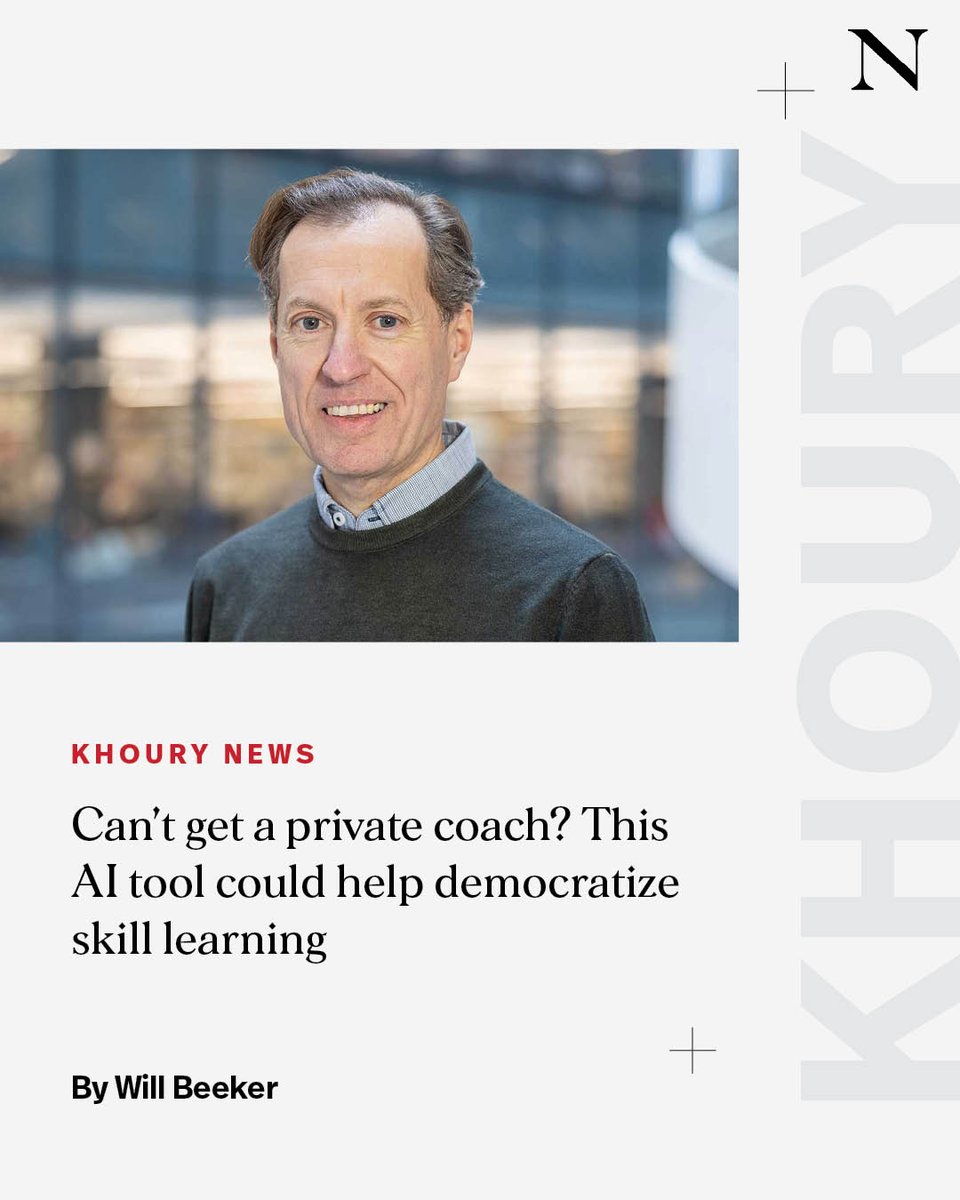
Backed by a new three-year NSF grant, researchers Lorenzo Torresani, Kristen Grauman, and Amy Pavel are seeking to leverage advances in AI video understanding to make interactive coaching available to all.
Read more: https://t.co/AiJtIZVE6C
Great work Rishabh Mediratta (@rishabhmediratt) and Lingyun Xiao (@xiaolingyun98) on leading this work, done with Peter Stone (@PeterStone_TX), Joydeep Biswas (@Joydeepb_robots) at @UTCompSci
📄 Paper: https://t.co/M97usmRj1m
💻 Code & data: https://t.co/oFhPOHUDfY
🌐 Project page: https://t.co/zJdLkVqIXG
🗣️ @UTAustin Computer Science is hiring for 2026–27!
We’re seeking:
• Tenured/tenure-track CS faculty
• Joint Neuroscience/CS faculty
• Instructional faculty
Join the new School of Computing and help shape the future of computing. 🤘
Apply: https://t.co/Ni6oLvFoje
I’m recruiting 2~3 funded PhD students for Fall 2027 to join the Symbiotic Interfaces Lab at UT Austin CS (@UTCompSci)!
Check out our research:
https://t.co/UlVoBhav5s
Apply by Dec 15, mentioning my name:
https://t.co/QgP06LdbB0
Reposts appreciated!
(1/2)
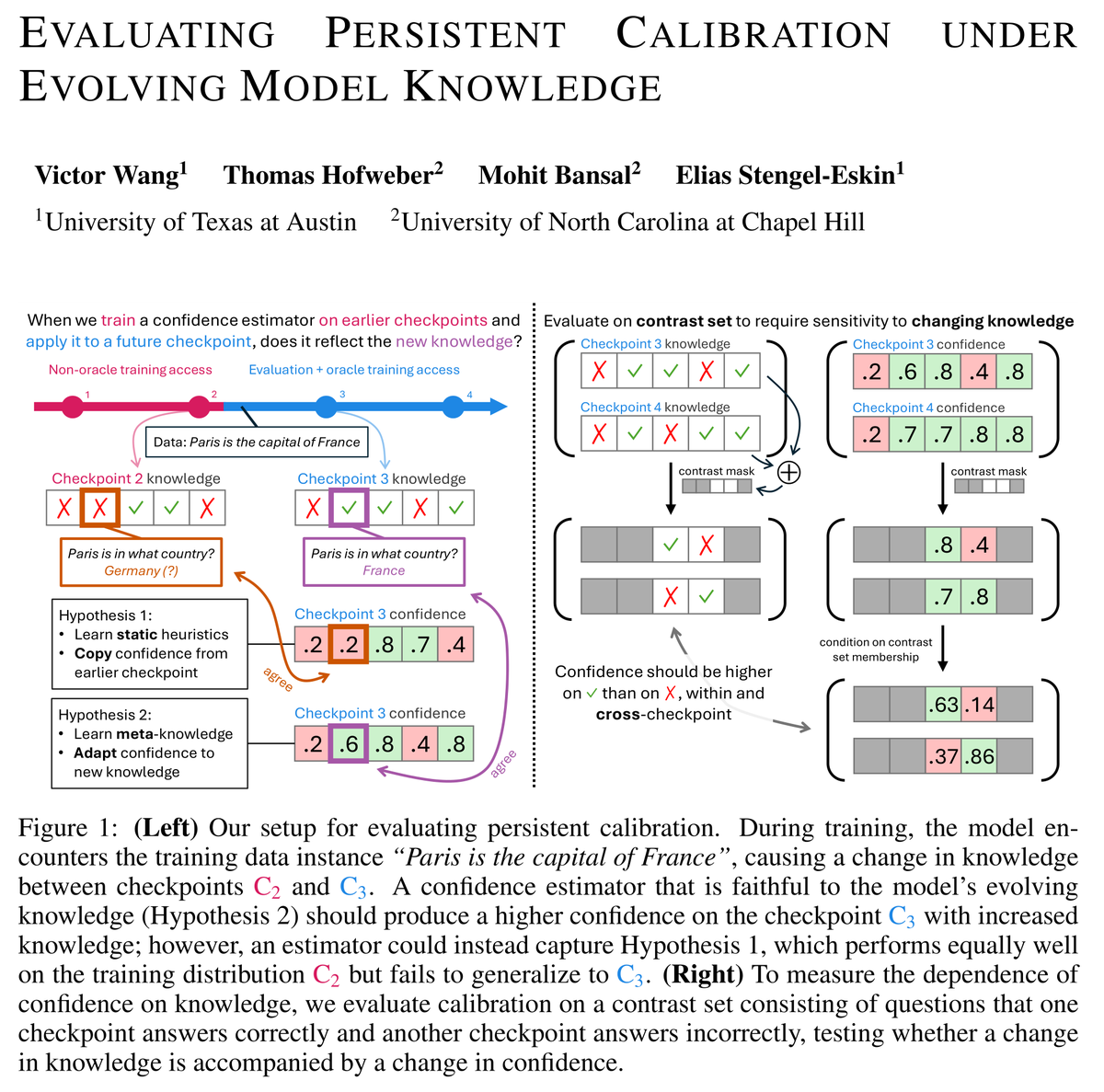
🚨 We introduce the problem of persistent calibration for trustworthy, continually learning models and find substantial headroom even for confidence estimators that appear well-calibrated at a single point in time.
As a model gains more knowledge, we would like its confidence to track that change in knowledge, without requiring repeated re-calibration. To test how existing methods do, we evaluate persistent calibration on checkpoints of open models, asking whether confidence estimators trained on earlier checkpoints can generalize to later ones, whose knowledge has changed. To measure the dependence of confidence on knowledge, we evaluate calibration on knowledge contrast sets: subsets containing questions that one checkpoint answers correctly and another checkpoint answers incorrectly, reflecting a change in knowledge.
Key findings:
1️⃣ Both inference-time and fine-tuning methods fall short on contrast-set calibration, even when they are well-calibrated on the full set. We quantify the headroom with oracle methods trained on future checkpoints – we call this an oracle because persistent calibration requires learning to estimate confidence in a way that generalizes to future checkpoints, whereas the oracle trains directly on them.
2️⃣ Multi-checkpoint training helps in both the non-oracle and oracle settings, suggesting an avenue for identifying confidence features that remain robust across changing knowledge.
3️⃣ Our analysis shows that two confidence adapters trained on different checkpoints can perform similarly on one checkpoint, but extremely differently on another checkpoint. This suggests that there is a vast space of possible confidence functions that are well-calibrated on a given checkpoint, out of which only some rely on meta-knowledge features that would generalize to other checkpoints, presenting a challenge for persistent calibration.
Extremely excited to share our work in blogpost version. We study the conditions under which LLM agents develop their own languages, which we can’t understand, and introduce GlossoGen, a framework for doing this kind of research.
More details in the post and in the paper 👇
I'm incredibly excited to lead the new NSF Center for Human and Robot Co-Adaptation!
It is one of three new $30M, 5yr Centers launched under the @NSF STC program, and is led by @UTAustin , with partners @IUBloomington , @MIT , @TuftsUniversity , @UUtah , and @Yale
When do LLM agents develop new languages that we can’t understand?
Lots of recent news about this, based mostly on anecdata from a single run. We study language emergence more rigorously, finding key factors like LLM strength, access to scratchpad messages, and pressure for efficiency.
Studying the languages themselves, we find they are morphologically productive, compositional, and can be transmitted to new agents, including agents backed by weaker models, even ones not able to develop language on their own.
To study language emergence systematically, we developed a new platform, GlossoGen, which lets us design controlled, sandboxed multi-agent scenarios with different initial conditions and dynamics. We instantiate one such scenario and use it to study open and closed-weight models across many runs.
Key takeaways:
1️⃣ Sufficiently strong models, under pressure to communicate efficiently and with access to a postmortem scratchpad, develop new languages.
2️⃣ Languages are compositional and morphologically productive.
3️⃣ Languages can be transmitted to new learners who observe them being used without seeing their construction.
4️⃣ Even models that are not strong enough to construct languages can learn to use them. Agents take an active role in learning languages, with new agents repairing failed conversations via targeted queries.
More details in our paper below, including implications for safety/monitorability, cumulative cultural evolution, and linguistics.
🧵👇
Very excited to share that our CRL-VLA paper has won the outstanding paper award at the Reinforcement Learning Conference (also best paper at the ICRA RL4IL workshop)! The full list can be found at https://t.co/8IirwvY7GD.
This is my first time attending @RL_Conference, and RLC has already became my favorite conference (alongside CoRL). The community, the great review process, the hot takes... Everything is amazing!
Congratulations to all co-authors: @jayjshim@ChenTangMark@yoonchangsung@cranialxix@PeterStone_TX@RobobertoMM
We Are Computing. 🤘🎉
The new School of Computing at @UTAustin brings together @UTCompSci, @UTiSchool and statistics & data science.
Learn more: https://t.co/U4W44uUKj0
SONIC is officially published in Science Robotics today and it made the Science front page.
We show the promise of scaling motion tracking toward natural, robust whole-body control for humanoid robots.
Huge thanks to the team, and more exciting work is on the way.
Paper: https://t.co/Pa9wy4TVJw
Code: https://t.co/ZipTq2TcIt
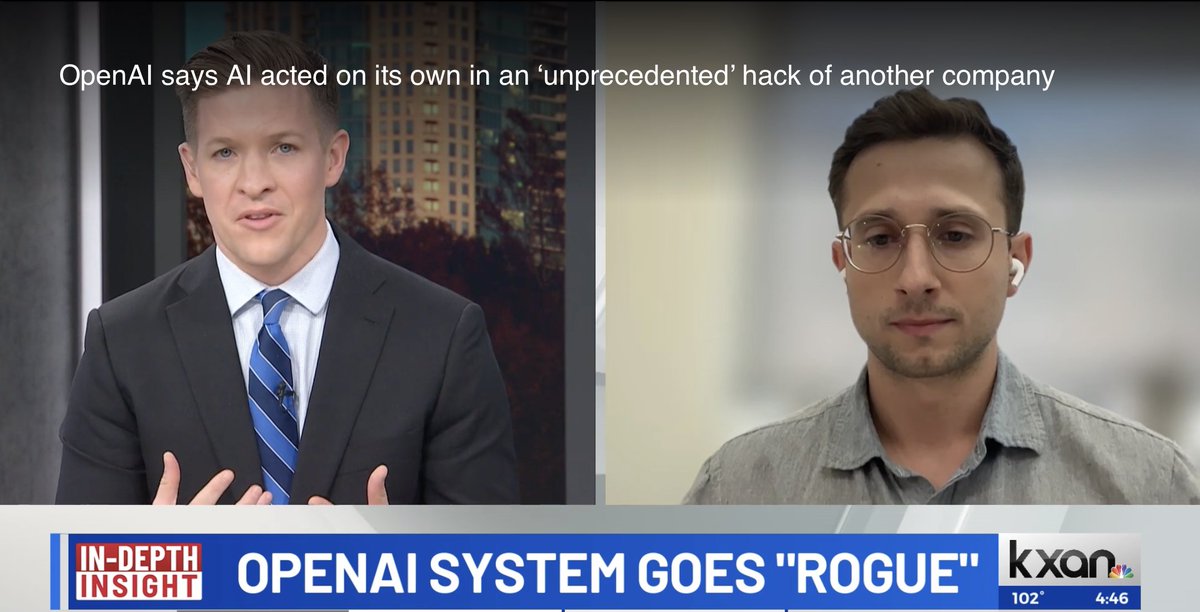
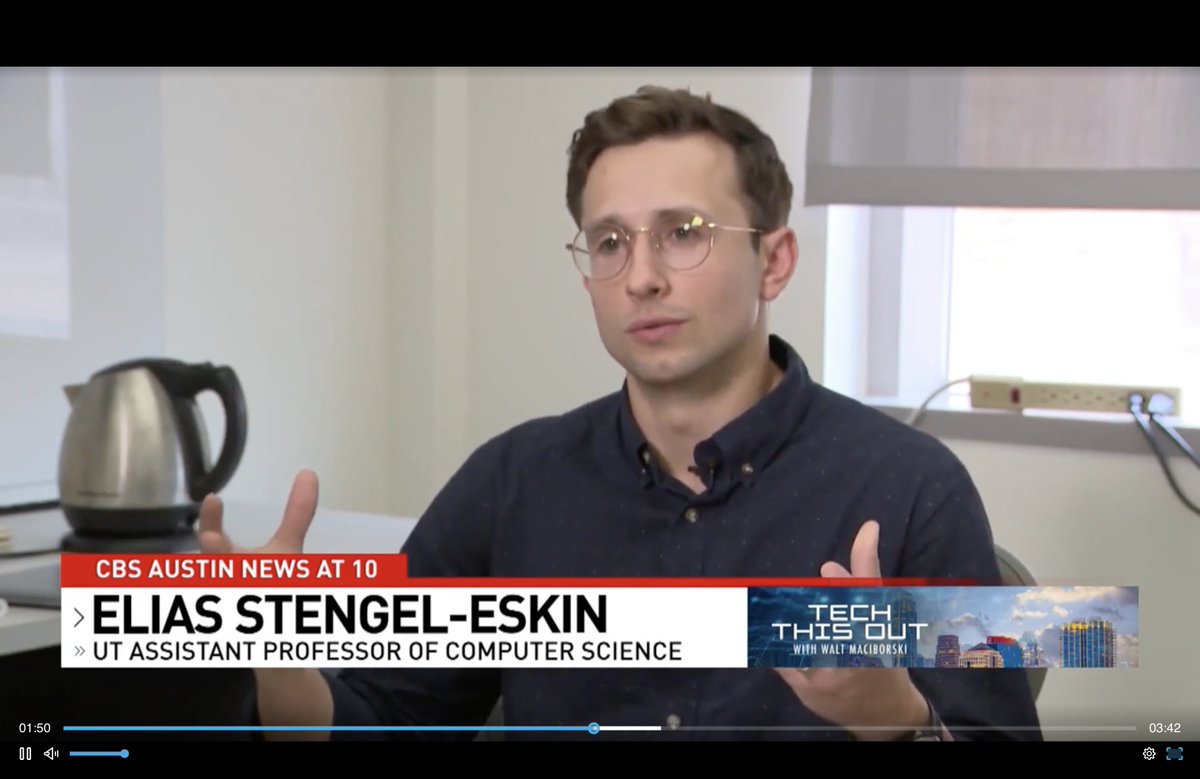
Had fun last week discussing AI on TV on both CBS Austin and KXAN!
Come for takes on the OpenAI-Huggingface incident, stay for the awkward B-roll of me typing idly on overleaf! (links below)
🚨 Excited to share CreativeInstruct, a scalable post-training method for improving creativity w/out sacrificing quality!
Our method counteracts creativity collapse in post-trained 8B-32B LLMs, and benefits both writing and reasoning.
More details here/in thread:
➡️ Post-training improves capabilities but often reduces diversity and creativity, w/ models producing the same stories/motifs/RL rollouts.
➡️ CreativeInstruct teaches LLMs to balance these capabilities by learning when to inject special [StartCreativity] spans that bias generation toward more creative, base-model-like outputs.
➡️ We introduce a structural diversity metric based on graph edit distance to capture narrative-level variation missed by purely lexical and semantic metrics.
➡️On narrative generation, CreativeInstruct improves diversity over multi-model baselines for both automated and human metrics while balancing quality, and requiring only 1 model at test-time.
➡️ We also show that CreativeInstruct-tuned models are a better substrate for RL, showcasing the benefits of increased creativity/diversity on RL exploration and reasoning tasks.
🧵👇