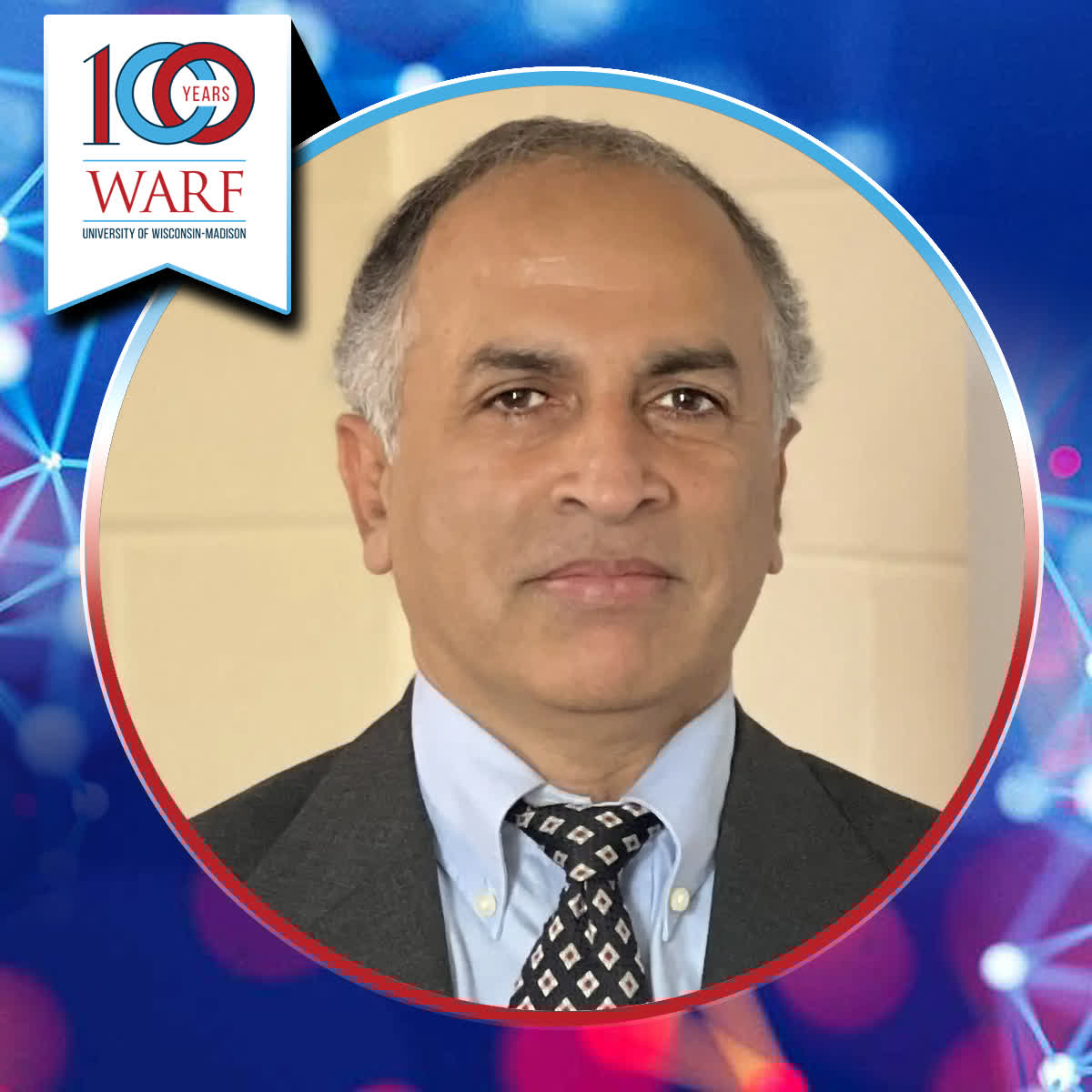
Meet Darryl Thelen, professor of @UWMechEngr@UWMadEngr, who researches the biomechanics and neuromuscular coordination of human movement, with applications in orthopedics, rehabilitation and sports medicine. @UW_NMBL https://t.co/njyrvZ14sH
🚀 Badger Engineers are cleared for takeoff!
The @UniversitiesWI Board of Regents approved the creation of a new aerospace engineering major. It will launch in @UWMechEngr in fall 2026!
https://t.co/IfadEUiWL5
Welcome to new @UWMechEngr faculty member So Yeon Kim, whose work focuses on understanding and engineering materials' damage tolerance under open-system reactions.
https://t.co/2OfHcBgkmD
🛠️ Thanks to a generous gift from alumnus Bjorn Borgen, @UWMechEngr has built upon its hands-on design offerings, enabling opportunities for all students—whether through class projects or student competition teams.
https://t.co/TNSbMQu110
Mini soft robots being developed in the lab of @UWMechEngr’s @yunusalapan can bend, roll, jump and crawl, making them candidates to deliver drugs in targeted areas of the body.
https://t.co/dsD0Q4Nuii
Krishnan Suresh works on topology optimization, design for additive manufacturing, computational mechanics and high-performance computing. #WARF100@uwchancellor@UWMechEngr@UWMadEngr https://t.co/tcuqoNOiyK
Meeting the growing demand for microchips is challenging, in part because current mechatronic systems have reached a limit. With an @NSF CAREER Award, Lei Zhou of @UWMechEngr & @UWMadisonECE aims to push mechatronic systems past that limit.
https://t.co/uNXpY7zmVm
Welcome (back) to @hagenowrobotics, a new assistant professor of CS. He researches HRI and robot teaching/teaming.
Hagenow completed his postdoc with @julie_a_shah at @MIT_CSAIL & @MITAeroAstro — but before that, he was a @UWMechEngr PhD.
Learn more: https://t.co/Id8W4kMXIz
Scott Sanders develops optical sensors and instrumentation that help solve critical problems related to energy, manufacturing and human health. #WARF100@uwchancellor@UWMechEngr@UWMadEngr https://t.co/80Y4RNh5Yo
With a $25 million gift to support the active learning wing of our forthcoming building and experiential learning, alumnus Bjorn Borgen is leaving a legacy.
The Bjorn Borgen Learning Commons will be a space for connection and collaboration.
https://t.co/EgBL9kMHE9
Congratulations to the #UWMadison teams who pitched and placed at the Wisconsin Governor’s Business Plan Contest: Galasys, FerroMX, Saturn Agrisense, SwallowEase Diagnostics, Synpha Biosciences, and CellTrack. #WITreps#WisconsinInnovates
Modern robots can move with incredible agility but still fall short in endurance.
Though most research has focused on better batteries, there is another possibility: Build robots that eat, @UWMechEngr’s @LabPikul writes in @ConversationUS.
https://t.co/0qChhQabJm
By combining topology optimization and #3DPrinting, a team of @UWMechEngr and @UWMadisonMSE engineers created a twisty high-temperature heat exchanger that outperformed a traditional design in heat transfer, power density and effectiveness.
https://t.co/OF9UWOP8ge
Father of three and Navajo Nation member Alastair Big Luna moved across the country at age 40 to pursue his PhD @UWMechEngr. He’ll be among the roughly 90 engineering PhD grads walking across the Kohl Center stage Friday to kick off #UWGrad.
https://t.co/2N6CFseIoQ
What will it take for bioinspired robots to match the endurance levels of their animal counterparts? @UWMechEngr’s @LabPikul explores the energy storage challenges and possibilities in a paper in @SciRobotics.
https://t.co/nrmrIggUTv
An emerging technology called volumetric #3DPrinting is pushing the boundaries of manufacturing even further—and @UWMechEngr’s Xiao Kuang is at the forefront of its development. He’s co-authored a roadmap for the technology in @NatRevMater.
https://t.co/8Kd8P94xNF
.@UWMechEngr major Ben Prunuske has some advice for incoming engineering students: Get involved, whether it’s through research, student orgs or mentoring.
“There are lots of doors you can open if you go looking.”
https://t.co/sdKtmwl4by
With a groundbreaking computational model, @UWMechEngr’s Weiyu Li has gained new understanding of a phenomenon that causes lithium-ion batteries to fail.
https://t.co/USvxKxUa8X
.@UWMechEngr researchers used molecular simulations to validate a cutting-edge machine learning model to design a better membrane that efficiently removes PFAS—”forever chemicals”—from drinking water.
https://t.co/GqJgCtZxcN