Gene therapies can be delivered in a protein shell called a capsid. Mythos 5.2 found a new way to predict a whole capsid’s structure.
In our tests, it accurately modeled 28 of the 34 capsids it attempted. Biologists could use it to design capsids faster and more cheaply.
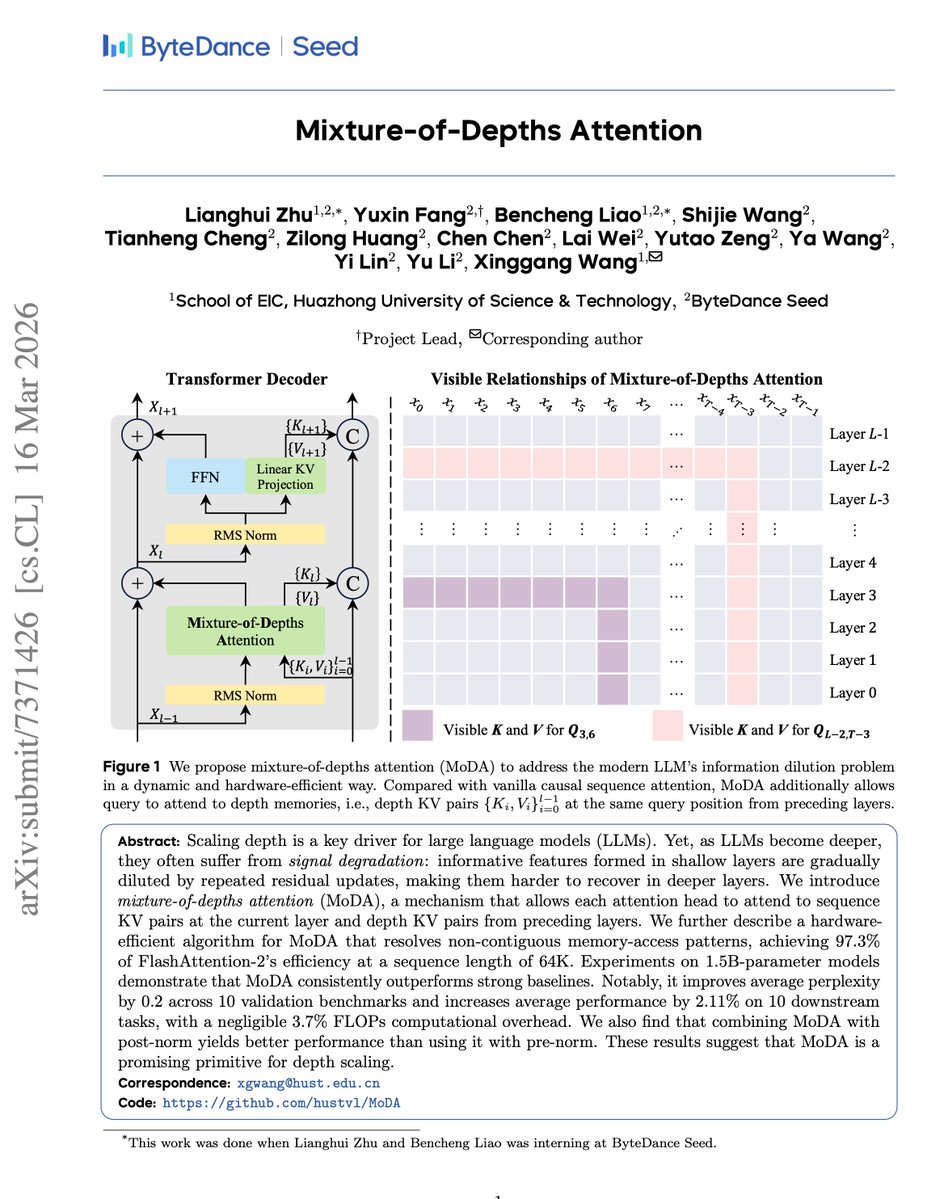
For a decade, we've made models wider and deeper—but we've barely changed how layers *talk* to each other.
Since ResNet's `x + F(x)` in 2015, the depth residual has been the only highway for inter-layer communication.
It's time to upgrade the staircase. 🧵
A central open problem for generative models in scientific discovery is how to go reliably beyond the observed data distribution—for instance, toward new-to-nature designs—without losing validity.
Very excited to share “Verifier-Constrained Flow Expansion for Discovery Beyond the Data” — a new paper on flow-based exploration for discovery that I will present at ICLR 2026 🇧🇷
We study how entropy exploration and verifier-feedback can be combined to adapt a pre-trained generative model toward new valid regions of a high-dimensional design space. The resulting formulation is principled, scalable, and supported by theory.
Empirically, on a drug-like molecular design task, we expand a pre-trained model increasing both diversity and validity.
Work done with amazing collaborators Kimon Protopapas, @yapinghsieh, and @arkrause. Paper and code in comments!