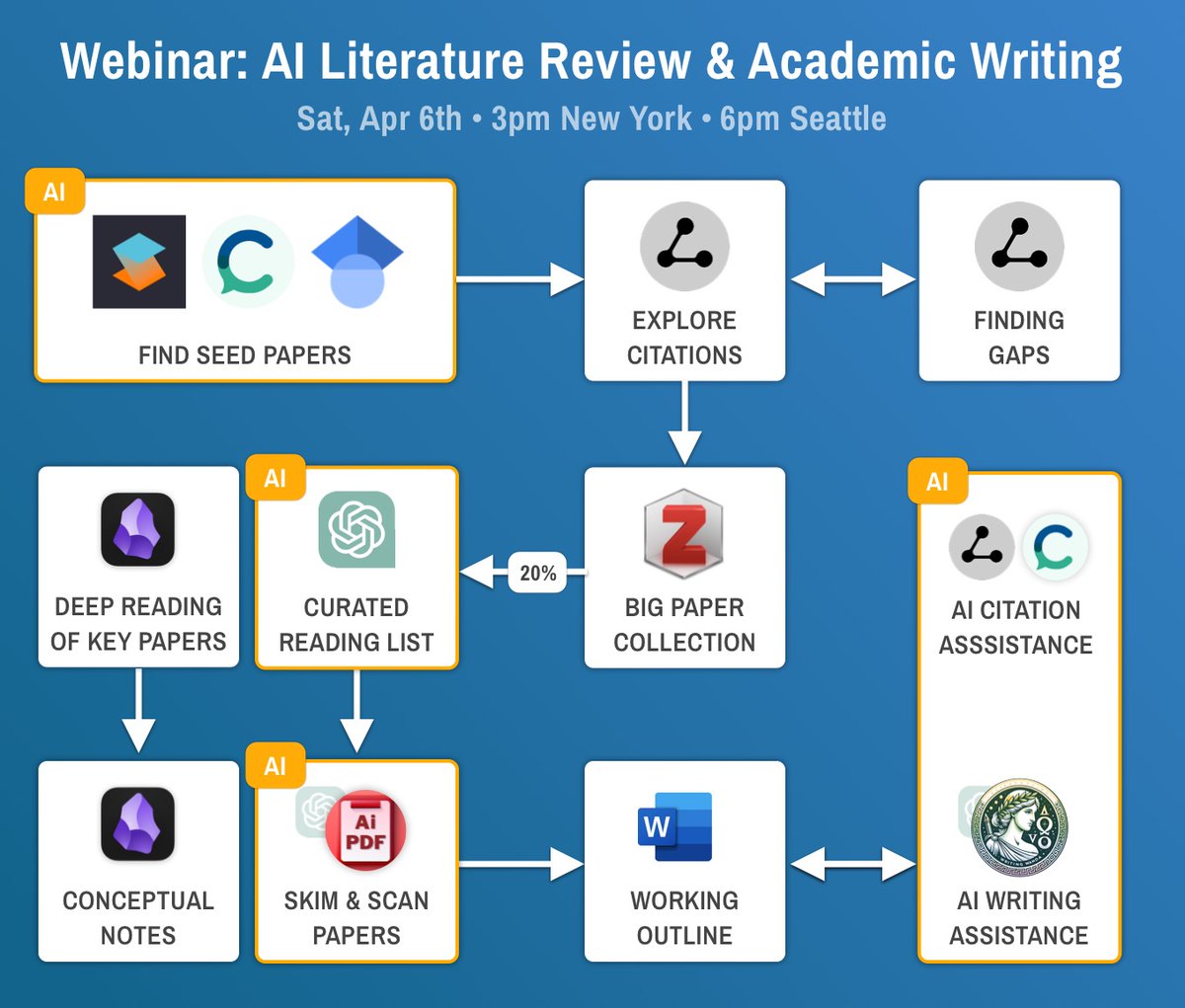
Webinar Apr 6th:
Literature Review & Academic Writing with AI
→ Find the most impactful literature quickly
→ Uncover reference gaps
→ Aid your writing process faithfully & ethically with AI
Link: https://t.co/hqSvB1XsGj
All details below:
👇
This is terrific! The approval of CASGEVY - CRISPR for treating sickle cell anemia marks a significant breakthrough in medicine. Next is to eliminate disparity barriers and ensure equitable access to all.
The FDA has approved a groundbreaking cure for sickle cell anemia called Casgevy which uses the gene-editing tool CRISPR.
@rehemaellis has more details on the new hope for those suffering with the debilitating blood disorder.
Want to remember every paper you read and be the most well-read person in the room?
Here is how you can do it:
📚1. Read only two papers a day, slowly
Everyone tries to use AI to read faster. Science is doomed if we all do this, instead read slower! Savour the paper, especially foundational and review papers. I consider 2-4 full papers in one day a lot. Think of yourself as a forensic detective who can solve a crime from just tiny bits of evidence - academia is very similar, and your evidence is papers.
✍️2. Don't highlight – write to remember
The longer you take to write in your own words, the more you consolidate your understanding. When reading the first time summarize every paragraph, especially the introduction.
📝3. Summarize the summaries
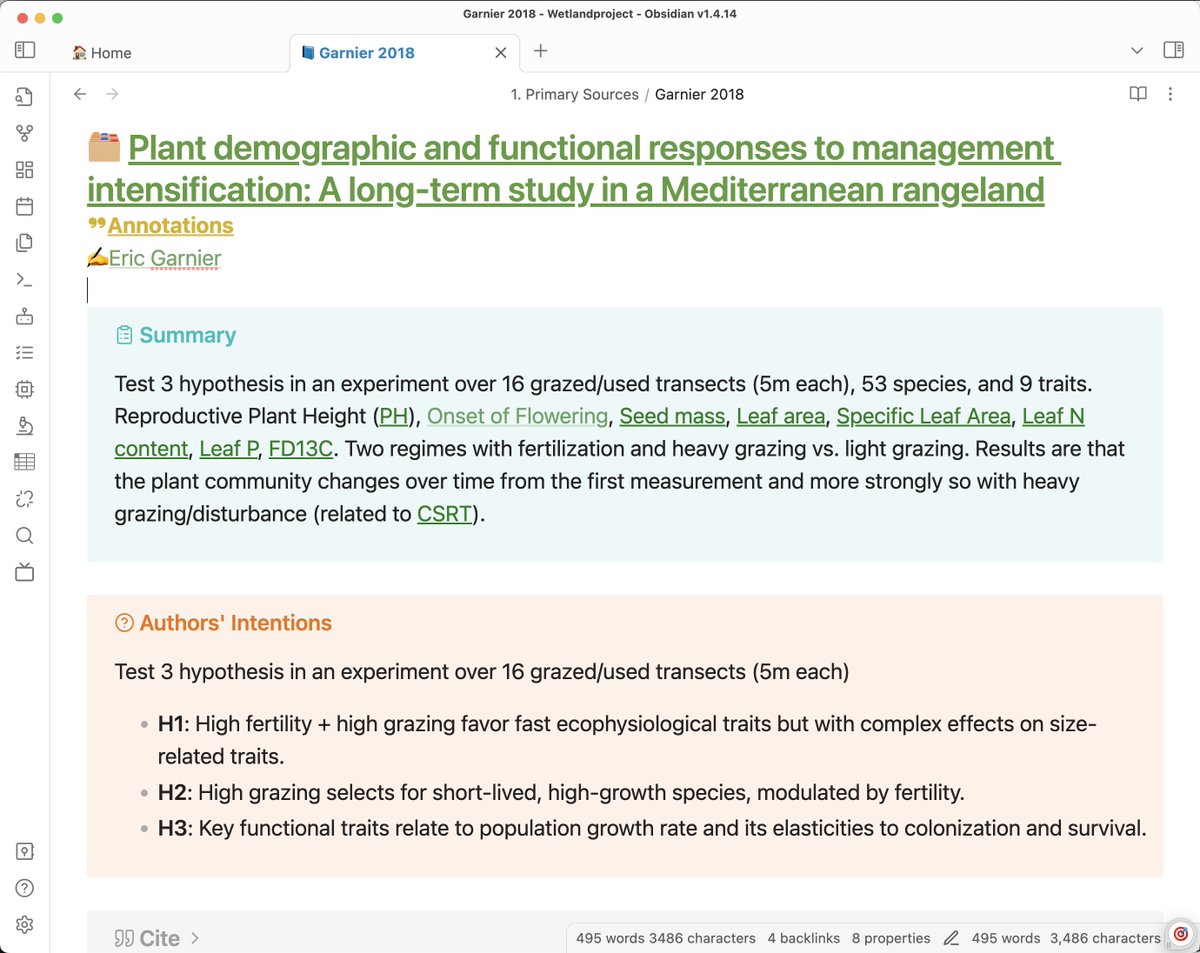
Once you have summarized a paper in your own words, summarize your summary. The advancement of every single paper is often just one tiny idea. (e.g. "Hotter climate leads to plants growing in higher elevation"). Once you get to a point where you have summarized the paper in 1-2 sentences you fully get it.
🤔4. Decode authors' intentions
This is crucial to your understanding. Why did the authors write the paper? Answer this as concisely as you can.
This is how I summarize papers and intentions, notice also the heavy linking to other notes in the summary:
📌 5. Track your sources
Most introduction and discussion sections will have a fair amount of findings from other papers put into context. Whenever you find a relevant idea, write it down and note the original source where it came from. Over time you will find recurring papers and identify what are the "foundational" papers and authors in your field.
📋6. Build a reading wish list
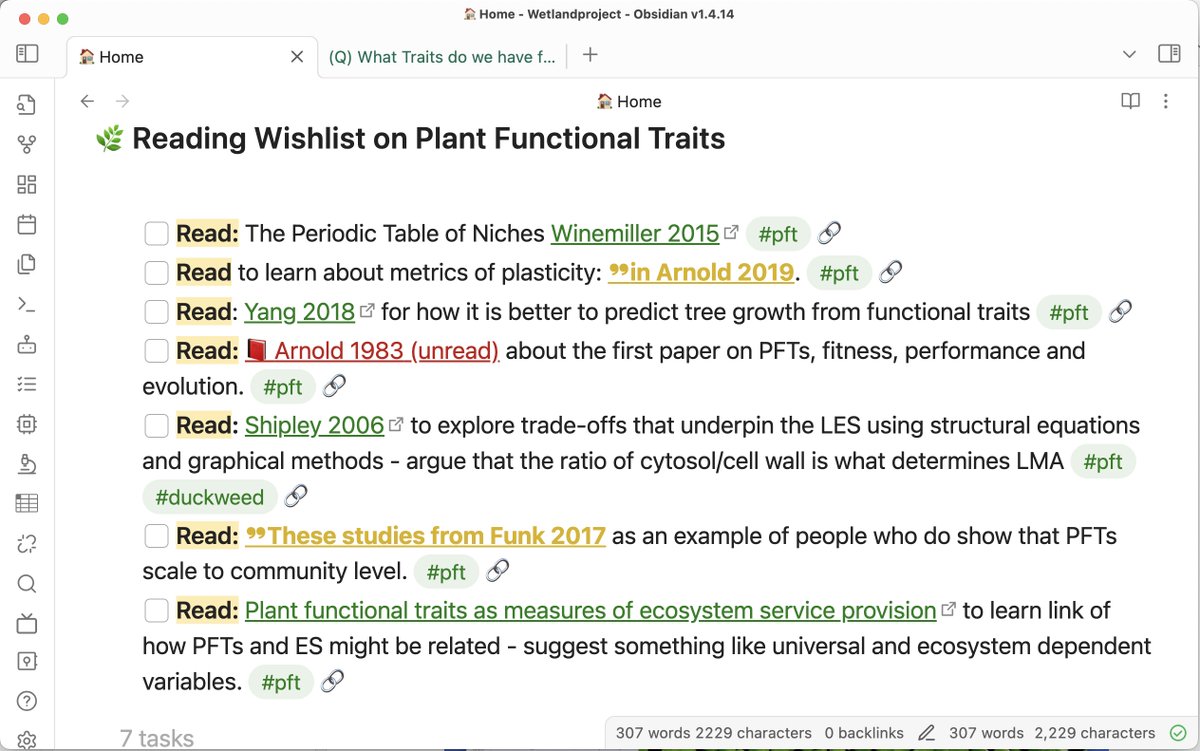
Building a reading list of papers and write down why you want to read them. Never just download papers "for later". The act of downloading is a reward that you get when you commit to reading a paper. This is how this can look:
🔄 7. The Feynman loop: Review your notes
Every time you re-read your notes you tend to refine them. Enrich them with new ideas and make them better. Treat your notes as if you write them for someone else who you want to teach. This is called the Feynman technique.
🖼️ 8. Visualize to Realize
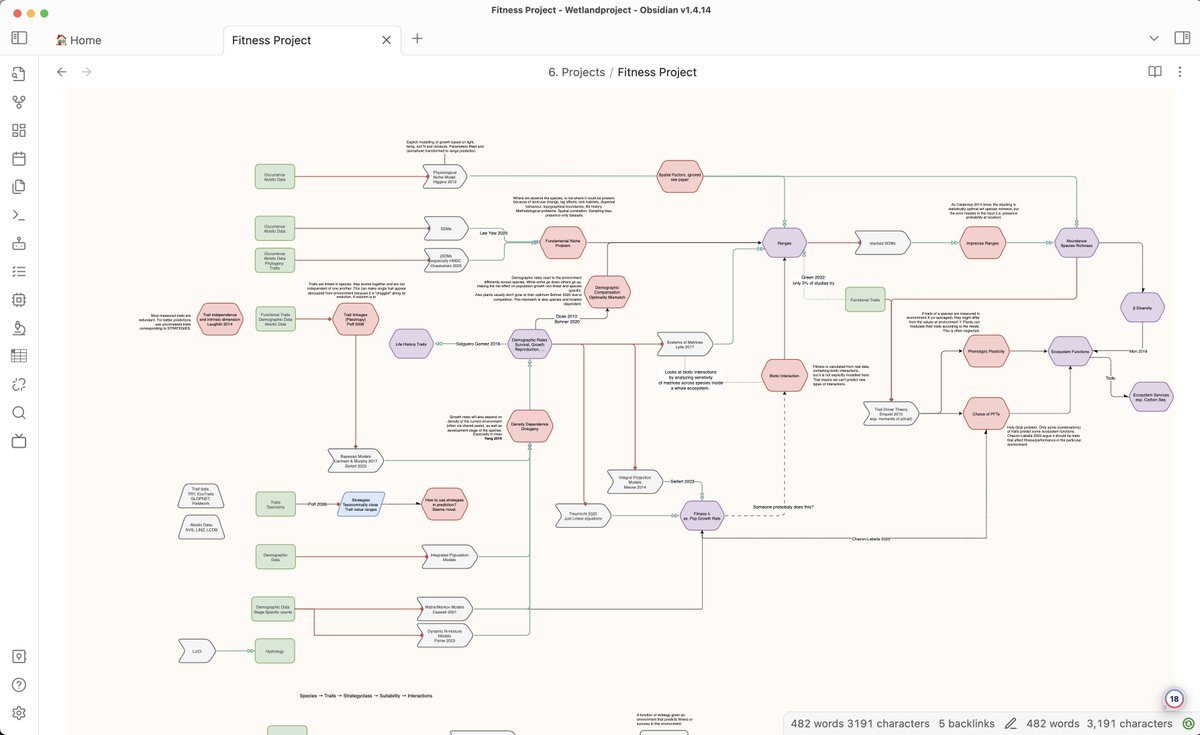
The ultimate summary is visual if you can break down your research into a visual summary you will see the gaps immediately.
I use @drawio to create SVG files and embed them into @obsdmd. So the result is directly embedded into my notes. Think of a simple visual language and use it. I use red for problems, green for data, gray for solutions etc. Here is how it looks:
I can't emphasize enough how crucial a note-taking strategy is in this process. It expands your memory horizon.
You know some things (knowns), others you know that you don't know (unknowns). This is your memory horizon. Everything beyond you don't know that you don't know (unknown unknowns).
Things that are unknowns over time become unknown unknowables. In other words, you forget you ever knew them.
This is what note-taking stops. You may forget a note is there, but it is still linked and present, it can never become an unknown unknowable anymore. If you review your notes, you will find it and remember it.
This process will surprise you! It is the most satisfying feeling.
Start your journey into academic note-taking on EffortlessAcademc(dot)com with my free 8-day starter guide!
During my last webinar, someone asked me:
Are the many (AI) tools for research not overwhelming? What should I use?
Daily, I only use 5 free core tools for very distinct use cases. The rest is nice to have:
1. @obsdmd for Knowledge
"Your mind is for having ideas, not holding them." is a very famous quote by David Allen a productivity expert.
Obsidian is the perfect substrate for ideas to grow in:
- Findings & References I read
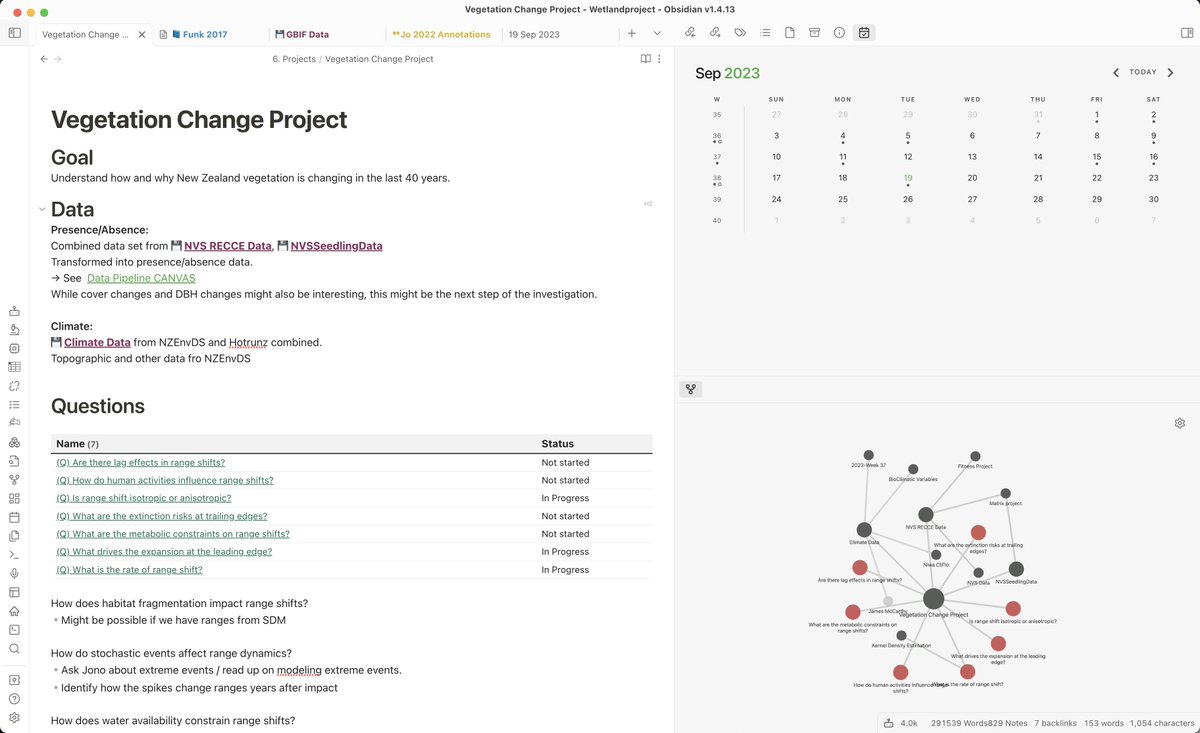
- Research questions I am working on
- Tasks and Ideas I need to explore
- Acts as a reference manager
- Documents big coding pipelines
- Storage for all the data I use in my research
2. @LitmapsApp for Discovery
Litmaps finds related papers to the papers in my collection. Think of it as a "Google for academic research" that is actually better than Google! No other tool leverages the visual representation of papers so well.
In one picture I can:
- Find the most cited papers
- Identify specific key authors
- Find impactful reviews
- Quickly see what is recent and what is foundational
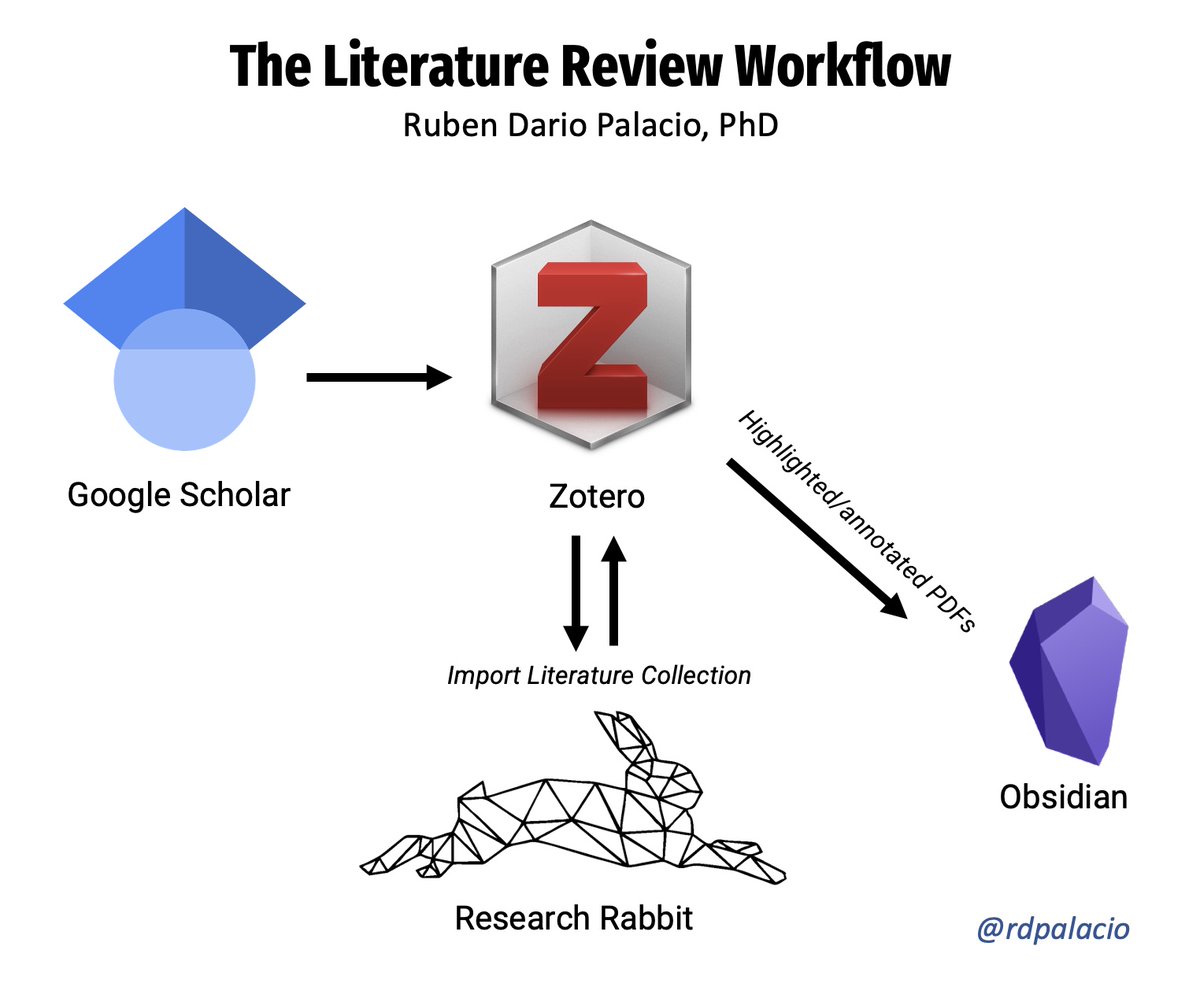
3. @zotero for MetaData Collection
I use Zotero purely as a service. The browser plugin allows me to capture a paper and Zotero automatically downloads the PDF. Then I go to Obsidian and with one click import the newest paper into my library.
This means I never interact much with Zotero itself.
Why manage papers in Obsidian? Because I reference them in my notes and can leverage Obsidians canvas to create networks of papers.
This is how this might look:
4. @drawio for Knowledge Synthesis
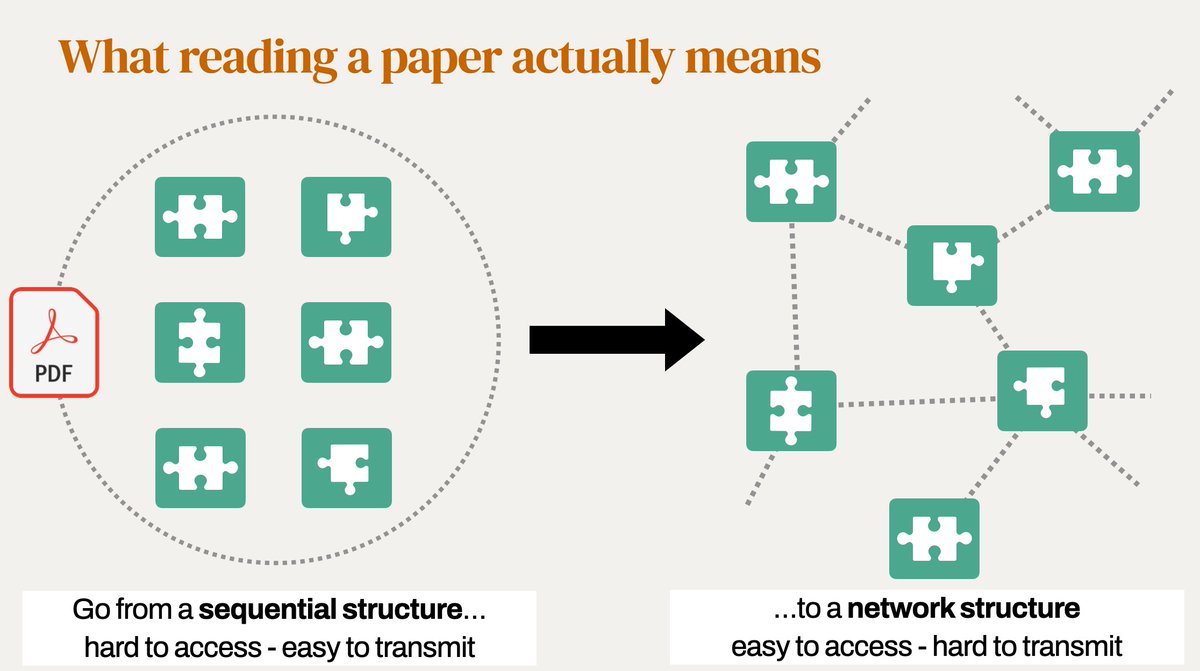
Our minds are networks, not databases. That means the highest form of understanding is a network of connected ideas and concepts. A free and awesome tool to do this is drawio.
5. ChatGPT and Github Copilot
Coding without AI these days is a waste of time. Even with 15 years of coding experience I get more done using AI tools. ChatGPT is great for asking broad questions like "What are libraries that do X". However the results are often erroneous and the mistakes are hard to spot.
Github CoPilot on the other hand helps me code line by line directly inside the coding environment. (Use PyCharm for Python or R, free educational licenses). It forces me to comment on my code as well.
--
This is it. You don't need much more than these for 90% of your research. Master these and you will be ahead of everyone else.
Below are some threads if you want to learn more about some of the tools:
@scite@LitMaps@zotero@obsdmd@LitmapsApp To take GOOD notes, I don't summarize.
Instead I break it up into concepts and link those together.
A summary is just paraphrasing.
But linking concepts generates new ideas.
Our brains are a network not a database.
You can do this with Obsidian but not with Zotero.
The first time I did a literature review, it took me months.
Now i can do it in a week.
How?
I spent 500+ hours refining a system for my notes. Here's is the end result:
👇
#AcademicChatter#AcademicTwitter#ScienceTwitter
If you have too many papers to read but no time, try this:
Pick core papers with @LitmapsApp.
Then balze through the rest with @scispace AI.
This workflow saves me days of reading work:
👇
A good mentor:
► Listens & asks you questions
► Is invested in YOUR goals
► Can help with their network
► Enjoys teaching
► Is available & ready to help
► Is someone you deeply admire & respect
Search for them.
They are the biggest factor for academic success.
Today I can finally say I've finished my PhD. I want to get a lot of things off my chest and @PhDVoice might be the right place for it. So here is the story of my PhD and my advice to people who are considering doing one.
AI-powered apps are here to stay, but it's highly unlikely they will replace scholars and academic writers.
Here are ten tips on how to become a proficient academic writer:








![rdpalacio's tweet photo. 17.
[Update 1] Based on the feedback, I've modified the figure to emphasize Google Scholar is not the only database to use! https://t.co/ayDp6Hl2qk](https://pbs.twimg.com/media/Fj0uFIrWQAAv_Je.jpg)