🦔Microsoft's internal strategy document for its new AI assistant Scout says the explicit goal of phase one is to "make people addicted." The doc, obtained by 404 Media, outlines a three-phase plan from "addictive app to agentic platform."
The tool sits on your desktop, manages your calendar, triages your inbox, files expenses, and acts on your behalf. It requires access to your accounts and files. Security and compliance are things to "figure out" later. Nadella already uses it.
My Take
After everything this week, I think this document accidentally explains the entire AI business model. Not just Microsoft's, everyone's. The product can't sustain itself on current pricing. We know that because Copilot just proved it on Monday. The unit economics don't work at flat rate. So the play is to get people locked in before the real bill arrives. Make the tool essential to how you work, let your company cut the people who used to do those tasks, and by the time consumption pricing kicks in, walking away costs more than paying up.
IBM's CEO just told us the industry needs $6 to $8 trillion in capex to chase revenue he says doesn't exist. Google diluted shareholders to fund a buildout it can't cover from cash flow. Oracle fired 30,000 people during a record quarter to redirect salaries into data centers. And Microsoft's answer to all of that is an internal doc where step one is addiction. They're not selling the product on value. They're selling dependency. Get people hooked before anyone calculates what it costs to run, and make sure they can't leave once they find out. A product that needs addiction to survive is a product that can't survive on its own.
Hedgie🤗
https://t.co/eux8IbCxxm
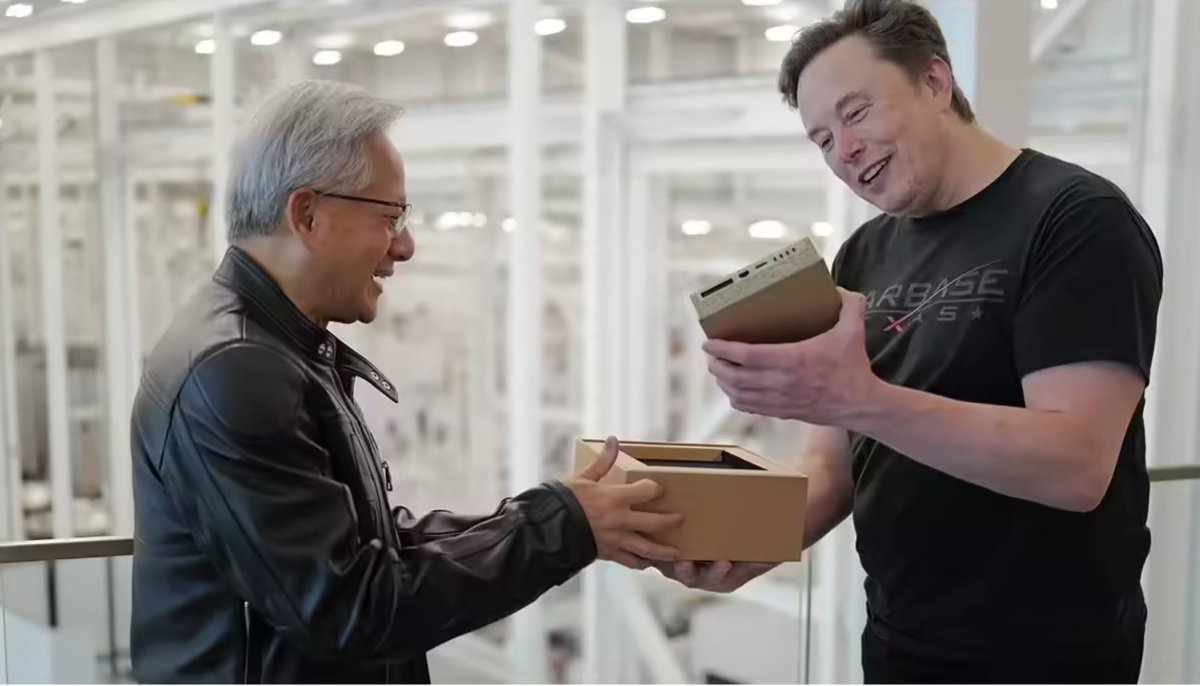
🚨Michael Burry just said Elon Musk and Nvidia's deal is built on fake numbers.
Burry published a detailed breakdown calling the entire structure "Fugazi", his word for fake.
He is alleging that billions of dollars in Nvidia chips are being hidden off balance sheets, and that American retirees are unknowingly funding the whole thing.
Nvidia, the world's largest AI chip company sold $5.4 billion worth of its most advanced GPUs, the GB200, to a company called Valor.
Valor is not a real operating business. It is a special purpose vehicle, a shell company created specifically to hold these chips and nothing else. Nvidia also invested $1.9 billion of its own money directly into Valor on top of the sale.
Those 100,000+ chips are now physically inside xAI's data center. xAI is Elon Musk's artificial intelligence company, the one that builds Grok. xAI is using every single one of those chips right now to run its AI models.
But here is what Burry is flagging.
Neither Nvidia nor xAI owns those chips on paper. Valor, the shell company holds legal title. That means $5.4 billion in GPU assets do not show up on Nvidia's balance sheet as inventory.
They do not show up on xAI's balance sheet as assets. They are legally invisible to both companies.
Nvidia gets to book the $5.4 billion as a completed sale and record it as revenue. xAI gets full use of the chips without owning them. And the risk disappears into a shell company in the middle.
Now here is where American retirees enter the picture.
Valor needed $3.5 billion in debt to fund this structure. Apollo provided it. Apollo is one of the largest asset managers on earth with $1.03 trillion under management and $834 billion specifically in private credit.
Apollo raised the $3.5 billion, packaged it into debt securities, and sold those securities to Athene.
Athene is Apollo's own insurance company. It sells fixed and indexed annuities, retirement savings products, to ordinary Americans.
When a retiree buys an Athene annuity, they believe their money is sitting in safe, stable investments. That money is now inside a structure funding Elon Musk's AI data center.
The numbers inside Athene are most alarming.
Athene holds $74.2 billion in reserves. It has moved $217 billion in assets into a captive insurer based in Bermuda, meaning those assets sit outside normal US insurance regulation and oversight.
Of the entire portfolio, 34.7%, equal to $103 billion, is classified as Level 3 assets.
Level 3 is an accounting classification that means there is no observable market price for these assets. No outside party can independently verify what they are actually worth.
The leverage sitting on top of those unpriced assets is 16 times.
Burry's says:
Every step of this structure is technically legal and publicly disclosed. But the entire thing was deliberately engineered across 8 to 12 steps to move credit risk off balance sheets and away from any market pricing.
- Nvidia books the revenue.
- Apollo collects the fees.
- xAI gets the computing power.
- And retirees sitting at the bottom of a 16x leveraged Bermuda insurance structure, holding $103 billion in assets with no market price carry the risk without knowing it exists.
Free to anyone interested.
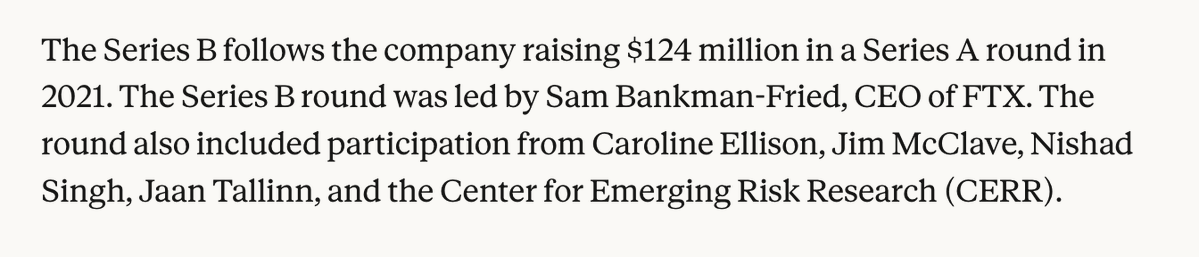
Part IV of the Heretic’s Guide to AI’ Stars is coming along nicely. In light of the news today about Apollo’s $38 billion debt raise for $GOOG TPUs (not $NVDA GPUs) for Anthropic, I have decided to pre-release one visual from Part IV. Enjoy.
https://t.co/EsB66cKJbw
Took me a while to figure out what all the ESMFold2 rage was about. At first, the benchmarking data didn't look super remarkable to me but it turns there are many impressive aspects:
- Fully open source, open weights + massive ESM Atlas (1.1B structures vs 0.2B for AF3).
- SOTA performance despite no MSA use. MSA search and triangular attention were simply taken out of the base model.
- Direct consequence, super low latency inference: 1024-residue protein structure prediction in 9 secs, still outperforming prior models on antibody-antigen tasks.
- Best in class PPI and antibody-antigen results. 65% pass rate on antibody-antigen benchmarks after inference-time scaling, significant improvement over AF3.
- Tons of experimental data, in particular with lab-validated miniprotein binders plus single-chain antibodies across 5 targets in cancer and immunology. Binding affinities consistent with therapeutic activity.
- Inference-time scaling benefits PPI: Multiple seeds + selection by confidence show real gains on challenging antibody-antigen predictions, leading to comments/hypotheses that it has learned an energy-function-like behavior via the folding module.
- Base model works without MSAs, but providing them further boosts prediction quality on difficult protein-protein interaction cases.
One caveat: No true scoring for protein-protein interactions, making it harder to assess which specific residues or domains are reliably involved in binding.
im an engineer and cybersecurity researcher, can't be bothered with legalese stuff – in touch with multiple lawyers and foundations who are handling that part. expecting urgency or accountability from the indian judiciary in cases involving institutions like cbse is wishful thinking.
The largest LLMs have around 14 trillion parameters, roughly 28 TB at FP16. At ~2 MB/sec of visual input, a human child accumulates over 300 TB of raw visual data by age 5 — more than ten times that. #JEPA
Today’s free newsletter is about how LLMs are the perfect grift to exploit an economy dominated by do-nothing managers and executives disconnected from any real work, and how the facade is crumbling as companies pay the true cost of AI.
https://t.co/X7qmNMFjYm
This is what we've been seeing with every company we work with.
Try justifying spending 100k on token spend when only 18k even makes it to a stable prod feature.
In the rush to maximize AI token spend, companies are wasting over 44% on bug fixes