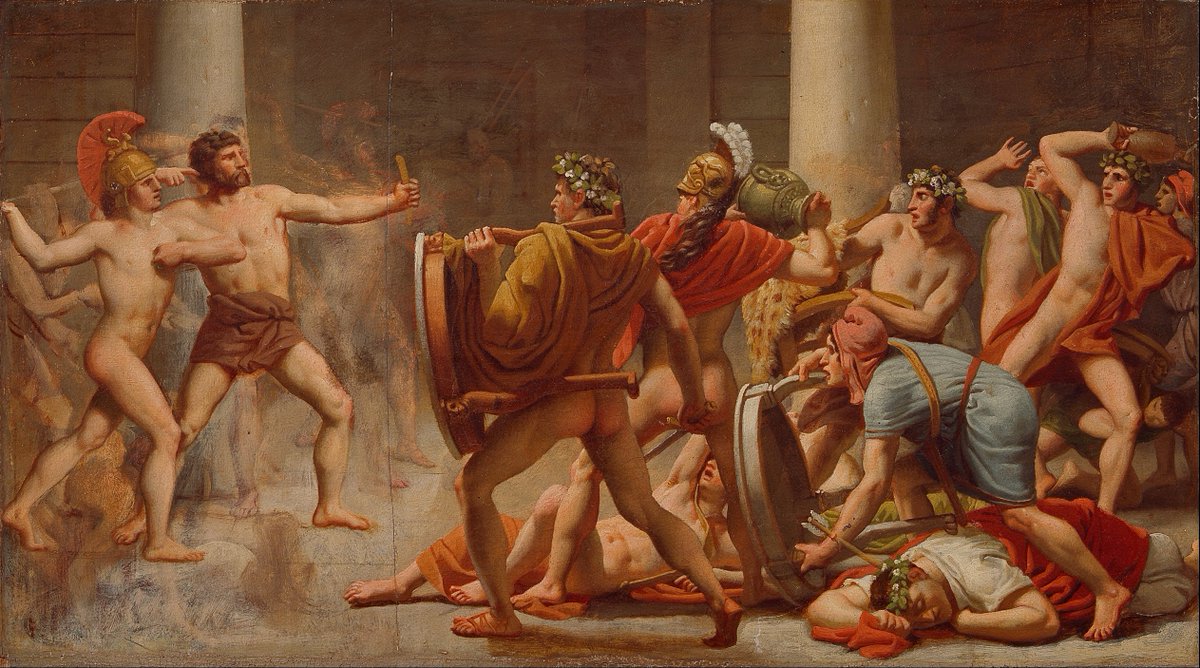
A powerful scene in the Odyssey happens when Odysseus finally returns to Ithaca after twenty years of war and wandering.
You would expect the story to end with celebration, with the hero coming home, the family reunited, and order restored.
Homer does something far stranger.
Odysseus arrives disguised as a beggar, because Athena warns him that the palace has been taken over by more than a hundred suitors who have been living there for years, eating his food, drinking his wine, and pressuring his wife Penelope to marry one of them.
They believe Odysseus is dead and in their minds the kingdom is already theirs.
So the king of Ithaca walks through his own halls dressed in rags while the men stealing his house sit comfortably at his tables. They mock him, throw scraps at him, and one of them even strikes him, and Odysseus takes it. That is the remarkable part, because the same man who blinded the Cyclops and survived twenty years of disasters now stands quietly while strangers insult him in his own home. Homer tells us his heart burns inside his chest and that he wants to attack them immediately, yet he restrains himself and waits.
Instead of striking, Odysseus studies the room carefully. He counts the men, watches their habits, and quietly observes which servants remain loyal and which have betrayed him. The hero of the Odyssey does something most people cannot do, which is delay revenge until the moment is right.
Eventually Penelope announces a contest and brings out Odysseus’ great bow, declaring that she will marry the man who can string it and shoot an arrow through twelve axe heads lined up in a row. One by one the suitors try and fail, because none of them can even bend the bow. Then the beggar asks for a turn. The suitors laugh at first, but the bow is eventually handed to him.
Odysseus takes it in his hands and strings it effortlessly. Homer says the sound of the bowstring tightening rings through the hall like the note of a swallow. Then he places an arrow on the string and sends it cleanly through all twelve axe heads.
In that moment the beggar disappears. Odysseus turns the bow toward the suitors and reveals who he is.
What follows is one of the most brutal scenes in Greek literature. The doors are sealed and the suitors realize too late that they are trapped inside the hall. Odysseus, his son Telemachus, and two loyal servants begin killing them one by one. There is no escape, no mercy, and no negotiation. The men who spent years consuming another man’s house die inside it.
It is a violent ending, but Homer wants you to understand something important. The real danger to Odysseus was never just the monsters and storms on the long journey home. It was the possibility that someone else might take his place while he was gone. When Odysseus finally returns, he reminds everyone in Ithaca of a simple truth: a man’s home is not truly his unless he is willing to fight for it.
Still think about this Peter Thiel quote
“Strategy is just euphemism for procrastination”
Great reminder that the best strategy is simply to execute. Nothing else comes close
nietzsche understood the futility of the normie pursuits.
moneymaxxing, girlmaxxing, chillmaxxing, slopmaxxing
pedestrian pursuits when collapsed into their implication signs in the action space become trivial. there is no great romance in the balancepilled chillmaxxer life.
when nietzsche proclaimed “i know of no better life purpose than to perish in attempting the great and the impossible”, he captured something more nuanced than just “do big things lil bro”
the parsimonious definition of a normie is a universal chillmaxxer; laced invariant throughout all their pursuits and thoughts is the lack of willingness to give it an asymmetric amount of themselves. more nuanced than that, the real invariance is the lack of understanding and want to be able to experience more than just traditionally defined human boundaries. terrified of being contrarian and standing out, truly owning their thoughts…people oneshot themselves with fear.
i was reflecting and almost everyone truly exceptional i know had an awakening that turned them from a normie into something more; the unsatiable urge to chillmaxx with your boys every tuesday night was replaced with a hunger and thirst to suffer so that they may become more.
is this a blessing or a curse?
an example of this is the canonical rich kid, no real tangible suffering beyond “omg i feel so lost, everything’s already sorted out”. you know what’s the real loss? the lack of the ontological appetite to push into the unknown, whatever it takes. is it a curse to never experience drive? to never experience what fire feels like? to never experience variance? no deep failures nor enchanting victories?
in math, once you know the trick to prove a theorem, you move onwards; there is beauty in coming up with the algorithm, there is minimal in executing it. when everything is trivial and can be “solved” in our heads, every action and its subsequent can be mapped out, it is a trivial pursuit. life is lived on the knife’s edge riding stochasticity, the second your outcome space becomes deterministic, what is the point of being alive?
No signs of an end to rapid gains in AI ability at ever-decreasing costs yet
I did my best to update my chart to take into account the price drop in o3 & the new models released by Google.
GPT-4 was 2.25 years ago,so its worth noting the trend when considering the future of AI.
From my favourite Paul Graham essay
“One of the most dangerous illusions you get from school is the idea that doing great things requires a lot of discipline”
@yurtyurt69@nashinia @jjkfan24289813 How tf would you? There was no way to aggregate sentiment as we can now. The internet was nascent, devoid of any platforms.
Agency > Intelligence
I had this intuitively wrong for decades, I think due to a pervasive cultural veneration of intelligence, various entertainment/media, obsession with IQ etc. Agency is significantly more powerful and significantly more scarce. Are you hiring for agency? Are we educating for agency? Are you acting as if you had 10X agency?
Grok explanation is ~close:
“Agency, as a personality trait, refers to an individual's capacity to take initiative, make decisions, and exert control over their actions and environment. It’s about being proactive rather than reactive—someone with high agency doesn’t just let life happen to them; they shape it. Think of it as a blend of self-efficacy, determination, and a sense of ownership over one’s path.
People with strong agency tend to set goals and pursue them with confidence, even in the face of obstacles. They’re the type to say, “I’ll figure it out,” and then actually do it. On the flip side, someone low in agency might feel more like a passenger in their own life, waiting for external forces—like luck, other people, or circumstances—to dictate what happens next.
It’s not quite the same as assertiveness or ambition, though it can overlap. Agency is quieter, more internal—it’s the belief that you *can* act, paired with the will to follow through. Psychologists often tie it to concepts like locus of control: high-agency folks lean toward an internal locus, feeling they steer their fate, while low-agency folks might lean external, seeing life as something that happens *to* them.”
@itschloedanii@NoTetherZone@gotchapoosayhoe She made her bed, these are the consequences of her actions. Every decision and comment she made led to this point, it’s not the responsibility of the group she vehemently admonished to exude grace. What happened here is unfortunate, but too bad.