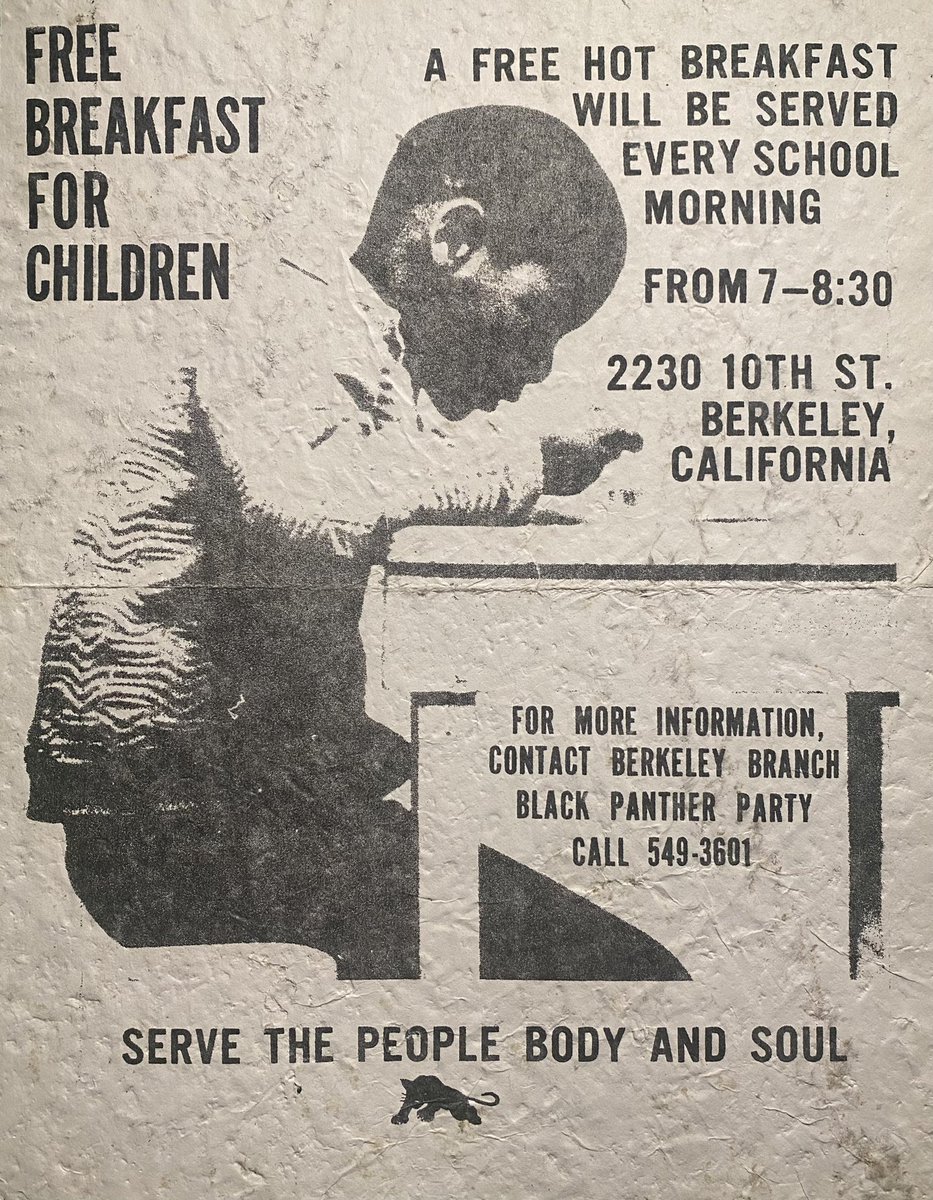
Below: A rare, original Civil Rights era flyer/poster from the Black Panthers, offering free hot breakfast for black children every school morning in Berkeley, California.
In the same time period, in Washington, D.C., a high-ranking law enforcement official described the Panthers as the "greatest thre@t" to the country.
In using the phrase the "greatest thre@t," was Director J. Edgar Hoover, who is on record detesting the Panthers and what they stood for, referring to the media image of the Panthers with we@pons, or a concern that educated, healthy black boys would one day become educated, healthy black men?
There are no other copies of this approximately five decades old flyer known to exist.
The saying goes: “Don’t meet your heroes; you’ll only be disappointed.” That wasn’t the case with Michael Cooper three decades ago in the basement of a church in Pasadena.
Cooper would go on to have his Lakers jersey retired and become a member of the Naismith Hall of Fame, but that night at a church in Pasadena, he was a concerned community member more so than a former defensive player of the year who Larry Bird said was the best defensive player that ever guarded him.
That night, I learned that Cooper was appearing at the church. At the time, I worked nearby and brought a stack of anti-gang posters I had designed. Cooper signed each poster and they were given to young people during his appearance. I kept one of them and it is pictured at the link below.
Cooper and his Showtime teammates had an effect on me growing up. By far the best example was when they won the 1985 championship against their nemesis, the Boston Celtics—and Larry Bird. The Lakers had never beaten the Celtics in a championship series—losing eight times—and the Lakers were blown away by 34 points at the Boston Garden in game 1 of that series. The Lakers were thoroughly embarrassed and written off for dead.
They didn’t give up and won four of the next five games, and defeated Boston 4–2, capturing the championship at the Boston Garden, the very same floor they had been run off just days earlier.
In times of trial, I think back to that series and remind myself that only I can extinguish hope by quitting before a positive history is written no matter how bleak the past has been.
Years later, a pair of Cooper’s game-worn and signed shoes from that historic 1985 championship season came available and I quickly bought them. In these shoes, Cooper guarded Larry Bird, Michael Jordan and more.
It’s impossible to say for sure, but I like to think that those simplistic anti-gang posters that Cooper signed years ago helped guard and inspire those kids in a Pasadena church.
Cooper would go on to become a successful TV analyst after his playing days.
https://t.co/fWcBdrixUC
I have been collecting Lakers memorabilia for years and recently began an important side collection that attempts to put together Black media history piece by piece.
The memorabilia pictured below represents KCAL broadcasting and Lakers history in a single piece—a special “LTV on KCAL 9” branded James Worthy autographed basketball. “Big Game James” moved from being an on court Lakers legend on KCAL to the KCAL broadcasting studio. In the beginning, the transition was not as seamless as his patented Worthy finger roll, as he reminisced in an interview with his former LTV running mate Jaime Maggio:
“I started working on the Paramont lot with Pat Harvey…that’s where I learned my trade. At the beginning I sucked—terrible. I had nothing but a name and I was a former Laker. And thank God guys like Scott Henry, who were patient with me while I learned the trade. That’s where the rubber met the road over there at LTV/KCAL-9/CBS. That’s where I learned how to do it.”
A consummate leader on the court, Worthy made the on court to on air transition before the era of athlete led podcasts.
The Black media history collection: https://t.co/ft2CNvi4b6.
Ms. Constant: The KHJ L.A. Rams Kenny Washington ad clipping arrived. There is no date on the back, but it is clearly from a vintage TV Guide magazine. A TV series listed on the backside of the KHJ ad had an original run from January-April 1977, which may help further narrow down when the Kenny Washington special aired on KHJ.
Pat Harvey and Nipsey Hussle each reported about L.A. in their own way. Harvey has enjoyed a successful career as a news anchor at CBS Los Angeles since 1989. Hussle was born a few years earlier and went on to paint vibrant and graphic L.A. street stories using rap lyrics before he was murdered in 2019.
The two had at least one in-person meet up: a 2019 interview, six weeks before Hussle was killed. The interview https://t.co/QpAxdg997A was short, but revealing (credit: @GerriConstant). The 33-year-old rapper, who was no stranger to cursing on his records, addressed Harvey as “ma’am.” The respect seemed mutual. When Harvey asked Hussle about his troubles with the law, it shed light on his story and was not used as a gotcha moment.
When talent from different generations like Harvey and Hussle can come together and talk openly, there is hope—even amongst his death, the interview can serve as a template for others.
Nipsey Hussle’s family carries on his legacy, but it is painful to think what could have developed had he not been taken away.
It is appropriate for you three to be featured on https://t.co/ft2CNvi4b6, along with other notable anchors like KHJ-TV Channel 9 pioneer Felicia Jeter https://t.co/X939j9QmTk
Pat Harvey: https://t.co/VrAYgckwcX
Sheba Turk: https://t.co/ECR1JSXFv3
Jim Hill: https://t.co/0Sg32aWkbl
Ms. Harvey @PatHarveyNews, I recently mentioned that you, Jim Hill and @ShebaTurk are my favorite news anchors. I grew up watching Jim Hill’s coverage of the 80’s Lakers with my father (which probably explains my collection of Showtime era memorabilia). As a young man, I watched you cover the tumultuous events of 1992 Los Angeles with professionalism and courtesy shown to the people going through it and living it. I see many of your qualities that allow you to relate to the community in Sheba Turk. The fact that many of my folks are from the South also makes me want to see your friend and colleague, a self-described “catfish and grits kind of girl,” succeed and thrive.
On TV, phone and tablet screens, you, Jim Hill and Sheba Turk have been welcomed into my home and office. And probably like many other viewers/supporters, I watch and stream KHJ, KCAL, CBS Los Angeles (or any future name variations) not because I have some kind of affinity to the channel or catchy new marketing slogans. I watch because of the talent and sincerity that is led by the O.G.’s—you and Jim Hill—and the relative newcomer, Sheba Turk (well…technically most everyone in Los Angeles news would be considered a newcomer relative to you and Jim Hill). Longevity is a blessing; you and Jim Hill have worked a combined 97 years in television news without missing a step.
That amazing number is worth repeating and highlighting; you and Jim Hill have nearly 100 years—a century—of combined, highly acclaimed television news broadcasting experience, almost 90 years of which were dedicated to directly serving the people of Los Angeles; an historic, unprecedented and unrivaled tag team.
Thank you.
@GerriConstant@Patharveynews@ShebaTurk The Jim Hill photograph on the site was unique; he seems to always be in a suit and tie and this photo showed his cool professionalism sans the suit and tie in an historic moment. https://t.co/hQcl5RoN5Y
@GerriConstant@Patharveynews@ShebaTurk My objective for the site https://t.co/XkHB4F954z is clear—Putting together black media history piece by piece. Your comments, suggestions and even pieces from you all and your colleagues are always welcome.
@GerriConstant@Patharveynews@ShebaTurk My objective for the site https://t.co/XkHB4F954z is clear—Putting together black media history piece by piece. Your comments, suggestions and even pieces from you all and your colleagues are always welcome.
Thrifted both for $10: a 1970s kids chair with a distorted blackf@ce image and a vibrant painting of a woman with natural hair.
One shows how casually stere0types were provided to children. The other celebrates women like Melba Tolliver and @ShebaTurk who have faced challenges and still insisted on regularly wearing their hair naturally as television news reporters and anchors.
How much has the underlying sentiment responsible for the second image of a beautiful black woman’s vibrant afro actually replaced the underlying sentiment responsible for the image on the childs chair?
Less than a week after seeing a larger-than-life representation of black women’s natural (albeit blue) hair (a San Francisco street artwork called “Sheba 3”; the red, white and blue image), two more visualizations/interpretations crossed my path—one ugly and one beautiful—while thrift shopping last night. I purchased both pieces for about $10.
Starting with the ugly. Based upon early research, the kids chair was likely produced in the 1960s or early 1970s by a company that had a manufacturing plant in Alabama. The image on the seat is stereotypical bl@ckface. Kids (probably not black kids) literally sat on a distorted image of a black girl during their formative years. These kids would now be adults in their mid 50s. Could these kids have matured and left behind the r@cism their parents obviously engaged in, as evidenced by them purchasing a chair like this?
The painting, acquired the same night as the chair at a different Goodwill, is clearly more modern and a 180 degrees different representation than that of the chair. Vibrant colors embrace the afro of a beautiful black woman. (Please do not infer that black women cannot be beautiful without wearing their hair naturally.)
I highlight and celebrate public women like Melba Tolliver, the first black anchor on national television. She wore an afro on air at a White House event in the 1970s despite her bosses telling her not to. I highlight and celebrate a modern day anchor at CBS Los Angeles, Sheba Turk, who was disparaged earlier in her career by some viewers for wearing her hair in a natural.
I do this to combat the negative images of black women that refuse to completely go away. Manufactured caricatures—like the one on the kids chair—are a reminder that not that long ago images like this were mass produced—affecting children who are now adults. And a reminder that there is more work to be done.
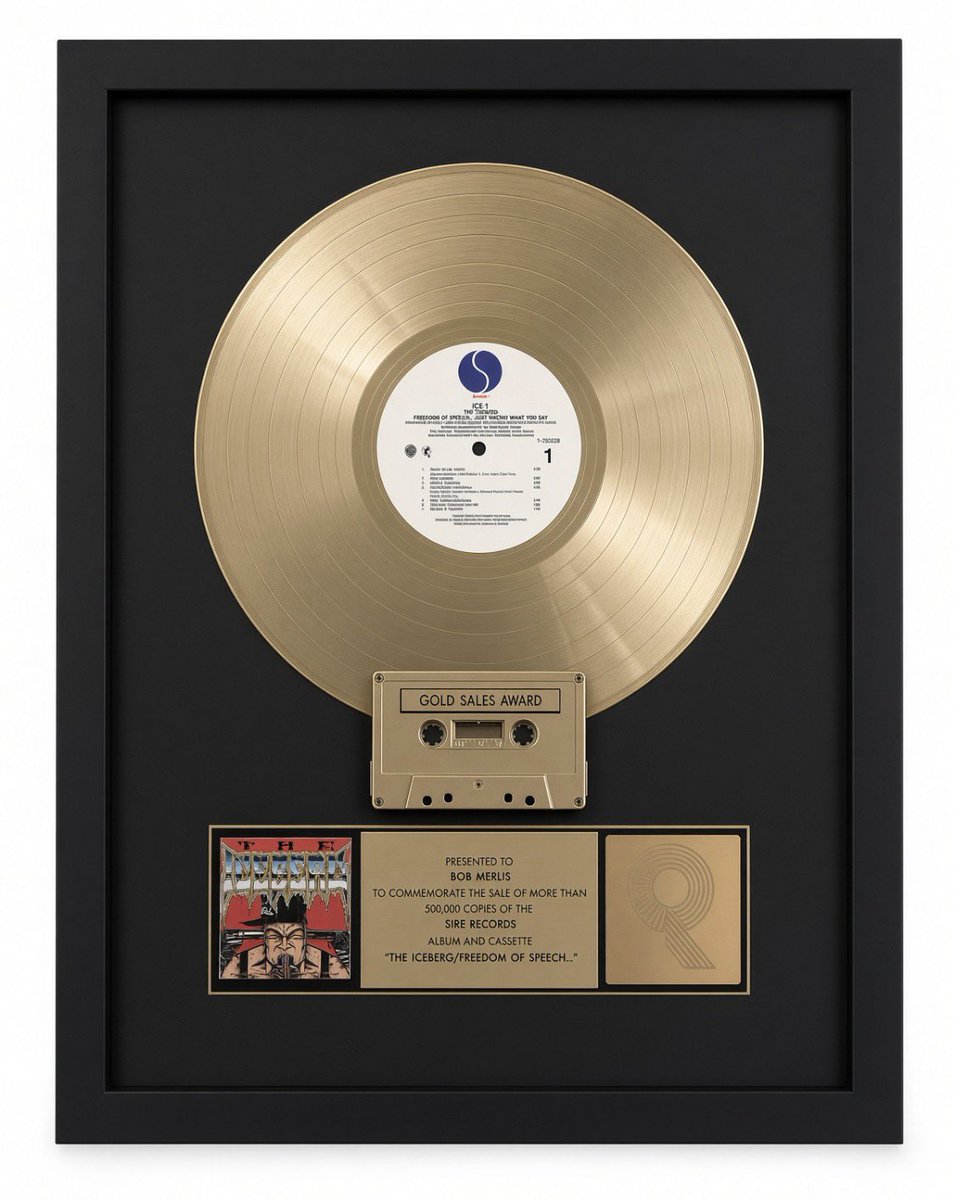
@FINALLEVEL This Gold plaque originally belonged to the head of publicity at Warner Bros. for your 1989 “The Iceberg/Freedom of Speech…” album. Just a few years later, you and Body Count went through it, experiencing firsthand the fall out over free speech.
Agreed—Harvey is the undisputed people’s champ of news anchors. She also has a talk show, info: https://t.co/lA3iFHwTOk. Turk’s love of books is legendary and she has a YouTube channel, go to https://t.co/FWXl1Zb9ct, where she has reviewed books, separate from her day job. Support our anchors’ extended passions.
Less than a week after seeing a larger-than-life representation of black women’s natural (albeit blue) hair (a San Francisco street artwork called “Sheba 3”; the red, white and blue image), two more visualizations/interpretations crossed my path—one ugly and one beautiful—while thrift shopping last night. I purchased both pieces for about $10.
Starting with the ugly. Based upon early research, the kids chair was likely produced in the 1960s or early 1970s by a company that had a manufacturing plant in Alabama. The image on the seat is stereotypical bl@ckface. Kids (probably not black kids) literally sat on a distorted image of a black girl during their formative years. These kids would now be adults in their mid 50s. Could these kids have matured and left behind the r@cism their parents obviously engaged in, as evidenced by them purchasing a chair like this?
The painting, acquired the same night as the chair at a different Goodwill, is clearly more modern and a 180 degrees different representation than that of the chair. Vibrant colors embrace the afro of a beautiful black woman. (Please do not infer that black women cannot be beautiful without wearing their hair naturally.)
I highlight and celebrate public women like Melba Tolliver, the first black anchor on national television. She wore an afro on air at a White House event in the 1970s despite her bosses telling her not to. I highlight and celebrate a modern day anchor at CBS Los Angeles, Sheba Turk, who was disparaged earlier in her career by some viewers for wearing her hair in a natural.
I do this to combat the negative images of black women that refuse to completely go away. Manufactured caricatures—like the one on the kids chair—are a reminder that not that long ago images like this were mass produced—affecting children who are now adults. And a reminder that there is more work to be done.
I think a good part of Freddie Jackson’s appeal was you were hearing an adult—a grown man—when he sang his classics like “You Are My Lady” and “Rock You Tonight.” There were no attempts to dumb down to cater to a young audience or screaming teenagers. His passing is a huge loss. At 70…gone way too soon.
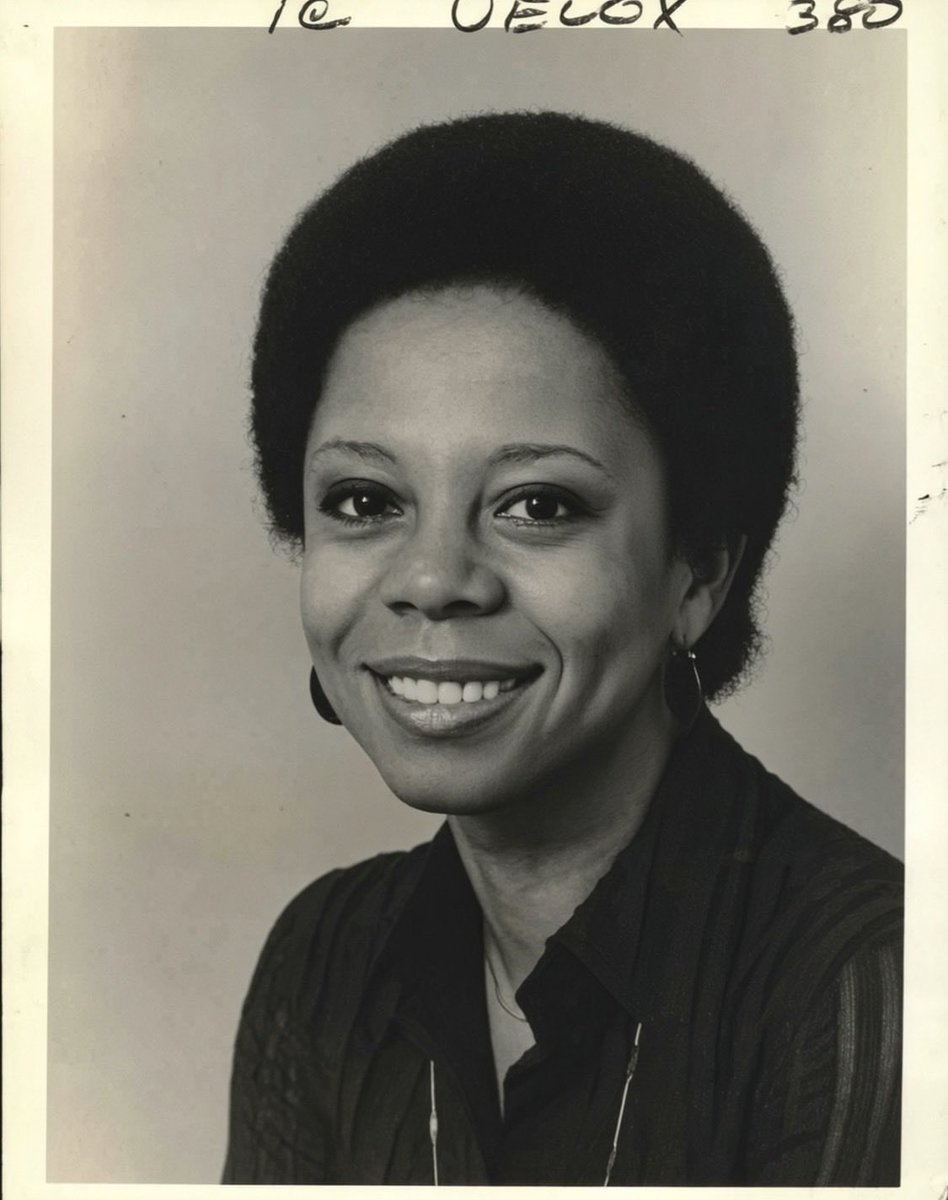
@ShebaTurk@Patharveynews Before social media and the Internet, there were black and white press photos. This tangible image of Melba Tolliver with a beautiful smile and hairdo is nearly 53 years old.
Before Ms. Harvey (reigning news queen) and Ms. Turk (in my opinion, an heir apparent), there was Ms. Melba Tolliver. She worked hard and became the first black American to anchor network news. It was not easy; she faced conflict by just trying to be herself. For example, she insisted on wearing her hair in a natural afro when covering the White House wedding of Tricia Nixon, which earned retaliation from her news bosses.
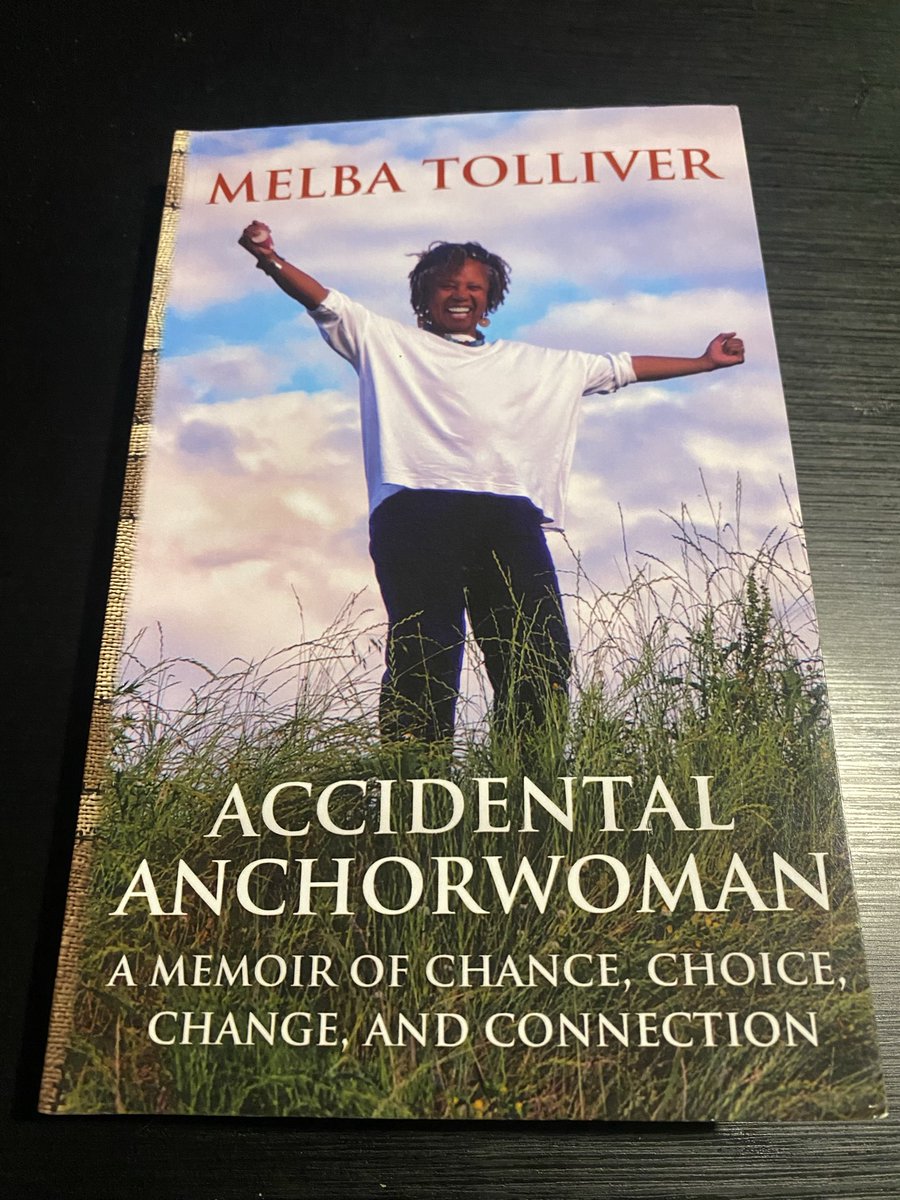
Ms. Tolliver is now 86 years old and I am proud and humbled to add this rare, signed copy of her memoir “Accidental Anchorwoman” to my collection. The prior owner may not have known what they had—the historic piece just arrived in the mail today.
I am sorry for the loss of your colleagues, @PatHarveyNews. It has to be difficult covering the story, yet you manage to balance sympathy and professionalism, like you always do. Tragic all the way around; prayers to the victims and their families—and all of you having to speak about your own.