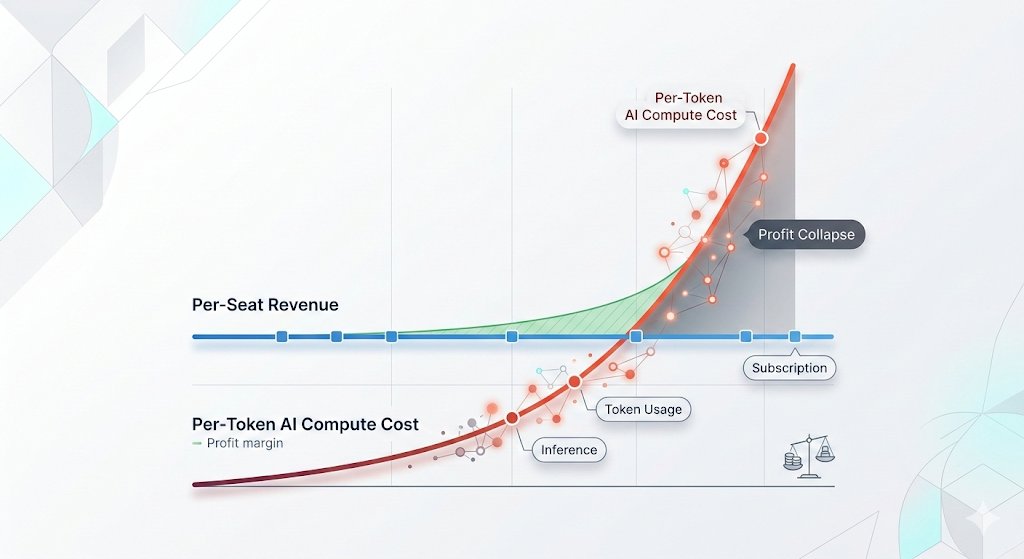
AI psychosis isn't delusion. it's a condition where your mental model of what AI is doing diverges so far from what it's actually doing that no signal reaches you before the decision is already made. the gap has a structure. and it scales with seniority.
CEOs are uniquely prone to AI psychosis because they’re sufficiently distant from the last mile of work that still has to happen to generate most value with AI.
So when they play with AI, they see the happy path results, often not considering the next 10 or 20 things that have to happen to get sustainable results from agents.
“Look I made this awesome product prototype”. Yes but you didn’t have to review the code before it went into production and fix a bunch of issues.
“Look I generated a contract”. Yes but you didn’t verify all the terms before it goes out to the counterparty and didn’t have to wire up all the past contracts to work with.
The best thing you can do as a CEO is to use AI a *ton* to figure out the real implications of agents in the enterprise, and come out the other side with an appreciation for both the upside and the real work that goes into them.
hedgie put numbers to something I've been hearing anecdotally for months: the AI token bill is getting ugly.
the thing nobody modeled was what happens when every employee in a 200k-person org is running 40 AI queries a day, at inference costs that weren't designed for that scale, with agent step billing on top.
the teams who built entire workflows around AI agents- content pipelines, research flows, operational stacks, are the ones getting squeezed hardest. because the unit economics that made it a no-brainer were built on token prices that aren't holding.
the real question is whether your AI setup is worth it at current (and if the trend continues - future prices) - and whether the teams who went AI-first earliest are the ones with the most to renegotiate
🦔Microsoft canceled its internal Claude Code licenses this week after token-based billing made the cost untenable, even for a company with effectively infinite cloud resources. Uber's CTO sent an internal memo warning the company burned through its entire 2026 AI budget in just four months. American AI software prices have jumped 20% to 37%, and GitHub (owned by Microsoft) is dropping flat-rate plans for usage-based billing across its products.
My Take
The AI subsidy era is ending in real time. The same company that put $13 billion into OpenAI and built the Azure infrastructure powering most of Anthropic's compute just looked at the bill from a competitor's coding tool and decided it was not worth paying. That is not a productivity failure on Anthropic's end. Token-based pricing is forcing every enterprise customer to confront the actual cost of running these models at scale, and the number turns out to be far higher than the flat-rate experiments suggested.
This ties directly to my Gemini Flash post yesterday. Anthropic, OpenAI, and Google all raised effective prices in the last six months. Enterprises that built workflows assuming AI costs would keep falling are now watching annual budgets evaporate in months. Two outcomes look likely from here. Either enterprises scale back AI usage to fit budgets, which slows the revenue ramp the labs need to justify their valuations ahead of IPOs, or the labs cut prices and absorb the losses, which makes the unit economics worse at exactly the wrong moment. Both paths land in the same place, the numbers stop working, and somebody has to take the writedown.
Hedgie🤗
meta cuts 8k roles to redirect toward AI + chinese labs matching frontier models at lower cost- two separate signals showing the same capital reallocation logic, where headcount is being traded for compute and american AI valuations are getting squeezed from both inside and outside. kind of points to the fact that the IPO window for OpenAI and Anthropic gets structurally narrower, not just competitively harder.
Personal update: I've joined Anthropic. I think the next few years at the frontier of LLMs will be especially formative. I am very excited to join the team here and get back to R&D. I remain deeply passionate about education and plan to resume my work on it in time.
AmexGBT going live and Kraken moving into stablecoins in the same week is not a coincidence. corporate travel spend is one of the last big B2B payment pools still running on slow rails. stablecoins just got a very credible use case.
most leaders i have met in the last two years have an opinion about AI. very few have done the work. that gap is where teams quietly lose ground. not in a board meeting. in a thousand small decisions where people look to leadership for signal and get noise instead.
i have sat in enough product rooms through my career to recognise a pattern. when new technology arrives, leaders fall into one of four responses. three of them fail. only one actually moves anything.
the first is the frozen skeptic. waiting for clear use cases. validated ROI. a proof of concept someone else ran first. the problem: clarity is a lagging signal. by the time it arrives, the competitive window is already closing. that is not being careful. it is being comfortable.
the second is the performative adopter. AI task force. prompt engineering workshop. internal demo day. all of it is activity that looks like progress and changes nothing. teams learn fast that the leader wants optics, not outcomes. so they give them optics.
the third is the anxious delegator. they know they should care, so they hand it to someone. a "head of AI." an innovation pod. a consultant. then they disengage. the work sits one layer removed from every real decision. nothing integrates. nothing compounds
the one that actually works is harder to name because it does not look like a strategy. it looks like a leader who uses the tools. personally. badly at first. who brings real problems, not demo prompts. who builds intuition before they build policy. they lead from contact, not from opinion.
the organisations pulling ahead right now are not the ones with the best AI strategy on paper. they are the ones where leadership has enough hands-on intuition to make a hundred small calls correctly, without a framework meeting every time. that is the compounding effect nobody is measuring.
the archetype that works is not smarter than the others. they are just closer to the work. wrote the full version, all four archetypes, what each one costs you, and what the shift actually looks like in practice:
https://t.co/9IgiU5e4YZ
wrote up the full pattern, what i saw across companies, what they taught me, and what a decision-first org actually looks like in practice: https://t.co/9kPv8rIaMB
everyone is reorganizing around AI. new titles, new team structures, new reporting lines.
almost none of it is working the way they hoped.
the problem isn't that they're moving too fast. it's that they're solving the wrong thing.
the orgs getting this right aren't asking "where does AI sit on the chart."
they're asking "who is accountable when the model is wrong."
then they build the structure backward from that answer.
the better question is: what decisions does your product make every day, and who owns the quality of those decisions?
AI changes the answer to that question more than it changes anything else. almost nobody is starting there.
the question most orgs are asking: where does AI sit?
central team? embedded engineers? chief AI officer?
these are org chart questions. and org charts are maps of how you think work happens, not how work actually happens.
quite a significant launch. X had anyway been speeding up financial news. it restructured how markets process reality. a single tweet moves a stock 4% before most traders even open their terminals. this gives X users structured access to that aggregation. will be super curious to see how broking and banking apps adapt to this as a lead generation or data enrichment channel!
𝕏 has always been the best source of financial news for traders and investors. Billions of dollars are allocated every day based on what people read on Timeline.
Today we're launching our new Cashtags feature in the US and Canada on iPhone, bringing real-time financial data to X.
Here's how it works:
1. When you search for or post a cashtag (or contract address), X will automatically suggest matching stocks or crypto tokens, so you can select the exact asset you had in mind.
2. Anyone who taps a Cashtag will see posts mentioning it along with its price chart—without ever leaving X.
This ensures that you're always matched to the chatter for the right stock or token.
Cashtags are just the first step in our commitment to be the best destination for the finance and crypto community.