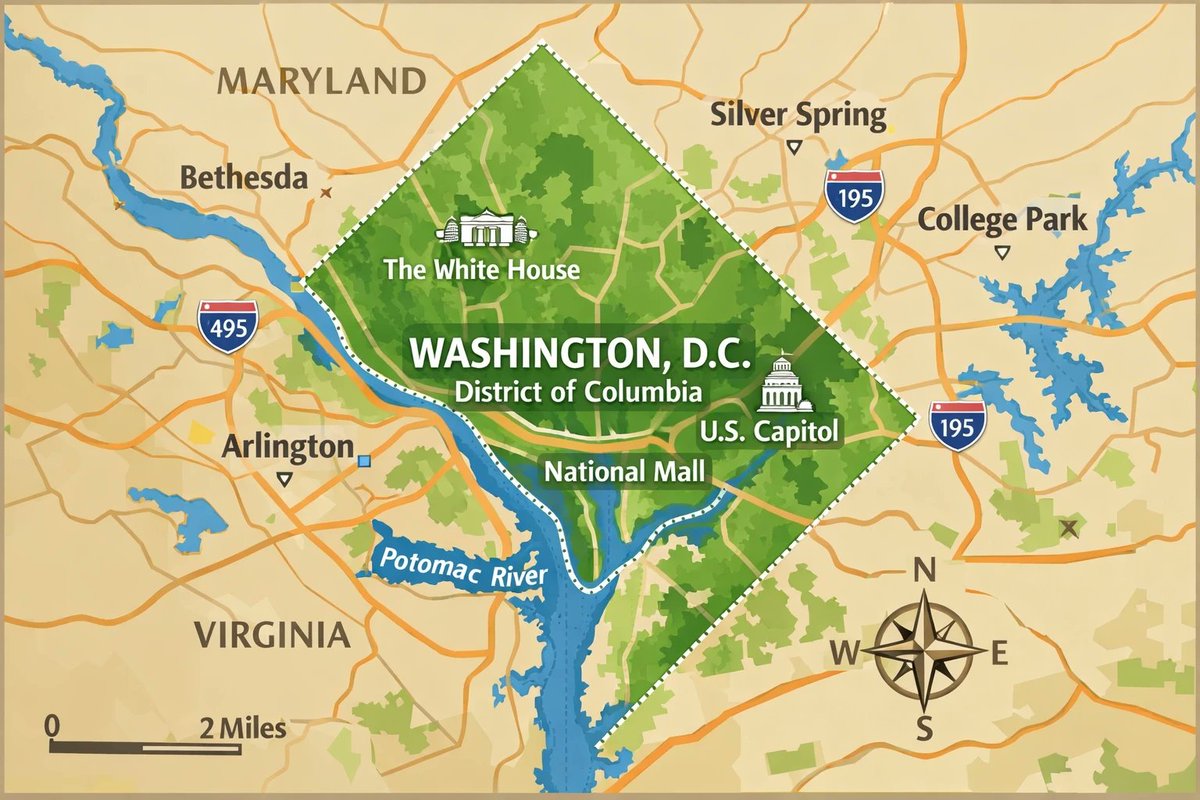
Ever wondered why the District of Columbia is half-diamond shaped instead of complete? Well, it used to be a full diamond. However, in 1846, the entire Virginia half was handed back.
Guess the major reason why?
1/n
Serious post everyone...All of these photos were taken on our public land out west. It looks like they're setting up to sell these same lands to "build affordable housing".
What they're really saying is they will be selling the land off to private equity for pennies on the dollar only to be bought using our own money from pensions and subsidies.
Your children will never get to know what it's like to have a cross country roadtrip camping on public lands along the way. Please speak up about this.
I know @doge probably has bigger fish to fry, but every photon of artificial light polluting our sky is technically energy wasted.
What if we could more efficiently redirect lighting only where it was needed, while also giving people back the stars?
In 2025, skywatchers can anticipate several remarkable celestial events:
Quadrantid Meteor Shower (January 3-4): This annual meteor shower is expected to peak, offering up to 120 meteors per hour under optimal conditions.
Mars at Opposition (January): Mars will be at its closest approach to Earth, making it particularly bright and ideal for observation.
Planetary Alignment (February 28): A r position all seven other planets, Mercury, Venus, Mars, Jupiter, Saturn, Uranus, and Neptune, in the Earth's sky simultaneously.
Saturn's Rings Disappearance (March): Due to Saturn's axial tilt, its rings will appear edge-on from Earth's perspective, causing them to seem invisible, a phenomenon occurring every 13 to 16 years.
Total Lunar Eclipses (March 13-14 and September 7-8): Two "Blood Moon" events will occur, during which the Moon will take on a reddish hue as it passes through Earth's shadow.
Increased Aurora Activity (July Peak): With the solar maximum peaking, intensified solar activity is expected to enhance auroral displays, potentially extending visibility of the Northern Lights to lower latitudes.
Venus and Jupiter Conjunction (August 11-12): The two brightest planets will appear very close to each other in the night sky, offering a spectacular view even to the naked eye.
Supermoons (October 7, November 5, December 4): Three consecutive supermoons will occur, with the November 5 supermoon being the largest and brightest since 2019.
Geminid Meteor Shower (December 14): One of the most active meteor showers, the Geminids, will peak, potentially showcasing 120 to 160 meteors per hour.
These events provide excellent opportunities for both amateur and seasoned astronomers to observe and appreciate the dynamic nature of our night sky.
👉 https://t.co/3tfRlBfX5G
Thank you again for all the outpouring of love for our Ben. I can’t tell you how much it means to me and my family.
He wasn’t just my best friend – he was America’s best friend ❤️
The aurora forecast for tonight (7/29-7/30) calls for KP7/G3 conditions!
Pending favorable data, aurora may be visible overhead in New England and the Midwest - and on the horizon as far south as North Carolina and Oklahoma.