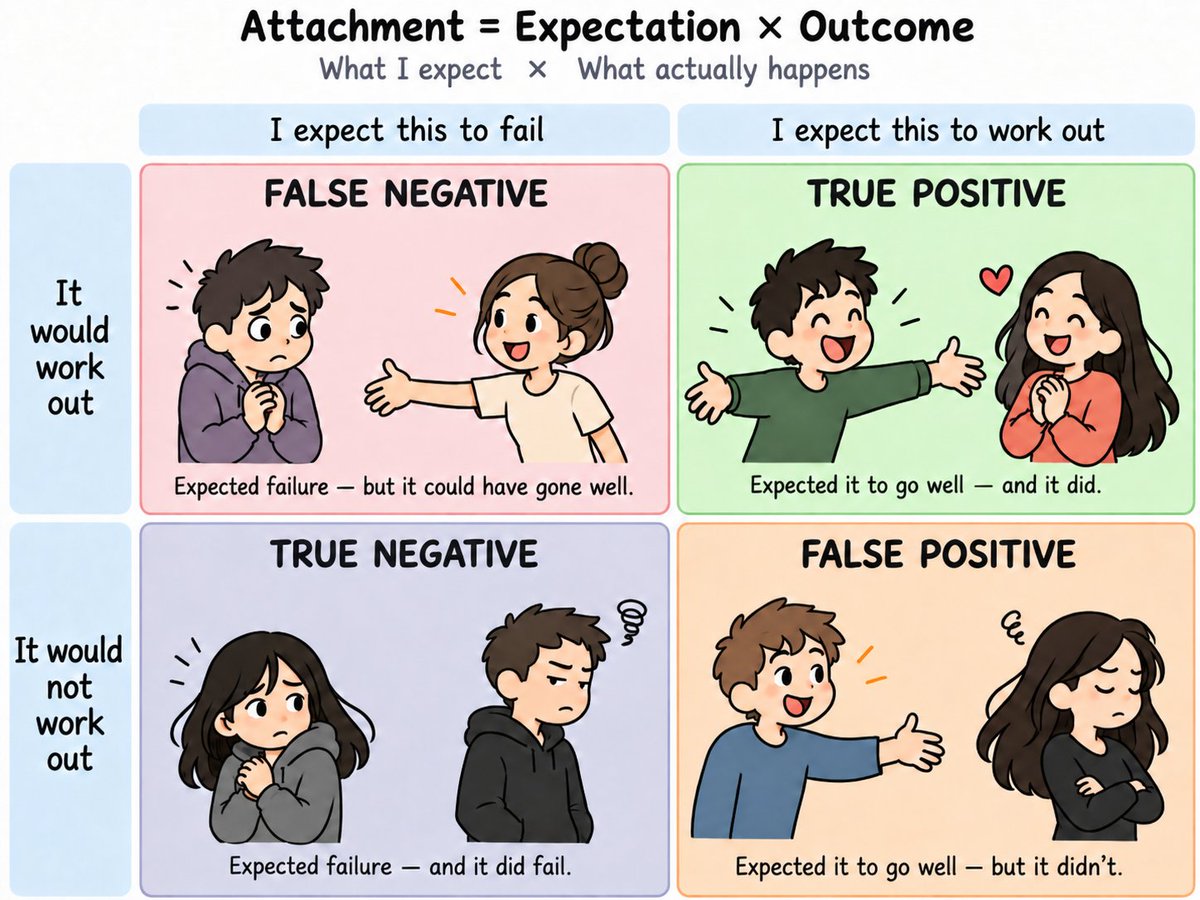
If you expect people to reject you then they will, more than they would otherwise, but it won't sting as much as you expect it.
If you expect people to fw you then they will, more than they would otherwise, but it will sting more when they don't.
The choice is yours.
If you casually flirt with every woman you meet and greet random guys with a “what’s up bro” energy, you'll go far in life. Everyone’s just a kid in an adult body. They want complements and connection. Be that guy and you’ll never be lonely or broke.
The more we develop a conscious relationship with our emotions, the more “negative” emotions become a support on the path of awakening.
A powerful moment on the spiritual journey in where are able to *rest in negative emotions*.
Instead of resting in the breath or in bliss or in spaciousness, we can rest in, say, fear.
Or we can rest in the feeling of anxiety.
Or we can rest in the feeling of sadness.
Fear, anxiety, sadness etc become refuges we can rest in instead of problems we resist.
Of course, when we learn to rest in them we see much of what makes them present as “sadness” or “fear” or “anxiety” is our resistance to them.
By resting in them, they naturally transform into something that may have exactly the same sensory make up but doesn’t present as something negative.
In many ways, learning how to become absorbed in breath or bliss or spaciousness serves as our training wheels for learning how to rest in challenging states.
We can become entirely absorbed in fear / anxiety / sadness using the same mental movement we become absorbed in breath / bliss / spaciousness.
In that absorption, the subject-object divide dissolves, resistance disappears and that sense of restfulness emerges.
Better yet, we can simply take our entire field of experience as our meditation object and become absorbed in the entire field until the sense of experience / experiencer dissolves globally.
The ever-changing field of experience becomes our resting place and we can worry less about whether it is sadness / fear / anxiety or bliss / spaciousness / love that fills it.
Although of course, when resting in this way, all phenomena - even the “negative emotions” - start to take on an aspect of bliss and spaciousness.
Instant metta trick: imagine the person you’re dealing with as a child as they were, dealing with their unique difficulties and enjoyments without trying to fix them. Good stuff, instant 2x joy
Sentient beings suffer. It's not because you're doing it wrong. It's because you are a sentient being.
This is the First Noble Truth as taught by the Buddha.
Cut yourself some slack. There's nothing wrong with you.
A near enemy of both agency and self-improvement is excessive self-reliance.
When I want to take on a big new project, my first thought is not usually “what should I do?” but rather “who should I reach out to?”
Agency doesn’t always look like rugged self-reliance.
It can often - more often I’d say - look like knowing how to navigate and network the ecosystems we’re all embedded in.
It’s good to remember that every person we know - or have a route to knowing - represents a potential extension of our brainpower, resource, imagination and opportunity horizon.
When we recognize this, it becomes silly to rely excessively on our own brain, imagination and resource.
What feels impossible when viewed from the POV of an isolated actor, suddenly starts to feel very possible when viewed from the POV of a network of actors.
This is especially true when we feel blocked or bottlenecked by something.
If a dream you have feels impossible, often the best way to change that isn’t just to brainstorm which actions you should take to achieve it.
It’s to brainstorm the 5 people you should get in touch with to collaborate with on making it happen.
There is almost no meditation technique I’m aware of that >50% of people don’t turn into an exercise in dissociation.
People will use jhana techniques to hide from their pain in bliss.
People will prematurely "dissolve" sensations in vipassana to avoid fully feeling them, instead of seeing sensations more clearly *by* feeling them.
People will use open awareness meditation to simply space out.
People will mistake emptiness practices for trying to contact an obliterating nothingness rather than contact the unfixed nature of phenomena.
People will even use metta practice to coccoon themselves in a kind of warm fuzzy feeling that protects them from experiencing emotions they find challenging.
Or to cartoonize others into 2-dimensinal objects of an abstract love rather than connecting to their actual suffering.
For most people, the fancier and more complex the dissociation the better, as complexity provides fertile ground for the misdirection that dissociation thrives on.
But when done properly, each of these practices should be a vehicle for contacting reality, not numbing it out.
The bliss and concentration of jhana creates a safe and clear container for investigating our suffering.
Vipassana provides tools for feeling our suffering so deeply that we come to see something of how its constructed.
A truly open awareness will be open to everything - including the messiest parts of our suffering.
Emptiness practice won't paint over suffering with nothingness, but rather bring fluidity, malleability and aliveness to it.
Metta will connect us to our sufferings and the sufferings of others in ways that give us greater capacity to feel - and practically respond - to them with compassion.
There's this image of meditation as an exercise in blissing out. And obviously accessing bliss can be an empowering part of it.
But actually, accessing pain, suffering and a tangible felt connection with our body, our life circumstances and the people around us is even more empowering.
I think a healthy attitude to meditation is to *assume* that we probably will not entirely escape this tendency to hi-jack it in service of our mind's habitual tendency towards dissociation.
By remaining vigilant to it, we can start to notice what the mental motion of dissociation looks like.
And by noticing what the mental motion of dissociation looks like, gradually we can learn and master the mental motion of reassociation.
The mental motion of making uncompromising contact with the fullness of our experience.
There are not many more fruitful skills to learn than that.
a surprising amount of inner work or whatever involves this type of activity i’ve never heard anyone name, which i would describe as undoing surprisingly powerful spells you cast / wishes you made / vows you swore when you were younger that are sort of ruining your life now
@nickcammarata@ChambaTiago@HellenicVibes How would you prompt claude in a way to be the best meditation guide/coach? I love resonate heavily with Burbeas work. Trying to work towards Jhanas at home with ~1-2 hours a day of practice