As ORE matures it should thrive in bear markets and benefit from risk-off environments. A flight to safety.
We got a glimpse of that with OREs price action following the 10/10 crash.
Until that becomes the norm our job isn't finished.
The Bitcoin Protocol has become digital De Beers. You should not have to buy your SoV from massive mining conglomerates that control 65%+ of the hashrate.
Pivot to $ORE. The fairest token distribution system ever created.
Very few “independent” thinkers cared about Zcash before it broke out. The same will, inevitably, be true of ORE.
Those people that CT puts on a pedestal, who recommended buying ZEC in the fall of last year post breakout, basically all sold too early and had to rebuy, and would probably have been better off just holding (they also mostly missed the initial 5x run up from 40 to $200)
The lesson here is to be careful who you listen to (the takes from respected influencers on here are, in all likelihood, not helping you think clearly). Take the time to think about things from first-principles and make your own mind up
To achieve truly asymmetric returns requires the courage to buy something before it is anywhere close to consensus, even within CT, as well as the courage to hold it over a multi-year time frame (so long as the axioms underlying your thesis remain in tact)
That sort of courage requires independence of mind
ORE Reserve Report:
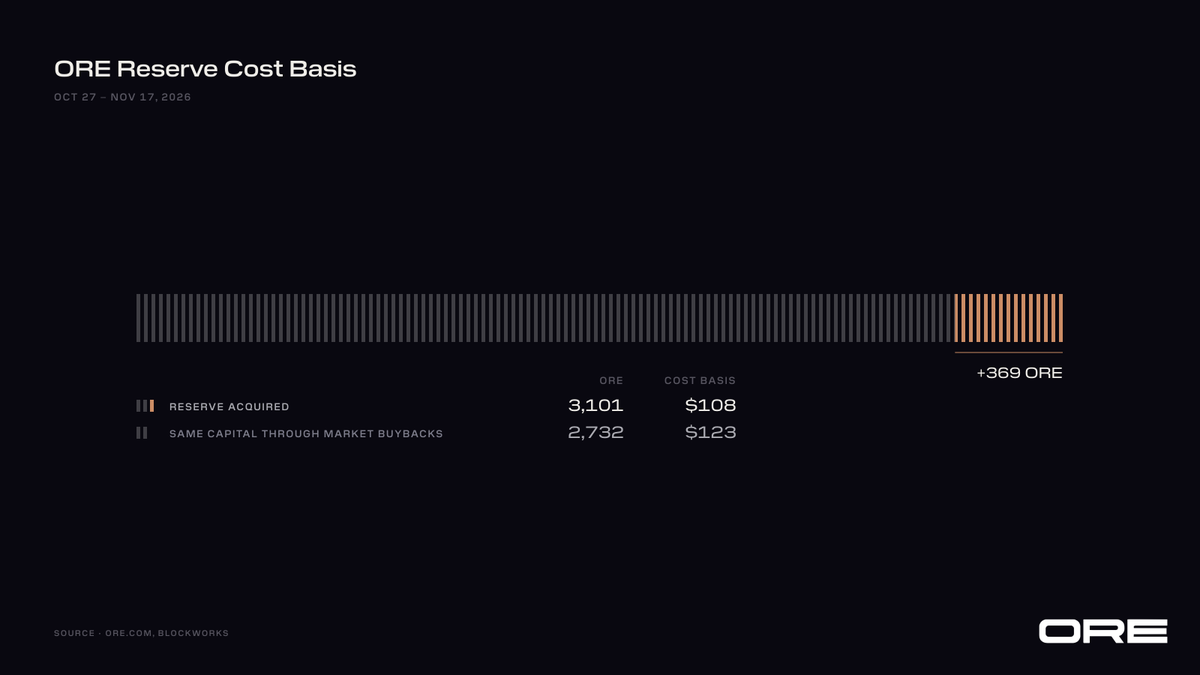
Over the past three weeks, the Reserve acquired 3,101 ORE at a $108 cost basis as $335K in resting bids filled.
The same capital spent through market buybacks would have acquired ~2,700 ORE at an average cost of $123 per ORE over this period. Resting bids allowed the Reserve to accumulate ~14% more ORE per dollar as prices declined.
$485K in protocol-owned liquidity remains in the Reserve as buy-side support below spot.
Privacy is fundamental to a future-proof store of value.
ORE is integrating Solana Privacy Rings by @Helius, bringing enhanced privacy infrastructure to token transfers on ORE.
With confidential transfers, users can move ORE without publicly revealing the assets or amounts involved.
More privacy on @solana. More privacy for ORE.
Btc 21m meme and never change anything unless absolutely necessary is a good SoV product roadmap. It covers 80% of the sov feature set.
Anywhere in the world, solana is the best place to run an sov market. This has a much bigger surface area, requires constant change to keep up with new hardware. But only works if the markets are immutable and never break and can’t be stopped. So we need cheap fast censorship resistant global state machines.
JitoSOL in the ORE Reserve. ORE in the Jito Treasury.
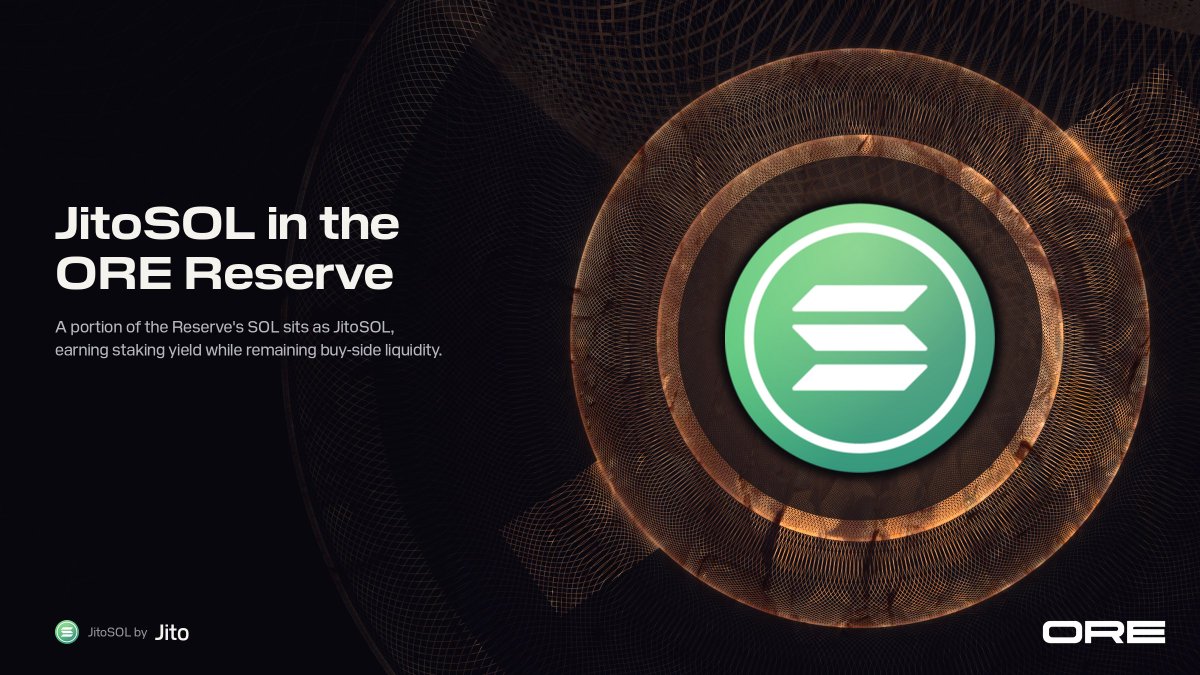
The Reserve holds part of its SOL allocation as JitoSOL, another productive asset earning yield while providing buy-side liquidity for ORE.
@JitoFDN has also added ORE to its treasury, establishing a position with its first ORE purchase.
My bull case for $ORE bakes in the fact that the majority of the market will continue to chop and remain spectacularly unimpressed with the mechanism that the SoV of SoVs offers.
And that’s fine.
Broad recognition was never a prerequisite for participating in the grid. I want to continue to accumulate ownership before the explanation becomes easy enough to fit into everyone else’s conviction(and it will). Consensus will be much more expensive than where we currently are.
The most interesting part of $ORE's design isn't live yet.
TLDR: Today, revenue generated by the ORE Reserve auto-compounds in isolation. Eventually, that revenue could be streamed to uORE holders (miners holding unclaimed rewards) as SOL mining credits, allowing the protocol to increasingly fund its own mining activity. The result is a flywheel that could strengthen mining incentives, lift staking yield, and put ORE on a path to net deflation.
First, it's worth understanding why ORE is different.
Bitcoin, Zcash, Ethereum, and Solana all use their native assets to incentivize network security. ORE doesn't have that requirement. It inherits Solana’s security, so it can direct its incentives toward a different objective: rewarding those who accumulate and hold the asset.
ORE is a store of value by design, and nearly every mechanism in the protocol reinforces this objective.
Consider how value flows through ORE today:
- Miners deploy SOL to earn ORE, aiming to acquire it below market price.
- A 10% refining fee on claimed rewards is redistributed to holders of unclaimed rewards (uORE).
- Mining revenue funds ORE buybacks, burial, staking rewards, and the Reserve.
- The Reserve provides liquidity while generating its own revenue through LP fees and yield-bearing assets like JitoSOL and USDv.
The result is a system where mining activity supports holders through multiple mechanisms, while the Reserve continues to grow and generate additional liquidity and revenue.
But there's one more piece to the design. Arguably the most interesting.
In AI, recursive self-improvement (RSI) describes a system capable of improving its own capabilities, with each improvement enabling further improvements.
ORE has a potential economic equivalent.
Today, the simplified flow looks like this:
Mining → Reserve → LP fees + yield → Reserve.
The Reserve grows, generates revenue through LP fees and yield, and reinvests that revenue into itself. A straightforward compounding mechanism.
But the loop back to mining remains open.
Now consider what happens when Reserve revenue is redirected to uORE holders as SOL credits, usable exclusively for mining ORE.
The flow becomes:
Mining → Reserve → LP fees + yield → SOL mining credits → Mining → Reserve.
The loop closes.
This is the recursive moment.
Consider the significance of this change.
Today, mining depends on SOL supplied by users. With mining credits, the Reserve’s own revenue becomes a new source of capital to fund that same activity.
Originally powered by user capital, ORE could become increasingly self-powered.
A protocol generating its own fuel.
There are two particularly interesting second-order effects here.
First, Reserve-funded mining credits could increase competition for ORE rewards, driving up production costs. To the extent this stimulates incremental mining activity, it generates additional protocol revenue, supporting buybacks, burial, staking rewards, and Reserve growth.
Second, and perhaps most importantly, this creates a potential path toward sustained net deflation.
At sufficient scale, additional protocol revenue could fund enough buybacks and burial to consistently exceed new ORE issuance.
To be clear, mining credits aren't live today, and it may be years before the economics justify turning them on.
The Reserve first needs sufficient scale and sustainable revenue to fund meaningful mining incentives without compromising its liquidity or long-term growth.
More importantly, the incremental mining activity needs to generate enough additional value to justify redirecting revenue away from direct compounding.
But the potential end state is worth considering: an economic system that compounds recursively, under its own power.
$ORE is up 12% today
price & revenue has been in a clear uptrend since mid september
$140k/day avg revenue (based on 30d rev) almost all of it goes to ORE buybacks/burns + stakers
56.2% of circulating supply is currently staked valued at $43.5M
ngl these rev/buyback numbers look too good for such a small float when you pair it w/ over half of circ supply being untradeable
only at $77M mcap btw, numbers don’t lie