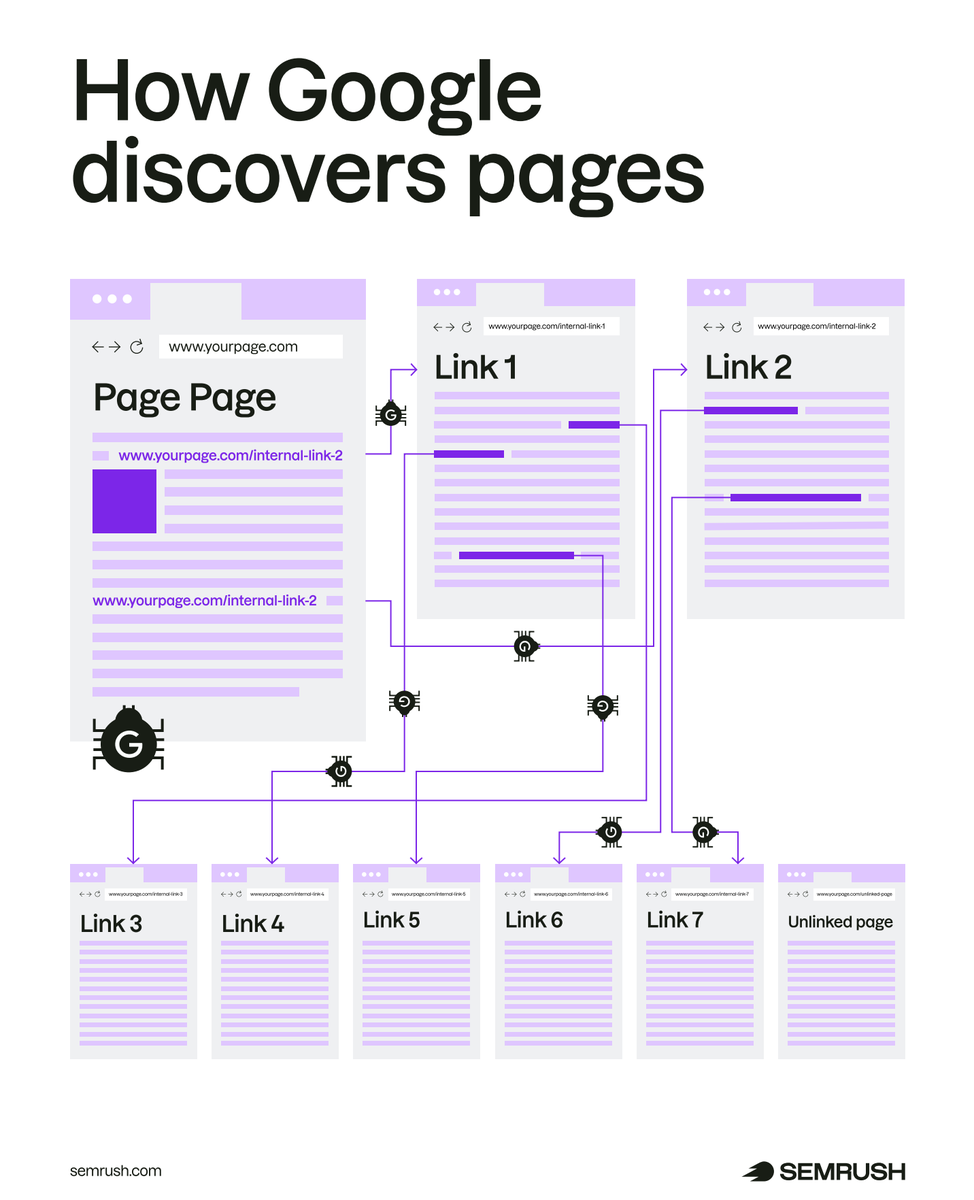
A web crawler is a bot that visits and processes webpages to understand their content.
They are also known as:
• Crawlers
• Bots
• Spiders
• Spiderbots
Search engines use crawlers to discover and categorize webpages. Website owners can also use crawler tools, such as backlink crawlers or technical audit bots, to monitor site performance, analyze competitors, and improve SEO.
Learn how they work in our blog: https://t.co/aNwKjrfP0P.
Buyer intent keywords are search terms that signal a user's readiness to make a purchase.
Someone who merely wants information about running shoes might search Google for “best running shoes for marathons.” Whereas someone looking to buy running shoes in the near future might ask ChatGPT “who has the best price for Nike Alphafly 3 shoes?”
Buyer keywords are valuable to marketers because they signal a user is further along in the buying cycle and closer to a purchase. They can be classified into two categories:
• Low intent (also called commercial intent)
• High intent (also called transactional intent)
https://t.co/ndWWQu7YCc.
How much time does it take to create a blog post?
Believe it or not, it's roughly 225 minutes.
Human content in general outperforms AI-written content, but it doesn't mean you can leverage AI in the process to help with efficiencies.
86% of buyers now use AI tools during their purchasing journey. They aren’t just Googling anymore. They ask ChatGPT, Gemini, and other AI tools to research solutions, compare vendors, and build shortlists.
If your brand doesn’t show up in those answers, you may never make the shortlist! Whatever you call it, the goal is the same:
Make sure AI tools can find, understand, and recommend your brand.
We analyzed the data behind this shift 👇
https://t.co/kagZlipetz.
Google just published a new doc explaining how its web crawlers work.
Nothing shocking, but a few reminders:
• Frequent crawling = usually a good sign
• Multiple specialized crawlers exist
• Freshness still drives crawl demand
Care about technical #SEO? This one’s for you: https://t.co/5TKHvRN1zG
Wondering how to report your AI Search Optimization results?
Our blog post breaks down what to track, how to explain it, and how to present it (plus a free template!): https://t.co/JgoKzJVLJg.
Everyone in SEO is panicking about AI Overviews, AI Mode, ChatGPT eating Google, but they're all making the same fundamental mistake: Confusing LESS traffic with LESS money.
YES, TRAFFIC WILL DROP. BUT THE TRAFFIC THAT REMAINS BECOMES INSANELY VALUABLE!!!
AI will answer the informational queries.
"What is SEO?", "how many calories in a banana?", "when was the Eiffel Tower built?", those clicks are gone. Nobody is visiting your blog post for that answer anymore.
Every click that survives the AI filter is a HIGH INTENT click. Someone who clicked through an AI answer to visit your actual website is further down the funnel than any organic visitor we've ever had before.
They've already been informed by AI, now they want to TRANSACT.
That means conversion rates go up, significantly. A site that used to get 100k visits at 2% conversion might drop to 40k visits at 6-8% conversion. The revenue stays the same or grows, you just have fewer time wasters.
NOW HERE'S WHERE IT GETS INTERESTING FOR GOOGLE'S BUSINESS MODEL..
Google makes ~80% of its revenue from ads. If AI Overviews answer informational queries for free, Google loses the ad impressions on those queries entirely.
So what does Google do? They INCREASE ad density and INCREASE ad costs on the remaining commercial SERPs, the queries where money is actually being spent.
We're already seeing this. More ad slots, more Shopping results, more sponsored placements on transactional queries. Google is squeezing more ad revenue out of fewer but higher value searches.
This means:
- Cost per click on Google Ads goes UP (fewer total impressions, same advertiser demand)
- The value of organic rankings on commercial terms goes UP proportionally (because the paid alternative is now more expensive)
- Every organic position 1 ranking on a transactional keyword becomes worth MORE money, not less
SEO doesn't die in this world. It becomes MORE valuable because the organic alternative to expensive ads is even more attractive to businesses.
AND THEN THERE'S THE NEW GAME ENTIRELY..
AI Visibility, getting your brand recommended by ChatGPT, Gemini, Perplexity and Google's own AI, is an entirely new channel that didn't exist 2 years ago - It will both require and create new strategies, new people and new budgets.
That's not the death of SEO, that's an EXPANSION of SEO into new surfaces, and an expansion that is not just following but actively riding the biggest investment trend in history.
The SEOs who will struggle are the publishers monetized by display ads. That model is genuinely under threat but it was way before ChatGPT ever dropped, and Google has been targeting it since HCU.
But eCommerce SEO? SaaS SEO? Local SEO? Lead gen? Affiliate? Parasite? Agency consulting? All of these verticals either stay the same or get MORE profitable as traffic concentrates into higher intent visits, and the expertise (or at least, perceived expertise) required is even higher.
Yes, this is the biggest change to search UX probably in our lifetime, but, we have had major changes that have massively disrupted us before; Featured snippets, penguin and panda, new types of penalties, ML and NLP algorithms, and a half dozen other events that had 100s of "SEO is dead" articles written on them...
Every single time, the industry adapted, evolved, and grew.
This time is no different - The tools change, the surfaces expand, the traffic shifts, but as long as people search for things and businesses want to be found, someone needs to make that happen.
That someone is us, and you can be damn well sure I'm about to get paid more for it, not less! 🔥
The brands that win in 2026 are doing this: mastering visibility in AI-powered search.
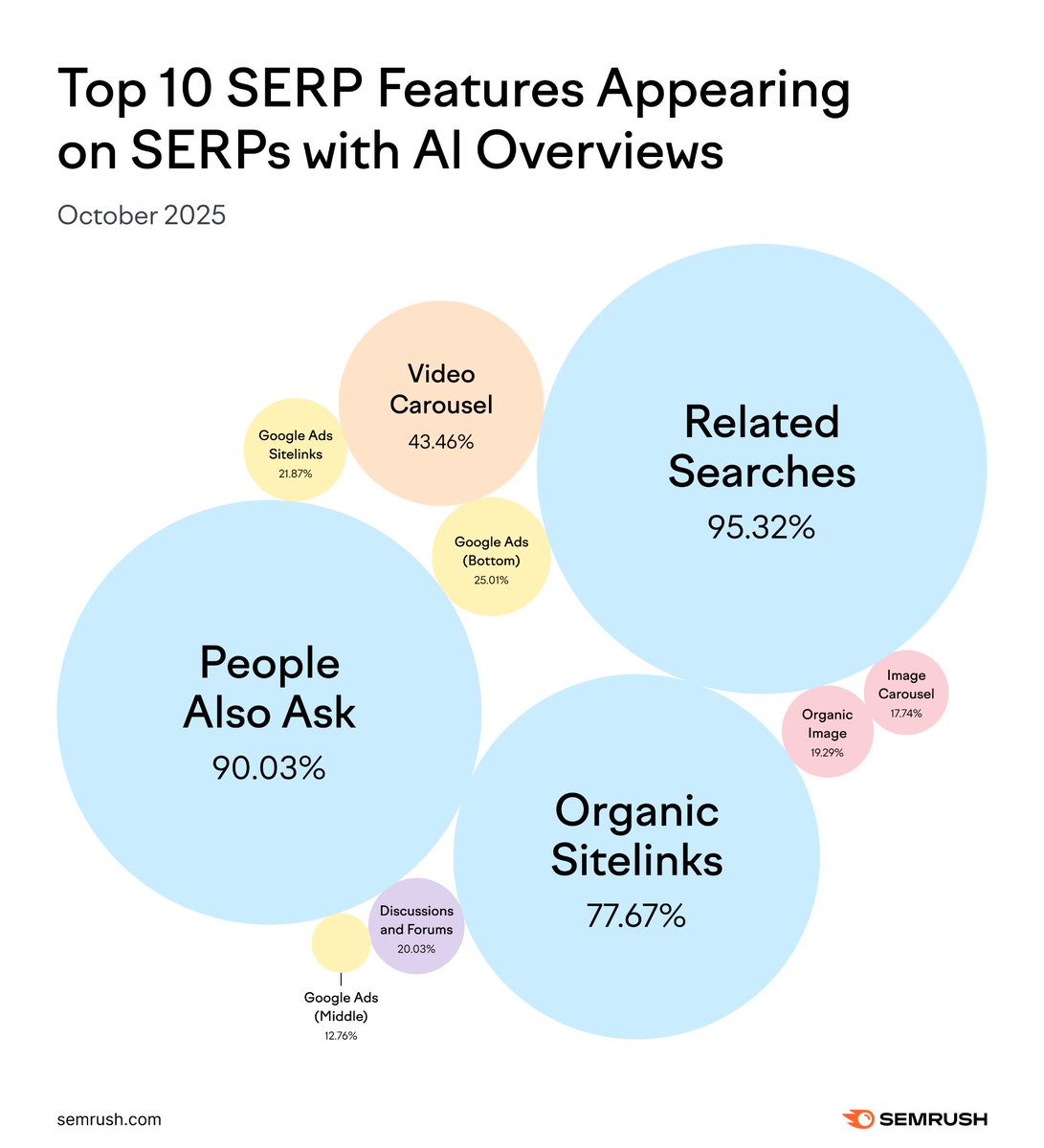
Google’s AI Overviews now appear on a growing share of queries, reshaping rankings, CTRs, and traffic patterns – and it’s not just informational keywords anymore.
If your content isn’t built to appear in these summaries, you’re missing a huge slice of visibility.
https://t.co/58pCh3PX8n.
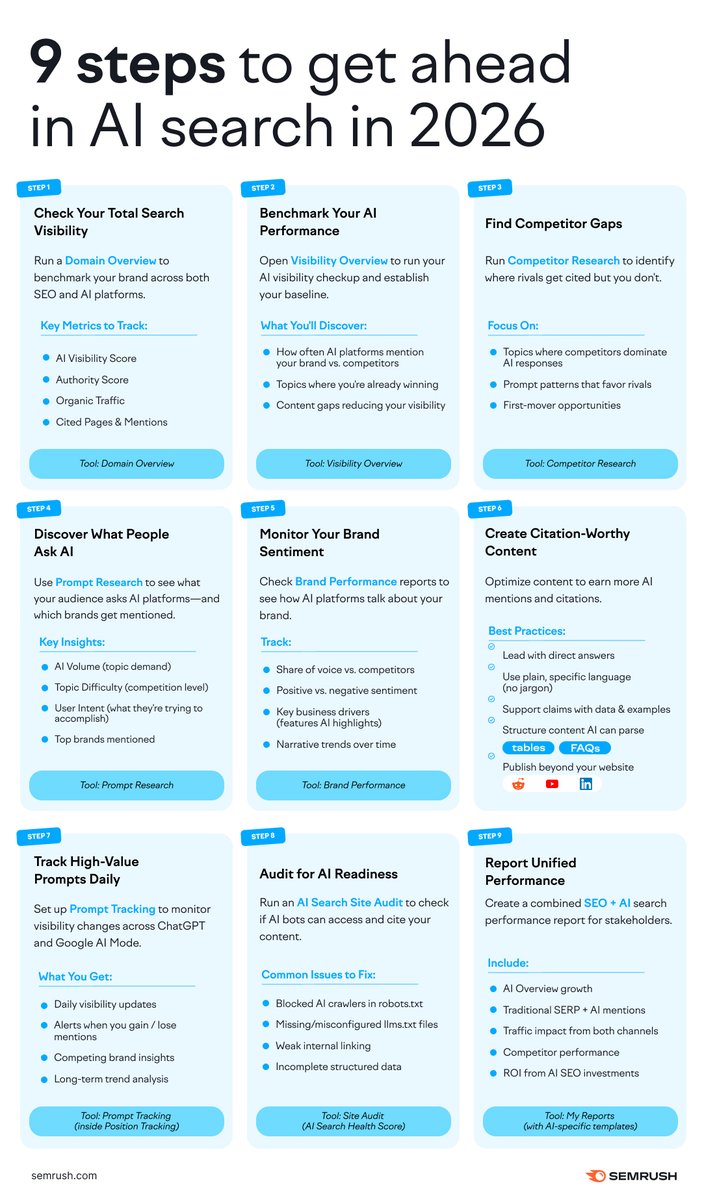
2026 starts with a simple question:
Can AI find, trust, and cite your brand?
This 9 step workflow is built for teams who want to answer that question with data, not assumptions.
From AI visibility benchmarking to unified SEO + AI reporting together, this is how modern search strategy starts the year 👇
https://t.co/6QGOlgRThH.
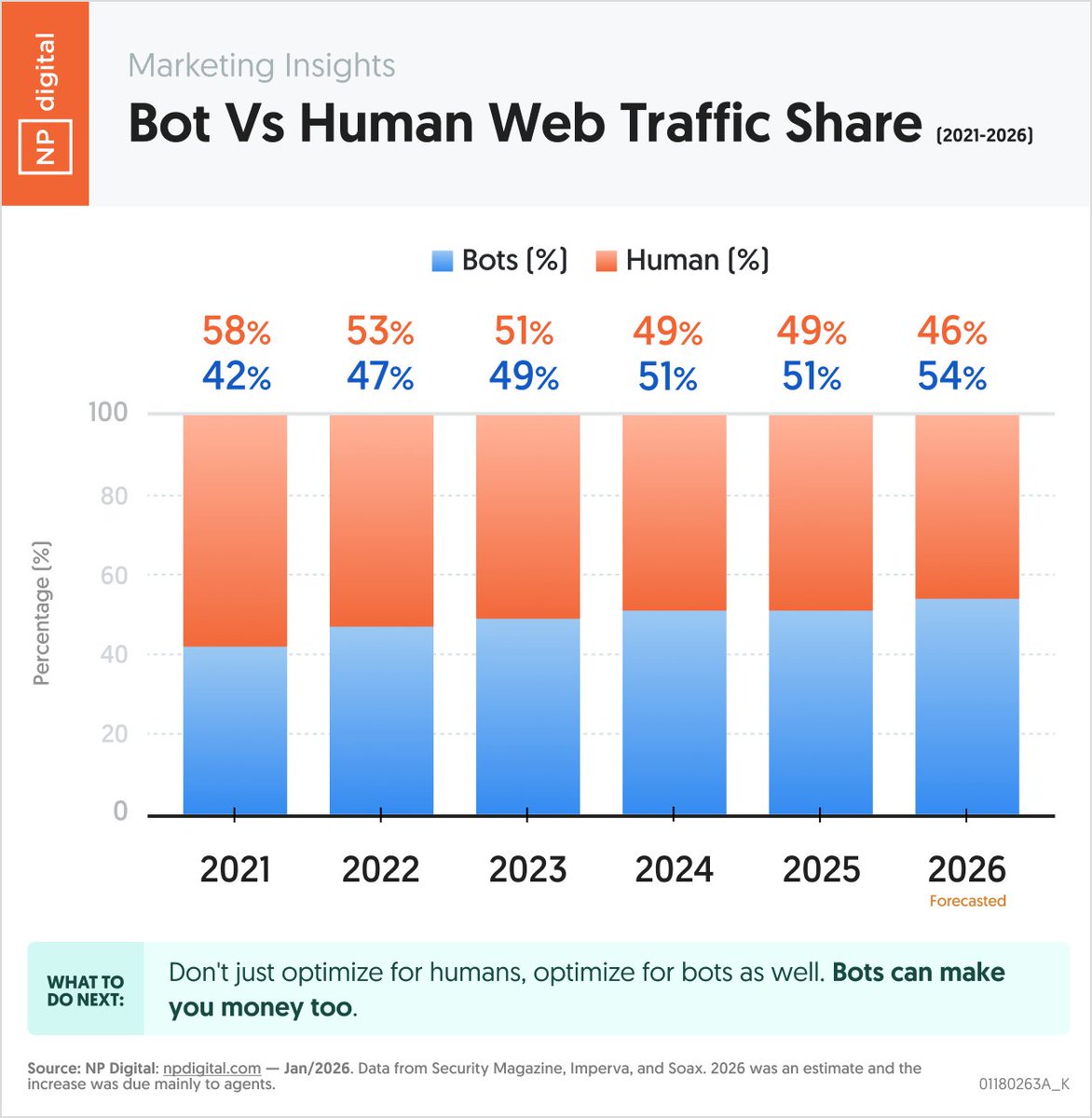
The majority of your website traffic is now bots, but you haven't even seen anything yet.
Everyone is talking about agents, but they're not really that popular yet.
Just wait 2 or 3 years, and the world will change because agents will be doing a lot more for humans.
And then your core focus will shift to optimize for agents AND humans. And to learn how to do this, make sure you attend our free webinar. https://t.co/1bHS58o8O4
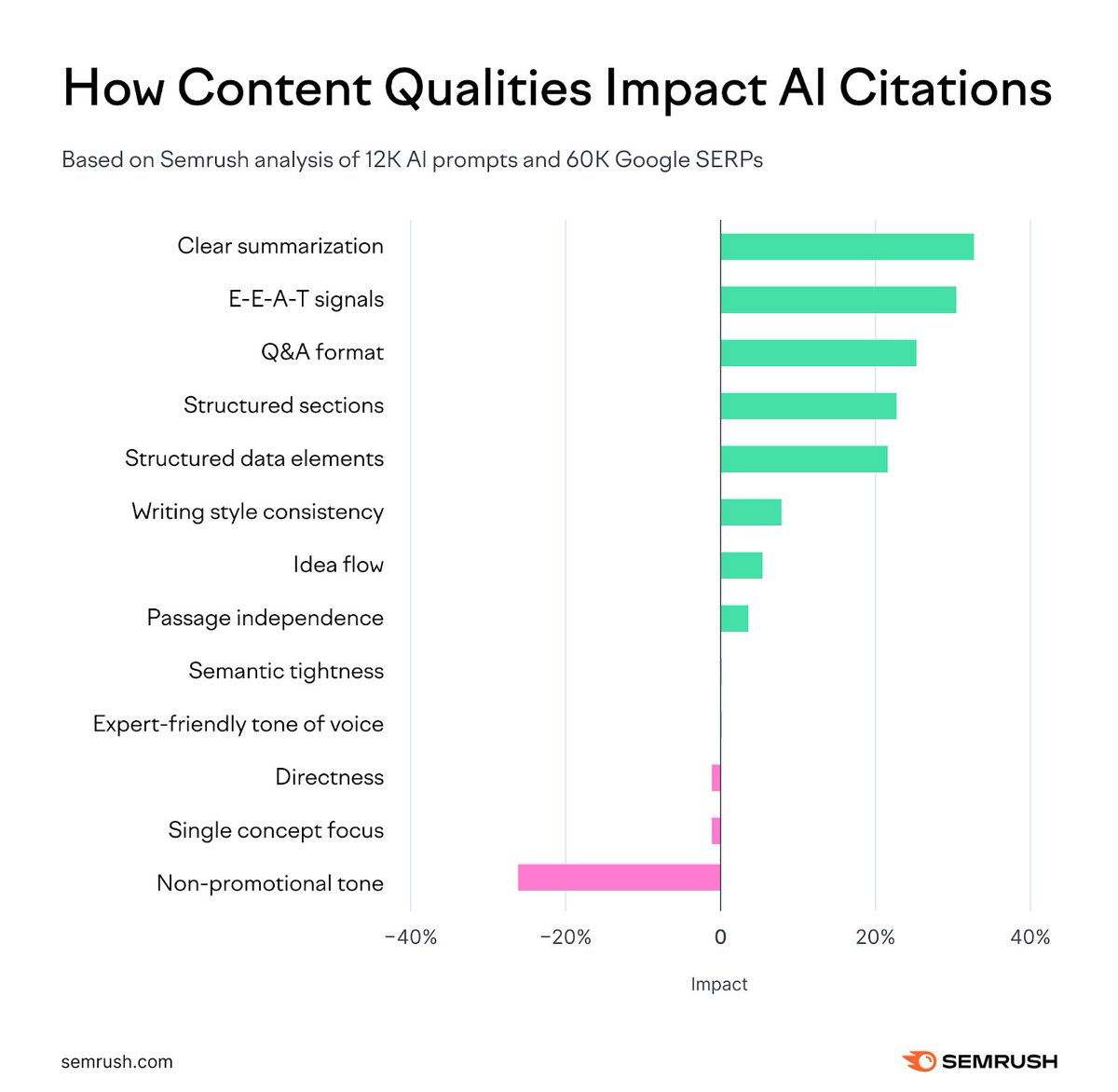
AI search platforms like ChatGPT, Google AI Mode, and Perplexity are changing how content gets discovered. But what makes one piece of content get cited while another gets ignored?
To answer this, we analyzed thousands of citations and compared them to similar pages ranking in Google. Our goal was to identify which text-only qualities most strongly correlate with AI citation behavior, and whether these patterns differ from traditional SEO signals.
Based on our research, we found five content qualities that showed a strong positive correlation with AI citations, plus one that showed a negative correlation:
• Clarity and summarization: +32.83%
• EEAT signals: +30.64%
• Q&A format: +25.45%
• Section structure: +22.91%
• Structured data elements: +21.60%
• Non-promotional tone: -26.19%
In other words: Content that leads with clear answers, demonstrates expertise, and uses structured formatting gets cited more often.
Full breakdown: https://t.co/wOQuqaevx5.
Here are the SEO trends you shouldn’t ignore this year 👇
1. AI-Generated SEO Content Is Now Mainstream
2. Alternatives to Google Are Becoming More Popular
3. Matching Search Intent Is Even More Important
4. Credibility Holds More Weight
5. AI Visibility Is Becoming a Key SEO Metric
6. AI Tools Are Transforming SEO Workflows
7. Zero-Click Searches Have Changed Search Behavior
8. Conversational Keywords Are Key
9. Local SEO Has Moved Beyond Just Google Business Profile Optimization
Fing out how to leverage them: https://t.co/9dDCuJQWhx.
Here are the main benefits of an AI-Driven Content Strategy:
• Automating repetitive tasks and freeing up time for creative or strategic thinking
• Better meeting your audience’s needs by creating the types of content they’re looking for
• Avoiding creative burnout by using AI content generators for drafting
• Gathering insights from lots of data without having to manually sift through it
• Getting more out of your marketing budget by increasing your output without having to hire more creators
https://t.co/tL73tWHsMj.
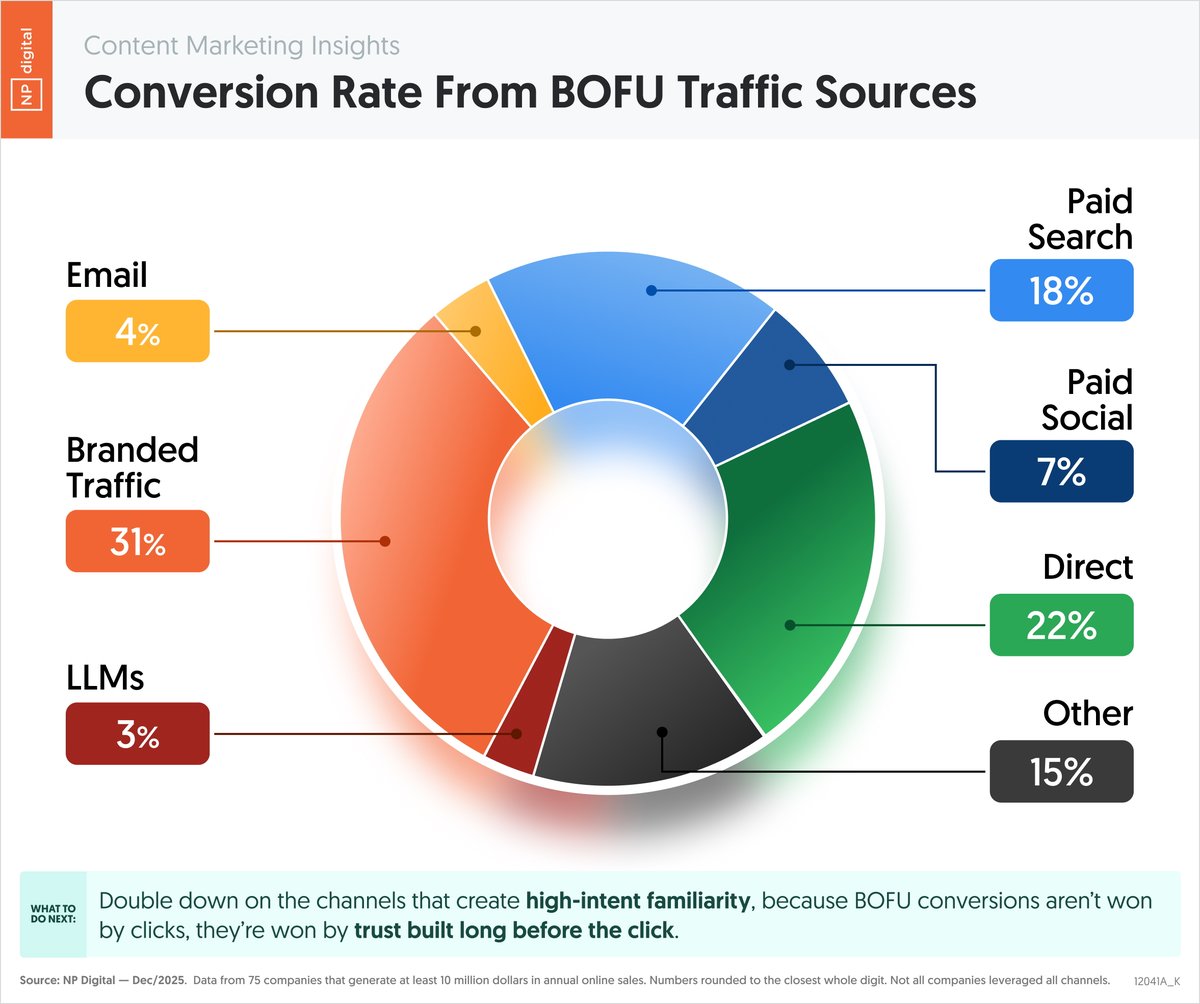
Which traffic sources are driving bottom-of-the-funnel conversions?
Here's data from 75 companies that generate at least $10 million in annual revenue.
On-page SEO is all about tweaking your page layout, keywords, and user experience so search engines get it - and rank it.
It’s like giving your content a final polish: clear, readable, and keyword-friendly. https://t.co/4vLyFl8vnI.
Google Maps marketing is a set of tactics you can use to make your local business listing appear more prominently in Google’s map results. Here's your guide for it!
https://t.co/9t9Bj5JmhX.
Look out Facebook, Instagram is the new king of the social web… but is it really?
Instagram is going to surpass Facebook in total monthly active users.
However, at our ad agency, NP Digital, the majority of our clients experience a higher LTV from their Facebook traffic compared to Instagram.
Why, you may ask? Facebook has an older audience, and many of those people purchased their homes back in the day when they were more affordable.
In other words, they have more money.