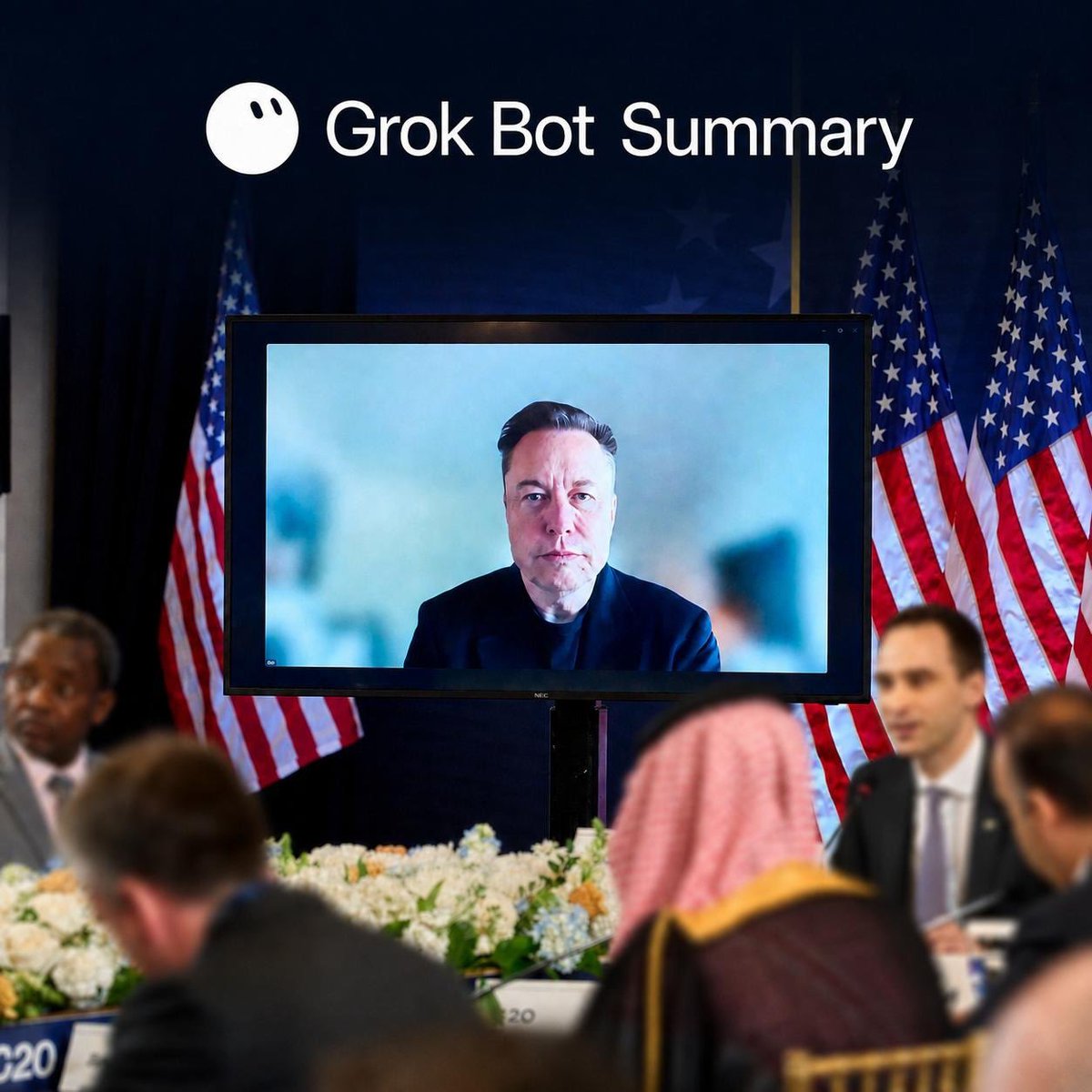
Grok Bot Summary of Elon Musk’s G20 Address Today 🇺🇸
Power, data centers, and the bottleneck
- There’s already a power crisis for AI, not a far-off one.
- Consensus he cited: at least a 15 gigawatt shortfall of power in 2027 for AI chips.
- AI chip production is rising ~40–50% a year. Power outside China is rising ~10–20%. The faster curve will overwhelm the slower one.
- Google, Anthropic, and others are already leasing compute from SpaceX because SpaceX built its own power plants. That was the only way they could turn capacity on fast enough.
- China has lots of electricity, but GPU export bans block the latest chips there. The real constraint is electricity growth outside China.
- Opportunity for other countries: build a lot of power, host AI data centers, and tax them / charge reasonable fees.
AI as a growth engine
- Countries should lean into new tech instead of staying stuck in the past.
- His rough estimate: digital AI alone could lift the global economy by 20–30%, or about $20–30 trillion a year.
- By the end of next year, AI should be able to do anything digital, anything that doesn’t require physically shaping atoms by hand.
- Software prediction: in about 12–18 months, AI writing software will be “Stockfish-level.” Humans won’t be able to compete, the way a chess engine on a phone can already beat Magnus Carlsen.
- Same window: AI becomes extremely good, possibly that same level, at all forms of engineering and anything digital.
- He also plugged 𝕏 as where almost all serious AI discourse happens, and said that’s how he follows the field day to day.
Robotics and physical AI
- Physical tech always takes longer than digital. Software copies instantly. Hardware needs huge global supply chains and moving a lot of atoms.
- A humanoid robot’s usefulness is three things multiplied: AI software × onboard AI chip × electromechanical dexterity (especially the hands). All three are improving exponentially.
- Once robots start making more robots, growth goes recursive: slow at first, then explosive.
- 10-year forecast (he called it conservative): well over a billion humanoid robots, each about 5× as productive as a human. That would mean those robots outproduce all humans combined.
- That physical layer is where he sees the economy growing by a factor of 10 or more, not just 20–30%.
How countries actually get new tech built?
- New things should be default legal, not default illegal. Heavy regulation (he pointed at the EU) doesn’t kill progress, but it slows it a lot.
- Startups are like saplings in a forest. Most governments over-support the big existing trees (incumbents) and under-support the small ones.
- Big companies have access to political leaders. Startups don’t. Policy should be biased toward young companies on purpose.
Excited to announce Claude for Open Source ❤️
We're giving 6 months of free Claude Max 20x to open source maintainers and core contributors.
If you maintain a popular project or contribute across open source, please apply!
https://t.co/inuh0hxREA
This is the most clear & important explanation about how LLMs work. Remarkably, there are still people who claim that AI can’t produce anything original because “it just predicts the next word.” Listen to Ilya to understand what “understand” really means.
Not gonna lie, this is the first time I’ve re-watched a AI generated trailer more than 10 times.
All credit to the amazing @AzeAlter
Audio score by @musoscientific
This needs to become a full movie.
Adventures in a future full of abundance
Marc Andreessen (@pmarca) is a prominent Silicon Valley entrepreneur, investor, technologist, and co-founder and general partner at Andreessen Horowitz. In this @UncKnowledge discussion, Andreessen reflects on his journey—from growing up in rural Wisconsin to founding Netscape and developing one of the first commercial internet browsers in his twenties to playing a pivotal role in shaping both Silicon Valley and national politics.
The interview also delves into the technological and political evolution of Silicon Valley and Andreessen’s own shifting political affiliations from left to right, along with his vision for leveraging technology to drive societal progress, the role of innovation in addressing energy challenges, border security, and national defense.
Andreessen also discusses @DOGE, a policy initiative focused on government efficiency (and the strategy DOGE may use to accomplish its goals), his “Techno-Optimist Manifesto,” and the imperative for revitalizing the US military’s technological capabilities to maintain global competitiveness. Watch the full episode of Uncommon Knowledge with host Peter Robinson (@P_M_Robinson) here:
@arxiv_sh Quantitative Results: The summary could incorporate specific performance metrics, such as MERV's 3.7% improvement in accuracy over prior methods, which underscores its effectiveness.