The Supreme Court has today resolved a seven-year commercial dispute valued at US$17 million (approximately UGX 71.49 billion) through mediation, bringing to a close 34 matters (arising from the dispute) before courts in Uganda, England and Wales.
The mediation was conducted before Lady Justice Prof. Lillian Tibatemwa-Ekirikubinza (Justice of the Supreme Court), at the Supreme Court in Kampala.
The case, Civil Appeal No. 28 of 2025, through Mediation No. 2 of 2026, has led to the resolution of 34 matters before courts in Uganda and abroad. These include 18 matters in the High Court of Uganda, 13 matters in the Supreme Court of Uganda, and three claims before courts in England and Wales.
The dispute arose from a Term Facility Agreement dated 11 December 2014, as amended, between the parties. It culminated in arbitration proceedings before the International Chamber of Commerce and the subsequent issuance of an arbitral award. The parties were thereafter involved in various court proceedings in Uganda, England and Wales.
Speaking after the mediation, Lady Justice Prof. Tibatemwa-Ekirikubinza thanked the parties and their advocates for their willingness to engage and for remaining calm throughout the mediation process. She congratulated them on bringing the seven-year dispute to a peaceful conclusion and encouraged business entities to resolve their differences through Alternative Dispute Resolution (ADR), which she noted offers faster and more cost-effective results.
In his remarks, Dr. Kirunda Robert, one of the lawyers in the matter, described the mediation as groundbreaking, noting that it had resolved 34 matters in Uganda and abroad. He emphasized the importance of mediation in protecting clients’ interests and delivering faster justice.
“Settling commercial cases through mediation protects clients’ interests while delivering faster justice,” he said.
He also stressed that prolonged commercial litigation drains corporate budgets through legal fees and thanked the mediator for her wise counsel throughout the process, which he noted led to a strategic commercial outcome.
One of the parties in the matter also thanked the mediator for the successful mediation, noting that it had saved costs, was time-efficient, and preserved business relationships between them as parties.
Present was HW Alex Mushabe Karocho (Private Legal Secretary to the Chief Justice), who conducted the pre-mediation meeting with the assistance of HW Norah Baluka (Research Magistrate attached to Lady Justice Prof. Tibatemwa-Ekirikubinza), and Ms. Patience Alina (Court Clerk)
Call for applications of the August/September 2026 intake!! As a token of appreciation, UTAMU is offering a 25% partial scholarship for its alumni for the next academic adventure. Call now: 0750599736, 0770884643, [email protected]. Apply now: https://t.co/RRNl5B9qpF
@UTAMU_News@baryamureeba
An employee who uses an employer’s computer for personal business cannot successfully claim infringement of privacy merely because the employer inspects that computer to verify its use. The inspection must, however, be lawful, proportionate and undertaken for a legitimate business purpose.
An employee should therefore be alert to the privacy implications of communicating private matters or storing personal data through an employer’s official computer or email systems.
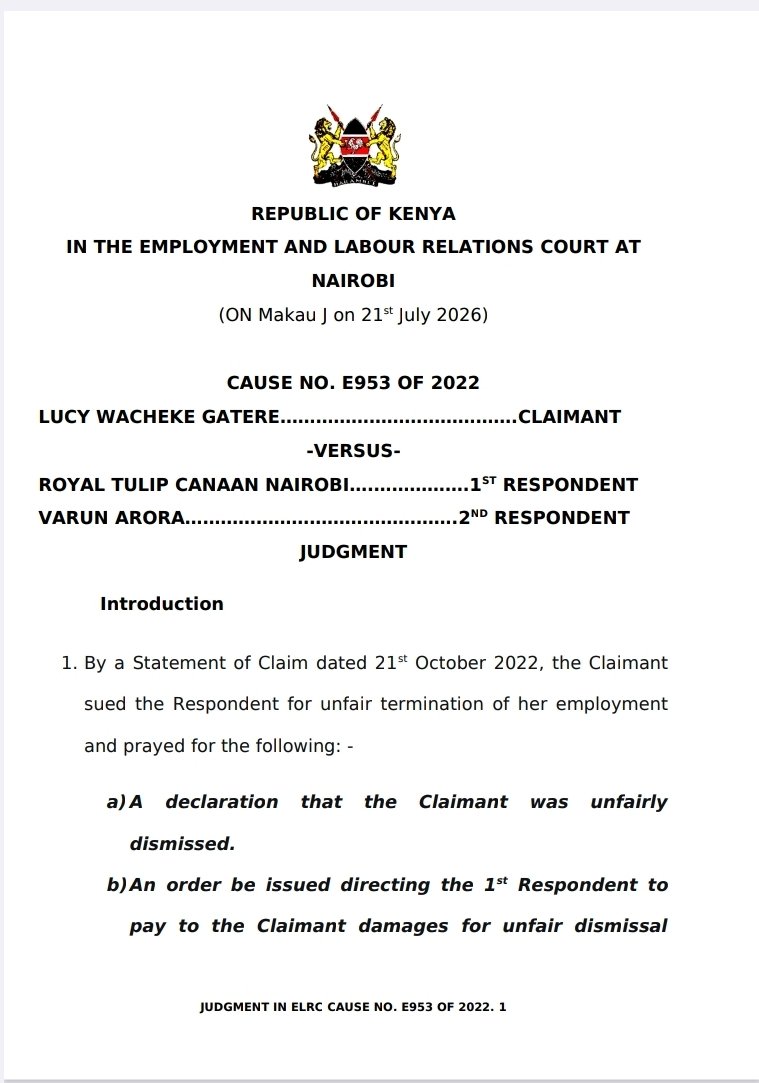
In Gatere v Royal Tulip Canaan Nairobi & another (Cause E953 of 2022) [2026] KEELRC 2119 (KLR), the Employment and Labour Relations Court at Nairobi held that the claimant had been verbally dismissed on 6 May 2022. Although the Court found that the employer had valid reasons for dismissing her arising from her conduct and performance, it held that the dismissal was procedurally unfair because she had not been accorded the disciplinary hearing required under section 41 of the Employment Act. The disciplinary proceedings subsequently initiated by the employer could not retrospectively cure that procedural defect. The Court held that any attempt to conduct a disciplinary hearing after an employer has already dismissed an employee is a nullity in law.
The Court further found that the claimant had been unlawfully harassed, intimidated and physically assaulted by the 2nd respondent. It held that his use of vulgar and demeaning language constituted harassment and violated her rights to dignity, fair labour practices and fair administrative action under Articles 28, 41 and 47 of the Constitution.
However, the Court rejected the claimant’s privacy claim arising from the inspection of her work computer. It held that the inspection of the employer-owned computer was lawful, proportionate and undertaken for a legitimate business purpose, namely, to verify whether she had been reading official emails and checking the events calendar. The Court therefore held that an employee who uses an employer’s computer for personal business cannot successfully claim infringement of privacy where the employer inspects the computer to verify its usage.
The claimant was awarded Kshs 1,138,250, comprising Kshs 255,300 in notice pay, Kshs 382,950 as compensation for unfair dismissal and Kshs 500,000 in general damages for harassment and constitutional violations. The award was subject to statutory deductions, together with costs and interest at court rate from the date of judgment.
Read and download full judgment: https://t.co/bl0X5rA8sd
Court’s mistake cannot be visited on the innocent litigants.
Imagine discovering that your case was dismissed because you failed to appear in court only to find that you were never notified of the hearing date.
That was the unusual procedural twist in Kibirige Timothy & Another v Tumwebaze Primah & Another.
The applicants’ case had been dismissed for non-appearance. However, they argued that neither they nor their advocates had received notice of the hearing date. Their lawyers had registered their contacts with the Judge’s clerk and were waiting to be notified after the matter was reallocated to a new Judge.
The court record later revealed an important fact: notification of the hearing date had not been issued to the parties because of an apparent error on the part of the Court.
Justice Bernard Namanya therefore reinstated the matter.
The court’s central finding was:
“The applicants’ failure to appear cannot properly be attributed to indifference or disregard of the court process.”
This is an important distinction.
Not every absence from court is carelessness. Sometimes, a party is absent because the machinery responsible for communicating the hearing date has failed.
Under Order 9 rule 18 of the Civil Procedure Rules, a dismissal for non-appearance may be set aside where the applicant demonstrates sufficient cause. But sufficient cause is not a magic phrase.
The applicant must provide a credible and satisfactory explanation showing that the failure to attend was not caused by indifference, lack of diligence, or disregard of the court process.
In this case, the explanation was simple and compelling:
You cannot blame a litigant for failing to attend a hearing whose date was never communicated to them.
The ruling also reflects a deeper principle of justice: procedural rules are meant to facilitate the fair determination of disputes, not to punish parties for administrative errors beyond their control.
The court therefore set aside the dismissal and restored the matter for hearing on its merits.
The implications are significant:
A dismissal for non-appearance is not necessarily the end of the road.
Courts must distinguish genuine procedural failure from deliberate indifference.
Where a litigant was not notified of a hearing date, the resulting absence cannot automatically be treated as negligence or disregard of the court process.
Digital justice systems must not only record cases they must reliably communicate hearing dates and procedural steps to the parties.
Most importantly, the ruling protects the right to be heard.
A case should ordinarily be decided on its merits not buried by a communication failure.
The lesson?
Before concluding that a party “ignored court,” the system must first answer a very basic question:
“Did the party actually know when to appear?”
Because justice cannot punish someone for missing an appointment they were never given.
#CivilProcedure ##ECCMIS