.@TelosConsilium published due diligence on MainStreet, flagging gaps in the protocol's construction. It unwound a few months later.
@LucaB_Cassa joined Beyond Yield to talk about what due diligence actually looks like now that curators have to be credit analysts.
$2 billion in active loans, built in the middle of a bear market, by founders who were still enrolled as students.
Two funding rounds, no dropouts, no in-person meetings for the first few months.
That is how @Morpho started.
Morpho shipped Midnight: fixed rate, intent-based lending built for the terms institutions actually price on.
@Morpho Co-founder @MerlinEgalite joins @dillonhanson12 on Beyond Yield to explain why a decade of fixed rate attempts stalled onchain, and what Midnight does about it.
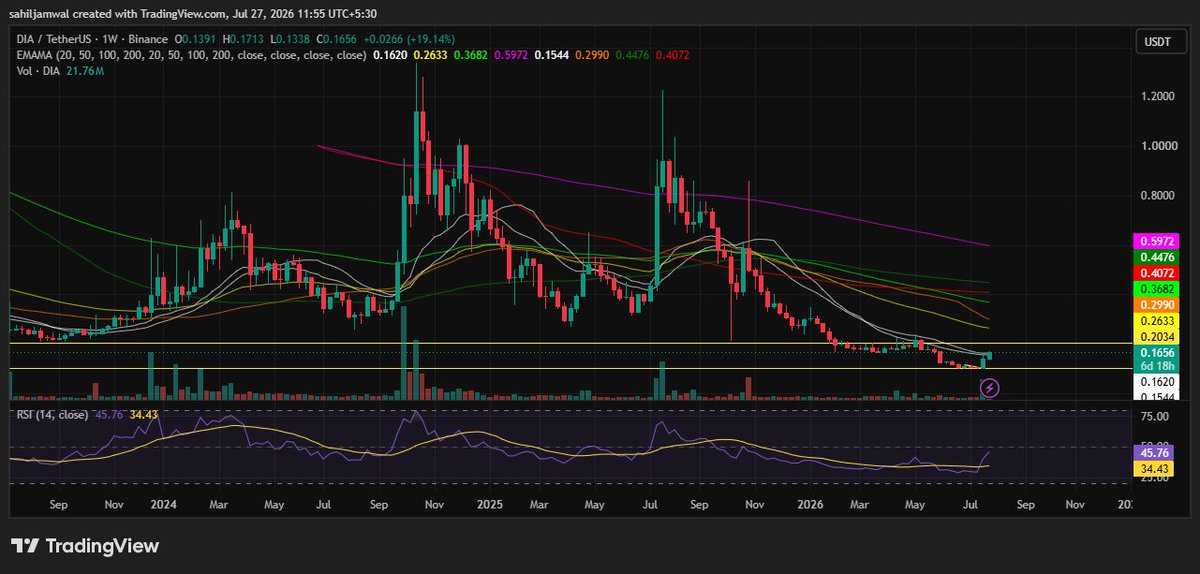
ethereum:0x84ca8bc7997272c7cfb4d0cd3d55cd942b3c9419 up 16.33% this week. Close at 0.1617.
But the price is not the story. The volume is.
The last few weeks were printing 800K, 1.2M, 1.5M. This week printed 20.53M.
That is a 10x volume expansion on a breakout candle. Price has reclaimed the key resistance zone and is sitting right at the 20 EMA. RSI jumped from the low 30s all the way to 44.95 in one week.
This is what the end of accumulation looks like on a weekly chart. Quiet weeks, low volume, price grinding the lows, then one week where everything shows up at once.
Staking live, 4.4 million DIA staked, oracle data across 60+ chains running every day, Oracle Grants Program still open for builders.
The infra was always there. The chart is just starting to notice. @DIAdata_org
The market can ignore fundamentals.
It can’t just ignore them forever.
While everyone was chasing the next shiny narrative, @DIAdata_org kept building the infrastructure for where capital is actually heading.
Today is a reminder that utility has a way of catching up.
$DIA 🔥
$DIA is actually an Oracle that can compete with $LINK.
I picked up a small bag just yesterday and was planning to share a buy call...
But before I could, it already pumped 30%. 🚀
Man... I should've bought more. 😅
Who's still bullish on $DIA?
Today, we are excited to launch DIA ZK, the verifiable data assurance layer for DeFi, RWAs, and cross-chain applications.
Yield-bearing stablecoins, tokenized treasuries, and vaults built on offchain strategies now hold tens of billions in onchain value. The highest yields among them are earned offchain: basis trades on centralized exchanges, tokenized treasuries, private credit, CeFi lending. While the token lives onchain, the strategy that pays it does not.
That creates a problem for issuers. Holders, risk curators sizing allocations, and lending markets deciding whether to list a token cannot see the custody balances, exchange positions, or loan books behind the yield. They ask for proof, and an issuer-controlled dashboard or a monthly attestation is becoming less convincing as the basis for trust.
In June this year, a yield-bearing stablecoin lost its peg after the third-party service that verified its reserves ended its relationship. A lending market built around the token was left with roughly $18 million of affected collateral, and a separate vault with no direct exposure to the stablecoin was hit too because both relied on the same verifier.
DIA ZK addresses this. It proves that a reported value came from the stated source and was not altered on its way onchain. It proves the statement rather than the value: a condition such as reserves exceeding supply, without revealing the underlying figures. The proofs are posted and verified on DIA's oracle chain, rather than relying on a feed that a single verification provider can switch off.
Reserve disclosure requirements under MiCA already apply in the EU, and the US GENIUS Act will introduce federal reserve and disclosure requirements for qualifying stablecoin issuers. Continuously proving backing onchain, without forcing an issuer to reveal its underlying books, is the next capability the oracle layer has to provide.
If your protocol depends on stablecoin reserves, tokenized fund NAVs, or vault collateral held offchain, this is where to start.
What's the catalyst for this $DIA pump?
Most likely the launch of ZK oracles, which are game-changers for any regulated asset with offchain reserves, collateral...
Price catches up with fundamentals sooner or later. $DIA's time is here.
ethereum:0x84ca8bc7997272c7cfb4d0cd3d55cd942b3c9419 is on a move, swooped the lows below 0.1$ and now surging with strong volume.
We could see a pump towards 0.5$ area in the coming days.
Last chance to load up ob cheap ethereum:0x84ca8bc7997272c7cfb4d0cd3d55cd942b3c9419
Market bounced, traders are hungry…
So, we're doing something fun for the next 8 weeks
8-week trading competition with @cedehub
🏆 $24,000 prize pool
💰 $3,000 up for grabs every week
compete, climb the leaderboard, win rewards
ethereum:0x84ca8bc7997272c7cfb4d0cd3d55cd942b3c9419 is on a move, swooped the lows below 0.1$ and now surging with strong volume.
We could see a pump towards 0.5$ area in the coming days.
Last chance to load up ob cheap ethereum:0x84ca8bc7997272c7cfb4d0cd3d55cd942b3c9419
everything you need to know about joining the DIA x CedeHub trading competition 🧵
compete with other $DIA traders, climb the leaderboard, and win your share of the $24,000 prize pool
🏆 𝗽𝗿𝗶𝘇𝗲 𝗽𝗼𝗼𝗹
• $24,000 total
• $3,000 awarded every week
• competition runs for 8 weeks
📝 𝗵𝗼𝘄 𝘁𝗼 𝗷𝗼𝗶𝗻
1. visit https://t.co/1rilPf6Xys
2. connect your web3 wallet
3. link your @binance account using a read-only API key
4. register for the DIA trading competition
📈 𝗵𝗼𝘄 𝘁𝗼 𝗰𝗼𝗺𝗽𝗲𝘁𝗲
• trade the DIA/USDT spot pair
• your trading volume is tracked automatically
• climb the live leaderboard as you trade
• claim rewards if you finish in the winning positions at the end of each week
📌 𝗿𝘂𝗹𝗲𝘀
✅ only verified trading volume counts
✅ spot only
❌ no margin
❌ no futures
❌ no perpetuals
that's it!
win real rewards for being the best trader on @cedehub 👉 https://t.co/ncwHoOqvar
@MartindRijke joined @maplefinance two weeks before the 2022 CeFi collapses.
Then he helped scale it from $9M to $3.6B in AUM, closing one institutional deal at a time while competitors shut down.
In this new episode of Beyond Yield, we explore how on-chain lending actually works, and why stablecoin yield lags adoption by 6 to 12 months.
another step toward full verifiability across the entire oracle data pipeline
data integrity becomes critical when capital is at stake, especially in the age of agentic trading
Today, we are excited to launch DIA ZK, the verifiable data assurance layer for DeFi, RWAs, and cross-chain applications.
Yield-bearing stablecoins, tokenized treasuries, and vaults built on offchain strategies now hold tens of billions in onchain value. The highest yields among them are earned offchain: basis trades on centralized exchanges, tokenized treasuries, private credit, CeFi lending. While the token lives onchain, the strategy that pays it does not.
That creates a problem for issuers. Holders, risk curators sizing allocations, and lending markets deciding whether to list a token cannot see the custody balances, exchange positions, or loan books behind the yield. They ask for proof, and an issuer-controlled dashboard or a monthly attestation is becoming less convincing as the basis for trust.
In June this year, a yield-bearing stablecoin lost its peg after the third-party service that verified its reserves ended its relationship. A lending market built around the token was left with roughly $18 million of affected collateral, and a separate vault with no direct exposure to the stablecoin was hit too because both relied on the same verifier.
DIA ZK addresses this. It proves that a reported value came from the stated source and was not altered on its way onchain. It proves the statement rather than the value: a condition such as reserves exceeding supply, without revealing the underlying figures. The proofs are posted and verified on DIA's oracle chain, rather than relying on a feed that a single verification provider can switch off.
Reserve disclosure requirements under MiCA already apply in the EU, and the US GENIUS Act will introduce federal reserve and disclosure requirements for qualifying stablecoin issuers. Continuously proving backing onchain, without forcing an issuer to reveal its underlying books, is the next capability the oracle layer has to provide.
If your protocol depends on stablecoin reserves, tokenized fund NAVs, or vault collateral held offchain, this is where to start.
USDh, @HermeticaFi's synthetic dollar, is backed by a delta-neutral Bitcoin strategy, not cash or treasuries.
As @jakob_btc notes, pricing a basis-trading position means tracking the strategy, not just the token's secondary market.
Traditional assets are moving onchain at scale.
Tokenized treasuries, equity ETFs, commodity exposure, FX pairs.
DIA Real covers 10,000+ traditional instruments with feeds sourced from where the assets actually trade, delivered across 60+ chains.
https://t.co/8mKv63ZBc4
For yield-bearing stablecoins, value is defined by the underlying protocol mechanics rather than by secondary market activity. Pricing needs to reflect that.
@RiverdotInc team on integrating DIA Value for satUSD+ across their omnichain stablecoin system:
When tokenized assets first emerged, risk assessment focused only on smart contract security.
@particula_io recognized the gap: you need to evaluate the underlying asset, custody, and redemption mechanics too.
That framework didn't exist. So they built it.