This haunting historical photograph shows an unnamed matchbox maker and her two young children standing with their few remaining possessions after being evicted in East London around 1890-1900...
By the time this photograph was taken around 1900, this East End mother appears to have reached the edge of survival. The family was forced onto the street because they could no longer afford the high cost of rent relative to their meager earnings.
Evicted from her home, she stands beside two young children and the few possessions the family could carry. We do not know her name. We do not know what happened after the photographer left. But women like her were part of an enormous hidden workforce that helped keep Victorian and Edwardian London running.
Matchbox making was one of the jobs poor women could perform from home. It sounds almost convenient. The reality was brutal.
Women and children assembled thousands of small cardboard boxes for extremely low piece rates. The work could continue late into the night, often in cramped rooms where cooking, sleeping, childcare and manufacturing happened in the same space. Every minute mattered because they were paid for what they produced, not for the hours they worked.
And poverty created its own expenses. Homeworkers could face deductions or costs for materials, while irregular employment meant that illness, pregnancy or a temporary shortage of work could push a household toward hunger or eviction.
The famous Matchgirls’ Strike of 1888 exposed conditions inside the Bryant & May factory and became a landmark in British labor history. But factory workers were only part of the story. Beyond the factory gates were countless women doing poorly paid piecework in tenements and rented rooms, largely invisible to the public.
That is what makes photographs like this so unsettling.
There is no factory floor here. No politician. No famous reformer.
Just a mother, two children, and what appears to be everything they could take with them.
Her name may have disappeared from the record. The economic system that brought women like her to this point did not.
#archaeohistories
EMCrit 433 - HALO Procedural Philosophy
Is a skilled doctor in a broken system doomed to fail? I break down institutional vs operator-level competence based on a paper from Colonetti et al. and map out the 12 high-acuity, low-occurrence skills every resuscitationist must master.
https://t.co/V0LyYPYFYv
Sux (succinylcholine): contraindicated due to severe hyperkalemia (K+ 5.8), which risks fatal arrhythmias
Propofol: causes vasodilation and hypotension, which would severely drop his borderline blood pressure and potentially compromise cerebral perfusion pressure
Ketamine: can increase heart rate and blood pressure, and some would avoid it in patients with active intracranial bleeding +/- tachycardia. However, the myth that ketamine increases ICP seems to be debunked
Versed/Fentanyl: this combination does not provide the rapid, reliable induction needed for rapid sequence intubation (RSI) in an emergent crash airway, and leaves paralysis out
Etomidate is "hemodynamically stable". Its duration of action is short and will not mask neuro exam more than a few min
#foamed #foamcc
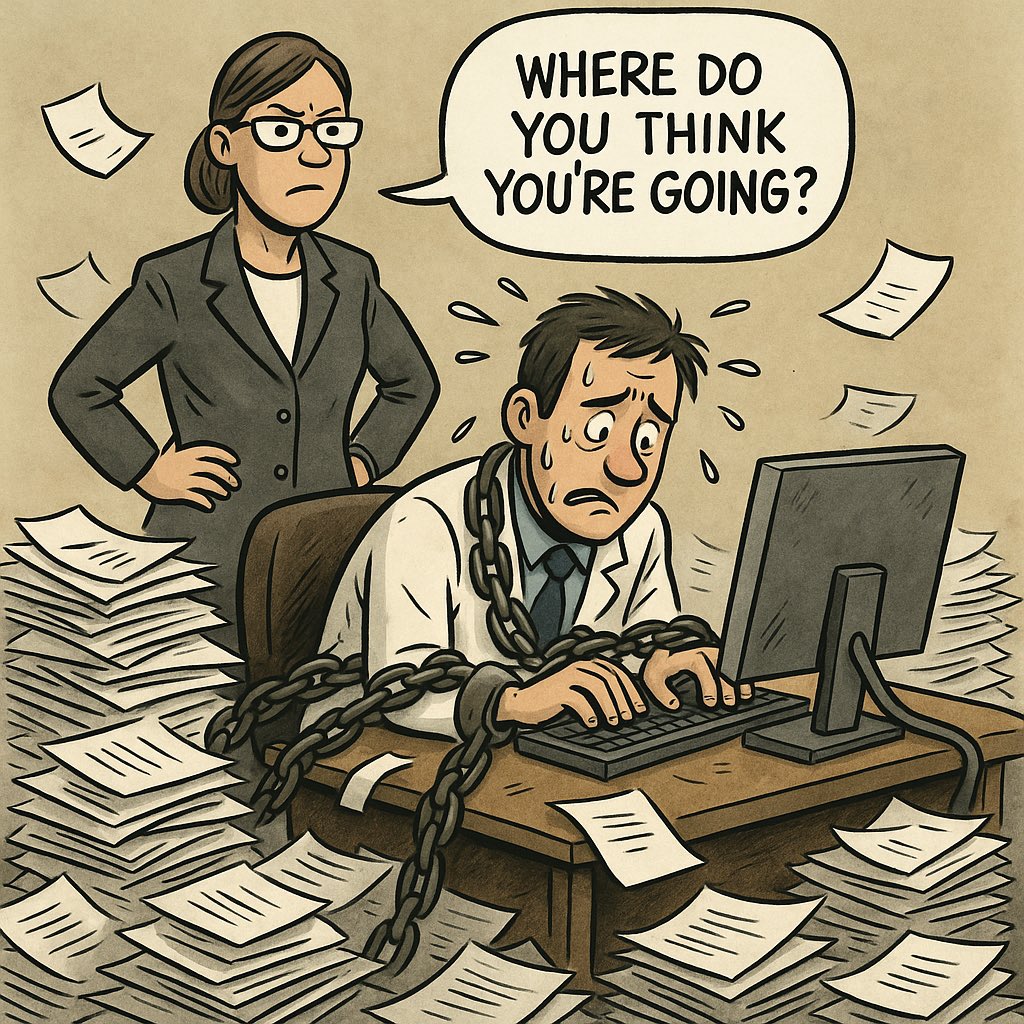
The physician shortage isn’t just about how many doctors we have.
It’s about how much time we are forced to waste.
Physicians in the U.S. spend an average of 16 hours per week on administrative tasks.
Not optional work. Not inefficiency.
But time we are required to spend—by payers, regulators, and federal programs—on prior authorizations, coding justification, compliance reporting, and EHR documentation.
That’s two full days per week stripped away from patient care.
Across the workforce, this removes 20–25% of total clinical capacity—not because physicians aren’t available, but because they are redirected away from the bedside by policy.
And this is not the global norm.
U.S. physicians spend four times more on billing and insurance-related tasks than their Canadian counterparts (Health Affairs, 2020).
In most European systems, administrative overhead is under 30 minutes per day.
In the U.S., it regularly exceeds 3–4 hours per day.
This administrative load is not the byproduct of better outcomes or safety.
It is the result of flawed, government-driven agendas that prioritize data collection, billing audits, and metric compliance over clinical judgment and time with patients.
Programs like MIPS, MACRA, “value-based” reporting frameworks, and EHR certification requirements were designed around bureaucratic performance indicators—not patient outcomes, not physician capacity, and certainly not operational efficiency.
They have created a system where physicians are penalized for focusing on care, and rewarded for satisfying administrative benchmarks.
This is not a staffing issue.
It is a structural policy failure.
Until the system stops forcing physicians to waste time proving their value on paper, we will never reclaim the capacity we already have.
#TipsForNewDocs
Congratulations on graduating from medical school.
You are joining an ancient and honorable profession.
You will never be a "provider." That term was coined by insurers and governments who want to reduce your role in the doctor-patient relationship.
Fight them.
A Chinese company just shattered OpenAI's $18 billion advantage:
They proved you can build ChatGPT-level AI for 100x cheaper.
And it's about to trigger the biggest market crash since the dot-com bubble.
Here's why the Chinese are keeping this a secret:
What is making America’s doctors sick?
That’s the question I found myself asking last night. I am at a clinical/scientific meeting this weekend and there are pre-programmed sections to discuss our practices and our personal lives, not just the patients we take care of. Last night physician after physician got up to the microphone and told stories of issues with major depressive disorder, substance use, anxiety, anger, and a host of concerning problems that impacted their professional and personal lives.
Lost in the discussion of all of these eye-opening stories was the fact that these are all outward signs of an underlying problem. Unlike what we do every day in our practices, last night was all about discussing the “symptoms” but we never did a root cause analysis.
So, what’s making America’s doctors sick?
It’s a sick healthcare system on life support. It’s the requirement to be available every hour of every day in a never disconnected world. It’s the legislators continuing to cut pay year after year. It’s the administrators squeezing every profit possible leading to less control over our staff and our operating rooms. It’s the reduced support teams in order to provide returns to stockholders. It’s the loss of autonomy from physicians having no choice but to become employed or sell their practices. It’s the inability to choose the implants we want to use for surgery because they aren’t on contract or are too expensive.
Our healthcare system is in multisystem organ failure right now. But just like a patient in the ICU, the knowledge of how to fix the problem lies with the physicians. We know where the problems are and we know how to get to the solutions. We need to go to roll up our sleeves and fix perhaps the most complicated patient we have ever taken care of…. The American healthcare system.
Let’s go to our state and federal legislators and show them the problems and the solutions. Let’s engage our patients to tell the stories they are facing. Let’s work together as a team again.
Let’s fight unfair practices in medicine that put the thumb on the scale in favor of large monopolies and marginalize physicians. Inflationary Updates for Physicians. Stark Laws. 340B. Site Neutrality. Prior Authorization. Physician Ownership of Hospitals. Medicare Advantage Reform. Workplace Violence. Noncompetes. Failed No Surprises Act Implementation.
Join your PAC. Help your Association’s advocacy efforts. Meet your state and federal representatives. Engage with your patients.
It’s time. Our voice is important and needed, but we can’t do it without everyone participating. The literal lives of our colleagues and our patients hang in the balance.
The @AARP bulletin today asks, “Where have all the doctors gone?” as more patients find themselves seeing PAs and NPs instead of medical doctors. I believe it’s no accident—policies are pushing out physicians to cut costs, leaving patients with fewer advocates and more confusion.