We have over 100,000ft² of safe space for you and your family to explore.
🌍
We will limit admissions and take ample precautions to help with social distancing, keeping your hands clean, and keeping our space safe… https://t.co/FSqWVjS0EW
Can you complete a mission to build and launch astronauts to the ISS?
Carefully choose a mission objective, hand select astronauts, build a rocket, and launch to the ISS! #VirtualSTEM360
Play RocketScience-Ride to Station today:
https://t.co/lMcqNWNaYG
Did you know that planets that orbit around other stars are called exoplanets? Exoplanets are very hard to see directly with telescopes. So how do we look for Earth-like planets in other solar systems? Learn all about it in this video! #VirtualSTEM360
https://t.co/SZk3xZRYEP
Did you know the ocean is hiding Earth's deepest trench?
At 36,070 feet deep, the Challenger Deep in the Mariana Trench is famously the deepest known point in the Earth's oceans. It owes its existence to plate tectonics!
#WorldOceansDay#VIrtualSTEM360
Did you know galaxies come in many different shapes and sizes?
A galaxy is a huge collection of gas, dust, and billions of stars all held together by gravity. Learn about the different shapes and become a Galactic Explorer.
#VirtualSTEM360
https://t.co/6k6yXDE1ev
Have you ever wanted to cruise around on the surface of another planet?
Well, you’re in luck! You can explore Mars here, drive the rover, and collect information about Martian rocks. #VirtualSTEM360#Mars
https://t.co/rSQoqIjw9b
Did you know the first U.S. spacewalk was on this day in 1965?
Astronaut Edward H. White II floats in the zero-gravity of space outside the Gemini IV spacecraft during a four-day Earth-orbital mission. #STEM360#NASA
Check out the photos here:
https://t.co/cl16lvF74Y.
Do you what phase of the moon you will see tonight? A Waxing Gibbous and the next full moon is on June 5th!
#VirtualSTEM360#MoonPhases
See if you can identify all of the moon phases here:
https://t.co/LmZaBUenGc
Which pole is colder? North or South?
Both the Arctic (North Pole) and the Antarctic (South Pole) are cold because they don’t get any direct sunlight. However, the South Pole is a lot colder than the North Pole. #VirtualSTEM360
https://t.co/ix5kOwxSuU
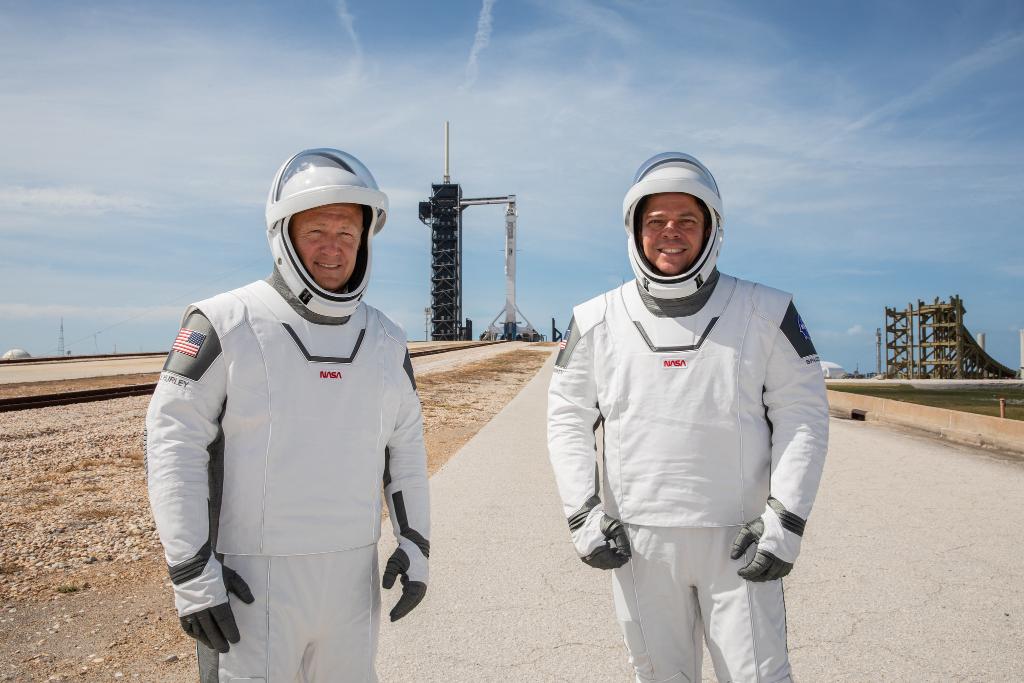
This weekend, a new era of spaceflight is set to begin!
Wednesday’s @NASA and @SpaceX Crew Dragon launch attempt was scrubbed due to weather. Now scheduled for tomorrow, Saturday, May 30 at 3:22 pm, be sure to watch the live coverage on NASA TV. #VirtualSTEM360#LaunchAmerica
How well do you know your own Sun? Test your knowledge by picking out the correct definition for different science terms about the Sun. #VirtualSTEM360
Play Solar Tricktionary here: https://t.co/TNJY3TpOHm
"We are not going to launch today."
Due to the weather conditions, the launch is scrubbing. Our next opportunity will be Saturday, May 30 at 3:22pm ET. Live #LaunchAmerica coverage will begin at 11am ET.
Looking for live views of the launch pad? We got you covered. 🚀👀
Check out the rocket that will carry @AstroBehnken and @Astro_Doug to the @Space_Station live at Launch Complex 39A before launch on May 27 at 4:33 p.m. ET: https://t.co/E5oYS5TKWV
Don’t forget to tune into @NASA TV today for the launch of @SpaceX’s Crew Dragon spacecraft. Coverage begins at 12:15pm and liftoff is scheduled for 4:33pm. #LaunchAmerica#VirtaulSTEM360
Check here for the full schedule: https://t.co/P2SOlWWLWg
#LaunchAmerica: We’re sending U.S. astronauts to the @Space_Station on a U.S. rocket from U.S. soil at 4:33pm ET on Wednesday, May 27. Here’s how you can watch: https://t.co/ChRxWaIkNP