@benjamincode Je ne trouve pas très malin ce melvynx et clairement Legé voir naze sur la confidentialité des données de ses propres clients vu qu'il traite tout par IA et n'a aucune compétence de développement il semblerait.
Il me fait ça, je dépose plainte.
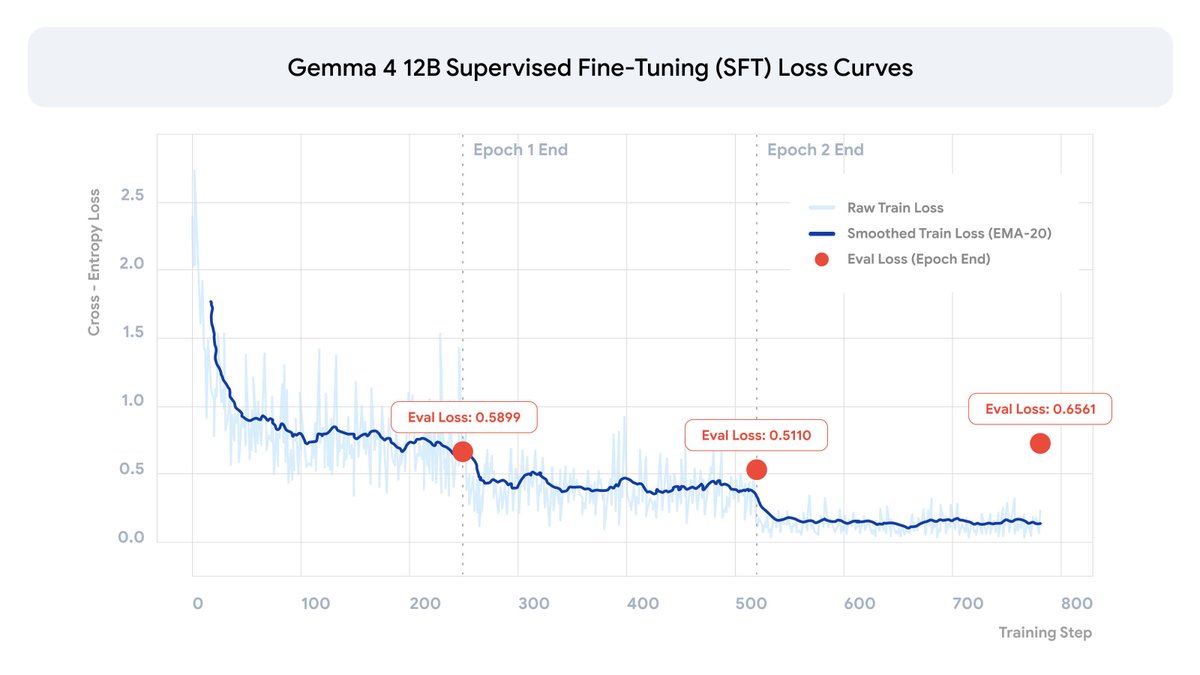
Ready to customize Gemma, but not sure how?
Have your agents assist you by using the gemma-trainer skill!
It helps agents set your training configs, manage training runs and evaluate results.
Let’s make fine-tuning Gemma 4 possible for everyone!
Gemma 4 is now faster and much more accurate! 🚀
Google made huge improvements to tool-calling and chat accuracy, reliability + speed.
To get fixes, re-download our updated GGUF, MLX, NVFP4 quants!
Unsloth quants: https://t.co/fpX21yWbge
Gemma 4 Guide: https://t.co/odRo9WjRpA
We’re rolling out some big improvements to Gemma 4, fueled by incredible community feedback and contributions!
Here is a breakdown of what’s being fixed and updated in this release: 🧵👇
@AlexFinn Est ce un problème de toute façon de ne pas être à la pointe tout le temps.
Je pense que c'est plus un risque d'y être que de laisser quelques mois passer avant de s'y mettre.
Ça permet de minimiser les risques.
Meet DiffusionGemma ⚡ Our latest experimental open model (Apache 2.0) that generates text up to 4x faster.
Instead of predicting and typing just one word at a time like most language models, it drafts and refines entire blocks of text simultaneously.
Here’s how it works 🧵 ↓
Andrej Karpathy: "90% of Claude's mistakes come from missing context, not a weak model."
41% mistake rate without a CLAUDE.md. 11% with the 4-rule baseline. 3% with the 12-rule version below
here are the 12 rules senior engineers settled on:
1. think before coding: state assumptions, don't guess. the model can't read your mind, stop hoping it will
2. simplicity first: minimum code, no speculative abstractions. the moment you let Claude add "for future flexibility," you've added 200 lines you'll delete next quarter
3. surgical changes: touch only what you must. don't let it improve adjacent code, that's how PRs blow up
4. goal-driven execution: define success criteria upfront, loop until verified. without them Claude either loops forever or stops too early
5. use the model only for judgment calls: classification, drafting, summarization, extraction. NOT routing, retries, status-code handling, deterministic transforms. if code can answer, code answers
6. token budgets are not advisory: per-task 4000, per-session 30000. by message 40 of a long debug, Claude is re-suggesting fixes you rejected at message 5
7. surface conflicts, don't average them: two patterns in the codebase? pick one. Claude blending them is how errors get swallowed twice
8. read before you write: read exports, callers, shared utilities. Claude will happily add a duplicate function next to an identical one it never read
9. tests verify intent, not just behavior: a test that can't fail when business logic changes is wrong. all 12 of Claude's tests can pass while the function returns a constant
10. checkpoint every significant step: Claude finished steps 5 and 6 on top of a broken state from step 4. nobody noticed for an hour
11. match the codebase conventions: class components? don't fork to hooks silently. testing patterns assumed componentDidMount, hooks broke them without surfacing
12. fail loud: "completed successfully" with 14% of records silently skipped is the worst class of bug. surface uncertainty, don't hide it
what actually compounds instead of the next framework:
- the CLAUDE.md file as institutional memory across sessions
- eval-driven changes, not vibe-driven
- checkpoints over speed
- explicit conflicts over silent blending
- discipline over framework, every time
- one repo, one rules file, no exceptions
be a few rules ahead of AI twitter before this becomes mass-opinion
study this
Meta discovered a technique that makes LLMs 94% more accurate.
And it completely destroys everything we thought we knew about prompting.
It's called Chain-of-Verification (CoVe).
Instead of asking the AI to just answer your prompt, CoVe forces the model to critically interrogate its own brain in a 4-step pipeline:
1. Generate Baseline: The AI writes a quick, rough draft response.
2. Plan Verifications: It scans its own draft and builds a list of factual questions to cross-examine itself.
3. Execute Independently: It answers those questions completely separate from the draft so it doesn't repeat its own bias.
4. Final Revision: It rewrites the entire answer using only the verified facts.
Traditional prompting tells the model: "Answer this question."
CoVe tells the model: "Answer this, figure out how you might have lied to me, fact-check yourself in secret, and then fix your mistakes."
The results are a total paradigm shift:
- Factual precision more than doubles on complex data tasks.
- Massive reduction in hallucinated entities.
- Zero fine-tuning required.
- Works across GPT, Claude, and Gemini instantly.
The reason it works is almost insultingly simple.
LLMs are terrible at generating long, perfectly factual narratives in one shot. But they are incredibly accurate at answering short, targeted verification questions.
GitHub acaba de matar el vibe coding?
Su nuevo repo spec-kit ya lleva 92k estrellas, y muestra hacia dónde va de verdad el desarrollo con IA.
Esto es lo que hace:
En vez de pedirle a tu IA "hazme una app de tareas" y rezar… ejecutas 6 comandos que convierten tu idea en una especificación estructurada que el agente puede ejecutar:
/speckit.constitution → define las reglas del proyecto (calidad, testing, UX)
/speckit.specify → describe QUÉ construir (no la tecnología)
/speckit.clarify → la IA hace preguntas para eliminar ambigüedades
/speckit.plan → ahora sí, eliges el stack
/speckit.tasks → genera una lista de tareas ordenada por dependencias
/speckit.implement → el agente lo construye
El entregable ya no es el código.
Es una especificación viva que tu IA lee, discute y ejecuta.
Funciona con Claude Code, Copilot, Cursor, Codex, Gemini y 25+ agentes más.
El cambio que casi nadie está viendo: "La IA escribe código" → "La IA ejecuta una especificación."
El desarrollo centrado en la intención es el nuevo estándar.
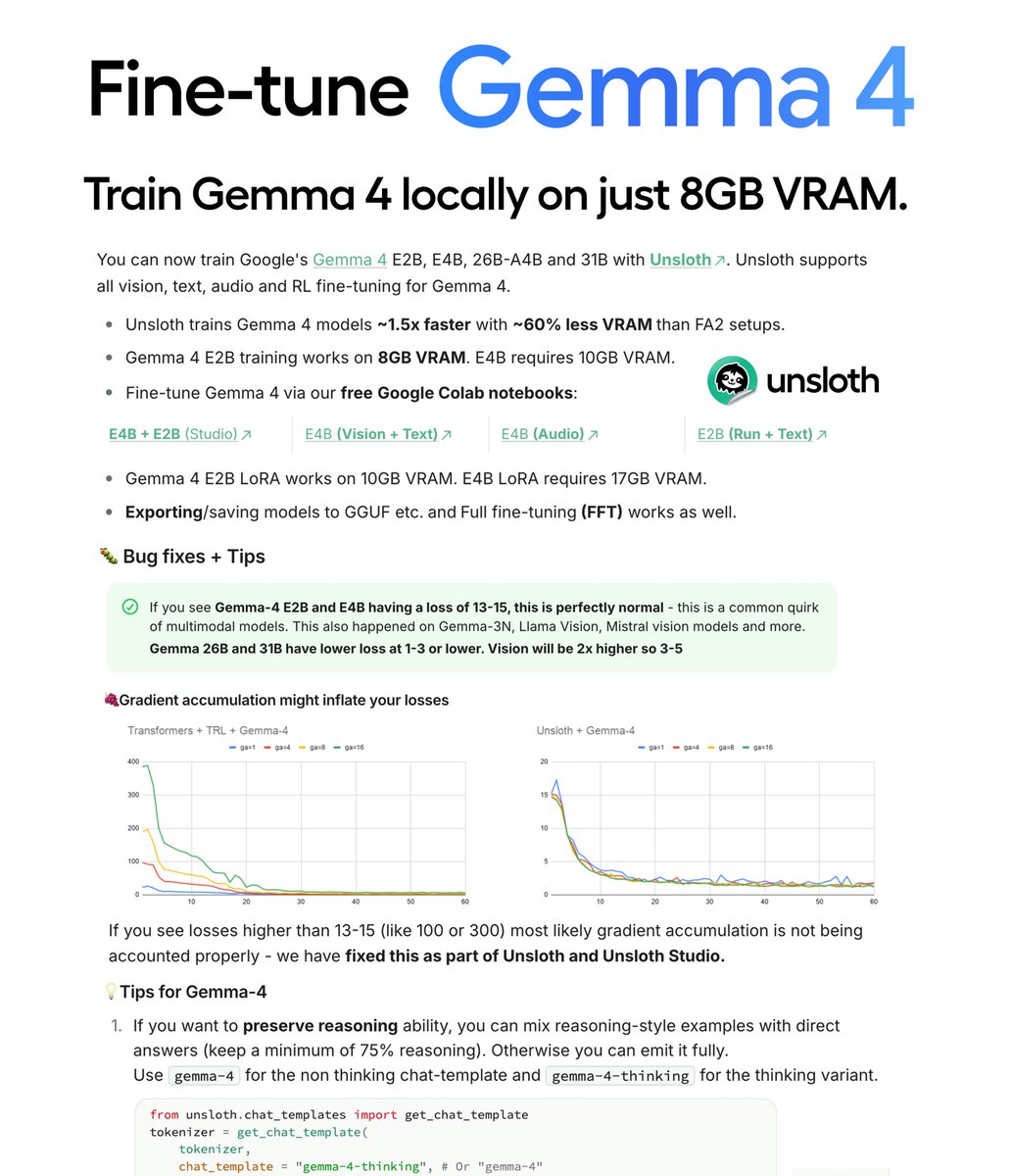
You can now fine-tune Gemma 4 with our free notebooks! 🔥
You just need 8GB VRAM to train Gemma 4 locally!
Unsloth trains Gemma4 1.5x faster with 50% less VRAM.
GitHub: https://t.co/aZWYAtakBP
Guide: https://t.co/NBwKoFH2lp
Gemma-4-E4B Colab: https://t.co/JjpCQgWEpL