What's the most compelling game demo that's been built on top of Generative Agents? What's the best way to use agents with short and long-term planning as a key part of gameplay?
I stopped playing Catan as soon as I discovered Civ 6. The brilliant thing about Civ is that it's "historical," without being too serious. Where else can the Mongols build the pyramids, recruit da Vinci, and conquer with tank armies?
It's sad that AAA studios and blockbuster movies have fallen into the same trap: spending more and more on visuals, relying on tried-and-true (tired-and-true?) franchises, forgetting that novel stories/gameplay are what make new movies/games special.
I love Breath of the Wild, but the game had no replay value for me. Once I've covered all corners of the map and found (most of) the game's secrets, the mechanics weren't enough by themselves to bring me back. While more sim-style games (ex. Civ) have infinite replay value.
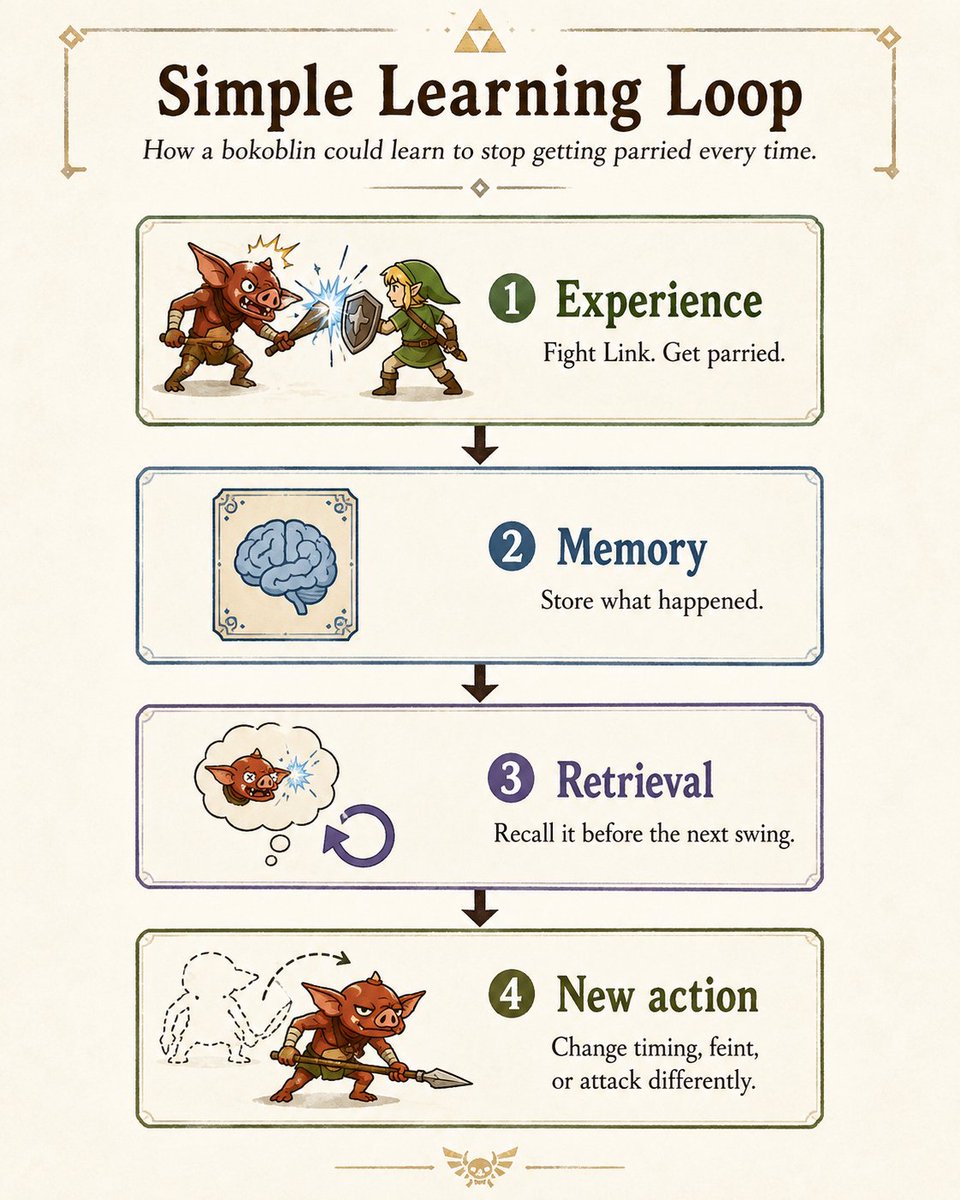
I've been playing with a few different strategies to give NPCs the ability to learn from their past. Would this type of simple learning loop make video game combat more fun?
Most times I use an agent it spends minutes rereading all my stuff – spending dollars and energy just to gather the context it needs to understand my work.
But it won’t always be this way. We can train that understanding into the model – amortizing across tasks.
We started Engram to build the systems required for a future where there are billions of models, each learning from users and deeply understanding their work.
I’m so grateful and excited to be working on this problem with this incredible team
Fresh blog post!
@modal partnered with @ScalingIntelLab, @HazyResearch, and @chelseabfinn's IRIS Lab to speed up research on speeding up AI research.
Read how scientists at the cutting edge are building the machines that build the machines with Modal.
https://t.co/FDbnp8DOuC
One key differentiator between effective automation and AI slop is caring — how much developers care about output quality and how well they can identify deficiencies.
I love Catan. I’ve played in tournaments, won one, and competed in the Catan National Championships. That care motivated how I approached building a digital version of the game.
I set up an agentic loop where agents generate game logic, other agents play the game to surface errors, and every human intervention becomes part of a growing library of regression tests. The result: a reliable digital implementation of Catan, alongside LLM agents that can actually play the game.
Here's how I did it: https://t.co/XHOqm6Q6hA
Presenting our work on self-improving LLM agents via in-context examples today at 4:30pm at #NeurIPS2025! Location #3400
Paper: https://t.co/FbemZMxLBs
Come by! 👋
Data centers dominate AI, but they're hitting physical limits. What if the future of AI isn't just bigger data centers, but local intelligence in our hands?
The viability of local AI depends on intelligence efficiency. To measure this, we propose intelligence per watt (IPW): intelligence delivered (capabilities) per unit of power consumed (efficiency).
Today’s Local LMs already handle 88.7% of single-turn chat and reasoning queries, with local IPW improving 5.3× in 2 years—driven by better models (3.2×) and better accelerators (1.7×).
As local IPW improves, a meaningful fraction of workloads can shift from centralized infrastructure to local compute, with IPW serving as the critical metric for tracking this transition.
(1/N)
Excited to present Axes-and-Tags this week at #ICCV2025! We put a lot of thought into enabling people to use AI to idea the in a productive way. Check out the paper or live demo below!
Work joint with @AsanshayG and @kayvonf
Paper: https://t.co/BSldsmo4kW
Code: https://t.co/xO3xfv3WX6
Website: https://t.co/XX0eB4YW2K
Tutorial: https://t.co/sCRehuygHt
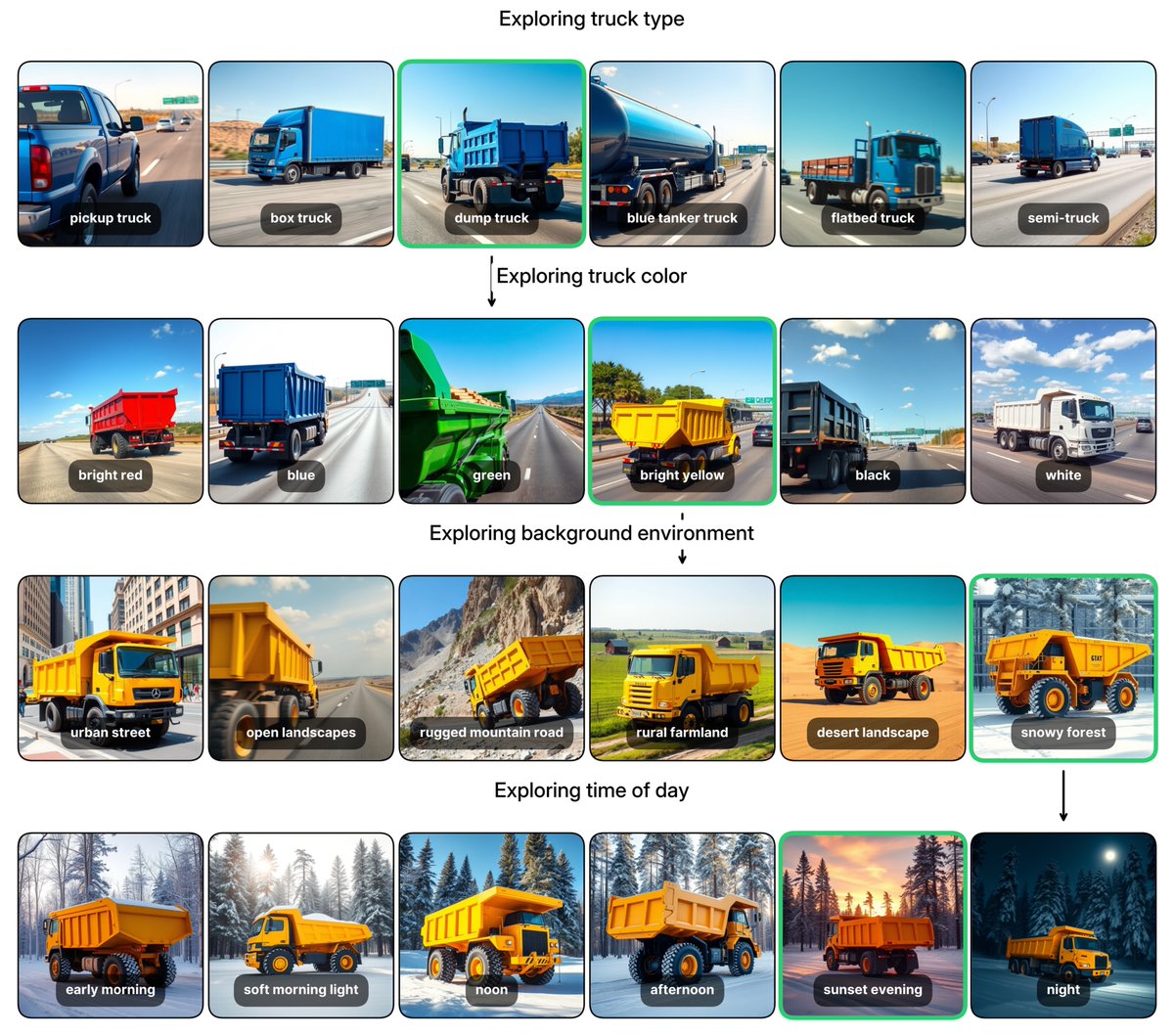
Current generative interfaces force users into inefficient trial-and-error with opaque prompts. Axes-and-Tags enables structured exploration by decomposing design spaces into interpretable axes users navigate systematically. Check out @AsanshayG's presentation at ICCV HiGEN!
We demonstrate this approach across three domains—diffusion images, HTML/CSS websites, and text composition—using identical exploration logic. Users report reduced cognitive load compared to blank-canvas prompting while achieving both breadth and depth in exploration.