$IonQ Great work up by @TechInnovationz on Philip Farah, @IonQ_Inc VP Global / Emerging Markets & Strategic GTM, at Quantum Korea 2026 in Seoul. Full session below, uncut. Definitely worth watching.
$IonQ The Selloff Mispricing argues that IonQ’s drop to a $37.51 close on July 15 reflects a macro-driven repricing of risk assets, not any deterioration in the company’s operating trajectory. A broad risk-off rotation triggered by Strait of Hormuz tensions hit high-beta quantum names across the board, yet IonQ’s delivery record remains flawless (16 commitments met, zero slipped), its Q1 backlog surged 554% year-over-year to $470 million, and the June 2026 executive orders on quantum networking and post-quantum cryptography have only reinforced the federal tailwind.
The report’s central claim is straightforward: when price compresses sharply for reasons external to the business while bookings, execution credibility, competitive positioning, and policy support hold or strengthen, the result is a valuation reset in the denominator rather than a re-rating of the numerator. At current levels, the same multi-year scenario framework developed in The Quantum Networking Tsunami now sits at a meaningfully lower entry point against an unchanged or improved set of fundamentals.
The view: A Strong Buy. For investors who have followed the series, today’s gap between sentiment-driven price action and operating reality represents an attractive opportunity to add exposure rather than a reason to step back. As I share my thoughts, I think of the incredible team Niccolo deMasi has assembled. Not lost on me is General Raymond, Bob Castillo, and Rick Muller.
I strongly suggest reading this report for all IonQ interested parties: https://t.co/lxmFxhRw0X
$IonQ The quantum tech sector has seen meaningful price volatility recently — and in my view, that volatility is creating one of the most compelling entry points for quantum tech companies that serious investors have seen, with one company - IonQ - by far being several levels ahead of everyone else . Let me be direct: I am not providing investment advice, but I want to be transparent — over the past week I have significantly added to my already very sizeable IonQ share ownership, and I intend to continue adding further. The primary catalyst? It is the information contained in this, the most extensive and accurate report on quantum networking - one researched without bias - one written to challenge my/our large IonQ holding - one written with the one singular question at hand: What do we do at this point with our IonQ holding, particularly after very significant gains since our first investments? The conclusion was overwhelmingly clear: add and keep adding.
(Here's the report - and if you're an IonQ or quantum tech investor - you should really take the time to read the whole report: https://t.co/T6gzXrpuKN)
Here is why: IonQ has quietly assembled the only three-layer quantum security flywheel in existence — physics-based key distribution (QKD) shipping today, post-quantum cryptography (PQC) deployed globally, and a live orchestration platform managing both simultaneously inside enterprise infrastructure — and that flywheel is already spinning, already integrated with Cisco's switching fabric, already generating revenue, and positioned to own the key management layer above the algorithms as PQC commoditizes exactly the way SSL and AES did before it; whoever owns that orchestration layer owns the recurring franchise, and right now only one company has all three pieces.
My team and I have spent years carefully and purposefully following quantum networking initiatives, and we have produced what I believe is the most extensive, most detailed, and most accurate quantum networking market report published anywhere — 100++ pages of primary-sourced, evidence-tiered analysis covering every major competitor, every deployment, every government contract, and every honest concession the thesis demands.
The conclusion, stated at full strength: IonQ is the clear leader in quantum networking across all addressable non-China markets — the only company on earth with commercial standing in both the security network and the compute network simultaneously, shipping product on the security side and holding the most advanced commercial-hardware interconnect demonstration on the compute side, anchored by the field's broadest owned stack, roughly 400 networking patents, a three-continent deployment base, and a ~$114.5M funded US-defense channel that no competitor matches.
What makes that claim trustworthy is precisely what surrounds it — this report concedes openly that networking is not yet a separately disclosed revenue line, that China's state-backed program exceeds IonQ on raw deployed scale in its own closed markets, and that much of the security footprint was inherited through acquisition; the leadership conclusion survives every one of those concessions, across every weighting scheme tested, and a claim that withstands its own strongest counter-arguments is the only kind worth underwriting.
Over the short term, the catalysts are datable and specific: SkyWater's regulatory close (which I expect to close in mid Q3- 2026, and which will trigger IonQ funding by the Trump Administration), the Q2 2026 financials on August 12th, and any networking revenue signal that converts this position from strategic optionality to a reported business line.
Over the long term, the architecture IonQ is assembling — ground fiber and space, security network and compute network, seven owned layers, the only company building the whole structure while rivals each built a single wall — is the kind of compounding infrastructure moat that rewards patience dramatically once the market begins pricing it.
Whoever owns the infrastructure of quantum communication will sit beneath the most security-sensitive systems in the world — enterprise data, financial networks, and national defense — and IonQ is the only company building and controlling that infrastructure across both land and space, with every layer owned and every advantage compounding: every deployment makes the next one cheaper, every contract pulls the next one closer, and every patent narrows the path a latecomer can take without licensing it.
The catch-up problem for every rival is not that the technology is secret — it is that IonQ's advantages compound faster than a follower can close them, and a competitor entering now is not paddling for the same wave IonQ caught; it is swimming after one already gathering speed, with the gap widening by the month.
A tsunami's defining cruelty is that it is underestimated until the moment it is inescapable — the warning signs are real but quiet, and quantum networking is sending those signals now: commercial QKD on live fiber, the first entanglement between two quantum computers, a defense establishment funding ahead of need, and ground and space assets being assembled into one architecture.
This report does not claim the wave has landed — networking revenue is still undisclosed, and that concession runs through every section — but it claims something more disciplined and, for an investor, more useful: that the asymmetry is the entire thesis, with limited downside if the wave is slow and structural advantage if it is not.
By the time the depth is obvious to everyone, the positioning will already be priced — and there is no report anywhere, on any platform, in any language, that documents IonQ's quantum networking position with more primary-source rigor, more honest concession, or more competitive depth than this one. The window is the quiet before — or it is not at all.
https://t.co/T6gzXrpuKN
On a very important note that does not show any public ties as of yet, Elon Musk confirmed just days ago that SpaceX ( $SPCX ) will begin deploying orbital AI data centers at scale by end of 2027 — with a new 11-million-square-foot Gigasat factory already under construction, a 1 gigawatt annual compute target in orbit, and Google, Amazon, and Blue Origin all racing to follow — and every one of those orbital platforms will require a physics-based, quantum-secure communications layer that classical encryption cannot provide, because a data center in orbit cannot be patched, cannot be serviced, and cannot survive a decade of harvest-now-decrypt-later exposure without quantum networking as its trust infrastructure. IonQ is the only company on earth that owns, today, the satellite communications assets (Capella, Skyloom), the quantum security stack (IDQ Clavis XG, Solteris, Clarion KX), the optical terminal hardware (Skyloom SDA-qualified), and the trapped-ion compute platform that together constitute the exact architecture that orbital data centers will require — and the race Elon just confirmed is the single most compelling external validation yet that the space-based quantum networking market this report covers is not a future thesis, it is an imminent procurement reality.
https://t.co/T6gzXrpuKN
@TaraBull Bernie has passed 4 bills in 19 years for our state, and two were naming post-offices. We have the oldest state with highest rate of young people leaving. #Boomeralert
Today marks the 250th anniversary of one of humanity's brightest, strongest, and most influential dreams – the American Dream of an independent, free, and prosperous nation that defends people's freedom, faith, and the pursuit of happiness.
That dream has endured many trials. It did not merely survive – it has, for two and a half centuries now, served as an example for other nations and helped the entire humanity stand firm and become freer. This was especially important in the 20th century, when America helped save the world from the rule of tyrants and built the alliances and partnerships that, for the first time, gave a large part of humanity lasting peace and the opportunity to develop in freedom.
Now, in the 21st century, America's influence and importance are certainly no less. And we see that particularly clearly in Ukraine, which is fighting for its independence, freedom, and our people's right to happiness with much the same hope, the same purpose, and the same determination with which Americans won and defended their own independence.
We deeply value the support of the United States, especially now, during Russia's full-scale war against Ukraine. American weapons – from the Javelins that President Trump decided to give to Ukraine to the Patriots that most reliably protect the lives of our people – everything the United States has provided to help us defend our country demonstrates the strength of the American spirit, American resolve, and American technology.
And we know the value of all these words better than anyone. When we ask America for Patriots, we believe that the values of respect for life and for people that prevailed 250 years ago will prevail again today. The world needs the kind of leadership that guarantees protection for freedom and for life.
I wish America a happy Fourth of July, the President of the United States and all Americans every success, and all of us around the world who value America – fruitful cooperation. "We hold these truths to be self-evident, that all men are created equal, that they are endowed by their Creator with certain unalienable Rights, that among these are Life, Liberty and the pursuit of Happiness." That is what unites all of us – all who respect America and thank America today.
May the dreams of free people always triumph over the evil and hatred of those who seek to destroy freedom. America, thank you! I am confident that if we're in it together, we'll definitely achieve peace! Congratulations on your Independence Day!
To the Americans:
I've travelled all over the world. I've familiarized myself with many places, and met many people. And I'm a Canadian, although I’m privileged to reside once again in the States.
And here's something I've noticed, and it’s a key element of America's continuing greatness:
You bloody Americans value success, and you believe in its existence.
This is something that doesn't really happen anywhere else in the world. Even in other free democracies—the United Kingdom; Finland, Sweden, and Norway; Australia, New Zealand and Canada; Germany, France, and the Netherlands (great countries all)—a counterproductive cynicism too often reigns.
Success is equated with exploitation.
Ambition is looked upon with contempt.
This happens sometimes in the United States too—particularly among the miserable progressives, who confuse their resentment, ingratitude and unearned skepticism with wisdom.
But in your great country, by and large, striving is admired and success celebrated.
This means that more people strive and succeed in the US than anywhere else. And it's increasingly obvious. You remain stunningly more innovative and productive than any people anywhere else on the planet.
And so I say, as all should who are fortunate enough to live in the western world, let alone America:
Thank God for the United States.
Thank God for the wisdom of its founders.
Thank God for its faith in the free market and in the natural rights of man.
Happy birthday, you damn Yankees and Southerners.
Long may your admirable country dominate the world.
Long may your freedom and hope provide an example to those suffering everywhere at the hands of their malevolent states.
May your two and a half centuries of unparallelled success be just the beginning.
Your country is the light of the world, and the city on the hill.
Thank God for the USA.
Happy 250th.
Dr. Jordan B. Peterson
$IonQ The strongest foundation I believe exists for @IonQ_Inc lies in these two small sections of the quantum network report and I think they’re worth repeating and sharing now. For all Q bulls - really try to find time to go through these reports. The marksmanship is in the very fine tuning.
1. The window compounds shut:
In orbital mechanics, a launch window is the narrow interval when a destination is reachable; miss it, and the target drifts out of range until the geometry realigns — sometimes years later, sometimes never on the same terms. Quantum-networking leadership behaves the same way. Every layer IonQ owns lowers the cost of its next deployment; every deployment books a customer a rival can no longer win; every patent narrows the path a latecomer can take without licensing it. A competitor starting today does not face the gap IonQ faced — it faces that gap plus everything IonQ has compounded since. The lead does not merely grow; it pulls the reachable window closed behind it. This is why “someone could replicate the stack” understates the difficulty: replication is a moving target accelerating away from the pursuer.
2. The SpaceX precedent:
This pattern has a recent and instructive parallel. SpaceX did not come to dominate launch by flying marginally better rockets; it won by owning the one piece of foundational infrastructure — reusable boosters — that made everything downstream structurally cheaper, then compounding that advantage with every flight while competitors were still designing their first reusable stage. Owning the bedrock layer first did not just win the launch market; it positioned SpaceX beneath the entire downstream economy of satellite communications and deep-space logistics that now depends on cheap, repeatable access to orbit. The strategic logic for IonQ is the same: own the foundational layer of quantum networking — the stack, the patents, the deployed footprint on land and in space — before the market understands its worth, and the downstream businesses that depend on that layer accrue to whoever built it first. The parallel is illustrative, not a forecast of identical outcomes; IonQ has not yet proven SpaceX-scale execution, and the comparison is offered as strategic logic rather than guaranteed result.
$IonQ A wave is invisible until it isn’t — the surface barely moves, and then it’s the whole horizon. That’s where quantum networking sits right now, and under @NiccoloDeMasi, IonQ has quietly built the broadest position in it of any company on earth: shipping security product today, holding the most advanced compute-interconnect demonstration achieved on commercial hardware, and assembling the only architecture spanning both land and space.
My team and I have carefully and purposefully followed quantum networking initiatives for several years and have been working diligently creating what I believe is the most detailed report of its kind published anywhere — every claim evidence-tiered, every concession made openly, the bear case steelmanned in full, and even the gaps we’re still waiting on disclosed laid out section by section. This isn’t a highlight reel; it’s the full audit, including the parts that don’t flatter the thesis. The market is still pricing IonQ as a computing story, and the networking market itself is expanding faster than I expected even a few months ago — that gap between visible attention and actual depth is the entire opportunity.
Critically — If you have invested in @IonQ_Inc you must read this report: networking is the giant, distinguishing bet Niccolo de Masi made to set IonQ apart from every other quantum competitor, and you owe it to your own position to understand exactly what that bet does and doesn’t yet prove. If you only skim it, you’ll get the bull case and miss the discipline that makes it credible; read it end to end, because the caveats are exactly where the thesis either holds or breaks.
First on the wave owns the wave — and right now, almost no one else is paddling - but that is going to change! Click on the link to view The Quantum Networking Tsunami report below:
https://t.co/T6gzXrpuKN
@BernieSanders Our state is the oldest in the nation with the highest rate of young people leaving, and boomers have plunged our country into $40T of debt. Hyperventilating is not policy.
$IONQ Every Scout starts with two words — BE PREPARED — and most never need them to mean more than a packed bag. The few who build a life around them, who treat readiness as a discipline rather than a slogan and carry it into service where the stakes are real, are the ones from whom Tier-1 operators are eventually drawn: not the loudest, not the best-equipped, but the most reliably ready when it counts — and that is exactly the distance my new report, The Delivery Verdict: IonQ's Tier-1 Mentality, measures in IonQ.
Here's the thesis, and I'm not going to soften it: as global enterprise crosses from quantum experimentation into quantum commercialization, the entire game stops being about who has the flashiest roadmap and becomes about who actually delivers — on time, ahead of schedule, when sovereign capability and real money are on the line — and on that measure IonQ isn't competing for the lead, it is the lead.
THE BIG QUESTION IS THIS: Does @IonQ_Inc fulfill its stated commitments and are they on-time, ahead of schedule, or behind, and what does this mean for their business operations and roadmap? In essence, can we TRUST IonQ to deliver what we many expect will be delivered in the future?
Most of us know, milestones hit early. Guidance beaten five quarters running. An integrated national-security full stack — computing, networking, sensing, security — delivered at a breadth no competitor anywhere is close to matching at the moment, while the rest of the field is still talking. We get it. You get it. But can the momentum sustain itself?
This is the moment that separates the operators from the aspirants, and the report documents — evidence-tagged, primary-sourced, open conditions intact — why IonQ has already crossed that line. IonQ has developed in many ways characteristics of a Tier-1 Operator.
Bottom line: this is the report that sets everything apart and tells you why.
https://t.co/VRSVhWYqKf
@DavidSacks Seems deliberate, like Oppenheimer leaking nuclear secrets to Russians. By leaking Mythos to other nations you create mutually assured destruction, and therefore a stable world.
$IonQ IonQ is, at present, the clear leader in the race to own the quantum full stack — the integrated control of hardware, cloud distribution, software, a fault-tolerant roadmap, and quantum networking that this report argues will decide the commercial leadership of the industry {to see the Full Stack Report visit:. https://t.co/Vbuk5SGIkL}).
The timing of this report was critical for it demonstrates that certain companies, @IonQ_Inc in particular, is positioned to compound their broad ecosystem lead based upon their operational multi-diagonal architecture that can maximize the release of advanced next generation systems (which is what the focus of the Quantum Frontier report is focused on: {https://t.co/8CxHCie4Pf}.
In essence it comes down to this: who owns the full stack, how far ahead are they from their competitors, and is the next system generation that significant that it could compound growth projections.
My view based upon four metric-driven reports that spans 300 pages, nearly 10 years of research my an experienced team, and real positions in the game is this: IonQ’s full stake architecture combined with their sixth generation system likely will compound their growth and market share, driving the market more than any other catalyst to greater maturity.
$IONQ Hanna delivers again. Another great report. Some highlights on IonQ versus its primary competition:
➡️ IBM: "the dilution refrigerator physics are not an engineering challenge waiting for a clever solution — superconducting qubits require near-absolute-zero temperatures because they are superconducting; that is definitional, not incidental. The $30M versus $1B-plus bill-of-materials gap at scale reflects this physics directly and does not close through better engineering. It closes only by changing the modality. "
➡️ Quantinuum: "no networking program, no foundry.... the business has one path to its $14 billion valuation: Sol on time in 2027, Apollo on time in 2029, customer diversification away from the RIKEN concentration the S-1 discloses, and no competing trapped-ion system demonstrating comparable QEC on a product platform before it does."
$IONQ
My friend @HannaSuds just published the report she says 10 years of work led to.
The Quantum Frontier Report - Part IV, the finale of her series. 12 companies, 4 modalities, scored on one discipline: peer-reviewed physics over SEC filings, filings over roadmaps, roadmaps over press releases.
What I respect most - it’s not a cheerleading piece. It names where each company actually leads today and attaches to every verdict the exact result that would overturn it.
No flash. No hype. Go read it. ↓
🔗https://t.co/mHSXukY9eg
#Quantum #QuantumComputing
After three reports that mapped the terrain, Part IV of the Quantum Technology Integration Series is the one that matters most - especially if you are an investor in the quantum sector or a end-user of quantum tech. I cannot express this clear enough, particularly if you're reading these reports to understand the quantum market.
https://t.co/8CxHCie4Pf
The Quantum Frontier report is not a recap or a simple culmination. It is the report that translates years of technical progress into a clear picture of the decisive 2026–2028 window — where the compounding advantage is accelerating, platform lock-in is forming, and the competitive field is beginning to separate in real time. If you are focused on Q and you do not really understand the depth of who and what is fast-approaching the market, you should really need to read this report. And make no mistake - things are going to move much, much faster than they ever have. Whoever is behind will have a great challenge recovering. Whoever leads - will likely see their growth compound substantially. It is all about timing - and the timing is now.
The window to act is measured in quarters, not years. But make no mistake, there is a compounding impact now in play and its very serious and significant.
Those who understand where demonstrated capability ends and integrated platform leadership begins will position before the rest of the market catches up.
If you only read one report in this series, read this one. I can't stress this enough: 10 years of research leads to this one report:
https://t.co/8CxHCie4Pf
$IONQ
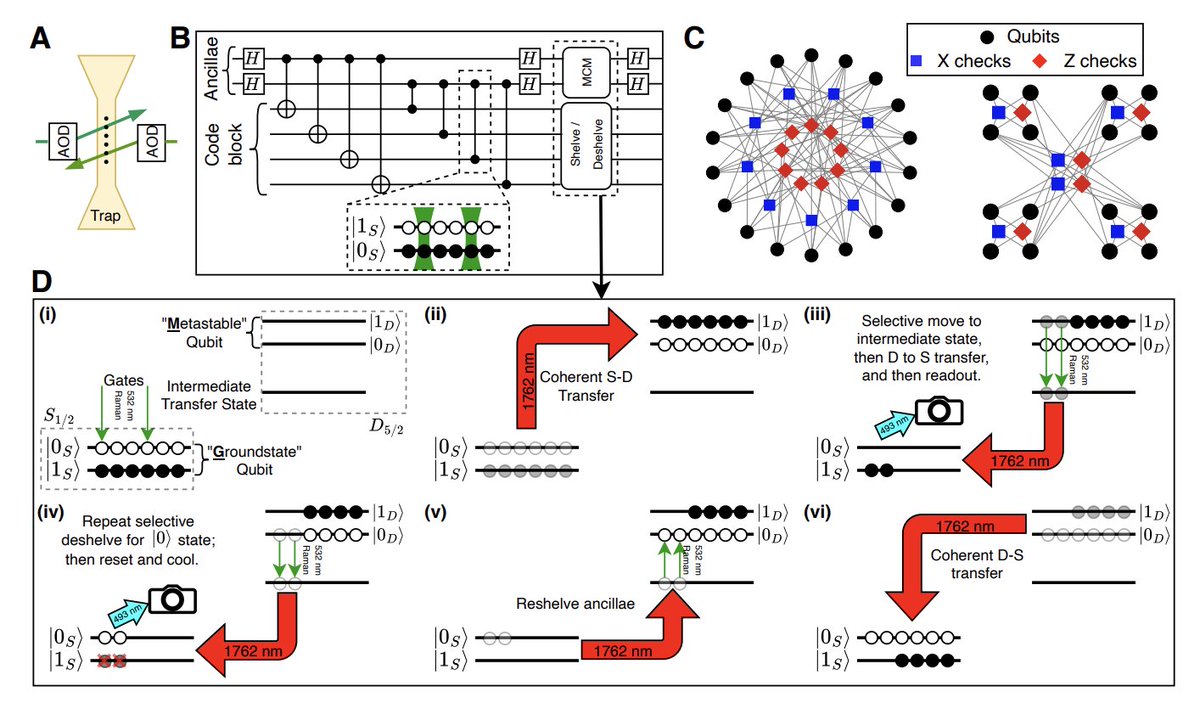
IonQ posted a paper titled "Breakeven demonstration of quantum low-density parity-check codes." Eleven IonQ authors, including Edwin Tham, Michael Goldman, Kenneth Wright, and Nicolas Delfosse.
Quantum computers work with individual atoms or other tiny physical systems as their basic units. Each unit is a physical qubit, and physical qubits are extremely fragile. Small disturbances cause errors that accumulate fast.
The way around this is quantum error correction. Many physical qubits group together to encode one logical qubit, a virtual unit more reliable than any of the physical qubits underneath. The logical qubit is what actually does the computation. The physical qubits constantly check each other for errors and correct them. A code is the specific recipe for how those physical qubits work together.
Breakeven is the milestone where the logical qubit lives longer than the physical qubits inside it. The error correction is fixing errors faster than the system is adding new ones from the overhead of running the code. Before breakeven, error correction is theoretical. After breakeven, it works.
Google reached breakeven last year on superconducting hardware. Superconducting qubits are tiny circuits cooled to near absolute zero. IBM, Google, and several others build on this approach.
Today IonQ reached breakeven on trapped-ion hardware. Trapped ions are individual atoms held in place by electric fields. No deep cooling needed.
IonQ ran nine different error-correcting codes across three different code families. All on the same 40-ion device. No hardware changes between codes. The best logical qubit lived 3.95 seconds. The physical qubits underneath it lived 3.3 seconds. The logical qubit outlived the physical qubits it was built from.
The technical innovation is called OMG. The system reads out individual qubits in the middle of a computation, then resets them, without physically moving any ions around. Other trapped-ion systems spend most of their runtime moving ions back and forth between different zones of the chip. They also dedicate up to half their qubits just to cooling the ones doing computation. IonQ's approach eliminates both.
The paper also makes a direct comparison to a recent IBM result. Same code and same qubit counts. IonQ's logical error rates came in 4 to 9 times lower. IBM had built a chip with custom structures just to run that one code. IonQ ran nine codes on the same standard device.
IonQ has joined the small group of companies that have demonstrated fault-tolerant error correction at breakeven. Google did it last year on superconducting hardware. IonQ did it today on trapped ions.
Where the comparison is direct, IonQ's hardware comes out ahead. The error rates were 4 to 9 times lower than IBM's on the same code. IonQ ran nine codes on its standard hardware where IBM required a custom chip just for one. And other trapped-ion systems carry transport and cooling overhead that IonQ's design avoids. The architectural bet is paying off in the field's most demanding experimental test.