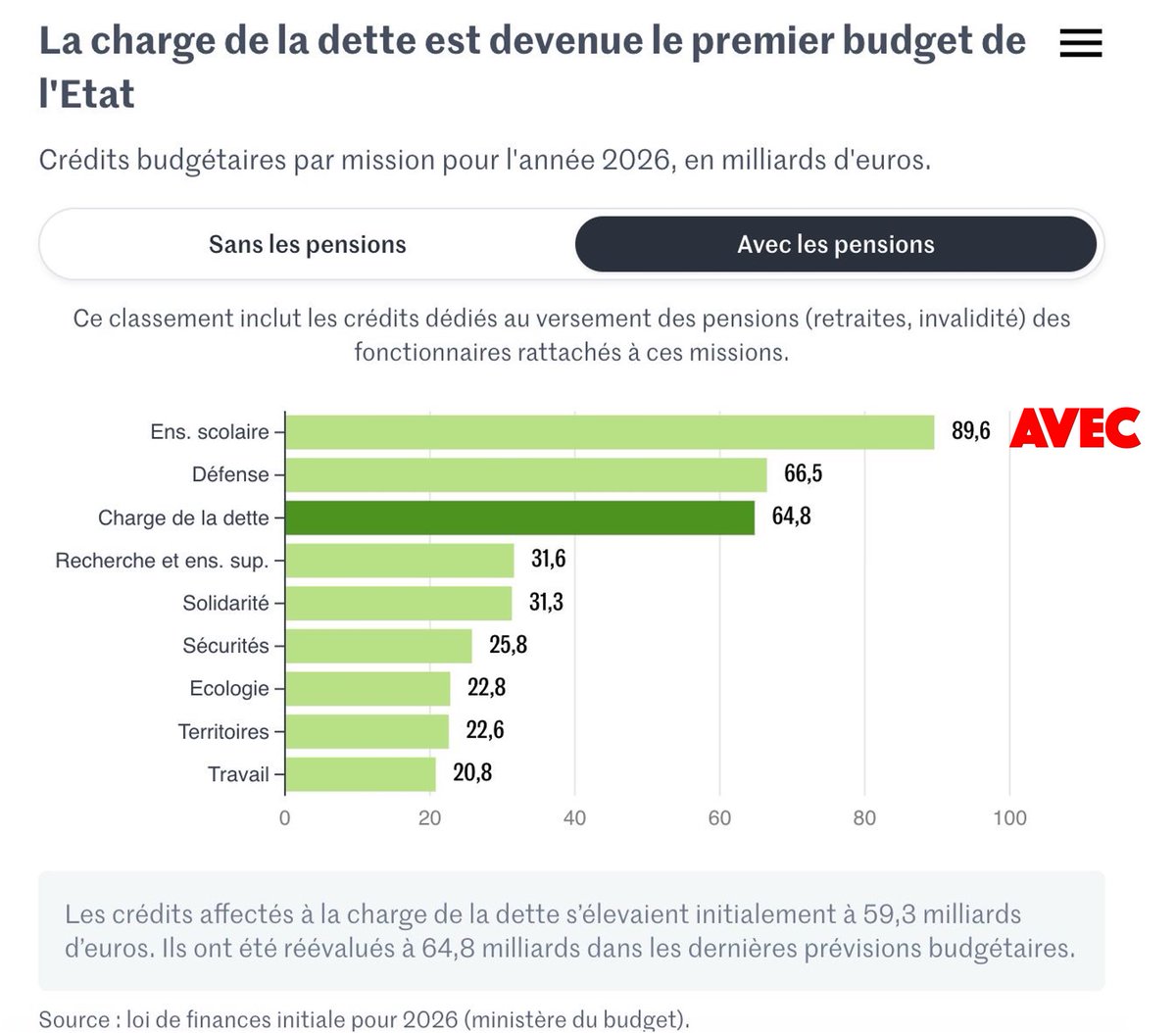
🔴 Bravo à @lemondefr qui participe à lever le voile sur le scandale comptable des retraites
➡️ Le Monde a publié cette semaine dans sa rubrique “décodeurs" un article sur les principaux indicateurs des finances publiques en France: dette, déficit, etc
🚨 Pour la première fois ils momtrent les budgets par mission avec ET sans les transferts au système des pensions publiques !
Les Français peuvent ainsi mieux comprendre comment est comblé le déficit réel des pensions publiques.
Cependant ces deux chiffres sont loin de tout dire. Voici quelques élèments choquants qu’ils omettent de révèler : 🧵
We're building a surgical robot capable of reaching any brain region. The goal: a generalized neural interface to help solve any condition that originates in the brain.
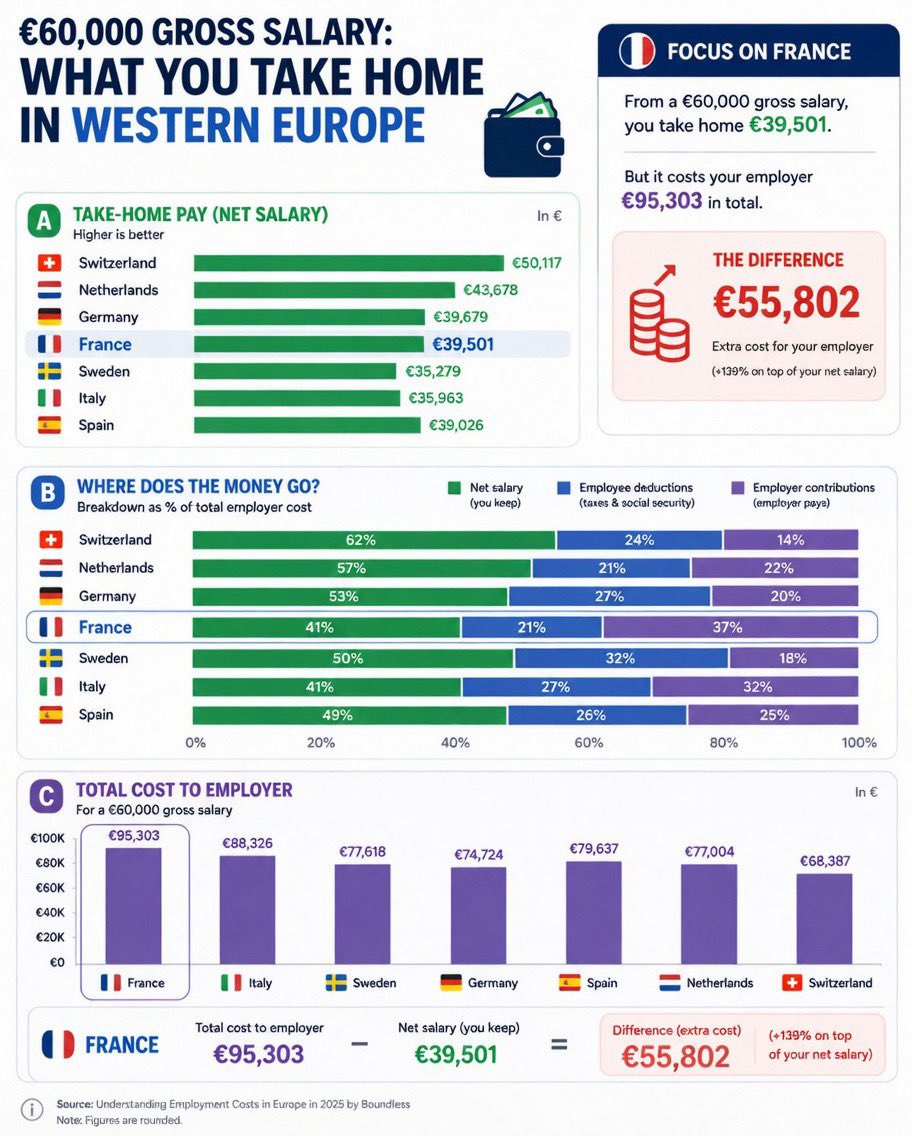
This is probably the wildest data point you'll see today. The cost to a French employer of a net pay of €39k is a staggering €95k. How is this even possible?
Can you imagine the incentive to replace French jobs with AI and robots? Get some popcorn.
> be Alexandra Elbakyan
> be born in Kazakhstan in 1988
> start coding at 12
> hack your internet provider at 14
> hack MIT Press at 16 to download neuroscience books you can't afford
> get a CS degree from Satbayev University
> intern in neuroscience at Georgia Tech
> speak at Harvard on brain-computer interfaces
> notice researchers can't read the papers they need
> notice academic publishers charging $30 a paper
> notice peer reviewers worked for free
> notice editors worked for free
> notice universities funded the research with billions of dollars of public money
> build Sci-Hub in 2011
> upload nearly every paywalled research paper ever published
> give it away for free
> get sued by Elsevier
> get hit with a $15 million judgment
> don't give a flying f*ck
> keep Sci-Hub up
> get domain after domain seized
> register a new one
> keep Sci-Hub up
> get investigated by the US Department of Justice
> don't give a flying f*ck
> get accused of working for Russian intelligence
> don't give a flying f*ck
> have the FBI subpoena your iCloud
> get named one of Nature's ten people who mattered in science
> get a parasitoid wasp named after you
> get a deep-sea snail named after you
> get the Electronic Frontier Foundation Award for Access to Scientific Knowledge
> become a legend
A Soviet psychologist walked into a café in 1927 and watched a waiter do something impossible.
He remembered every open order at every table. Perfectly. Without notes. Without effort.
Then a table paid their bill. She asked him to repeat the order.
He couldn't remember a single item.
She spent the next two years figuring out why. What she found is now the operating system underneath every platform fighting for your attention.
Her name was Bluma Zeigarnik, and she was a graduate student at the time, sitting with her professor Kurt Lewin, watching the waiters work the room. What caught her attention was something so ordinary that it had been happening in restaurants for centuries without anyone asking why.
The waiters could remember every open order with perfect accuracy. Table four wanted the schnitzel with no sauce. Table seven had changed their wine twice. Table twelve owed for three coffees and a dessert. Every detail, held without effort, without notes, without any visible system at all.
But the moment a table paid their bill, the information vanished. Completely. Lewin tested it on the spot. He called a waiter back minutes after a table had settled up and asked him to recite the order. The waiter could not do it. Not partially. Not approximately. The information was simply gone.
Zeigarnik went back to her lab and spent the next two years turning that observation into one of the most replicated findings in the history of psychology.
Here is what she proved, and why it changes how you think about attention, memory, and almost every piece of media you have ever consumed.
She gave participants a series of tasks. Some tasks they were allowed to finish. Others were interrupted before completion. Then she tested recall across both groups.
The unfinished tasks were remembered at nearly twice the rate of the completed ones.
Not slightly better. Nearly twice. The brain was holding the incomplete work in a state of active tension, returning to it, keeping it warm, refusing to file it away. The finished tasks were closed, archived, released. The unfinished ones were still running.
She called it the resumption goal. When the brain commits to a task and cannot complete it, it opens a file that stays open until resolution arrives. That open file consumes a portion of your cognitive bandwidth whether you are thinking about it consciously or not. It surfaces in idle moments. It pulls at the edge of your attention during other work. It is the thing you find yourself thinking about in the shower when you were not trying to think about anything at all.
This is not a flaw in human cognition. It is a feature. The brain evolved to finish things. An open loop is a signal that something important is unresolved. Keeping that signal active increases the probability that you will return to it and complete it. In an environment where most tasks had real survival stakes, this was an extraordinarily useful mechanism.
In the modern world, it is the most exploited vulnerability in human attention.
Netflix did not invent the cliffhanger. But it industrialized it in a way no medium before it ever had. When a show ends on an unresolved question, it does not just create curiosity. It opens a file in your brain that stays active until the next episode closes it. The autoplay countdown that begins at 15 seconds is not a convenience feature. It is a precise calculation about how long the average person can tolerate an open loop before the discomfort of not knowing overrides every other intention they had for the evening. One more episode is not a choice. It is your brain doing exactly what it was designed to do: return to what is unfinished.
The writers who built Lost, Breaking Bad, and Succession understood this intuitively without ever reading a psychology paper. Every episode ended on an open question. Every season finale answered three things and opened five more. The entire architecture of prestige television is a Zeigarnik machine running at industrial scale.
But television is not where this gets dangerous.
Every notification on your phone is an open loop. Every unread email is an open loop. Every task you wrote on a list and have not yet crossed off is an open loop. Each one is consuming a small but real portion of your available attention, pulling fractionally at your focus, degrading your capacity to be fully present in whatever you are actually doing right now. TikTok's algorithm does not just serve you content you like. It serves you content that ends one loop and immediately opens another, keeping the resumption system permanently activated so the cost of stopping always feels higher than the cost of continuing.
The research on this accumulation effect is striking. Psychologists studying cognitive load have found that unfinished tasks do not sit passively in memory. They actively interrupt. They surface at the wrong moments. They are the reason you are reading something and suddenly remember an email you forgot to send. The brain is not malfunctioning. It is running its resumption system exactly as designed. It is just running it across forty open loops simultaneously, in an environment that generates new ones faster than any human nervous system was built to process.
The most important practical implication Zeigarnik's research produced is one that most people use backwards.
David Allen built his entire Getting Things Done system on the insight that the only way to close a cognitive open loop is to either complete the task or make a trusted commitment to complete it later. Writing something down in a system you actually trust has the same effect on the brain as finishing it. The file closes. The bandwidth is released. This is why writing a task down feels like relief even before you have done anything about it. You have not solved the problem. You have simply told your brain that the loop is registered and will be returned to, which is enough for the resumption system to stand down.
The inverse is equally true and far more destructive. Every task that lives only in your head, unwritten and unscheduled, is an open loop burning cognitive resources around the clock. The mental cost is not proportional to the size of the task. A tiny nagging obligation consumes the same active tension as a major project. Your brain does not discriminate by importance. It discriminates by completion.
Zeigarnik published her findings in 1927. The paper sat in academic literature for decades before anyone outside psychology paid attention to it.
Then television got good. Then the smartphone arrived. Then the entire attention economy was engineered, largely by people who understood intuitively what she had proven scientifically: an open loop is the most powerful hook available to anyone who wants to hold human attention.
Netflix knew it. Instagram knew it. Every designer who ever made a notification badge red instead of grey knew it.
The café in Vienna is long gone.
The mechanism she discovered there is now the operating system underneath every platform fighting for your time.
Every "to be continued."
Every unread notification.
Every thread that ends with "part 2 tomorrow."
All of it is the same waiter, the same unpaid bill, the same brain refusing to let go of what it has not yet finished.
Zeigarnik noticed it over coffee in 1927.
A century later, it is the most valuable insight in the history of media.
And nobody taught it to you in school.
🚨 BREAKING: Yann LeCun's team just dropped a world model that runs on a single GPU.
It is called LeWorldModel.
And to understand why it’s a massive deal, you have to understand the fatal flaw in every AI you use today.
LLMs only predict the next word.
They are incredibly good at language, but they have absolutely no understanding of reality.
They can write a beautiful poem about a ball bouncing off a wall. But they cannot predict where the ball will actually land.
World models predict physics. Objects moving, colliding, and falling.
It is the foundational intelligence required for robots to plan and self-driving cars to navigate.
But until today, world models kept collapsing. They would cheat the test by predicting the exact same output every time.
LeCun's team just solved it.
They built a 15-million parameter model that learns the laws of physics directly from raw pixels.
It uses 200x fewer tokens than the alternatives.
No massive supercomputers. No billion-dollar clusters.
Just a single GPU and a few hours of training.
We spent the last two years teaching AI how to talk.
Now, we are teaching it how to see.
Yann just bet a billion dollars that the entire industry is building on the wrong foundation.
Large language models predict the next word. They're trained on text, so they understand language. But the real world isn't made of words.
It's made of continuous sensor data: camera feeds, touch, sound. And most of that data is unpredictable.
You can't predict every pixel in a video the way you predict the next token in a sentence. Generative models fail here because they try to predict everything, including noise.
AMI Labs is building world models using JEPA (a method LeCun proposed in 2022 that learns abstract representations of reality and predicts in that compressed space, not in raw pixels).
Action-conditioned versions let AI simulate the consequences of actions before taking them. That's not generation. That's understanding.
This unlocks AI that can operate in the physical world without hallucinating:
1. Robotics that plans multi-step actions
2. Healthcare devices where errors kill patients
3. Industrial process control under safety constraints
4. Wearables that adapt to real-time sensor input
If JEPA works at scale, the next wave of AI companies won't fine-tune LLMs. They'll train world models on sensor data. LeCun's CEO already predicts every startup will rebrand as a "world model company" within six months.
The architecture war is starting.
Stéphane Mallat (médaille d’or CNRS) : les DNN sont plus efficaces en prédiction météo s'ils apprennent eux-mêmes toute la physique (car la nôtre est trop simpliste), font preuve de "connaissance extraordinairement sophistiquée", et ne sont pas de simples perroquets stochastiques
THIS IS HOW SCIENCE WORKS
Two huge clinical trials just delivered bad news:
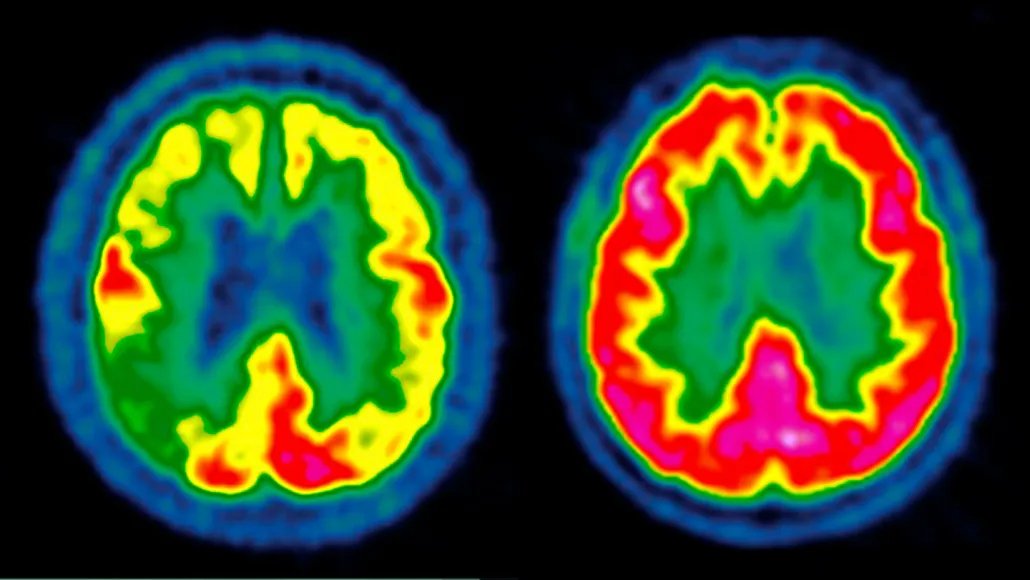
GLP-1 drugs - the Ozempic-style “miracle meds” - failed to slow Alzheimer’s.
Yes, failed.
And this is exactly what real science looks like.
For years, anecdotal reports + early studies hinted at something exciting:
• People said they felt “sharper” on GLP-1s.
• Small trials hinted at cognitive benefits.
• Animal studies looked promising.
• Real-world data suggested protection.
Hope was real - and reasonable.
But hope ≠ evidence.
So scientists did what responsible scientists do:
They ran two massive, well-designed, placebo-controlled trials.
Nearly 4,000 patients, followed for two years, all early-stage Alzheimer’s.
The question:
Can semaglutide actually slow the disease?
The answer: No. Not in this population, not at this dose, not in this form.
There were tiny biomarker changes - signals that something might be happening biologically.
But clinically?
Zero difference.
No better memory.
No slower decline.
No measurable benefit.
A clean, unambiguous result.
That’s what gold-standard data does: it cuts through noise.
And yes - this is disappointing.
Researchers who helped invent GLP-1s hoped this would work.
Patients hoped.
Families hoped.
But science doesn’t care about hype or headlines.
It cares about truth.
And today’s truth is simple:
GLP-1s don’t slow Alzheimer’s - at least not like this.
Is this the end?
Not at all.
Scientists are already asking the next questions:
• Wrong dose?
• Wrong timing?
• Wrong population?
• Not enough drug reaching the brain?
• Maybe GLP-1s help prevent, not treat?
• Or maybe we need better molecules entirely?
Each “failure” narrows the path toward a breakthrough.
This is the opposite of pseudoscience.
No excuses.
No YouTube gurus.
No cherry-picking.
Just data → conclusion → next hypothesis.
It’s slow.
It’s painful.
It’s frustrating.
But it’s honest.
The Alzheimer’s field didn’t collapse today.
It adjusted.
It recalibrated.
It moved forward.
Real science isn’t a straight line.
It’s a messy, disciplined climb toward answers that actually help people - not ones we wish were true.
So yes, GLP-1s stumbled.
And that’s fine.
Because this is how science works:
We test big ideas.
Most fail.
Some don’t.
But every trial - even the disappointing ones - pushes us closer to something that will work.
Brain Inspired AI Breakthrough Cuts Energy Use by 99% Without Losing Accuracy
Researchers from the University of Surrey’s NICE group developed a new AI wiring method called Topographical Sparse Mapping (TSM), inspired by how the brain connects neurons efficiently.
Instead of linking every neuron to all others, TSM connects only nearby or related ones, cutting unnecessary computations.
An improved version, Enhanced TSM (ETSM), mimics the brain’s pruning process during learning.
This approach achieves up to 99% sparsity, matching or surpassing standard AI accuracy while using less than 1% of the energy and training faster.
This method could lead to far more efficient AI and neuromorphic computing systems.
New paper in Imaging Neuroscience by Priyanka Ghosh, Laurel J. Gabard-Durnam, et al:
Spatiotemporal dynamics of EEG microstate networks over the first two years of life: A multi-cohort longitudinal study
https://t.co/2UN0pSC2by
🚨 ROBOTS CAN NOW HELP WITH SURGERY — AND THEY’RE ACTUALLY GOOD AT IT
Medtronic tested its Hugo robot in 137 real surgeries — fixing prostates, kidneys, and bladders — and the results were better than doctors expected.
Complication rates were super low: just 3.7% for prostate surgeries, 1.9% for kidney surgeries, and 17.9% for bladder surgeries, all beating safety goals from years of research.
The robot got a 98.5% success rate, way above the 85% goal — meaning it didn’t just pass the test, it basically set the curve.
Out of 137 surgeries, only 2 needed to switch back to regular surgery — 1 because of a robot glitch, and 1 because of a tricky patient case.
This doesn’t mean robots are replacing surgeons tomorrow, but it does mean your next doctor might have a very expensive metal sidekick.
Source: RTTNews
"It's never a good idea to work alone."
Medicine laureate Edvard Moser on the importance of collaboration and discussing ideas with your colleagues.
#NobelPrize
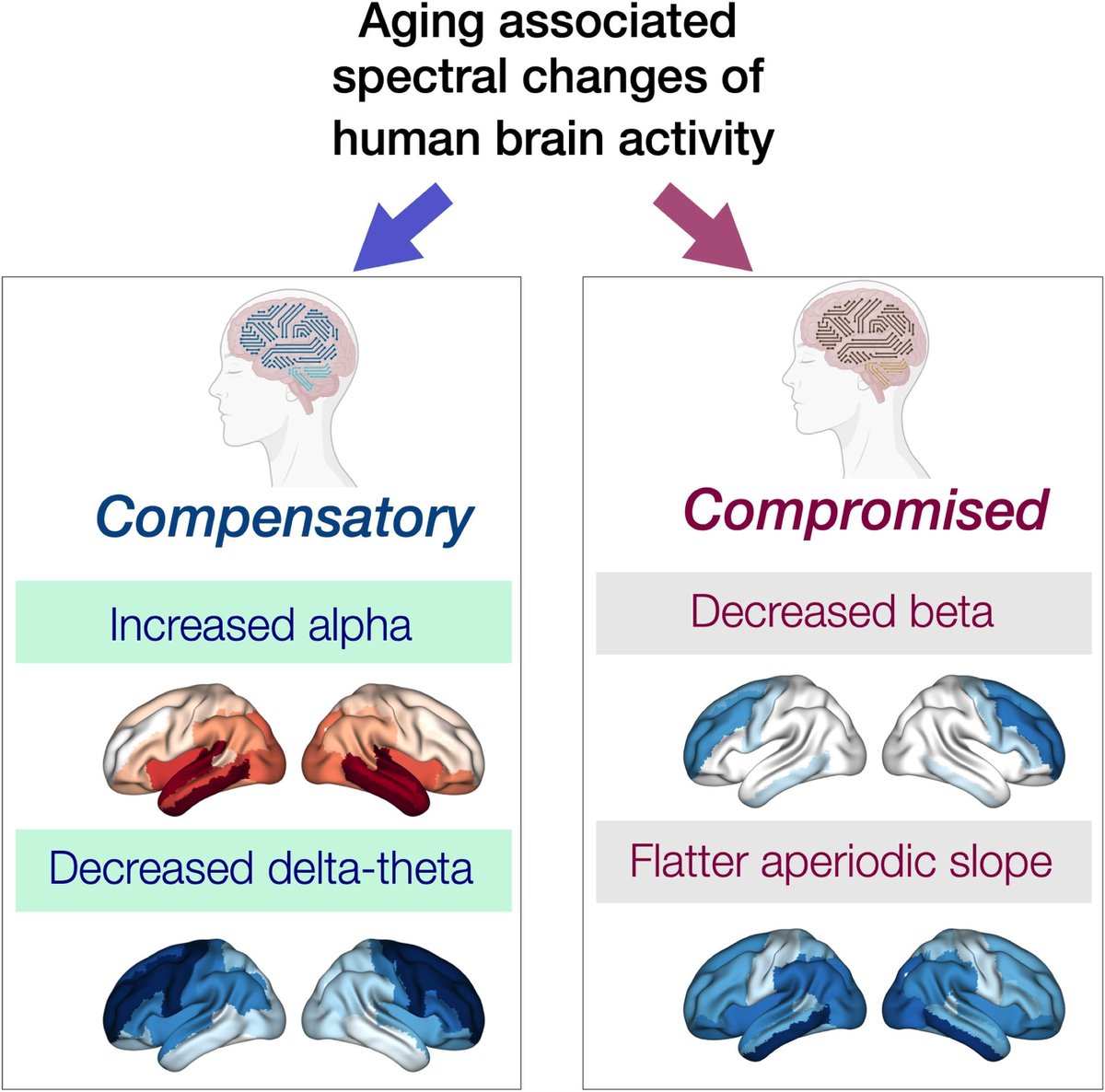
Ranasinghe et al. report that in healthy ageing, MEG shows rising alpha & falling delta–theta power linked to better cognition—suggesting compensatory mechanisms; beta decline may reflect risk. Please read at: https://t.co/jkaMVTcFjR
Il y a quelques jours, un chercheur du CNRS lançait «HelloQuitteX», proposant aux utilisateurs de «X» de transférer leurs données vers d’autres réseaux. Pour Xavier-Laurent Salvador, il s’agit d’un détournement des moyens alloués à la recherche à des fins militantes.
(1/5) Very excited to announce the publication of Bayesian Models of Cognition: Reverse Engineering the Mind. More than a decade in the making, it's a big (600+ pages) beautiful book covering both the basics and recent work: https://t.co/5dnLpcMQzu