Starting to understand how a radical SAM enzyme makes a thioether crosslink - the auxiliary iron-sulfur cluster binds the substrate!
https://t.co/vNt3iuRO3w
Registration is open for #DiscoverBMB! Join us in Seattle to explore 11 symposia, browse exciting exhibits, and attend talks by high-profile scientists and rising stars, panel discussions, poster presentations, interest group sessions and workshops! https://t.co/hjnsLsKX03
Our newest paper in Biochemistry finally balances the reaction catalyzed by the tRNA-modifying radical SAM enzyme TYW1 showing that carbon dioxide is the second product and that the auxiliary cluster serves as an oxidant.
https://t.co/JD0VET2ObM
Beyond thrilled to see our newest paper in ACS Central Science, where we report studies that reveal breathtaking substrate tolerance by radical SAM RiPP maturase.
https://t.co/i73OODXw2H
Congratulations to Catherine Drennan (@Drennan_Lab) at @MITBiology, who won the William C. Rose Award! Her lab studies the structural biology of metalloenzymes, & her pedagogical work includes research into best practices for active lectures.
https://t.co/Q4Ae4xgzHv #DiscoverBMB
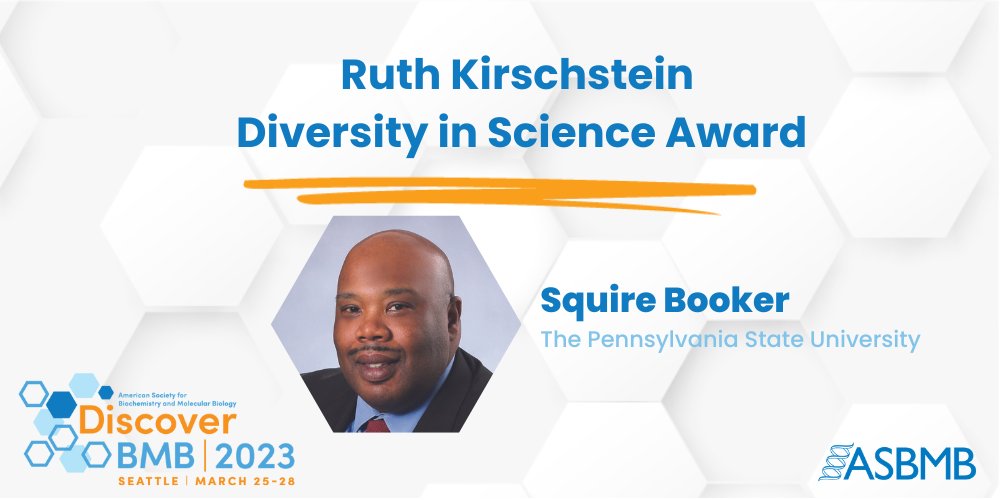
Congratulations to Squire for receiving both the Ruth Kirschstein Diversity in Science Award, AS WELL AS the Merck award! I think he is the first person to receive TWO awards in the same year from ASBMB!
Congratulations to @BookerMan_PSU at @PSUScience, on winning the 2023 Ruth Kirschstein Diversity in Science Award! Booker is a past chair of the ASBMB’s Minority Affairs Committee and established the ASBMB IMAGE grant-writing workshop. #DiscoverBMB
https://t.co/Q4Ae4xgzHv
Congratulations to the winners of the 2023 ASBMB Annual Awards! Colleagues & other leaders in the field nominated the winners for making significant contributions to biochemistry and molecular biology & to the training of emerging scientists. #DiscoverBMB
https://t.co/Q4Ae4xgzHv
Thank you all for joining us at #ASBMB2022 at #ExpBio! It was a wonderful experience, and we so appreciate the enthusiasm with which you shared your work. The countdown to our 2023 annual meeting, #DiscoverBMB, is on! We hope you'll join us in Seattle!
https://t.co/62egkMHhlZ
It was such a treat to co-organize the 2022 ASBMB (@ASBMB) meeting in Philadelphia with Martha Cyert (@cyertmartha). Thank you to all the theme organizers, speakers, poster presenters, attendees, and ASBMB for making this a great meeting. See you in Seattle in 2023!
@ASBMB A2. No reason to not write out the most important points of the poster and practice them so that you have a clear idea of what you will communicate.
@ASBMB A4: Do have a "short story" that covers the key topics in your poster. If the person has a deeper interest, they will let you know and explore more. But most people are trying to get to a bunch of posters so plan to engage for 5 minutes at the most unless they ask for more.
@ASBMB A4. It is a good idea to solicit some feedback to help catch errors and make sure that it is clear to a general audience. Ask the reader to tell you what they expect to see when they go to the abstract to see if you did a good job of conveying the key scientific findings.
@ASBMB A3. Stream of consciousness works in writing a novel or a short story, but not a scientific abstract. Outline and stick to it. Keep it free of scientific jargon. Also, no one needs to know the concentrations of assay components, unless it is relevant to the study.
@ASBMB A2. Anatomy of an abstract: 1) general statement of the scientific area, 2) the big biological problem that is being addressed, 3) the key experimental results, 4) concise interpretation, 5) and if appropriate, what is next for the studies.