WHY I THINK THE MARKET IS WRONG ABOUT $RKLB
My initial take through the Rocket Lab earnings call is that the market is mistakenly viewing the Neutron delay in isolation and missing the very significant progress that has already been achieved prior to the launch of Neutron. Revenue for the quarter more than doubled to a record $267.8M with Space Systems revenue of approximately $215M or 80% of total revenue for the quarter. GAAP gross margin of 33.6% exceeded the company’s guidance of 29% to 31% for the quarter and the company reaffirmed guidance for Q4 revenue of $270M to $290M.
The company is already manufacturing satellites, optical communications equipment, propulsion systems and other key spacecraft components for commercial and governmental customers. In short, Rocket Lab is participating in the growth of the space economy.
I’d also note that a lot of people are looking at the Neutron delay through the lens of how long it will take to turn the $3.57B backlog of 117 launches and over 55 spacecraft in development and production into actual dollars. As noted above, only about a third of that total is expected to turn into revenue over the course of the next 12 months.
So it is frustrating but what really sticks out to me is that the contracts to add 8 more launches to the Neutron manifest of 16 at greater than $515M per launch were signed at a higher price ($70M per launch versus $55M) – and that Rocket Lab could have signed on for even more launches at that higher price. This is a company with increasing demand and improving pricing – and it has a significant delay in the launch of its next major product. That is very different from a company whose customers are losing confidence.
The even greater opportunity that Rocket Lab is developing is to become a space-based manufacturing company and launch service provider that can build spacecraft, launch them, and then operate the associated space-based infrastructure and services to generate recurring revenue.
The pending acquisition of Iridium will add a large established satellite communications network with more than 2.5M subscribers to the Space Systems segment, creating a large and growing source of recurring revenue from the associated communications services in addition to the Space Systems manufacturing and launch services.
The Company’s existing relationships with Defense customers are also gaining traction, with customers seeking to implement their own space-based infrastructure and services, where they can have greater control over the associated systems and services.
Rocket Lab’s financing situation is also stronger than it was earlier this year, with the Company holding approximately $4.7B in cash and securities and the acquisition bridge loan having been retired. Importantly, however, the flexibility that has been created has come via a significant equity raise, with the Company’s share count increasing by approximately 23% over the past year, and Iridium has substantial existing debt that will remain on the Company’s balance sheet following the close of the acquisition.
Operating cash flow even turned positive in the quarter for $7.2M, although free cash flow remained decidedly negative. In summary, I don’t think that Rocket Lab’s earnings are suddenly going to become profitable, but rather the Company is in the process of building out a large and much more diversified business, with improving future economics as the Company’s existing production programs scale, and the Neutron launch vehicle enters into commercial service.
The disappointment with Neutron is obvious as the first stage composite tank will require a refurbishment which will now push the inaugural flight to 2027 with no fixed launch date for the time being.
While the management reiterated that increased spend will be required until Neutron is flying regularly, production is advancing towards the recurrent production phase, adjusted EBITDA is expected to turn positive within six months post first flight, while sustainable free cash flow will take longer as it will depend on the rate of Rocket Lab’s reusable launch vehicles expansion.
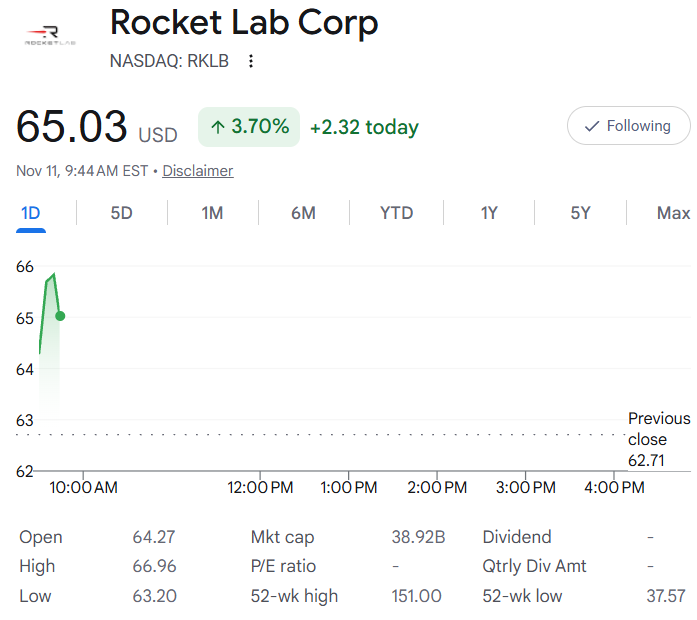
Moreover, Rocket Lab’s stock price trades at a significant premium to its conventional aerospace peers. While I don’t think for a second that RKLB is cheap as it is trading at a significant premium to its peers’ stock prices and while there is plenty of competition from SpaceX alone and very Integration Challenges with Iridium’s satellite comms business, the market is definitely fixingate on the wrong things here (i.e. the timeline for Neutron’s launch) and missing the wood for the trees as the current Space Systems business is expanding very rapidly and commands large commitments from customers already while launch prices are moving up!
My only conviction here is that Peter Beck will translate all of this into very successful launches, ever-improving margins and, importantly, sustainable cash generation without too much further dilution for new investors. I remain very bullish on long-term potential of this company to become one of the space economy’s defining companies and today’s earnings actually strengthened that long-term thesis of mine even further than the corresponding drop in the stock price would suggest.
Does it concern anyone else about how all of these other offshore CEXs with little to no US presence rush to immediately cut off MEXC users from transferring assets?
Who is actually being protected by it…
What % of MEXCs total volume was illicit?
I can go to any large CEX and flag 9-10 figs in illicit activity.
I think anyone can agree MEXC historically has had a quite relaxed AML / KYC policy.
But the $16B illicit amount being alleged by FinCEN seems overstated to me so I’d like to see the data and comps.
Starts to feel a bit of gov’t overreach for cases like HTX or MEXC when much worse offenders like Kucoin are not being sanctioned...
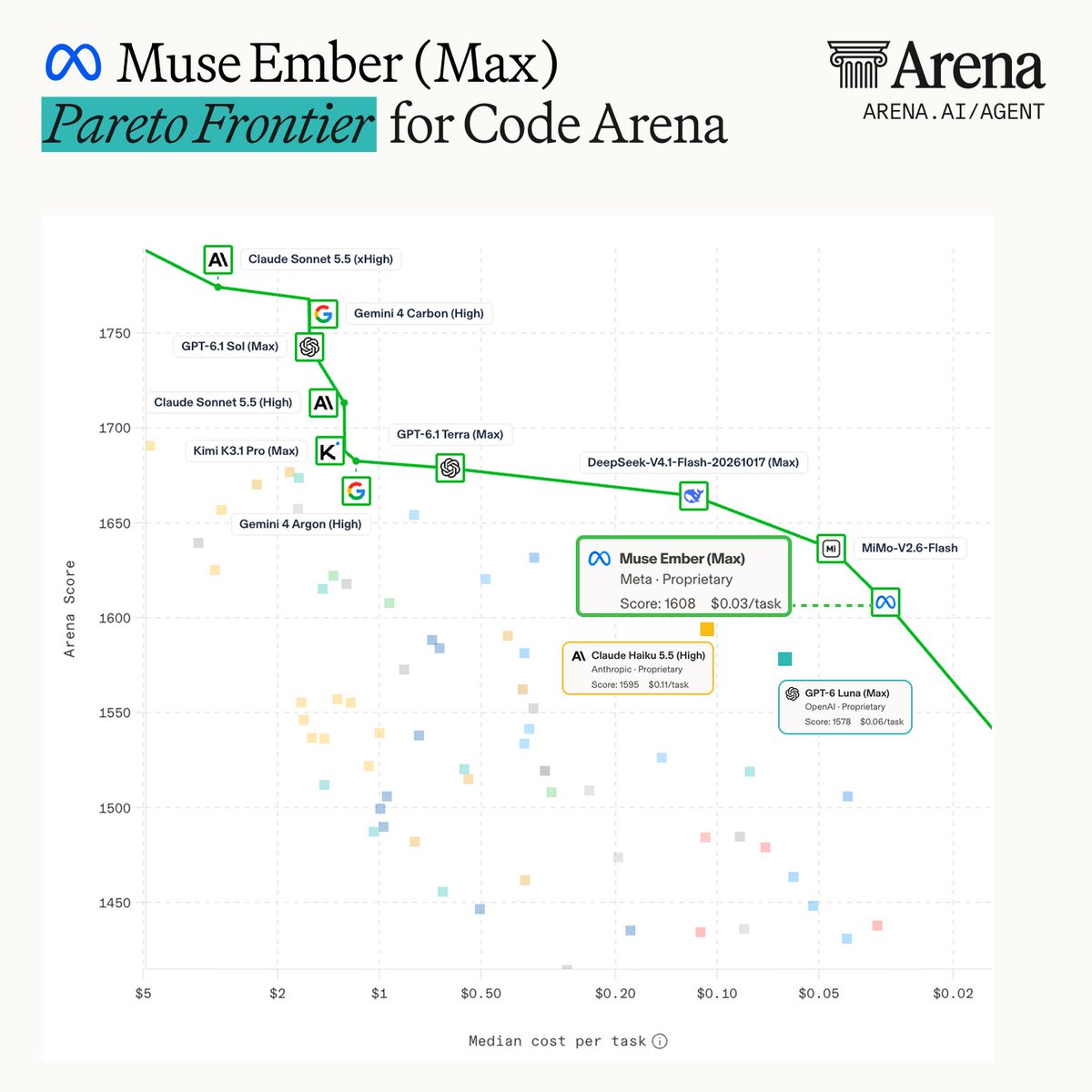
Exciting news: @AIatMeta's Muse Ember (Max) is the highest-performing small model in the Code Arena: WebDev with 1608 pts, outperforming two leading small models from Anthropic and OpenAI:
- Claude Haiku 5.5 (High): #35, 1595 pts
- GPT-6 Luna (Max): #42, 1578 pts
At a 1608 score at a median cost of $0.03 per task, this puts Ember on the Pareto frontier. Neither Haiku 5.5 nor Luna makes it. Despite all three models having the same API pricing of $0.10/$0.50 per million input/output tokens, Ember's median cost per task is 2× lower than Luna ($0.06) and 3.7× lower than Haiku ($0.11).
In our own testing, Ember demonstrated impressive speed and efficiency, completing 25 complex generations in 2 mins per task, at a total cost of just $1.
Huge congrats to @alexandr_wang and the @AIatMeta team on this impressive release! A major step forward for small models that deliver strong real-world coding capabilities at a fraction of the cost.
Anthropic is reportedly targeting ~$69B in its IPO below earlier expectations of $80B–$100B.
That would still make it one of largest IPOs ever with 867M shares priced between $70–$80 implying a potential valuation of around $1.4T.
AI game development is exploding on Roblox:
- An growing share of top games were launched in the last 90 days
- Roblox MCP daily users are exploding
- An increasing fraction of game development time is spent using AI
- Asset uploads are shooting up
In other words, people are using AI to make games, and other people are actually playing them.
More charts: https://t.co/Z2QvvaZENZ
Introducing A5S Async V1: the world's most accurate speech recognition model for speaker-attributed transcription.
#1 on VoiceArena, ahead of ElevenLabs, AssemblyAI, Deepgram, NVIDIA, Meta & more.
The next-best model makes 41% more errors across 5 public benchmarks.
And yes, every lab says they're #1. So we open-sourced our benchmark.
Try it now👇
excited to be speaking at @aiDotEngineer this wednesday at 10:10am PT!
i will be talking about how the grok @bot team shipped 11,000 PRs last month without compromising on code quality
hope to see you there: https://t.co/ChMpIyyDLl
$RKLB Iridium just signed an MOU with Vodafone Qatar as GPS interference and conflict across Gulf make resilient satellite connectivity super important.
And what I like about this for Rocket Lab is that every new carrier relationship could eventually generate recurring service revenue while creating demand for satellites it manufactures and potentially launches on Neutron.