Most dApps today are still confined to the blockchain they were built on.
Their data lives there.
Their logic executes there.
Their users are limited by it.
Coinweb changes that.
Instead of relying on its own consensus system to “agree” on what happened on another chain, Coinweb continuously parses and reacts to canonical L1 blockchain data directly from the source chains themselves, deterministically.
To date, we have parsed over 40,000,000,000 L1 transactions.
This gives developers building on Coinweb direct access to blockchain data across every connected ecosystem.
Directly from the underlying chains themselves.
That means developers can build dApps that react to real multi chain activity in deterministic ways.
A transaction either happened on the blockchain or it didn’t.
No subjective validator voting.
No probabilistic bridge consensus.
No federated trust assumptions.
This becomes especially powerful for emerging categories like autonomous AI agents.
An AI application built on Coinweb could monitor activity across multiple chains simultaneously and execute deterministic actions based on verifiable blockchain events:
• Rebalance treasury positions across ecosystems
• Execute cross chain liquidity strategies
• React to payment settlement events
• Coordinate multi chain gaming economies
• Trigger automated workflows based on real blockchain activity
All from a unified application layer with direct access to canonical L1 data.
Reactive Smart Contracts execute based on verifiable blockchain events, allowing applications to coordinate logic across ecosystems with predictable outcomes and reduced complexity.
This is a fundamentally different model for building multi chain applications.
Bridge-first cross-chain is the long way around, and @Pact_Swap does not need that detour.
Most existing solutions make you trust the middle.
Deposit into a bridge.
Wait for a message.
Trust a validator set.
Hope the wrapped asset stays backed.
That is not clean cross-chain execution.
That is infrastructure debt hidden behind a swap button.
Pact Swap takes the native route across Bitcoin, Litecoin, Dogecoin, Ethereum, BNB Chain, Polygon, and TRON.
No bridge custody as the trading path.
No extra validator set deciding what happened.
No wrapping everything until the architecture looks simple.
Real chains.
Native transactions.
Cross-chain order flow.
#DeFi done Right
We will have @AntonCoinweb representing Coinweb and contributing to this year’s Litecoin Summit in Amsterdam!
Looking forward to connect with the LTC community!
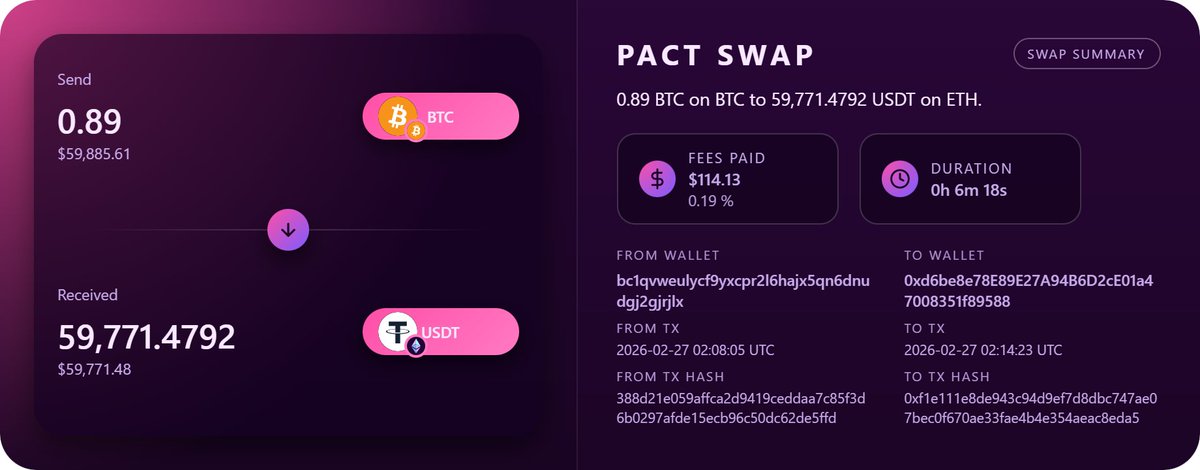
0.19% fees for a cross-chain BTC → USDT on ETH swap.
On @Pact_Swap someone swapped 0.89 BTC to 59,771.4792 USDT on ETH.
Fees paid: $114.13 (0.19%). 👀
Who said cross-chain has to be expensive?
#Defi done right!
@CoinwebOfficial itself operates as an L2 layer with the unusual property of being able to read and write state across multiple base chains simultaneously. Within that architecture, $CWEB serves as the neutral gas and settlement asset for any application built on top of the network.
Why this matters for the broader ecosystem:
- @Pact_Swap is the first major application demonstrating the model at scale
- The same infrastructure can support other dApps using $CWEB the same way
- $CWEB demand isn't limited to one application's success or failure
- Cross-chain applications inherit #Coinweb's settlement guarantees by default
Market makers & liquidity providers: here’s a deeper look at why Pact Swap @Pact_Swap, built on Coinweb’s PACT framework @CoinwebOfficial, is structurally different from typical cross-chain DEXs.
1) Native cross-chain liquidity (no bridges):
Pact Swap enables swaps between native assets like $BTC, $ETH, and other L1/L2 tokens without bridges or external validators, just L1 transactions.
That means:
• No wrapped assets
• No bridge custody risk
• Real, native order flow across chains
2) Lower capital overhead for liquidity:
Traditional cross-chain systems often rely on validator sets or bridge liquidity that must be locked for long periods.
Pact Swap is designed to be up to 95% cheaper for native cross-chain swaps, reducing infrastructure costs tied to liquidity operations.
3) Built-in over-collateralized security model:
Every swap is over-collateralized with automatic compensation if something goes wrong, using Coinweb’s reactive smart contracts.
For MMs and LPs, this means:
• Defined risk parameters
• Programmatic guarantees
• Fewer trust assumptions compared to bridge-based liquidity
4) Fully composable liquidity layer:
Pact Swap is deployed entirely as smart contracts so anyone can integrate, route, or build liquidity strategies on top.
This opens the door for:
• Custom MM strategies
• Aggregator routing
• Cross-chain arbitrage opportunities
• Institutional-grade liquidity infrastructure
5) Permissionless listings against native BTC:
Projects can list tokens directly against native BTC or other supported assets.
Result:
• New liquidity pairs
• Cross-chain price discovery
• More volume sources for MMs
Bottom line:
Pact Swap turns cross-chain trading into a native, composable liquidity environment, with lower costs, built-in guarantees, and real multi-chain order flow for market makers.
Ethereum is evidence in @Pact_Swap , not a vault.
In Pact Swap, ETH moves on Ethereum with normal L1 transactions. Those transactions are observed as inputs to a PACT, they are not locked in a bridge or pooled in a contract.
The judgement does not come from Ethereum consensus or a validator set. It comes from @CoinwebOfficial PACT logic that evaluates whether the required cross-chain state transitions actually happened.
If they did, collateral is released. If they did not, collateral is seized in favor of the wronged user. ETH never leaves Ethereum in either case.
That separation matters. Ethereum provides verifiable state, not custody. Enforcement happens through rules and collateral, not asset lockup.
#DeFi done right!
A lot of people look at @Pact_Swap and see "just" a cross-chain DEX.
If you actually read the whitepaper, you notice something most people overlook.
PactSwap separates order creation from settlement and supports multiple settlement facilities. Settlement is not locked to one mechanism, and new settlement facilities can be added over time.
That means an order is not tied to a single execution path. The same order type can settle in different ways depending on the chain and the situation.
Examples of settlement facilities include direct peer to peer settlement on Bitcoin style chains, vault based settlement, Lightning Network settlement, routing into existing DEX liquidity, and NFT based settlement.
Most DeFi systems hardcode a single settlement model and then try to stretch it across every chain.
PactSwap does the opposite. Settlement mechanisms can evolve as new chains, assets, and liquidity venues become relevant.
This part of the design is rarely discussed, but it has real implications. It allows cross-chain swaps to expand without introducing new trust layers or redesigning the core protocol.
That is the kind of architectural choice that tends to matter more over time than short-term features.
#DeFi done Right!
🚀 2026 is ON. Interoperability is inevitable. 🚀
Coinweb @CoinwebOfficial is building the future where blockchains work as one, no bridges, no compromises, just true cross-chain computation at scale.
Pact Swap @Pact_Swap is taking that power live, delivering native cross-chain swaps that are faster, safer, and capital-efficient, powered by Coinweb’s PACT framework.
No wrapping. No waiting. No limits.
🔥 This is the year of real cross-chain DeFi.
$BTC $ETH
PactSwap is redefining cross-chain DeFi with its focus on native asset trading. @pact_swap lets you swap real Bitcoin, Ethereum, BNB, Litecoin, Tron, Dogecoin, and Polygon assets directly, without any bridges or wrapped tokens that introduce extra risks.
Built on @coinwebofficial’s PACT framework, it uses overcollateralized reactive smart contracts to ensure every trade is secure and trustless. If something goes wrong, automatic compensation kicks in, keeping your funds protected. This approach delivers up to 95% lower fees compared to traditional cross-chain solutions, while supporting seven chains seamlessly.
Liquidity providers can back real swaps, earn fees, and maintain full custody, with minimal slippage thanks to smart routing. The platform has already hit impressive milestones like $10M in total volume, 27k swaps, and over 5k unique users in its MVP phase. It’s capital-efficient, composable, and truly decentralized. Dive in at https://t.co/KvNEQJQhiR.
@Pact_Swap isn’t “another DEX.”
It’s the first real cross-chain upgrade powered by Coinweb’s reactive smart contracts
🔹native swaps
🔹no bridges
🔹no wrappers
🔹no trust assumptions
This is how BTC ↔️ ETH was always meant to work.
Cheaper, safer, multi-chain from day one.
🚀 Pact Swap @Pact_Swap is here: An advanced cross-chain decentralized exchange for swapping authentic BTC, ETH, DOGE & more between blockchains—bridge-free, wrapper-free, validator-free. Totally permissionless & trust-minimized!
🔗 Leveraging @CoinwebOfficial’s PACT system—a layer for consensusless interoperability via collateralized, reactive smart contracts that make swaps secure and economical.
No need for bridge validators; on-chain logic auto-enforces execution or provides refunds/collateral payouts.
⚡ What sets it apart:
• Authentic bridgeless trading
• Slashed fees & boosted speed
• Native assets only
• Open, permissionless listings across Coinweb chains
• DeFi composability unlocked
🚀 Meet Pact Swap @Pact_Swap, the future of cross-chain DEXes!
Swap real BTC, ETH, DOGE & more across blockchains without bridges, wrappers, or third-party validators—fully decentralized, permissionless, and secure.
🔗 It runs on @CoinwebOfficial’s PACT tech: A non-consensus interoperability layer with collateralized smart contracts that reactively handle swaps affordably and safely.
Ditching bridge validators, it uses pure on-chain rules to ensure trades complete or trigger refunds/collateral automatically.
⚡ Why choose it?
• Genuine bridgeless swapping
• Cheaper fees, faster settlements
• No wrapped tokens needed
• Permissionless for all Coinweb chains
• Seamless DeFi composability
🚀 Introducing Pact Swap @Pact_Swap: Revolutionizing cross-chain DEX with direct swaps of native BTC, ETH, DOGE & others across networks—no bridges, no wraps, no outside validators. All trustless and open to anyone!
🔗 Built atop @CoinwebOfficial’s PACT framework—a consensus-free interoperability solution using collateral-backed reactive contracts for efficient, secure chain coordination.
It skips separate validators, relying on on-chain mechanisms for guaranteed fulfillment or instant refund/collateral release.
⚡ Standout features:
• Pure bridgeless cross-chain action
• Lower costs & rapid processing
• Support for unaltered native assets
• Anyone-can-list on Coinweb chains
• Perfect for DeFi mashups
Tried a cross-chain swap on @Pact_Swap today...
BNB on BNB Chain 🔁 ETH on Ethereum
Honestly? Super smooth.
Fast, cost-efficient & the UX is way better than most bridges I’ve used.
What stood out the most is the tracking flow...
Most cross-chain swaps leave you staring at the screen like “uhh… did my funds get stuck?” 😅
PactSwap actually guides you through every step:
1️⃣ Sending tx (BSC in my case)
2️⃣ Mined
3️⃣ PACT
4️⃣ Finalized
5️⃣ Receive tx (ETH in my case)
Plus a real-time timer ⏳
Whole thing took around 2 minutes end-to-end
And this is still just their MVP.
If the early product feels this clean, the full release is going to be fun to watch
@PACTSWAP daily volume record went over $600K... This was achieved with only one merchant integrated and with a dedicated community.
This is pure product-market fit delivered by @CoinwebOfficial infrastructure. The real key: PACT's cross-chain swaps use Coinweb's $CWEB as the locked collateral/economic security layer.
More volume = more $CWEB locked up. The collateral flywheel is spinning! This is the start of the $CWEB utility era. 🚀#PACT #CWEB @Pact_Swap