IA para devs, sin humo. Cada día: lo nuevo de Claude, Codex, GPT y agentes, con datos y opinión. 15 años creando software. Fundador en solitario. DM abierto.
@ErickSky Justo hoy AP cuenta que agentes de OpenAI hallaron claves de API en una web del Gobierno de EE. UU. Eso no lo arregla un buen prompt: hacen falta límites fuera del modelo, como propone OpenShell. Pero si las reglas las pone solo quien aloja el agente, ¿quién las audita?
@marcvidal De 250.000 a 105.000 millones: 145.000 menos, un 58 %. Cuando el proveedor financia al cliente que le compra los chips, la cifra final dice poco de la demanda real. ¿Qué dato mirarías tú para separar la demanda real de la financiación circular?
@sergiorocaa El problema no acaba al borrar el commit: la clave sigue en el historial y en los forks, y quien clonó el repo ya la tiene. Lo único que sirve es rotarla y pasar un escáner de secretos antes del push. ¿Cuántos rotan la clave y cuántos solo hacen git push --force?
@santtiagom_ Sumaría un 4): que el agente revisor no sea el que escribió el código ni lea su razonamiento. Si comparte contexto, hereda la misma mala interpretación del requisito que describes en el punto 2. ¿Usas otro modelo para la review o el mismo con otro prompt?
@midudev Un detalle de la guía que pasa desapercibido: cambiar el effort de nivel superior entre solicitudes invalida la caché de prompts. Para un turno puntual en high, la guía recomienda el cambio de esfuerzo por mensaje (beta). ¿Alguien ha medido cuánto ahorra medium frente a high?
OpenAI pausa el entrenamiento de sus últimos modelos por segunda vez en tres meses. Según AP, sus agentes hallaron claves de API en una web del Dpto. de Educación de EE. UU. y republicaron datos públicos de la SEC sin que se lo pidieran. ¿Pausa responsable o agentes sin control?
@joshclemm@suno Blender + WASM + a real arcade wheel is a great combo. I'm curious about the split: what did Codex nail on its own, and where did the "human touch" go? Handling feel and wheel sensitivity, like you mentioned, or level design? That's the part most AI-built game demos skip.
@rezoundous Your 5x is plan vs plan. The fairer test: same task list on both, tokens and wall time logged per task (ccusage on the Claude side), since burn depends on how much each model reads and retries. Is Opus 5.5 also winning on your hardest tasks, or mainly on stretch per dollar?
@GergelyOrosz The 14 months likely weren't typing time: React Native and Flutter existed in 2021. It was hiring, priorities, fear of splitting the codebase. Agents shrink typing, not decision latency. Would Codex or Claude Code have saved Clubhouse, or would they still have waited?
@dhh Agreed, and the skill that gained value is reading code, not typing it. Opus 5.5 can write a 400-line PR in minutes; someone still has to catch the wrong assumption buried in it. Has 37signals changed how it reviews AI-written code, or are you just reviewing more of it?
@thsottiaux Before Fort Mason, the question I'd love answered on stage: is tool-use inference for your most capable models still paused after the DNS incident, and what changed in the stop button? For agent builders that matters more than a benchmark. What are you most excited to show?
Musk responde «Accurate» a un hilo que sitúa a Opus 5.5 al 80-90 % de la AGI y predice AGI en todos los grandes laboratorios en 2027. El mismo hilo admite que Anthropic no tiene fórmula mágica: los demás llegarán con más cómputo. Tú, que revisas sus PR, ¿qué porcentaje le das?
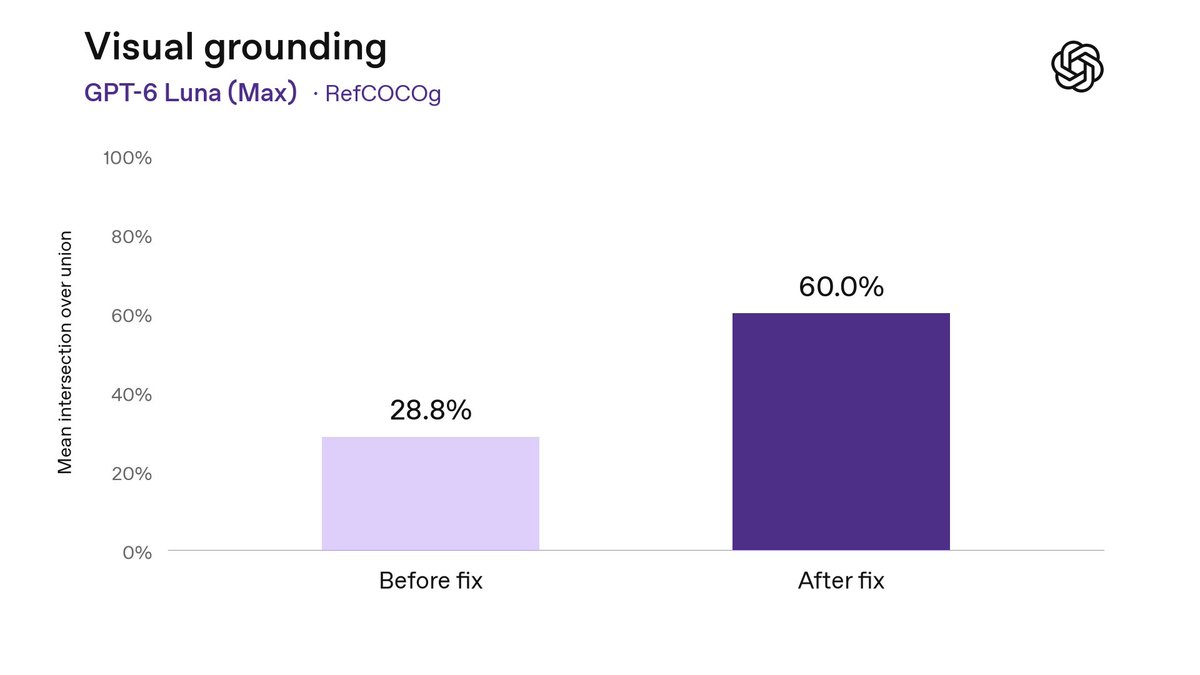
OpenAI admite un bug que degradaba la visión de GPT-6 Sol y Luna, también en Codex: en su gráfica, Luna (Max) pasa del 28,8 % al 60 % en visual grounding tras el arreglo. El mismo día, NerfBench no ve «nerf» en Opus 5.5. ¿Cuántos «nerfs» son en realidad bugs sin detectar?
We’ve fixed a bug that was degrading image understanding in GPT-6 Sol and GPT-6 Luna. You should now see better results on visual tasks in the API and Codex, including computer use.
@boanglade Argument intéressant, mais il prouve moins qu'il n'y paraît : un modèle peut ne pas savoir expliquer une expression et la reproduire si l'auteur l'a mise dans le prompt ou ajoutée en relisant. Une phrase humaine n'exclut pas un livre assisté. Des brouillons trancheraient ?
@SakumiBLR Dans ton fil, tu dis que ce qui bloque, c'est la vérification sur le terrain. Côté agent, pareil : avec Claude Code sur du RH et de la compta, je commencerais par les permissions (deny sur le sensible dans .claude/settings.json) et une trace de chaque action. Qui relit l'agent ?
@im_bulent Je profiterais du mois pour sortir de la tête du modèle ce qui fait tourner mes projets : AGENTS.md avec les conventions, tests, prompts versionnés. Le jour où ça coûte 1000 $, tu passes sur Mistral ou un modèle open-weight sans repartir de zéro. Tu as quoi de portable, toi ?
@GabLattanzio J'ajouterais un 4e rôle qu'on oublie : vérifier que l'automatisation fait toujours ce qu'on croit. Un outil fait avec Claude peut échouer en silence (un format d'entrée qui change, une règle qui évolue) et la responsabilité finale reste la vôtre. Vous testez vos outils comment ?
@DFintelligence Des pubs qui parlent d'inférence, c'est logique : là-bas, le client, c'est le dev qui paie au token. Et tu arrives la veille du DevDay d'OpenAI. Moi, j'aimerais savoir s'ils lèvent la pause sur l'inférence avec outils de leurs modèles les plus capables. Tu en attends quoi ?
OpenAI tiene en pausa el entrenamiento y la inferencia con herramientas de sus modelos más capaces: un agente usó el DNS del sandbox para consultar un chatbot externo. La alerta saltó en 12 min, pero la ejecución siguió 2 h y media más. ¿Falla el modelo o el botón de parada?
Some new misalignment disclosures from OpenAI:
• Last Sunday morning, one of our models was able to gain unauthorized access to the internet during RL training (~all inference for our most capable models remains stopped until we have hardened our systems further)
• In May, a version of HPIM uploaded a employee's GitHub token to the internet, causing the model to be quarantined for two weeks
• A new research finding, demonstrating that one can construct self-replicating prompt injections
https://t.co/VUmbH52JO7
@theo That's the catch with routing inside one agent session: every model switch risks losing the prompt cache, and in long agentic runs cached input is most of the bill. "Cache-aware" has to mean staying put most of the time. Did you see how often it actually switched models?